
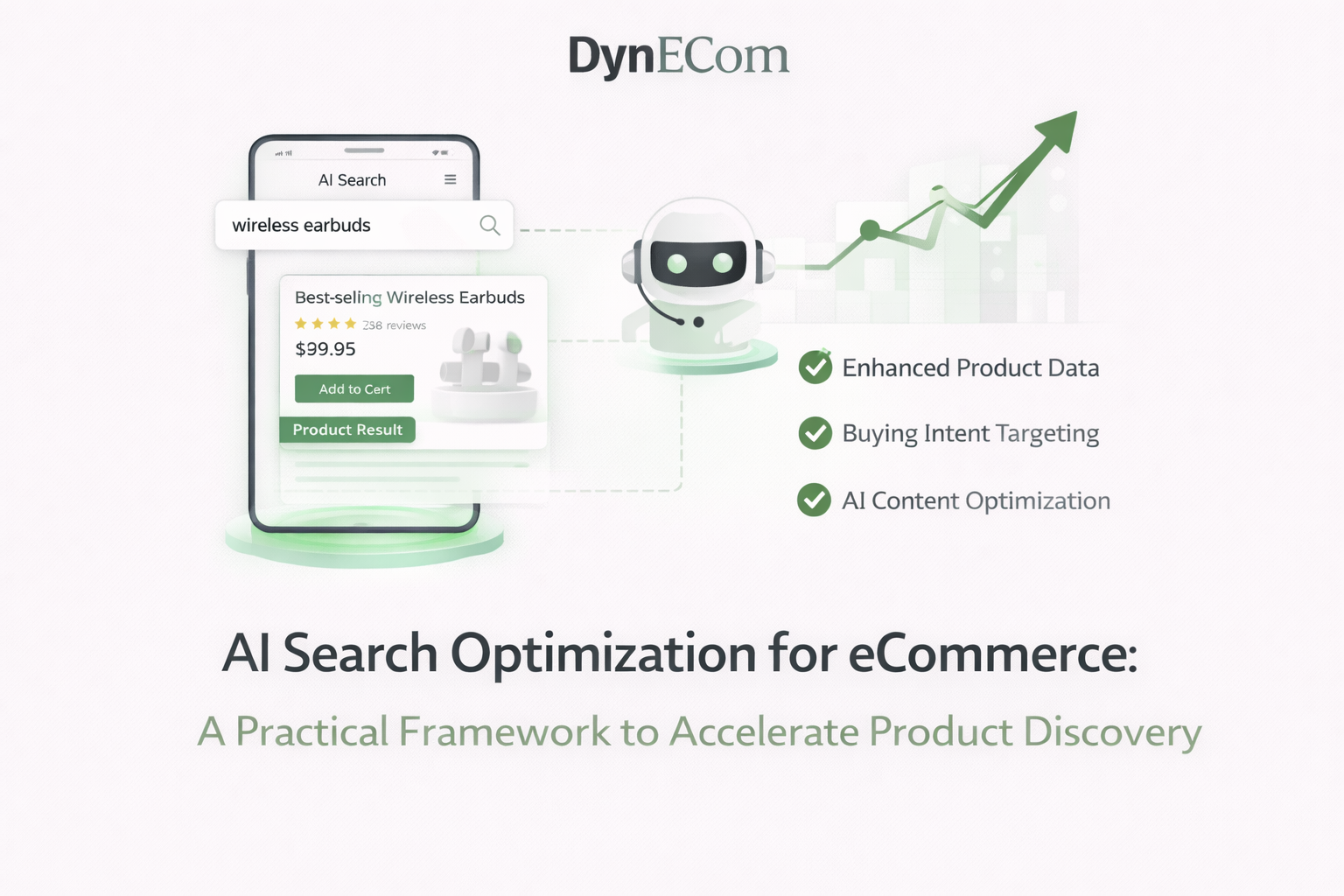
Introduction: The Rise of AI Search in eCommerce
The way consumers discover products and make purchase decisions online is changing rapidly. For over two decades, eCommerce growth depended heavily on traditional search engines where users typed short keyword queries like “buy running shoes” or “best gaming laptop.” That’s changing.
Today, buyers begin their purchase journey with AI-powered search experiences that can span multiple questions and discussions to help a customer identify the best purchase options.
Instead of scrolling through search results, shoppers now ask detailed questions like:
- “What’s the best laptop for video editing under $1500?”
- “Which running shoes are best for flat feet?”
- “Recommend eco-friendly clothing brands.”
AI systems analyze large language models (LLM) and generate summarized recommendations, often highlighting specific products or brands.
This shift has major implications for eCommerce sites.
Research shows:
- AI-powered search now drives up to 46% of eCommerce traffic, according to surveys of marketers.
- 58% of consumers rely on AI platforms for product recommendations.
- AI Overviews appear in about 13% of searches and reduce traditional click-through rates by 34.5%.
In short, product discovery is shifting from search engines to AI answers.
To remain visible, eCommerce sites must move beyond traditional SEO techniques and adopt AI Search Optimization (also called Generative Engine Optimization or GEO).
Sites that adapt early and distance themselves from their competitors can capture more organic traffic, improve conversions, and win more customers.
This article introduces a practical framework for optimizing eCommerce content for AI-driven product discovery.
How AI Search Is Changing Product Discovery
Traditional search engines rank websites based on signals like keywords, backlinks, and page authority. Users then compare different sites before making a purchase decision.
AI search works differently.
Instead of showing a list of links, AI systems generate answers by synthesizing multiple sources, often recommending specific products or brands.
Traditional Search vs AI Search
| Factor | Traditional Search | AI Search |
| Interface | List of ranked results | Conversational answers |
| User query | Short keywords | Long natural-language prompts |
| Decision process | Users compare multiple sites | AI summarizes options |
| Visibility | Ranking position matters | Being cited in AI answers matters |
| Content style | Keyword optimized | Context-rich, structured content |
| Trust Indicator | User Interactions | Page Freshness |
| Content | Prioritized | Completeness |
AI systems also tend to cite multiple sources for credibility, typically around 7–9 references per response.
This means your content must be:
- Trustworthy
- Well-structured
- Rich in product information
- Useful for answering buyer questions
Why AI Search Matters for eCommerce Brands
AI search is not just another marketing trend—it fundamentally changes the product discovery funnel.
AI search is transforming how shoppers evaluate products. Instead of browsing multiple websites, users rely on AI to:
- summarize product options
- highlight key features
- recommend products for specific use cases
This creates an opportunity for brands that provide clear, structured product information and helpful decision-making content.
Key Market Trends
| Trend | Impact on eCommerce |
| Conversational search queries | Users describe needs rather than keywords |
| AI recommendations | Platforms recommend products directly |
| AI summaries | Reduce clicks on traditional search results |
| Higher AI conversion rates | AI traffic often shows stronger buying intent |
AI sessions can convert at around 15.9% compared to roughly 1.8% from traditional search, demonstrating how AI recommendations shorten the buying journey.
This means AI search can potentially drive more qualified traffic and higher conversions.
The AI Search Optimization Framework for eCommerce
To win visibility in AI search results, brands need a structured approach.
Here is a six-step framework to optimize product discovery through AI search.
Step 1: Optimize Product Data for Machine Understanding
AI systems rely heavily on structured product information to interpret content correctly.
If your product pages lack clear attributes, AI engines may struggle to understand the product and exclude it from recommendations.
Key Product Attributes to Include
- Product type and category
- Materials and specifications
- Size and dimensions
- Compatibility and use cases
- Pricing and availability
Example
Instead of writing a generic description:
❌ “Comfortable running shoes designed for performance.”
Use structured detail:
✅ “Lightweight running shoes for flat feet with breathable mesh, shock-absorbing midsoles, and arch support designed for long-distance runners.”
Detailed product information helps AI models connect your product to specific user queries and buying scenarios.
Step 2: Leverage Competitor Content to Build Better Content
One powerful way to improve AI search visibility is by analyzing and improving upon competitor content.
Your competitors’ pages reveal:
- questions buyers frequently ask
- product attributes customers care about
- missing content opportunities
Instead of copying competitors, use their content as a benchmark to create more comprehensive and helpful content.
Example Content Gap Analysis
| Content Element | Competitor Page | Your Opportunity |
| Product comparison | Limited | Provide detailed comparisons |
| FAQs | Few questions | Expand FAQ section |
| Use cases | Generic | Add real-world scenarios |
| Product reviews | Minimal | Highlight social proof |
By leveraging competitor insights, you can create more complete content that AI systems are more likely to reference.
Step 3: Create AI-Friendly Content Structures
AI models prefer clear, structured information.
Content that works best for AI systems often includes:
- FAQs
- Comparison tables
- Buying guides
- Step-by-step explanations
Example: Comparison Content
| Feature | Product A | Product B |
| Weight | 250g | 290g |
| Arch Support | High | Medium |
| Ideal Use | Long-distance running | Casual running |
Comparison-style content is extremely useful for AI because it answers common buyer questions directly.
Step 4: Automatically Add Reviews and FAQs to Overcome Buyer Objections
A major barrier in online shopping is buyer hesitation.
Customers often ask questions like:
- Is the product durable?
- Does the size fit correctly?
- Is it worth the price?
Adding reviews and FAQs directly to product pages helps address these concerns.
Many eCommerce brands now automatically generate FAQ sections based on customer questions and review insights.
Benefits of Review and FAQ Content
| Element | Benefit |
| Customer reviews | Build trust and credibility |
| FAQ sections | Answer common buyer questions |
| User-generated insights | Add authenticity |
| Structured FAQ content | Improve AI visibility |
This content not only improves user confidence but also helps AI systems understand real-world product experiences.
Step 5: Optimize for Conversational Queries
Traditional SEO focused on short keywords.
AI search relies on natural language prompts.
Example Query Types
| Traditional Search | AI Search Query |
| “best office chair” | “What is the best ergonomic chair for working from home?” |
| “running shoes women” | “Which running shoes are best for beginners with knee pain?” |
To capture these queries, create intent-driven pages such as:
- “Best laptops for graphic designers”
- “How to choose a standing desk”
- “Top eco-friendly clothing brands”
These pages match how users interact with AI assistants.
Step 6: Build Authority Signals for AI Trust
AI systems prefer citing trusted and authoritative sources.
Research shows that brand mentions and external references strongly influence AI visibility.
Important Trust Signals
- Quality backlinks
- Brand mentions across websites
- Customer reviews
- Expert insights
- Author credibility
- Page updates
- Completeness
For eCommerce brands, this means:
- Publishing expert guides
- Getting mentioned on blogs and industry sites
- Building brand authority through content marketing
The stronger your brand footprint, the more likely AI systems will reference your content.
Step 7: Use Schema and Structured Data
Structured data helps search engines and AI models understand your content.
Important schema types for eCommerce include:
- Product schema
- Review schema
- FAQ schema
- Organization schema
Benefits of Schema
| Schema Type | Benefit |
| Product | Provides product details for AI engines |
| Review | Adds trust signals |
| FAQ | Answers user questions |
| Organization | Strengthens brand entity |
These signals make it easier for AI systems to extract and summarize product information.
Step 8: Keep Content Fresh and Updated
AI systems prefer recent and updated sources.
Studies show that URLs cited in AI responses tend to be about 25% fresher than typical search results.
Content freshness plays an increasingly important role in both SEO and AI search. Regular updates help ensure that product information remains accurate and relevant.
Many successful eCommerce brands now implement monthly content refresh cycles to:
- update product descriptions
- add new FAQs based on customer questions
- include recent product reviews
- refine buying guides
Recommended Content Update Cycle
| Content Type | Update Frequency |
| Product pages | Monthly or quarterly |
| Category pages | Every 3–6 months |
| Buying guides | Every 6–12 months |
Frequent updates signal that your content is reliable, current, and actively maintained, which improves trust for both search engines and users.
Common Mistakes in AI Search Optimization
Despite the growing importance of AI search, many brands still make critical mistakes.
Mistake 1: Publishing thin or generic content
AI systems prioritize depth, relevance, and unique insights over surface-level information.
Mistake 2: Ignoring product data
AI needs structured product information.
Mistake 3: Copying competitor content without improvement
If your content doesn’t add new value, AI has no reason to surface it over existing sources.
Mistake 4: Writing only for keywords
AI search values context and meaning, not just keywords.
Mistake 5: Neglecting brand authority
Strong brands appear more frequently in AI responses.
These mistakes limit your chances of appearing in AI-generated recommendations.
The Future of Product Discovery
AI search is still evolving, but several trends are clear.
Key Predictions
| Trend | What It Means |
| Conversational commerce | Shopping begins with AI questions |
| AI recommendation engines | Products discovered through AI summaries |
| Voice-based search | Voice assistants driving purchases |
| Personalized AI results | Recommendations tailored to user preferences |
In the near future, the shopping journey may look like this:
Question → AI recommendation → product comparison → purchase
Instead of browsing dozens of pages, users will rely on AI-curated recommendations.
Final Thoughts
AI search is reshaping how consumers discover products online.
Brands that continue relying solely on traditional SEO risk losing visibility in the new search ecosystem.
To succeed in this environment, eCommerce companies must:
- Optimize product data for machine understanding
- Create structured, informative content
- Include Competitor-driven content insights
- Target conversational search queries
- Build strong brand authority
- Implement schema and structured data
- Regularly update content
By adopting this AI search optimization framework, eCommerce brands can improve product discovery, increase organic visibility, and drive more conversions in the AI-driven search landscape.
The future of search is no longer just about ranking pages.
It’s about being the source AI trusts when recommending products.
Turn Your eCommerce Content Into a Product Discovery Engine
Most eCommerce stores already have hundreds or thousands of product pages.
The real challenge isn’t creating more content — it’s optimizing the existing content so it performs across modern search ecosystems.
A strategic content optimization approach can help you:
- Increase organic traffic from both traditional and AI-powered search
- Improve product discoverability across search platforms
- Address buyer objections through reviews and FAQs
- Increase conversions and win more customers
If your organic traffic has plateaued or your product pages are not performing well, it may be time to rethink your content strategy.
👉 Request a free eCommerce content audit to identify gaps in your product and category pages and discover opportunities to improve visibility and conversions.