
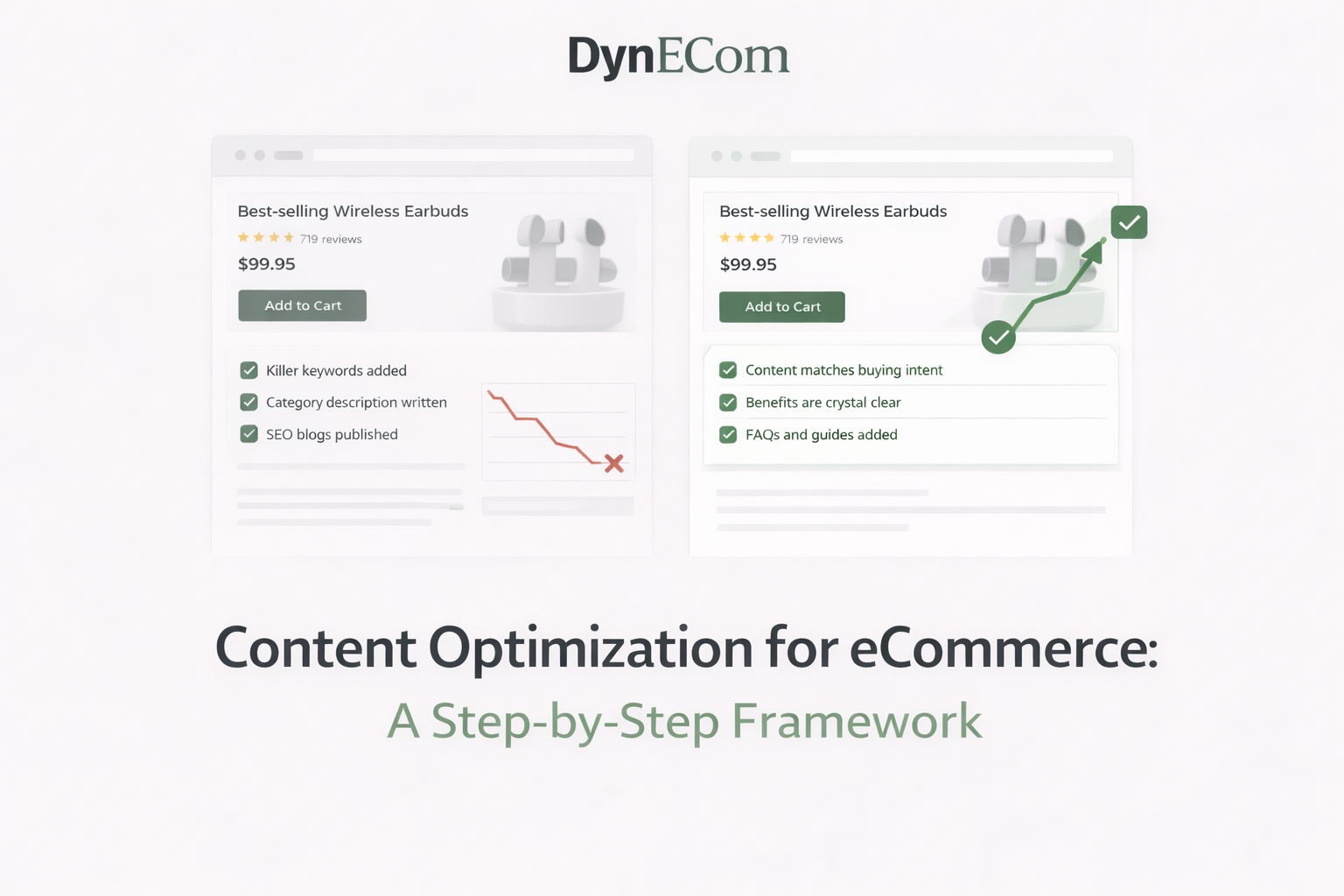
Introduction: Why “Optimized Content” Still Fails in eCommerce
Most eCommerce brands believe their content is optimized.
They’ve:
- Added keywords to product pages
- Written category descriptions
- Published SEO blogs
- Improved metadata
Yet performance still looks like this:
- Traffic grows slowly (or plateaus)
- Rankings fluctuate
- Conversion rates remain flat
- Paid ads do the heavy lifting
The reason is simple:
Most eCommerce content is optimized for algorithms — not for buying decisions.
In 2026, content optimization is no longer about stuffing keywords or checking SEO boxes. It’s about aligning content with intent, structure, and revenue impact. After you accomplish this, and with the growth of AI search, the challenge becomes always delivering better content than your most visible competitors.
Modern eCommerce content must also:
- Optimize for organic traffic from both traditional search engines and AI-powered search experiences
- Improve conversions and help brands win more customers
- Continuously evolve through regular content updates
- And deliver competitively superior content
This guide breaks down a step-by-step content optimization framework designed specifically for eCommerce — not publishers, not SaaS, not blogs.
What Content Optimization Really Means for eCommerce
Content optimization in eCommerce is the process of improving existing and new content so that it:
- Matches search intent precisely
- Helps users make confident purchase decisions
- Supports category and product discoverability
- Improves conversion signals Google cares about
- Optimizes visibility across both traditional search results and AI-powered search experiences
- Scales across thousands of SKUs
This applies to:
- Product pages
- Category pages
- Collection pages
- Buying guides
- Informational blogs
But each page type requires a different optimization approach.
Step 0: Research Your Competitors
It’s not enough to satisfy every step in this process. Before you begin your optimization, spend some time being the customer, searching for your product, and visiting your competitors. If you have the time, look for things your competitors do better than you do. If you notice relative strengths, it’s likely that the search engines will as well. Your goal is to follow these steps, but ultimately deliver an improved product page that any customer or search engine would recognize as being superior to other resellers of the product.
Step 1: Segment Content by Intent (Not by Page Type)
Before optimizing anything, you must answer one question:
What decision is the user trying to make on this page?
Intent Layers in eCommerce
| Intent Type | User Mindset | Example Query | Ideal Page |
| Informational | Learning | “what is organic cotton” | Blog / Guide |
| Commercial | Comparing | “best organic cotton t-shirts” | Category / Guide |
| Transactional | Buying | “buy organic cotton t-shirt men” | Product Page |
❌ Common mistake
Optimizing all pages the same way.
✅ Correct approach
Optimize content based on intent, then map it to the appropriate page.
This step alone fixes a large percentage of underperforming SEO content.
Step 2: Optimize Product Pages for Clarity, Confidence, and Context
Most product pages are written like inventory records.
Modern product page optimization focuses on decision acceleration.
Core Elements of an Optimized Product Page
1. Value Proposition (Above the Fold)
- Who is this product for?
- What problem does it solve?
- Why choose this over alternatives?
2. Intent-Aligned Description Structure
Instead of one long description, break content into:
- Use cases
- Key benefits
- Differentiators
- Technical details
- Trust & reassurance
3. Objection Handling via Content
Use FAQs and microcopy to answer:
- Is this durable?
- Will this fit me?
- Is it worth the price?
- What if it doesn’t work?
Every unanswered question is a conversion leak.
Step 3: Transform Category Pages into Content-Led Landing Pages
Category pages are where most eCommerce SEO money is made — yet they’re rarely optimized properly.
What an Optimized Category Page Includes
| Section | Purpose |
| Intro copy | Clarifies who the category is for |
| Buying guidance | Helps users choose faster |
| Sub-category links | Improves crawl & UX |
| Internal links | Routes authority to SKUs |
| FAQ block | Captures long-tail intent |
Category pages can also benefit from competitive content analysis.
By analyzing and leveraging your competitors’ content, you can identify:
- Missing buyer questions
- Additional product attributes
- Content gaps that create ranking opportunities
Then build better, more helpful content that outperforms competing pages.
Content Placement Tip
Keep intro content concise (60–120 words).
Expand with:
- Collapsible sections
- Below-the-fold buying guides
- Supporting content blocks
Optimize for readability and decision support — not word count.
Step 4: Use Data to Optimize Content (Not Guesswork)
Creative intuition alone doesn’t scale in eCommerce.
High-performing teams use data signals to decide:
- What to expand
- What to trim
- What to restructure
Key Data Sources for Optimization
| Data Source | Insight |
| Search Console | Query-to-page mismatch |
| Analytics | Bounce & exit behavior |
| Heatmaps | Content engagement |
| Conversion reports | Revenue by landing page |
| Internal search | User language |
If users search “size guide” internally, your product content is incomplete.
Continuous improvement is essential.
Many successful brands implement monthly content updates to:
- Refresh product descriptions
- Add new FAQs
- Update buying guides
- Improve category explanations
Regular updates signal content freshness to search engines and AI models while improving user experience.
Step 5: Optimize for Semantic Depth, Not Keyword Density
In 2026, Google evaluates topical completeness, not keyword repetition.
How to Build Semantic Depth
- Cover related attributes (materials, sizes, compatibility)
- Answer comparison-style queries
- Use natural language buyers use
- Include real-world context and scenarios
- Expand content based on competitor coverage and customer questions
This improves:
- Rankings for long-tail keywords
- Featured snippet eligibility
- Visibility in AI-generated search summaries
Step 6: Align Content with UX & CRO Principles
Content optimization must work with design and conversion strategy, not against them.
Content + UX Best Practices
- Scannable sections
- Short paragraphs
- Bullet points
- Visual anchors
- Clear CTAs after decision points
Poor UX nullifies great content.
Search Engines increasingly rank based on how users experience content — not just what it says.
Step 7: Build a Scalable Content Optimization System
Manual optimization doesn’t scale for eCommerce.
A structured system ensures content improvements can be applied across hundreds or thousands of products.
Scalable Optimization Framework
| Layer | Optimization Focus |
| Template level | Structure & hierarchy |
| Category level | Intent & guidance |
| Product level | Differentiation & trust |
| Blog level | Support & discovery |
| Internal links | Authority flow |
To scale efficiently:
- Use content templates
- Incorporate automated review and FAQ blocks
- Perform monthly content refresh cycles
- Continuously improve pages using competitor insights and customer data
Common Content Optimization Mistakes in eCommerce
- Writing long content with no decision logic
- Copying competitor descriptions instead of improving them
- Ignoring category pages
- Optimizing blogs while product pages stay weak
- Measuring success only via traffic
- Not updating content regularly
These mistakes create the illusion of SEO progress — without real growth.
Market Trends: Why Content Optimization Matters More Than Ever
- AI-powered search reduces visibility of generic content
- Product-led content ranks more consistently
- Brands with deeper content outperform marketplaces
- Content optimized for both traditional and AI search captures more organic traffic
- Conversion signals increasingly influence rankings
Content that helps users decide faster wins.
Final Framework Summary
Effective eCommerce content optimization requires:
- Intent-first thinking
- Page-specific optimization strategies
- Data-driven decisions
- CRO + SEO alignment
- Competitive content intelligence
- Continuous updates and freshness
- Scalable systems
Optimized content isn’t just about ranking pages — it’s about helping buyers make decisions, improving conversions, and driving sustainable revenue growth.
Remember that all customers and search engines have a lot of choices. To maximize visibility, you’ll want to maximize the completeness of your product pages relative to your competitors.
If your organic traffic is stagnant or underperforming, it’s time to rethink your content strategy.
Request a Free eCommerce Competitive Content Audit and discover how well your products stack up against your competitors.
👉 Get your free competitive content audit here