
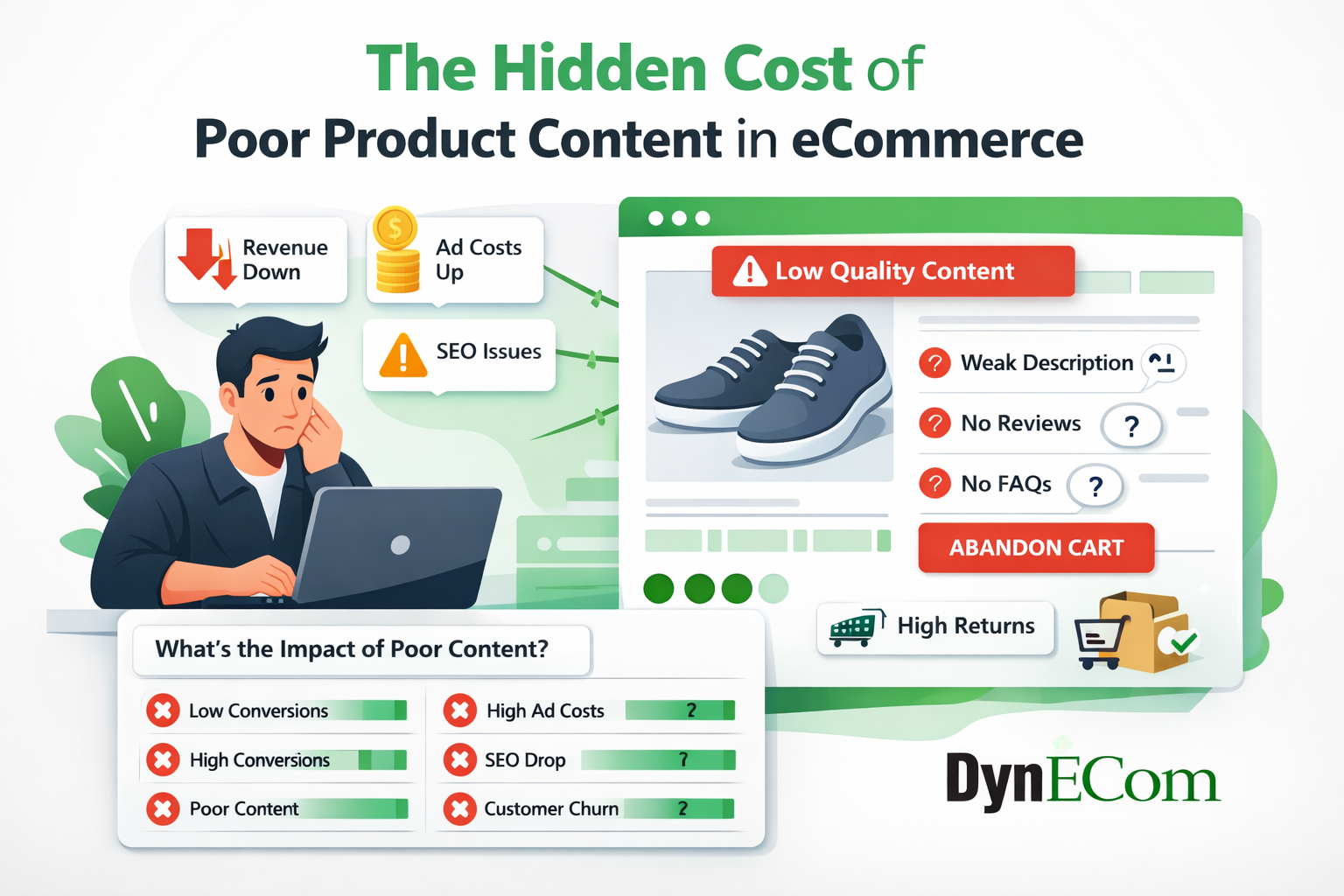
Introduction: The Revenue Leak No Dashboard Shows
When eCommerce revenue drops, teams usually blame:
- Rising ad costs
- Seasonality
- Competition
- Algorithm updates
Very few teams look at product content.
That’s because poor product content doesn’t break anything visibly.
- It doesn’t crash pages.
- It doesn’t trigger alerts.
- It quietly underperforms.
In eCommerce, silent underperformance is often more expensive than visible failure. Unless you actively invest in measuring your content’s performance, you’ll never know how much great content could deliver. Content is the fuel that feeds both traditional and AI-powered search, as well as the key ingredient for turning a site browser into a customer.
Most brands today also overlook another important factor:
Product content must be optimized for both traditional search engines and AI-powered search experiences.
Content that isn’t superior to your competitors loses organic visibility, product discovery, and potential customers.
This article breaks down the hidden costs of poor product content — costs that compound across SEO, paid ads, conversions, brand trust, and long-term growth.
What “Poor Product Content” Actually Looks Like
Poor product content isn’t always obvious.
It often looks like:
- Short, generic descriptions
- Feature lists with no context
- Manufacturer-supplied duplicative copy
- No differentiation from competitors
- No buyer guidance
- Missing attributes or product applications
The content technically exists — but it doesn’t do the job.
The job of product content is to close the sale:
- Answer buyer questions
- Reduce uncertainty
- Reinforce value
- Support ranking signals
- Drive confident purchase decisions
When product content falls short, the cost is real — even if it is difficult to measure and may not be visible in analytics dashboards.
Cost #1: Lost Conversions (The Most Obvious — and Most Ignored)
Let’s start with the simplest math.
Example Scenario
Monthly product page visits: 50,000
Conversion rate: 1.2%
Average order value: $80
Monthly revenue: $48,000
Now improve product content:
- Clear value propositions
- Better product explanations
- Objection-handling & FAQs
- Real customer insights
- Multiple photos
If better content can convert just 1 site visitor out of every 250 customers to buy, when they otherwise wouldn’t have purchased, the new conversion rate rises to 1.6%
New revenue: $64,000
That’s $16,000/month lost due to content alone.
Multiply this across dozens or hundreds of SKUs, and the loss is potentially massive.
Better product content doesn’t just increase rankings — it improves conversions and helps brands win more customers.
Cost #2: Higher Paid Ad Costs (Poor Content = Expensive Traffic)
Most teams separate ad performance from product content quality, but advertising platforms don’t.
Poor product content can:
- Increase Bounce Rates
- Lower Time-on-Page
- Weaken Engagement Signals
Which can lead to:
- Lower Quality Scores
- Higher CPCs
- Worse ROAS
You’re not just paying for traffic.
You’re paying for content inefficiency.
Weak product pages force paid campaigns to compensate for problems that better content could solve.
Cost #3: SEO Underperformance (Even with “Good” Keywords)
Google doesn’t rank product pages simply because they contain keywords.
It ranks pages that:
- Fully satisfy search intent
- Provide useful product information
- Demonstrate topical depth
- Earn engagement signals
Thin content leads to:
- Ranking stagnation
- Poor long-tail visibility
- Missed featured snippets
- Weak inclusion in AI-generated summaries
Modern product content must be optimized to attract organic traffic from both traditional search engines and AI-powered search systems.
Content that performs well across both environments gains greater visibility and more consistent product discovery.
Cost #4: Brand Trust Erosion (The Long-Term Damage)
Product pages are not just sales pages — they are brand experiences.
Poor content sends subtle signals like:
- “We don’t understand our customers.”
- “Our products are commodities.”
- “Price is the only reason to buy.”
Over time, this results in:
- Lower repeat purchases
- Reduced brand recall
- Higher price sensitivity
High-quality product content builds trust before the first purchase happens.
Trust leads to better conversions, stronger loyalty, and long-term customer relationships.
Cost #5: Increased Returns & Customer Support Load
Unclear product content creates confusion.
Customers may misunderstand:
- Product features
- Compatibility
- Sizing
- Expected results
This leads to:
- Higher return rates
- Increased support requests
- Negative product reviews
Common Content Gaps That Cause Returns
- No sizing guidance
- No usage context
- No limitations explained
- No compatibility information
Many successful eCommerce brands now automatically integrate customer reviews and FAQ content into product pages.
These elements help address real buyer concerns and reduce hesitation.
Benefits of Reviews & FAQs
| Content Element | Impact |
| Customer reviews | Builds trust and credibility |
| FAQ sections | Answers common objections |
| Real customer insights | Adds authenticity |
| Structured FAQ blocks | Improves visibility in AI and search results |
By proactively answering buyer questions, brands reduce both returns and support costs.
Cost #6: Missed Long-Tail & AI-Driven Search Visibility
Search behavior has evolved significantly.
Buyers now search using:
- Detailed questions
- Comparisons
- Specific use cases
Poor product content misses opportunities to appear for:
- Long-tail keywords
- Conversational search queries
- AI-generated search summaries
High-quality content expands query coverage, increasing visibility across both traditional search results and AI-powered recommendations.
The result: more organic traffic and higher product discoverability.
Cost #7: Ignoring Competitive Content Intelligence
Many brands create product content in isolation.
However, competitor pages contain valuable insights about:
- Customer questions
- Product positioning
- Missing information opportunities
By analyzing competitor content, you can identify content gaps and improve upon them.
Example Competitive Content Opportunity
| Content Element | Competitor Page | Your Opportunity |
| Product explanation | Basic features | Add benefits and use cases |
| Buyer questions | Few FAQs | Expand FAQ section |
| Product comparisons | Limited | Add comparison tables |
| Social proof | Minimal | Highlight reviews and trust signals |
Leveraging competitor content doesn’t mean copying it.
It means creating more comprehensive content that better serves the buyer.
Cost #8: Inability to Scale Content Efficiently
Weak product content creates long-term scalability problems.
Teams often compensate by:
- Publishing more blogs
- Increasing ad budgets
- Discounting products aggressively
Instead of fixing the core issue.
Strong product content creates a foundation that supports:
- SEO growth
- AI search visibility
- paid advertising performance
- conversion optimization
It allows marketing teams to scale growth without constantly increasing spend.
What High-Performing Product Content Does Differently
| Poor Content | High-Performing Content |
| Feature lists | Benefit-driven explanations |
| Generic language | Buyer-specific messaging |
| No structure | Intent-driven sections |
| No FAQs | Objection-handling FAQs |
| No context | Use-case clarity |
| SEO-only focus | SEO + CRO optimization |
This isn’t about writing more content.
It’s about writing content that helps buyers make decisions.
How to Fix Poor Product Content (Without Rewriting Everything)
Step 1: Identify Revenue-Critical SKUs
Start with:
- Top traffic pages
- High-margin products
- Top ad landing pages
Fixing these first creates the largest revenue impact.
Step 2: Rebuild Content Around Buyer Questions
Ask questions like:
- Who is this product for?
- Who is it not for?
- What objections stop the purchase?
- What alternatives do buyers compare?
Answer these directly on the page.
Step 3: Introduce Structured Content Blocks
Use structured sections such as:
- Benefits and value propositions
- Comparison tables
- Use-case highlights
- FAQs
- Trust signals
Structured content improves both readability and search performance.
Step 4: Implement Regular Content Updates
Content should not remain static.
Many high-performing eCommerce teams implement monthly content updates to keep product pages fresh.
These updates may include:
- New product insights
- Updated descriptions
- Additional FAQs
- Recent customer reviews
Frequent updates help maintain relevance for both traditional search engines and AI-powered search systems.
Market Reality: Why This Matters More in 2026
Several trends are increasing the importance of product content:
- Paid traffic continues becoming more expensive
- Google prioritizes depth over keyword density
- AI search summarizes shallow content
- Brand trust influences rankings and recommendations
Product content is no longer optional.
It’s core infrastructure for eCommerce growth.
Final Thought: Poor Content Is the Most Expensive “Free” Mistake
Most eCommerce brands don’t intentionally create poor product content.
They inherit it.
They overlook it.
They underestimate its impact.
But the cost is real — and it compounds over time.
Fixing product content doesn’t just improve SEO.
It improves every channel that drives revenue.
Turn Your Product Content Into a Revenue Engine
Most eCommerce brands already have hundreds or thousands of product pages.
The real opportunity isn’t creating more content — it’s optimizing existing product content so it drives discovery, conversions, and long-term growth.
A strategic content optimization approach can help you:
- Increase organic traffic from both traditional and AI-powered search
- Improve product discoverability across search platforms
- Address buyer objections using reviews and FAQs
- Increase conversion rates and win more customers
If your product pages are underperforming or your organic growth has stalled, it may be time to rethink your content strategy.
Request a free eCommerce content audit to identify gaps in your product content and discover opportunities to improve traffic, rankings, and conversions.
👉 Get your free audit and start turning product content into a growth engine.