
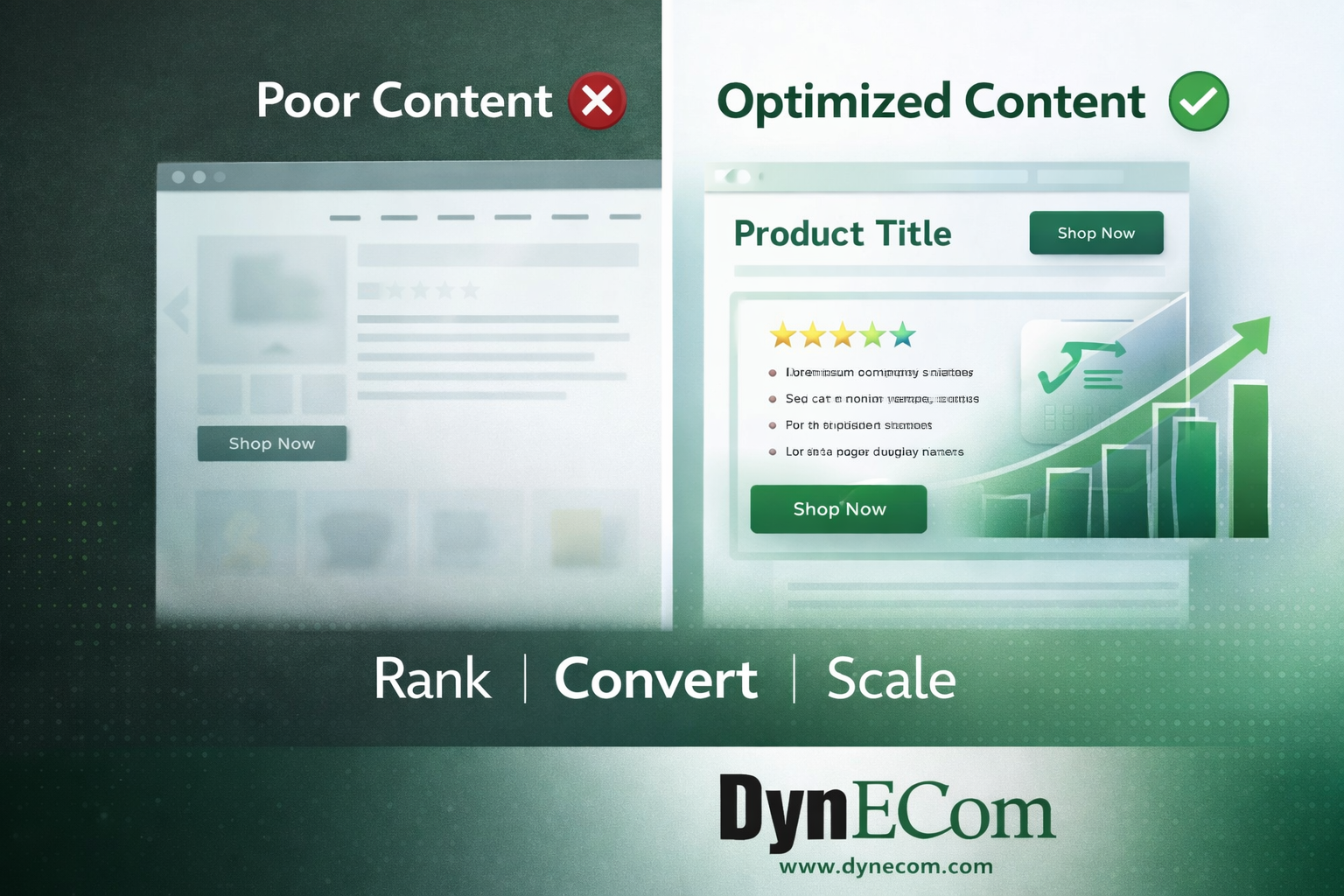
In today’s competitive eCommerce landscape, traffic alone is not enough. Thousands of online stores attract visitors every day, yet only a fraction convert those visitors into paying customers. As AI reduces organic traffic, successful sites rely on one critical factor: content optimization.
Your product content is either selling for you or costing you sales.
At DynEcom, we consistently see brands investing heavily in ads, SEO, and promotions, only to underperform because their content fails to rank, engage, or convert. This blog explores why content optimization matters, how it impacts rankings, AI visibility, and conversions. Plus, how eCommerce brands can use product content as a competitive advantage.
What Is Content Optimization in eCommerce?
Content optimization is the process of refining and improving your website content—product pages, category pages, descriptions, metadata, and supporting content—so that it:
- Ranks higher on search engines
- Aligns with user intent
- Builds trust and clarity
- Converts visitors into buyers
Unlike basic content creation, optimization is data-driven. It relies on keyword research, competitor analysis, user behavior, and performance metrics to ensure every word serves a purpose.Optimized content doesn’t just look good—it performs.
The Hidden Cost of Poor Content
Many eCommerce businesses underestimate how damaging poor content can be. Common issues include:
- Thin or generic product descriptions
- Duplicate content across products or categories
- No keyword alignment with search intent
- Unclear value propositions
- Missing FAQs, specs, or trust signals
The result?
- Low organic visibility
- High bounce rates
- Poor conversion rates
- Wasted ad spend
If your traffic is coming but conversions aren’t, content is often the bottleneck.
Why Content Optimization Matters More Than Ever
1. Search Engines Reward Quality, Not Quantity
Google’s algorithms have evolved significantly. Today, search engines prioritize:
- Relevance
- Depth
- User experience
- Content freshness
- Engagement signals
Simply stuffing keywords into product descriptions no longer works. Optimized content focuses on search intent, answering exactly what users are looking for at each stage of the buying journey.
When your content is optimized:
- Product pages rank for high-intent keywords
- Category pages capture broader discovery searches
- Your store becomes more visible without increasing ad spend
2. Optimized Content Improves Conversions
Ranking on page one is only half the battle. What happens after the click matters even more.
Optimized content helps convert visitors by:
- Clearly explaining benefits, not just features
- Addressing objections before they arise
- Providing scannable, easy-to-read information
- Using persuasive language backed by data
Shoppers don’t want to guess. They want clarity, confidence, and reassurance. Well-optimized content delivers exactly that.
3. It Helps You Win Against Competitors
In most eCommerce niches, you’re not competing against one brand—you’re competing against dozens.
Content optimization gives you an edge by:
- Analyzing top-ranking competitors
- Identifying content gaps they’ve missed
- Creating richer, more helpful pages
- Matching (and exceeding) search intent
At DynEcom, we don’t guess what works—we benchmark against competitors and optimize strategically to outperform them.
The Role of Data in Content Optimization
Effective content optimization is never based on assumptions. It’s built on data such as:
- Keyword search volume and intent
- Click-through rates
- Conversion rates
- Bounce rates and time on page
- Competitor rankings and content depth
Data shows what users want, how they behave, and where your content is falling short.This is why guessing or copying competitors blindly often fails. What works for one brand may not work for another unless it’s contextualized with data.
Optimized Content Builds Long-Term Growth
One of the biggest advantages of content optimization is its compounding effect.
Unlike ads, optimized content:
- Continues to drive traffic over time
- Improves performance as it’s refined
- Reduces dependency on paid media
- Strengthens brand authority
An optimized product or category page can generate consistent revenue month after month without increasing spend.
That’s sustainable growth.
Key Areas Where Content Optimization Matters Most
Product Pages
Your product pages are where conversions happen. Optimizing titles, descriptions, images, FAQs, and internal links can dramatically improve sales.
Category Pages
Category pages often rank for high-volume keywords. Optimizing them properly can unlock massive organic traffic.
Metadata (Titles & Descriptions)
These impact click-through rates directly. Optimized metadata can increase traffic without changing rankings.
Supporting Content
Buying guides, FAQs, and comparison content support decision-making and improve topical authority.
Common Content Optimization Mistakes
Even experienced brands make these mistakes:
- Optimizing only for keywords, not users
- Ignoring mobile readability
- Writing long content without structure
- Never updating existing pages
- Treating all pages the same
Optimization is not a one-time task—it’s an ongoing process.
How DynEcom Approaches Content Optimization
At DynEcom, we follow a structured, performance-driven approach:
- Data & Keyword Research
Understanding intent, not just volume. - Competitor Analysis
Identifying gaps and opportunities. - Content Structuring
Making content readable, persuasive, and scannable. - SEO + Conversion Alignment
Balancing rankings with user experience. - Continuous Optimization
Monitoring performance and improving over time.
We don’t rely on templates. Every optimization is tailored to the brand, category, and audience.
The Bottom Line: Content Is a Revenue Asset
Content optimization is not just an SEO tactic—it’s a revenue strategy.
When done right, it:
- Drives qualified traffic
- Builds trust
- Improves conversions
- Strengthens brand authority
- Delivers long-term ROI
If your content isn’t optimized, you’re leaving money on the table—every single day.
Ready to Optimize Your Content?
If your store is getting traffic but struggling to convert, it’s time to rethink your content strategy.
At DynEcom, we help eCommerce brands:
- Rank higher
- Convert better
- Scale sustainably
🌐 Learn more at DyneCom
Because we don’t guess—we optimize based on real data.