
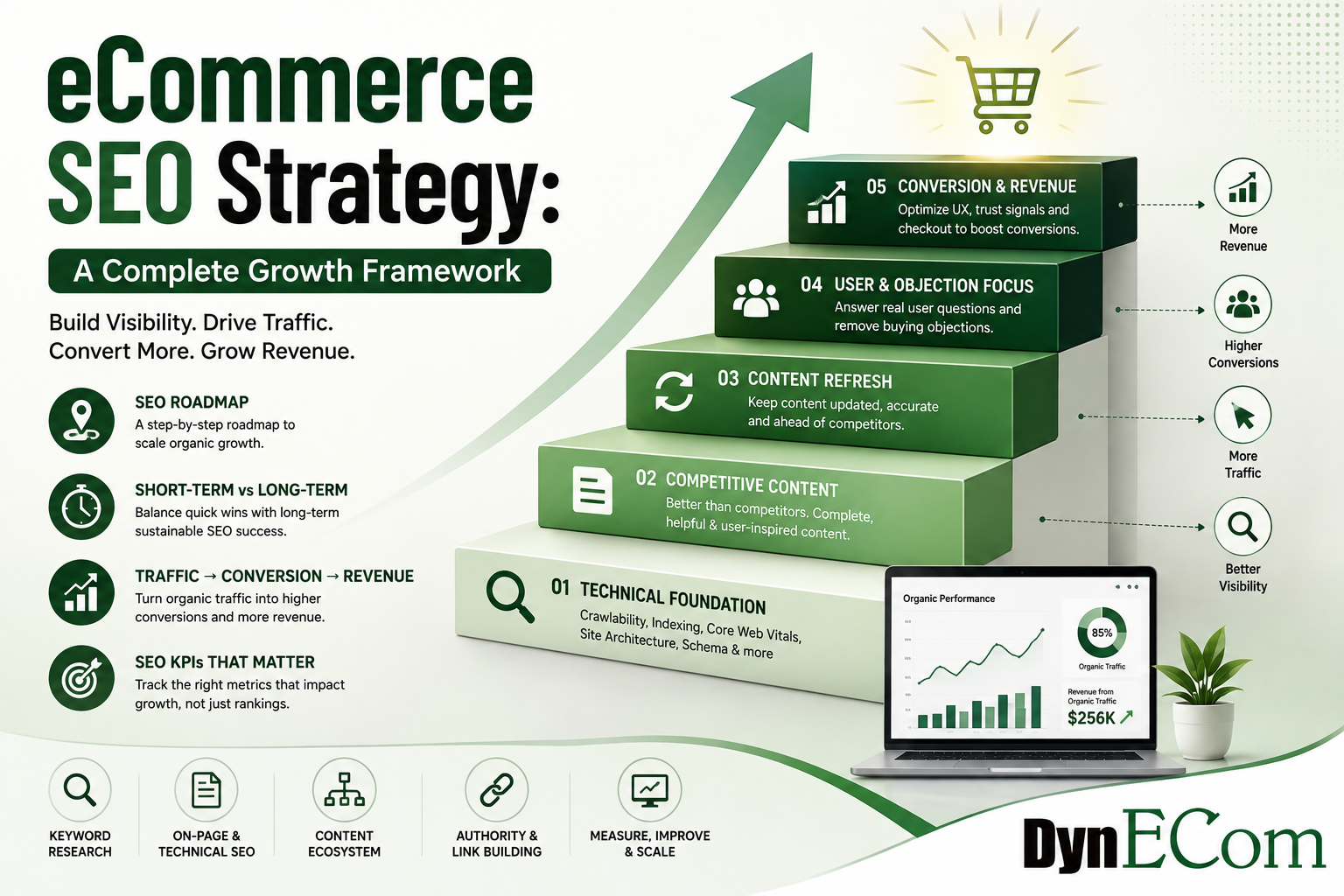
An effective eCommerce SEO strategy is no longer about ranking a handful of keywords. Today’s winning brands build a growth framework that connects search visibility, AI discoverability, customer trust, and conversion optimization into a single system.
As Google, ChatGPT, Gemini, Perplexity, and other AI-powered discovery platforms reshape how shoppers find products, SEO has become much more than technical optimization. Product pages must answer customer questions, outperform competitor content, stay continuously refreshed, and remove buying objections before a customer ever contacts support.
At DynEcom, we believe that successful eCommerce SEO isn’t built on checklists—it’s built on competitive content. Instead of asking, “Is this page optimized?”, the better question is, “Is this page more useful than every competing page?” That mindset transforms SEO from a traffic tactic into a sustainable revenue engine.
What is an eCommerce SEO Strategy?
An eCommerce SEO strategy is a long-term growth framework designed to increase qualified organic traffic, improve AI search visibility, convert more visitors into customers, and maximize revenue.
Rather than optimizing isolated pages, successful brands optimize the entire customer journey—from product discovery to post-purchase engagement.
An effective strategy includes:
- Technical SEO
- Category page optimization
- Product page optimization
- Internal linking
- Content marketing
- Buying guides
- Product comparisons
- Structured data
- AI Search Optimization (GEO)
- Conversion optimization
- Content refreshes
- Performance measurement
Why Traditional SEO Isn’t Enough Anymore
Many SEO guides still recommend:
- Add keywords
- Write meta descriptions
- Build backlinks
- Improve page speed
Those practices still matter.
But they are no longer enough.
Today’s search engines—and AI assistants—reward websites that provide:
- More complete information
- Better customer education
- Stronger topical authority
- Fresh content
- Helpful answers
- Comprehensive product information
The brands winning organic search are no longer creating optimized pages.
They’re creating better pages than competitors.
The Modern eCommerce SEO Growth Framework
Instead of thinking about SEO as rankings, think of it as a revenue flywheel.
Competitive Content
        ↓
Better Rankings
        ↓
More Qualified Traffic
        ↓
Higher Engagement
        ↓
Better Conversion Rates
        ↓
More Revenue
        ↓
Content Refresh
        ↓
Repeat
Every stage supports the next.
Phase 1: Build a Strong Technical Foundation
Cover:
- Crawlability
- Indexation
- XML sitemaps
- Core Web Vitals
- Mobile usability
- Structured data
- HTTPS
- Site architecture
Without a technically healthy site, great content struggles to perform.
Phase 2: Build Competitive Content
This should become the centerpiece of the article.
Instead of saying:
Create quality content.
Discuss:
Competitive Content
Competitive content means producing pages that are demonstrably more complete, more relevant, and more useful than competing pages.
That includes:
- Better product descriptions
- Rich specifications
- Buying advice
- Product comparisons
- FAQs
- Customer objections
- User-inspired questions
- Use cases
- Compatibility information
The objective isn’t merely to satisfy search engines—it is to become the best resource available for the shopper.
Phase 3: Keep Content Fresh
One of the biggest SEO mistakes is treating product descriptions as finished.
Successful brands continuously improve content by:
- Monitoring competitors
- Updating product features
- Adding new FAQs
- Incorporating customer reviews
- Refreshing specifications
- Including emerging search trends
Fresh content improves relevance for both traditional search engines and AI-powered discovery systems.
Phase 4: Create Complete Content Ecosystems
Every important category should include:
- Buying guides
- Comparison pages
- Educational blogs
- Product FAQs
- Troubleshooting articles
- Care guides
- Videos
- UGC
- Category pages
- Product pages
Every piece should strengthen every other piece through internal linking.
Phase 5: Turn SEO Traffic Into Revenue
This is where many SEO guides stop.
DynEcom shouldn’t.
Traffic doesn’t generate revenue.
Conversions do.
Your SEO strategy should also optimize:
- Product images
- Customer reviews
- Trust signals
- Shipping information
- Buying confidence
- Objection handling
- Related products
- Checkout experience
SEO without conversion optimization simply creates more opportunities to lose customers.
Short-Term vs Long-Term SEO Strategies
| Short-Term SEO | Long-Term SEO |
|---|---|
| Technical fixes | Build topical authority |
| Optimize existing pages | Create competitive content |
| Improve internal links | Publish buying guides |
| Update metadata | Build comparison pages |
| Refresh product descriptions | Continuous content refresh |
| Fix indexing issues | AI search optimization |
| Improve page speed | Earn backlinks naturally |
Short-term improvements often deliver quick wins, while long-term investments create durable competitive advantages that compound over time.
The Traffic → Conversion → Revenue Framework
Many businesses stop measuring SEO after rankings.
The better framework is:
Stage 1
Traffic
Measure:
- Organic sessions
- Search visibility
- Click-through rate
↓
Stage 2
Engagement
Measure:
- Time on page
- Scroll depth
- Product interactions
↓
Stage 3
Conversions
Measure:
- Add-to-cart
- Conversion rate
- Checkout completion
↓
Stage 4
Revenue
Measure:
- Organic revenue
- Average order value
- Revenue per visitor
- Customer lifetime value
This ensures SEO investments are evaluated by business outcomes—not vanity metrics.
SEO KPIs Every eCommerce Business Should Track
Visibility KPIs
- Organic traffic
- Keyword rankings
- Search impressions
- Click-through rate
- AI search mentions
Engagement KPIs
- Time on page
- Pages per session
- Scroll depth
- Bounce rate
Conversion KPIs
- Add-to-cart rate
- Conversion rate
- Checkout completion
- Assisted conversions
Revenue KPIs
- Organic revenue
- Revenue per visitor
- Average order value
- Customer lifetime value
- Return on SEO investment
Common Mistakes
Avoid:
- Treating SEO as a one-time project
- Using manufacturer descriptions
- Ignoring customer objections
- Publishing thin content
- Neglecting AI search optimization
- Failing to refresh content
- Measuring rankings instead of revenue
- Producing content that’s no better than competitors’
Best Practices
- Build better content than competing pages—not just optimized content.
- Refresh high-value pages regularly.
- Answer real customer questions and objections.
- Combine SEO with CRO for stronger business outcomes.
- Build complete topic clusters around every major product category.
- Measure success using revenue, not rankings alone.
- Treat content as an evolving asset that grows more valuable through continuous improvement.
Conclusion
An effective eCommerce SEO strategy is no longer about chasing rankings or checking technical boxes. It’s about building a sustainable growth framework where every product page, category page, and educational resource works together to increase visibility, build trust, and drive revenue.
The brands that succeed won’t simply publish more content—they’ll publish better, more complete, and continuously evolving content. By combining competitive content, regular content refreshes, user-inspired insights, objection-focused messaging, and conversion optimization, businesses can create a compounding organic growth engine that performs across traditional search, AI-powered discovery, and every stage of the customer journey.
If you found this guide helpful, don’t miss our comprehensive pillar article:
The Ultimate eCommerce SEO Guide for 2026
Learn everything about technical SEO, content strategy, on-page optimization, site architecture, AI search optimization, product feeds, structured data, and much more—all in one place.

Dharmendra Tripathi is a Senior Digital Marketing & Customer Success leader with deep expertise in eCommerce SEO, performance marketing, and marketplace growth. With years of experience managing SEO and advertising campaigns across Google, Meta, Amazon, Walmart, and Shopify, he helps brands improve search visibility, maximize advertising ROI, and accelerate online sales. Passionate about AI-powered search, content optimization, and analytics, Dharmendra regularly shares actionable insights to help eCommerce businesses stay ahead in an evolving digital landscape.