
The Complete Blueprint to Increase Organic Traffic, Elevate AI Search Visibility, Improve eCommerce Conversion Rates & Drive Sustainable Revenue
Published by DynEcom | Enterprise eCommerce SEO & AI Search Optimization
Table of Contents
Part 1: Foundations
- Executive Summary: eCommerce SEO in 2026
- What eCommerce SEO Is and How It Differs from Traditional SEO
- Search Evolution: Google, AI Overviews, ChatGPT, Gemini, Perplexity, TikTok, YouTube, and Marketplaces
- eCommerce Search Intent and Page-Type Mapping
Part 2: Strategy
- Keyword Research and Revenue-Weighted Opportunity Scoring
- Site Architecture, Taxonomy, and Internal Linking
Part 3: On-Page SEO
- Product Page SEO and Product Variant SEO
- Category Page SEO and Commercial Investigation Content
- Internal Linking Strategies for eCommerce
Part 4: Technical SEO
- Technical SEO Foundations for eCommerce
- Crawl Budget and Indexation
- Faceted Navigation SEO
- Core Web Vitals for eCommerce
Part 5: Content SEO
Part 6: AI Search Optimization
- Platform SEO: Shopify, Magento, BigCommerce
- GEO, AEO, LLM Visibility, and AI Search Measurement
- Conversational Commerce and Agent-Friendly Website Readiness
- Entity SEO for eCommerce Brands
- International SEO for Global eCommerce Brands
- Merchant Center Optimization for Organic and AI Shopping Visibility
- Product Feed SEO: The Structured Commerce Layer
- Product Variant SEO: When to Index, Consolidate, or Group Variants
- Out-of-Stock, Discontinued, and Product Lifecycle SEO
- Programmatic SEO for eCommerce Catalogs
- Headless Commerce and JavaScript SEO
- Edge SEO for Enterprise eCommerce
- Marketplace SEO and Omnichannel Search Alignment
- AI Search Measurement and Governance
- Vector Search, and Semantic Product Optimization
- Conversion-Focused SEO and Product Page CRO
Part 7: Measurement
Part 8: Execution & Growth Strategy
- Common eCommerce SEO Mistakes and Troubleshooting Playbooks
- eCommerce SEO Workflow – 90-Day, 6-Month, and 12-Month Implementation Roadmaps
- Future of eCommerce SEO
Part 9: Wrapping Up
1. Introduction to Modern eCommerce SEO
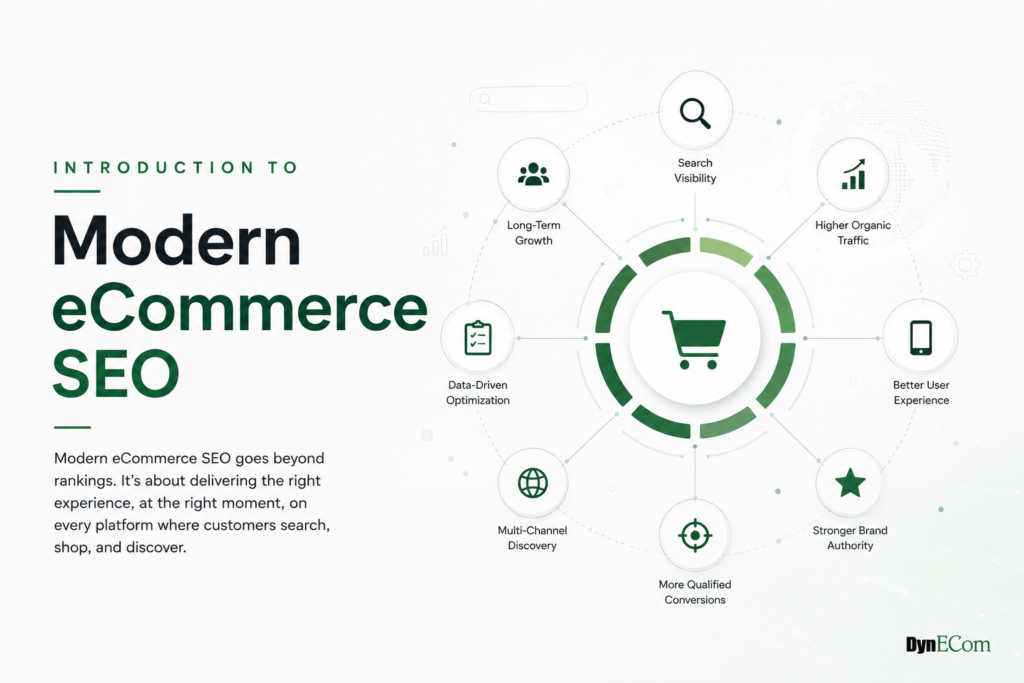
The eCommerce industry is navigating one of the most significant shifts in digital commerce history. For over a decade, online retailers anchored their customer acquisition strategies on three pillars: Google’s organic rankings, paid advertising, and marketplace visibility. Brands invested in category page optimization, backlink acquisition, Google Shopping campaigns, and aggressive bidding on transactional keywords. That model worked, until the fundamental nature of search itself began to change.
eCommerce SEO has evolved far beyond simply adding keywords to product pages. In 2026, successful online stores need to optimize their websites for:
- Traditional Google search rankings
- AI-powered search experiences
- Product discovery engines
- Conversational search tools
- Mobile-first indexing
- Conversion-focused user experiences
- Semantic relevance and topical authority
Search engines are becoming increasingly intelligent. Google now evaluates:
- Search intent
- User engagement
- Content quality
- Product data structure
- Site experience
- Expertise and authority
- AI readability
At the same time, platforms like ChatGPT, Perplexity, Gemini, and AI Overviews are changing how customers discover products online requiring eCommerce sites to rethink their own content strategies.
In 2026, the search landscape is no longer a single channel dominated by Google’s blue links. It has fragmented into a rich ecosystem of discovery platforms – Google Search, Google AI Overviews, ChatGPT, Perplexity, Gemini, voice assistants, TikTok search, YouTube, Reddit, and an expanding universe of conversational commerce interfaces. Each platform surfaces products differently, rewards different content qualities, and serves users at different stages of their buying journey.
This fragmentation has profound implications. Modern consumers rarely follow a linear path from search query to purchase and are arriving at eCommerce sites later in their purchase journey. Consumers are comparing products across multiple platforms, validating choices through reviews and community discussions, asking AI assistants for personalized recommendations, consuming buying guides and comparison content, and looking for social proof before committing. The buying journey is now circular, multi-touchpoint, and deeply influenced by how well a brand’s content performs across all of these information channels simultaneously.
Search engines have evolved in lockstep with consumer behavior. Google increasingly evaluates topical relevance, semantic depth, expertise signals, engagement quality, and content helpfulness rather than simply rewarding pages stuffed with the right keywords. At the same time, large language models (LLMs) like ChatGPT and Gemini have introduced an entirely new discovery paradigm: instead of returning a list of blue links, these systems generate synthesized recommendations, buying comparisons, and conversational answers that cite specific products and brands.
This creates both enormous risk and genuine opportunity. eCommerce sites relying on thin product pages, duplicated manufacturer descriptions, and generic category content will find themselves increasingly invisible. Not just in traditional search but across the AI-generated answer surfaces that are rapidly capturing consumer attention. Meanwhile, sites investing in semantic SEO, AI-readable content, structured product data, and comprehensive buying experiences are building compounding competitive advantages that paid advertising cannot replicate.
This means modern eCommerce SEO is no longer just about ranking pages but expanding product page relevance to a broader range of long-tail search queries. It is about:
- Building discoverability and more complete product pages
- Improving product visibility
- Increasing revenue by overcoming customer concerns
- Reducing paid acquisition dependency
- Creating long-term organic growth
This guide represents DynEcom’s comprehensive framework for winning in this new environment. DynEcom was founded on the conviction that eCommerce SEO requires a fundamentally different approach than generic SEO consulting. One that understands large product catalogs, complex site architectures, faceted navigation challenges, conversion psychology, the unique demands of AI-powered product discovery, and the fact that it’s more important than ever to deliver better content than competitors. Throughout this guide, we draw on principles and methodologies refined across hundreds of eCommerce engagements to give you a complete, actionable blueprint for 2026 and beyond.
2. What is eCommerce SEO?
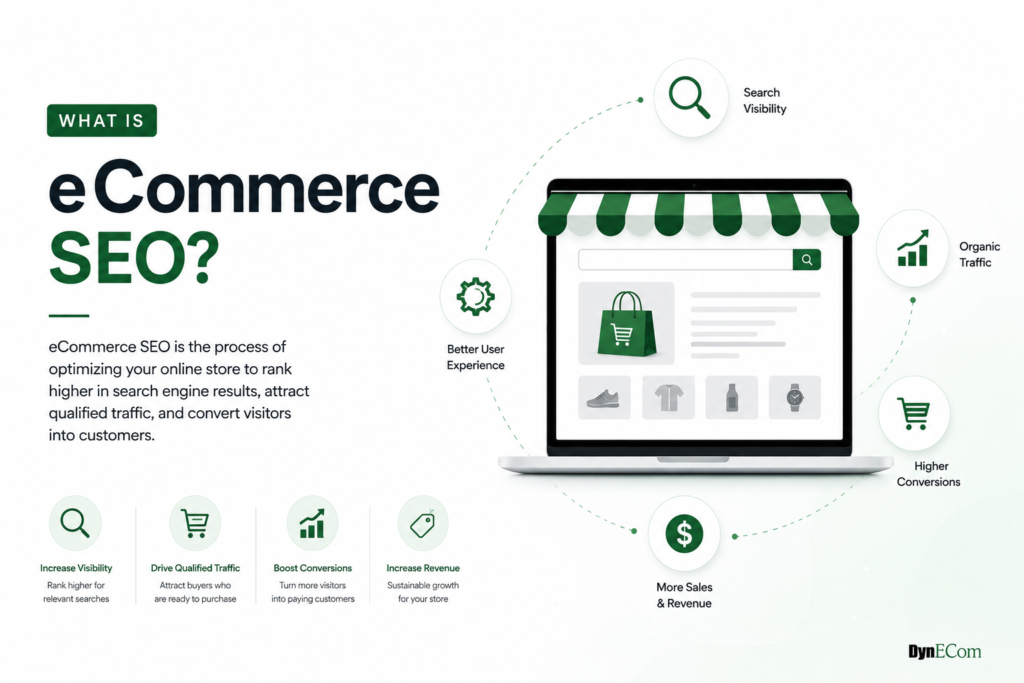
eCommerce SEO is the process of optimizing an online store to improve visibility in search engines and drive qualified organic traffic to:
- Product pages
- Category pages
- Collection pages
- Brand pages
- Buying guides
- Blog content
- Comparison pages
The primary goal is to attract users actively searching for products and convert them into customers.
Unlike traditional SEO, eCommerce SEO involves managing large-scale websites with:
- Thousands of products and product categories
- Complex category structures
- Dynamic URLs
- Faceted navigation
- Product variants
- Inventory changes
- Large internal linking systems
Why eCommerce SEO Matters More Than Ever
Paid advertising costs continue to rise across:
- Google Ads
- Meta Ads
- TikTok Ads
- Amazon Advertising
- Retail media networks
Many sites are becoming overdependent on paid traffic at a time when customer acquisition costs continue to rise ahead of inflation. SEO provides a scalable acquisition channel that compounds over time.
Benefits of eCommerce SEO
| Benefits | Impacts |
|---|---|
| Higher organic traffic | More qualified visitors |
| Lower CAC | Reduced dependency on paid ads |
| Long-term growth | Rankings compound over time |
| Better conversion rates | Intent-driven traffic converts better |
| Improved trust | Organic rankings increase credibility |
| Increased AI visibility | Better exposure in AI-generated answers |
eCommerce SEO vs Marketplace SEO vs Retail Media
| Factor | eCommerce SEO | Marketplace SEO | Retail Media Advertising |
|---|---|---|---|
| What it is | Optimizing your own website to rank in Google, Bing, AI Overviews, ChatGPT, Perplexity, and other search engines. | Optimizing product listings inside marketplaces such as Amazon, Walmart, eBay, Etsy | Paid advertising on retailer-owned networks such as Amazon Sponsored Products, Walmart Connect, Target Roundel, Instacart Ads |
| Primary Goal | Increase organic visibility on Google and AI search platforms | Increase visibility within marketplaces | Increase paid visibility on retailer platforms |
| Traffic Source | Google, Bing, ChatGPT, Perplexity, Gemini, AI Overviews | Amazon, Walmart, eBay, Etsy, Target, Wayfair | Amazon Ads, Walmart Connect, Target Roundel, Instacart Ads |
| Core Activities | Technical SEO Category page optimization Product page optimization Content marketing Internal linking Schema markup GEO/AEO optimizationLink building | Sales velocity Conversion rate Review count Review quality Inventory availability Price competitiveness Fulfillment speed Listing relevance | Bid strategy Budget Conversion rate Product rating RelevanceRetailer algorithm |
| Ownership | Fully owned traffic | Marketplace-owned traffic | Retailer-controlled paid traffic |
| Cost Structure | Organic investment | Organic marketplace optimization | Paid advertising budget |
| Time to Results | 3–12 months | Weeks to months | Immediate |
| Scalability | Very high | Moderate to high | Limited by budget |
| Long-Term Value | Compounding asset | Platform dependent | Stops when spend stops |
| Conversion Intent | Research + purchase | High purchase intent | Extremely high purchase intent |
| Content Focus | Product pages, category pages, guides, blogs | Product listings and catalog optimization | Sponsored products and display ads |
| Ranking Factors | Content quality, backlinks, authority, technical SEO | Sales velocity, reviews, relevance, pricing | Bid amount, relevance, conversion rate |
| AI Search Visibility | High impact | Limited impact | Very limited |
| Brand Building | Strong | Moderate | Moderate |
| Customer Ownership | Full ownership of customer relationship | Limited ownership | Limited ownership |
| Data Access | Full analytics and first-party data | Restricted marketplace data | Retailer-controlled reporting |
| CAC (Customer Acquisition Cost) | Decreases over time | Usually stable | Often increases over time |
| Competitive Barrier | Content authority and expertise | Reviews, pricing, fulfillment | Advertising budget |
| Dependency Risk | Low | Medium to high | High |
| Typical KPI | Organic traffic, rankings, revenue | Marketplace sales, rank position | ROAS, ACOS, TACOS, attributed sales |
| Advantages | ✓ Builds a long-term asset ✓ Reduces paid advertising dependency ✓ Supports AI search visibility ✓ Full customer ownership ✓ Strong brand authority |
✓ Faster ranking improvements ✓ Very high buyer intent ✓ Immediate access to marketplace traffic |
✓ Immediate traffic ✓ Immediate sales opportunities ✓ Highly measurable |
| Disadvantages | ✗ Slower results ✗ Requires ongoing content investment ✗ Competitive industries can take time |
✗ Limited customer ownership ✗ Platform fees ✗ Heavy competition ✗ Vulnerable to marketplace algorithm changes |
✗ Traffic disappears when spending stops ✗ Rising CPCs and CACs ✗ Increasing competition |
Enterprise SEO Prioritization Matrix
Large catalogs create more SEO opportunities than teams can execute. Prioritization must be based on business impact, not issue count.
| Score Factor | Weight | How to Score |
|---|---|---|
| Revenue impact | 35% | Estimated revenue upside if fixed. |
| Search demand | 20% | Monthly demand and ranking opportunity. |
| Technical dependency | 15% | Lower score if multiple teams/blockers required. |
| Confidence | 15% | Evidence from data, tests, or competitor patterns. |
| Effort | 15% | Lower score for high effort; higher for quick wins. |
Priority score formula: (Revenue Impact x 0.35) + (Search Demand x 0.20) + (Confidence x 0.15) + (Ease of Execution x 0.15) + (Strategic Importance x 0.15). Use this score to build monthly roadmaps and avoid stakeholder-driven prioritization that over-focuses on low-impact visible issues.
How DynEcom Helps eCommerce Teams Grow Through SEO
DynEcom specializes in helping eCommerce brands improve organic visibility, product discoverability, and conversion performance through AI-driven eCommerce SEO strategies. Our expertise includes:
- Product page optimization
- AI search optimization (GEO)
- Category page SEO
- Technical eCommerce SEO
- Conversion-focused content optimization
- Marketplace and omnichannel SEO strategies
Unlike traditional SEO agencies, DynEcom focuses specifically on the unique challenges of eCommerce growth including large product catalogs, faceted navigation, duplicate content management, and AI-powered product discovery.
3. How Search Has Changed in 2026
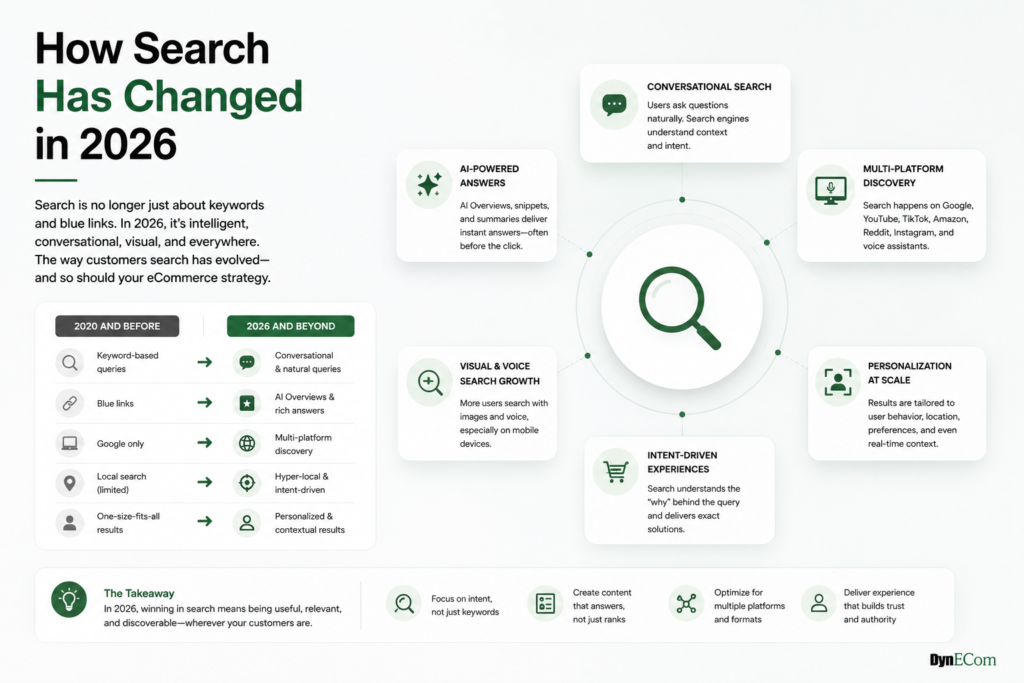
To understand modern eCommerce SEO, you must first understand the forces reshaping how consumers find products. The changes are not incremental; they represent a genuine paradigm shift in information retrieval.
The Rise of AI-Generated Search Experiences
Google’s AI Overviews, rolled out progressively since 2024, now appear for a significant portion of commercial and informational queries. These AI-generated summaries sit above traditional organic results and synthesize information from multiple sources into a single, conversational answer. For eCommerce, this means that a brand’s product page might never receive a click, but the brand name and product recommendation might still appear in the AI summary if the content is well-structured and authoritative enough to be cited.
ChatGPT’s browsing capabilities and shopping integrations have introduced another layer of AI-mediated discovery. Users increasingly ask ChatGPT questions like ‘What are the best ergonomic office chairs under $500 for someone with lower back pain?’ and receive ranked recommendations with specific product names, features comparisons, and direct purchase links. The brands that appear in these answers are not necessarily the ones with the highest domain authority. They are the ones whose product content is most clearly structured, most semantically complete, and most aligned with the specific intent expressed in the question.
What Is AI Search Optimization?
AI Search Optimization is the practice of increasing your brand’s visibility within AI-generated answers, often referred to as:
- Generative Engine Optimization (GEO)
- AI SEO
- LLM SEO
- Answer Engine Optimization (AEO)
Instead of optimizing solely for search engine rankings, businesses must optimize for AI recommendations, citations, summaries, and conversational responses.
Traditional SEO asks:
“How do I rank #1?”
AI Search Optimization asks:
“How do I become the answer for a broader range of questions?”
How AI Search Engines Work?
AI search engines do far more than match keywords to webpages. Modern platforms such as ChatGPT, Perplexity, Gemini, and Claude analyze vast amounts of information from across the web to determine which sources are the most trustworthy, authoritative, and relevant to a user’s question.
Instead of simply displaying a list of links, these systems attempt to generate direct answers. To do that, they evaluate numerous signals that help them determine whether a company, website, product, or piece of content deserves to be referenced or recommended.
While each AI platform uses its own algorithms and ranking methods, most rely on a common set of authority and trust signals.
1. Content Authority
AI systems prioritize websites that consistently publish accurate, comprehensive, and valuable content. A website that regularly demonstrates expertise in a subject area is more likely to be viewed as a reliable source. Authority is built over time through:
- In-depth educational content
- Original research and insights
- Comprehensive guides and tutorials
- Consistent topical coverage
- Accurate and regularly updated information
For example, if a website has published hundreds of high-quality articles about eCommerce SEO, AI systems are more likely to recognize it as a trusted authority on that topic than a website with only a few superficial articles.
The more expertise a website demonstrates across a subject area, the greater its chances of being referenced in AI-generated responses.
2. Brand Mentions Across the Web
AI search engines evaluate more than just your website. They also analyze how frequently your brand name is mentioned across the broader internet.
Mentions on trusted websites help AI systems understand that a company is recognized within its industry and discussed by other authoritative sources. These mentions may come from:
- Industry blogs
- News publications
- Business directories
- Forums and communities
- Podcasts
- Conference websites
- Industry association websites
- Research publications
Importantly, many of these mentions do not need to contain backlinks. Even unlinked brand references can contribute to an AI model’s understanding of a company’s reputation and industry presence.
When AI systems repeatedly encounter your brand in relevant contexts, they become more confident in associating your business with specific topics and areas of expertise.
3. Reviews and Online Reputation
Trust is a critical component of AI recommendations. To evaluate trustworthiness, AI systems often consider third-party review signals and reputation indicators.
Reviews provide independent validation that customers have interacted with a business and found value in its products or services. Common reputation sources include:
- Google Business Profiles
- Industry review websites
- Marketplace reviews
- Software review platforms
- Customer testimonials
- Professional recommendation sites
AI systems may assess:
- Review volume
- Average ratings
- Review recency
- Consistency across platforms
- Overall customer sentiment
A business with a strong reputation across multiple trusted review platforms is generally more likely to be viewed as credible than a business with limited or inconsistent feedback.
4. Expert-Led Content
AI platforms increasingly favor content that demonstrates genuine expertise. Many modern ranking systems attempt to determine whether content was created by individuals with real-world experience, professional qualifications, or recognized authority in a specific field. Signals that may strengthen perceived expertise include:
- Author biographies
- Professional credentials
- Industry certifications
- Published research
- Speaking engagements
- Case studies
- First-hand experience
- Expert interviews
For example, a medical article written and reviewed by healthcare professionals is generally more trustworthy than anonymous content lacking evidence of expertise. Similarly, an eCommerce SEO guide written by a practitioner who has managed enterprise-level SEO programs may carry greater weight than generic content without demonstrated experience.
Expert-driven content helps AI systems identify reliable sources and reduce the risk of surfacing inaccurate information.
5. Structured and Organized Information
AI systems perform best when information is presented clearly and logically. Well-structured content makes it easier for both search engines and AI models to identify key topics, understand relationships between concepts, and extract useful information. Strong content structure typically includes:
- Clear headings and subheadings
- Logical content hierarchy
- Concise paragraphs
- Tables and comparison charts
- FAQ sections
- Bullet-point summaries
- Schema markup
- Internal linking
For example, a guide that clearly separates definitions, examples, processes, and FAQs is easier for AI systems to interpret than a large block of unstructured text.
Structured content increases the likelihood that AI models can accurately reference, summarize, and cite your information when generating answers.
6. External Citations and References
AI search engines place significant value on external validation. When respected organizations, publications, and industry authorities reference your business, content, or research, these citations reinforce credibility. Examples include:
- Industry associations
- Government websites
- Academic institutions
- Research organizations
- Professional directories
- Trade publications
- Major media outlets
- Educational resources
These citations act as trust signals because they indicate that independent organizations consider your content or business valuable enough to reference.
The quality of citations often matters more than quantity. A mention from a highly respected industry publication can carry considerably more influence than dozens of mentions from low-authority websites.
7. User Engagement Signals
Although AI systems do not rely solely on traditional search metrics, user engagement can still influence perceived content quality. Positive engagement signals may include:
- Time spent on page
- Repeat visits
- Social sharing
- Content downloads
- Newsletter subscriptions
- Low bounce rates
- Strong click-through rates
When users consistently interact with and engage with content, it can indicate that the information is useful and satisfies search intent.
AI systems often seek to surface content that has proven valuable to real users, making engagement an indirect indicator of quality.
8. Entity Recognition and Knowledge Graph Signals
Modern AI systems increasingly rely on entities rather than keywords alone. An entity can be a company, person, product, location, or concept that AI models can clearly identify and understand. For example, AI systems attempt to connect information about:
- Companies
- Founders
- Products
- Services
- Industries
- Locations
- Topics
The more consistently your business information appears across the web, the easier it becomes for AI models to establish relationships and build confidence in your brand’s identity.
This is why consistency across websites, directories, social profiles, and business listings is becoming increasingly important.
9. Freshness and Content Updates
AI search engines prefer information that remains accurate and current. This differs from traditional search engines that value content longevity. Instead, AI search sees content freshness as a content trust signal. Outdated content can reduce trust and increase the likelihood that AI systems reference newer sources. Regular updates help maintain relevance by:
- Refreshing statistics
- Updating screenshots
- Adding new industry developments
- Expanding coverage
- Correcting outdated information
- Addressing emerging trends
Content that is actively maintained signals reliability and demonstrates ongoing expertise.
10. Topical Depth and Coverage
AI systems often evaluate how comprehensively a website covers a subject rather than focusing on individual pages in isolation. A strong topical authority strategy includes:
- Pillar pages
- Supporting articles
- FAQs
- Case studies
- Research content
- Comparison guides
- Industry insights
- Educational resources
When a website demonstrates deep expertise across an entire topic ecosystem, AI models are more likely to trust it as a source of information.
Why These Signals Matter?
AI search engines are designed to answer questions using the most trustworthy information available. Their goal is not simply to rank pages but to identify sources that demonstrate expertise, authority, trustworthiness, and relevance. The strongest AI-visible brands typically combine:
- High-quality content
- Strong brand recognition
- Positive customer reviews
- Expert authorship
- Structured information
- Trusted external citations
- Consistent entity signals
- Comprehensive topical coverage
As AI-powered search continues to evolve, businesses that invest in these foundational authority signals will be significantly more likely to appear in AI-generated answers, citations, recommendations, and conversational search experiences.
The Multi-Platform Discovery Reality
Search is no longer limited to Google. Customers now discover products through:
- Google Search
- AI Overviews
- ChatGPT
- Perplexity
- Voice assistants
- Amazon search
- TikTok search
- YouTube
Modern SEO strategies must optimize for both:
- Traditional search engines
- AI-powered search experiences
TikTok search has emerged as a genuine product discovery engine, particularly for younger demographics. A significant percentage of younger Gen Z consumers now begin their product research on TikTok, watching short-form review videos before moving to Google or a brand’s website. YouTube continues to serve as a major research platform for considered purchases like electronics, furniture, and fitness equipment. Reddit threads increasingly appear in Google results and are trusted by consumers as authentic, unsponsored reviews.
This multi-platform reality means that eCommerce SEO can no longer be treated as a purely technical discipline focused on on-page optimization and link building. It requires a holistic content strategy that creates consistent, authoritative brand signals across platforms. Signals that both traditional search engines and AI systems use to determine which brands are credible enough to recommend.
| Discovery Platform | Primary User Intent | Content Format | SEO Implication |
|---|---|---|---|
| Google Search | Research & purchase | Product/category pages | Traditional on-page + authority |
| Google AI Overviews | Quick recommendations | Synthesized summaries | Structured, entity-rich content |
| ChatGPT / Perplexity | Conversational buying advice | AI-generated answers | GEO & semantic depth |
| TikTok Search | Product discovery, reviews | Short-form video | Brand presence & UGC |
| YouTube | In-depth product research | Long-form reviews | Video SEO & brand authority |
| Amazon Search | Direct purchase intent | Product listings | Marketplace SEO |
Traditional SEO vs. AI Search Optimization
The distinction between traditional SEO and AI Search Optimization (also called Generative Engine Optimization, or GEO) is not merely semantic, it represents fundamentally different optimization philosophies with different success metrics, different content requirements, and different competitive dynamics.
Traditional SEO is primarily about ranking signals: keyword density, backlink profiles, page authority, technical crawlability, and on-page optimization elements like title tags and meta descriptions. The goal is to secure high positions in the search engine results pages (SERPs) for target keywords and convert the resulting clicks into sales. Success is measured in keyword rankings, organic traffic volume, and click-through rates.
AI Search Optimization operates on a different logic entirely. AI systems do not rank pages in the traditional sense; they synthesize information from multiple sources and generate original responses. To appear in these responses, your content must be recognized as authoritative, cited as a reliable source, and semantically aligned with the specific intent expressed in the query. Success is measured not in rankings but in citation frequency, mention quality, and the ability to influence AI-generated buying recommendations.
The critical insight is that these two disciplines are not mutually exclusive; they are complementary. A brand that builds genuine topical authority, creates semantically complete product content, and structures that content for machine readability will perform well in both traditional search and AI-generated answers. The brands that fail are those treating them as separate strategies or, worse, optimizing only for traditional search while ignoring the AI layer entirely.
| Dimension | Traditional SEO | AI Search Optimization (GEO) |
|---|---|---|
| Primary goal | High keyword rankings | AI citation & mention visibility |
| Success metric | Organic traffic, CTR | AI inclusion rate, brand mentions |
| Content focus | Keyword optimization | Semantic completeness, entity clarity |
| Authority signal | Backlinks & domain authority | Topical depth & entity recognition |
| User interaction | Click to website | AI-mediated recommendation |
| Content length | Optimized for target keyword | Comprehensive, multi-angle coverage |
| Structured data | Schema for rich snippets | Schema for AI interpretation |
| Competition | SERP position battles | Content quality & trustworthiness |
AI Search Optimization Checklist
To improve visibility across ChatGPT, Google AI Mode, Gemini, Perplexity, and Claude:
✓ Build strong traditional SEO foundations
✓ Publish authoritative content
✓ Create comprehensive buying guides
✓ Develop topical authority
✓ Implement structured data
✓ Improve E-E-A-T signals
✓ Earn quality backlinks
✓ Increase digital PR coverage
✓ Generate reviews and testimonials
✓ Strengthen entity recognition
✓ Monitor AI recommendations regularly
✓ Publish original research and insights
| DynEcom Insight Most eCommerce brands we audit invest heavily in traditional SEO while completely ignoring the AI layer. In a world where AI Overviews capture 15–35% of search clicks on commercial queries, this is no longer an acceptable gap. DynEcom’s integrated framework addresses both layers simultaneously, ensuring that content investments compound across traditional and AI-generated discovery surfaces. |
4. Understanding Search Intent in eCommerce
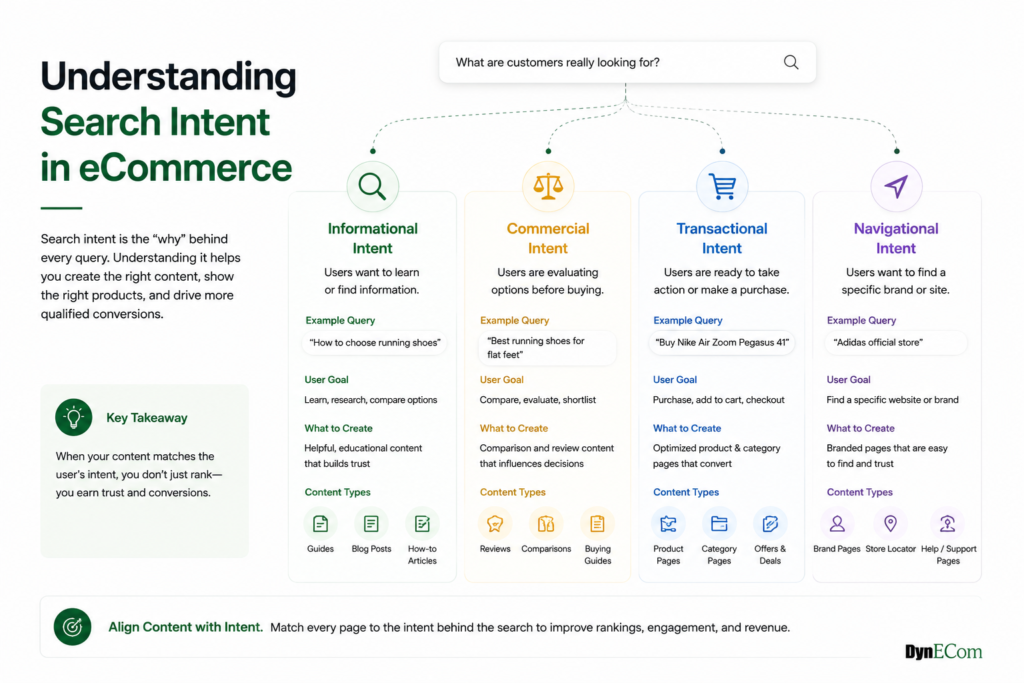
Search intent is the single most important factor in determining whether a piece of content will rank, convert, and generate revenue. It sounds simple in theory; give users what they are looking for, but in practice, eCommerce intent analysis is layered, nuanced, and frequently misunderstood.
The Four Intent Categories and Their eCommerce Applications
A. Informational Intent
Users want information. Examples:
- how to clean running shoes
- best laptops for students
- what is mechanical keyboard
Best content types:
- Blog posts
- Guides
- Tutorials
- Educational content
Informational intent encompasses queries where users seek knowledge rather than immediate purchase options. ‘How does mechanical keyboard actuation work?’ or ‘What is the difference between memory foam and latex mattresses?’ are informational queries. These users are not yet ready to buy, but they represent high-value future customers who can be captured through educational content and nurtured through the buying journey. The mistake many eCommerce brands make is creating blog content that answers these questions but fails to build any bridge toward their product catalog.
B. Commercial Investigation Intent
Users compare options before purchasing. Examples:
- Best wireless earbuds
- Shopify vs WooCommerce
- Top gaming chairs
Best content types:
- Comparison pages
- Buying guides
- Reviews
- Listicles
Commercial investigation intent is where most eCommerce revenue opportunity lies. Queries like ‘best standing desks for home office’ or ‘Dyson vs Shark vacuum comparison’ signal users who are actively comparing options and approaching a purchase decision. These queries demand comparison content, curated product recommendations, and buying guides that help users make confident decisions. Brands that rank well for commercial investigation queries with high-quality comparison content enjoy some of the strongest conversion rates in organic search.
C. Transactional Intent
Users are ready to buy. Examples:
- buy standing desk online
- running shoes under $100
- office chair free shipping
Best content types:
- Product pages
- Category pages
- Collection pages
Transactional intent represents users ready to purchase. ‘Buy Nike Pegasus 41 size 10’ or ‘standing desk free shipping under $300’ are transactional queries that should be captured by optimized product and category pages. The mistake here is not having sufficiently specific landing pages for highly specific transactional queries, forcing users to sift through irrelevant results.
D. Navigational Intent
Users already know the brand, website, product, or destination they want and are trying to navigate directly to it. Examples:
- Nike official website
- Shopify pricing page
- ChatGPT login
- Canva templates
- LinkedIn company page
Best content types:
- Homepage
- Login pages
- Brand pages
- Product-specific landing pages
- Support pages
Navigational intent – users searching for a specific brand or website; matters for eCommerce in a different way. If your brand name produces confusing results, competitors rank above you for branded queries, or your category pages appear for competitor brand searches, you have a navigational SEO problem that requires immediate attention.
| Intent | Best Page Type | Primary KPI | Content Requirement |
|---|---|---|---|
| Informational | Guide, tutorial, glossary | Assisted conversions, internal clicks | Explain clearly and link to relevant category/product pages. |
| Commercial investigation | Buying guide, comparison page, category guide | Organic revenue, product clicks | Provide recommendations, criteria, comparisons, and FAQs. |
| Transactional | Product, category, collection | Conversion rate, revenue | Reduce friction and show price, availability, reviews, specs. |
| Navigational | Homepage, brand page, login/support | SERP control, branded CTR | Make brand destination clear and protect against competitors. |
| Local / availability | Store locator, local inventory page | Calls, directions, local orders | Show location, inventory, hours, pickup/shipping options. |
Intent Layering: The Advanced Concept
The most sophisticated eCommerce SEO practitioners understand that single queries often carry multiple intents simultaneously. The query ‘best protein powder for muscle gain’ is simultaneously informational (what ingredients work for muscle gain?), commercial investigation (which products are best?), and potentially transactional (ready to buy now). A page that satisfies all three layers; educational content, product comparison, and a clear purchase path, will systematically outperform pages that address only one intent dimension.
DynEcom’s intent mapping process begins by classifying every target keyword not just by primary intent category but by intent complexity – how many layers of need the query expresses. High-complexity queries require richer, more comprehensive page architectures. Low-complexity transactional queries require frictionless, conversion-optimized experiences with minimal distraction.
Q: How do I identify the search intent of a keyword?
A: The most reliable method is to analyze the actual search results for that keyword. If Google returns mostly blog posts and guides, the intent is informational. If it returns product and category pages, the intent is transactional. If it returns comparison articles and ‘best of’ lists, the intent is commercial investigation. Search results are Google’s interpretation of what users want-follow their lead.
5. eCommerce Keyword Research
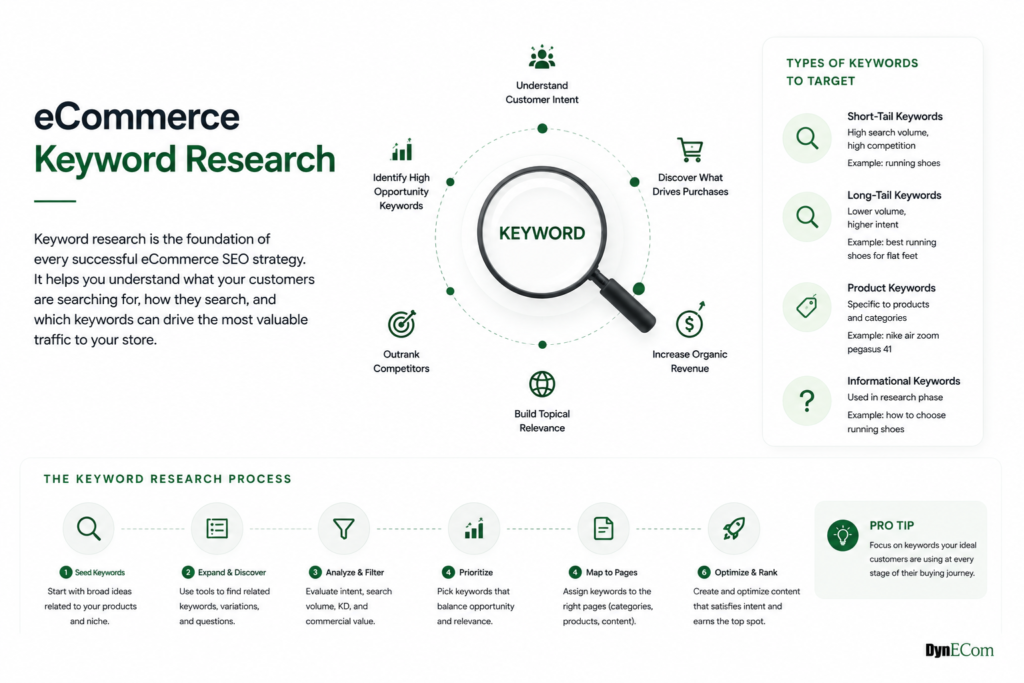
Keyword research for eCommerce is structurally different from keyword research for content publishers or lead generation sites. You are not just trying to attract traffic; you are trying to attract buyers at specific stages of the funnel, across potentially thousands of product categories and SKUs, while managing the practical reality that not every product page can have individually crafted keyword strategies without automation or systematic frameworks. The goal is to identify:
- High-volume keywords
- Commercial-intent searches
- Long-tail searches designed to precisely identify a specific product
- Low-competition gaps
- Product-specific queries
The Three-Tier Keyword Architecture
Effective eCommerce keyword research operates across three tiers. Tier one consists of broad commercial category keywords — ‘running shoes,’ ‘protein powder,’ ‘standing desk’ — that represent the highest search volumes and the strongest purchase intent at scale. These keywords should be targeted by your primary category pages. Competition is fierce, but ranking for even moderate positions generates substantial traffic.
Tier two encompasses subcategory and attribute-filtered keywords — ‘men’s trail running shoes,’ ‘vanilla whey protein powder,’ ‘height-adjustable standing desk with memory presets.’ These keywords have lower individual search volumes but collectively represent a much larger addressable audience, often with stronger purchase intent because the specificity signals the user knows exactly what they want. These keywords should be targeted by subcategory pages and well-constructed faceted navigation landing pages.
Tier three is the long-tail product-specific keyword universe — ‘Brooks Ghost 16 women’s wide width,’ ‘Optimum Nutrition Gold Standard Whey chocolate 5lb,’ ‘Flexispot E7 standing desk review.’ These queries have modest individual volumes but close to zero competition and the highest conversion rates. Product pages, product-specific buying guides, and comparison content capture this tier.
Competitive Gap Analysis
The most powerful keyword research technique for eCommerce is competitive gap analysis—identifying high-value keywords where competitors rank but your site does not. By analyzing the top three to five competitors in your category using tools like Ahrefs or Semrush, you can identify structural content gaps where market share is actively being lost. These gaps often reveal entire content categories—buying guides, comparison pages, use-case-specific landing pages—that competitors have built out and your site is missing entirely.
DynEcom’s keyword research process specifically prioritizes revenue-weighted gap analysis, identifying not just keywords competitors rank for, but keywords that drive measurable transaction volume based on commercial intent scoring and average order value estimation. This allows us to prioritize content investments that generate revenue, not just traffic.
At DynEcom, keyword research goes beyond search volume. We focus on identifying:
- High-converting transactional keywords
- Revenue-driving commercial intent searches
- AI-search opportunities
- Product-level long-tail keywords
- Category authority gaps
- Competitor keyword weaknesses
Our process combines SEO data, search intent analysis, conversion behavior, and AI visibility trends to build scalable content strategies that drive both rankings and revenue.
| Keyword Tier | Example | Target Page Type | Intent Strength | Competition |
|---|---|---|---|---|
| Tier 1 – Category | running shoes | Category page | Medium-High | Very High |
| Tier 2 – Subcategory | men’s trail running shoes | Subcategory / filtered page | High | Medium |
| Tier 3 – Long-tail product | Brooks Cascadia 17 trail shoe | Product page | Very High | Low |
| Commercial investigation | best trail running shoes 2026 | Buying guide | High | Medium |
| Problem-aware | running shoes for plantar fasciitis | Guide + category | High | Medium-Low |
6. Site Architecture for eCommerce
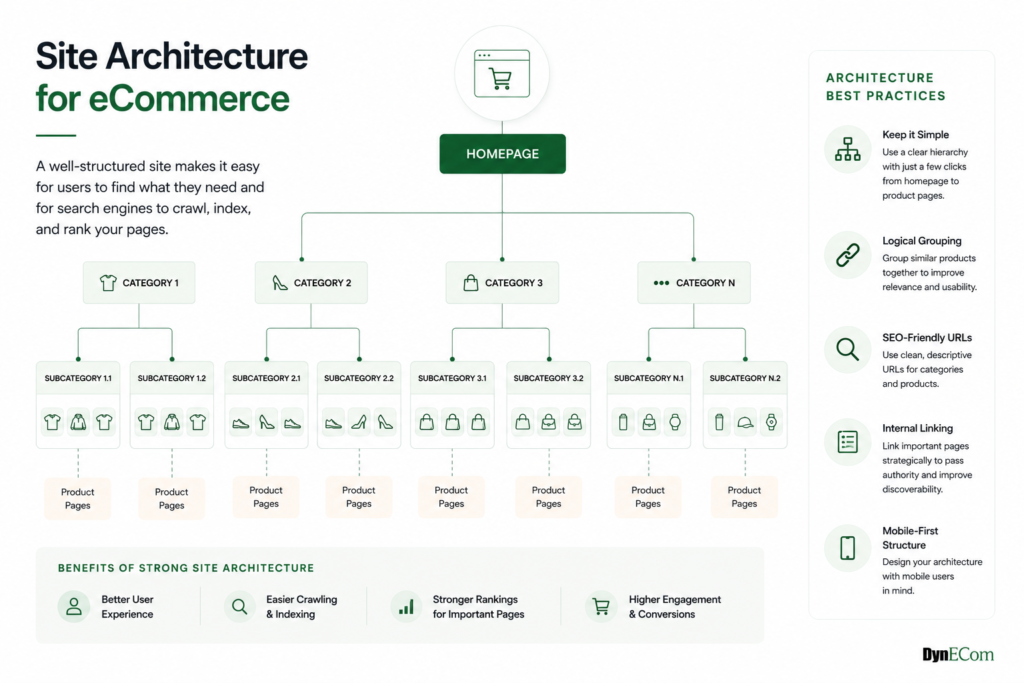
Site architecture is the skeletal framework upon which every other SEO investment depends. A well-designed architecture ensures that search engine crawlers discover every important page efficiently, that internal link equity flows purposefully toward high-value pages, that users navigate intuitively toward purchase, and that the site scales gracefully as product catalogs grow. Site architecture directly impacts:
- Crawlability
- Rankings
- Internal linking
- User experience
- Conversion rates
The fundamental principle of eCommerce site architecture is the flat hierarchy: every important page should be reachable from the homepage in as few clicks as possible. The industry standard recommendation is three clicks or fewer for product pages. Beyond three clicks, pages begin to receive significantly less crawl attention and accumulate less internal link equity; both of which suppress rankings.
Information Architecture (IA) is the foundation of every successful eCommerce website. It determines how products, categories, subcategories, and content are organized, connected, and discovered by both users and search engines.
A well-structured IA helps shoppers quickly find products, improves user experience, strengthens internal linking, distributes authority throughout the site, and enables search engines to crawl and index pages more efficiently.
For large eCommerce stores with thousands or even millions of products, Information Architecture becomes one of the most important SEO considerations. Even excellent content and strong backlinks can struggle to perform if the site’s architecture is confusing, fragmented, or difficult to navigate. An effective eCommerce architecture should prioritize:
- Logical organization of products and categories
- Scalability for future growth
- Easy navigation for users
- Efficient crawling and indexing
- Strong internal linking
- Clear topical relevance
- Minimal crawl waste
- Improved conversion paths
The Ideal eCommerce URL Architecture
A well-structured eCommerce URL hierarchy mirrors the logical product taxonomy:
- yourdomain.com → the homepage, targeting broad brand and category signals
- yourdomain.com/category/ → targeting high-volume category keywords
- yourdomain.com/category/subcategory/ → targeting attribute-specific keywords
- yourdomain.com/category/subcategory/product-name/ → individual product pages
This structure creates a clear topical hierarchy that search engines use to understand the relationship between content types and to allocate authority accordingly. Parent category pages inherit relevance signals from their subcategories and product pages, creating a natural topical clustering effect.
Why Architecture Matters
A poor structure can:
- Waste crawl budget
- Create duplicate pages
- Dilute authority
- Confuse users
Search engines use site architecture to understand:
- Which categories are most important
- How products relate to categories
- Topic relationships across the website
- Site hierarchy and authority distribution
- Crawl priorities
- User navigation pathways
A strong architecture provides numerous benefits:
- Improved Crawl Efficiency: Search engines have limited crawl resources. A well-organized architecture helps crawlers discover important pages quickly and reduces wasted crawl budget.
- Better Indexation: Pages that are properly linked and logically positioned within the site hierarchy are more likely to be indexed.
- Enhanced User Experience: Customers can find products faster, reducing frustration and improving conversion rates.
- Stronger Internal Authority Flow: Strategic architecture helps distribute link equity from high-authority pages to category, subcategory, and product pages.
- Increased Organic Visibility: Well-structured categories often rank better because search engines can clearly understand topical relevance and relationships.
Flat vs Deep Site Architecture
One of the most important decisions in eCommerce Information Architecture is whether the site follows a flat or deep structure.
What Is Flat Site Architecture?
A flat architecture minimizes the number of clicks required to reach any page on the website. Example:
Home
→ Category
→ Product
In this model, products are only a few clicks away from the homepage.
Advantages of Flat Architecture
- Improved Crawlability: Search engine bots can discover products more quickly.
- Faster Indexation: Pages closer to the homepage tend to get crawled and indexed more frequently.
- Better Link Equity Distribution: Authority flows more efficiently throughout the site.
- Improved User Experience: Customers reach products faster.
- Stronger Organic Performance: Important pages remain highly accessible.
Challenges of Flat Architecture
As product catalogs grow, maintaining a purely flat structure becomes difficult. For example:
- 20 products = easy
- 2,000 products = manageable
- 200,000 products = impossible
Large stores eventually require additional hierarchy layers.
What Is Deep Site Architecture?
A deep architecture introduces additional levels between the homepage and products. Example:
Home
→ Department
→ Category
→ Subcategory
→ Brand
→ Product
Advantages of Deep Architecture
- Better Organization: Useful for stores with extensive product catalogs.
- Improved Product Classification: Products can be grouped more precisely.
- Easier Inventory Management: Merchandising teams often prefer structured organization.
Challenges of Deep Architecture
- Increased Crawl Depth: Products become harder for search engines to discover.
- Reduced Authority Flow: Link equity weakens as pages move further from the homepage.
- Poor User Experience: Too many navigation steps can frustrate shoppers.
- Crawl Budget Inefficiencies: Search engines may spend resources crawling unnecessary levels.
Siloing and Topical Clustering for eCommerce
Advanced eCommerce architectures use a siloing approach where related product categories, supporting guides, and comparison content are grouped into thematic clusters. A fitness equipment brand might have a ‘Home Gym Equipment’ silo containing the category page, subcategory pages for treadmills, dumbbells, and resistance bands, plus supporting content like ‘How to Build a Home Gym on a Budget’ and ‘Best Home Gym Equipment for Small Spaces.’ These pieces interlink extensively, creating a topical cluster that signals deep expertise in the subject area.
The practical effect of proper siloing is that the entire cluster tends to rank better collectively than individual pages would rank in isolation. Google’s understanding of topical authority has become sophisticated enough to reward sites that demonstrate comprehensive, well-organized expertise in a subject area—not just individual pages with high keyword density. A strong structure improves:
- Rankings
- Indexation
- Navigation
- Revenue per session
Information Architecture Best Practices Checklist
- Keep important pages within 3–4 clicks of the homepage
- Build a scalable category hierarchy
- Organize products based on user behavior and search demand
- Use faceted navigation carefully
- Prevent crawl waste from filter combinations
- Implement breadcrumbs across all category and product pages
- Create strong contextual internal links
- Eliminate orphan pages
- Monitor crawl depth regularly
- Align architecture with both user experience and SEO goals
A well-designed Information Architecture serves as the blueprint for sustainable eCommerce growth. It improves discoverability, strengthens rankings, enhances user experience, and creates a scalable framework capable of supporting thousands or even millions of products while maintaining strong organic search performance.
| Common Mistake Many eCommerce sites undermine their architecture by placing products in multiple categories (creating duplicate URL issues), using session-based URL parameters that generate millions of unique URL variants, or allowing faceted navigation to create unintended thin-content pages. These issues erode crawl budget and dilute the authority that proper architecture is designed to concentrate. |
7. Product Page SEO: From Catalog Entry to Revenue Engine
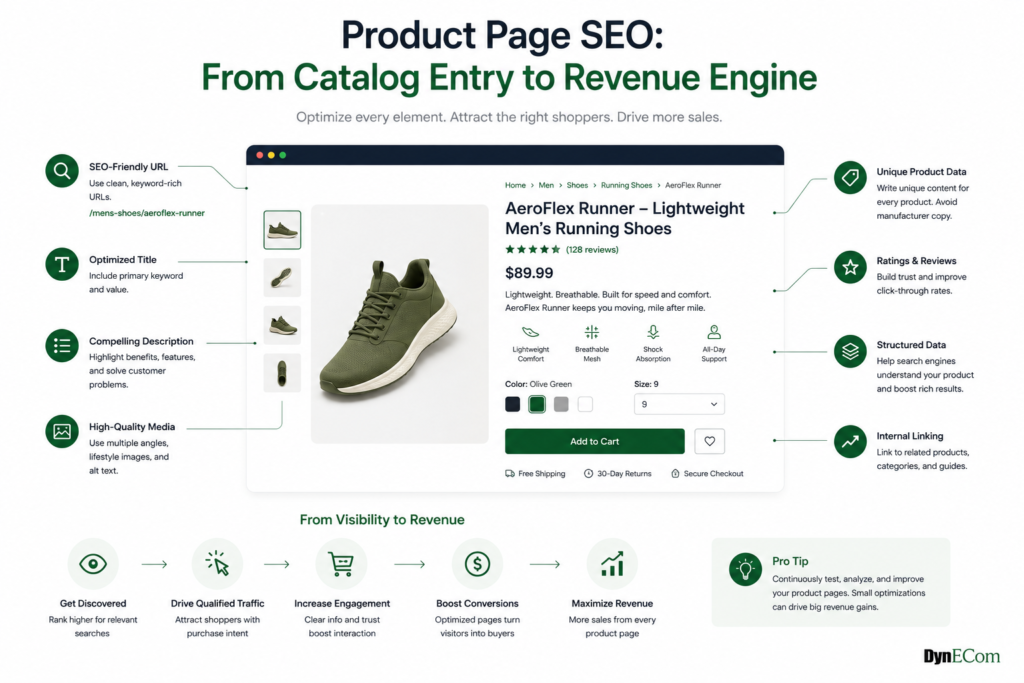
Product pages are the revenue engine of an eCommerce website. A properly optimized product page should satisfy:
- Search intent
- User experience
- Technical SEO
- Conversion optimization
Product pages are the highest-stakes real estate on an eCommerce website. They are simultaneously the final destination for purchase-intent traffic, the primary content consumed by product-researching users, the pages that AI systems most frequently reference when generating product recommendations, and the pages that directly generate revenue. Yet the vast majority of eCommerce sites treat them as simple catalog entries—a title, a price, a few bullet points copied from the manufacturer, and a photo.
This represents one of the largest untapped opportunities in modern eCommerce. A product page that is genuinely engineered to rank, convert, and surface in AI-generated recommendations is not just a better marketing asset—it is a structural competitive advantage that compounds over time.
The Architecture of a High-Performing Product Page
Every element of a product page exists in a functional relationship with both search algorithms and human psychology. Understanding this dual audience—machines and buyers—is the foundation of effective product page optimization.
A. Optimized Product Titles
The product title is the most semantically important element on the page. It serves as the primary signal for keyword relevance, the first text users read, and a critical component in how AI systems categorize and recommend the product. An effective product title balances three requirements: keyword targeting (what terms do buyers search?), descriptive clarity (what is this product specifically?), and differentiating attributes (what makes this product distinct?).
A title like ‘Nike Air Zoom Pegasus 41 Men’s Running Shoe – Wide Width, Breathable Mesh, React Foam Cushioning’ performs dramatically better than ‘Nike Men’s Shoe’ because it captures multiple search intents simultaneously, communicates product specifics that reduce uncertainty, and provides AI systems with rich categorical and attribute signals for classification.
B. Unique, Semantically Rich Product Descriptions
The single most costly mistake in eCommerce SEO is the widespread use of manufacturer-provided product descriptions. Across large product catalogs, this practice creates massive duplicate content problems, as identical descriptions appear on dozens or hundreds of retailer websites. Search engines identify this duplication quickly and decline to rank pages that offer no original value.
Beyond the duplicate content problem, manufacturer descriptions are written to serve distribution catalogs, not consumer buying decisions. They list specifications without explaining benefits, use technical language without consumer-friendly translation, and miss entirely the questions that drive real purchase decisions: ‘Is this comfortable for someone with wide feet?’ ‘Will this blender handle frozen fruits without overheating?’ ‘How does this compare to the model it replaced?’
Effective product descriptions function as mini buying guides. They translate specifications into benefits, anticipate and answer purchase objections, contextualize the product within specific use cases, and create the kind of semantic richness that search engines use to match pages with long-tail query variations. A 300-word description for a standing desk might naturally incorporate semantic variants like ‘height-adjustable desk,’ ‘sit-stand workstation,’ ‘ergonomic desk for back pain,’ and ‘home office desk with memory settings’—not through keyword stuffing, but through genuinely comprehensive product explanation.
Mini Case Study: Sporting Goods Retailer
A mid-sized sporting goods retailer came to DynEcom with a catalog of 11,000 SKUs, all using manufacturer descriptions. Organic product page visibility was minimal—less than 8% of product pages received any organic clicks in a 90-day period. The technical SEO foundation was adequate; the content was the problem.
DynEcom implemented a three-phase product content strategy. In phase one, we prioritized the top 500 revenue-driving SKUs and created comprehensive product descriptions combining benefits language, semantic variants, use-case scenarios, and FAQ sections addressing the most common pre-purchase questions. In phase two, we scaled this approach across 3,000 additional products using a combination of DynEcom’s semantic content framework and structured content production workflows. In phase three, we implemented automated review content integration to expand the living semantic footprint of each page.
After 6 months, the retailer saw a 94% increase in organic product page clicks, a 23% improvement in product page conversion rates, and a 67% expansion in the number of keywords for which product pages ranked in the top 20 positions.
C. Trust and Conversion Signals on Product Pages
SEO and conversion optimization are not separate disciplines on product pages—they are deeply intertwined. The same content elements that help pages rank also help buyers convert. Reviews, detailed specifications, comparison tables, FAQ sections, and expert-written product insights all increase dwell time and engagement signals that search algorithms interpret as quality indicators. They also reduce the friction and uncertainty that prevent purchases.
User-generated content—particularly reviews—has a dual SEO value that is consistently underappreciated. Reviews naturally expand the semantic footprint of a product page with authentic buyer language that matches how real users search. A review mentioning ‘comfortable for wide feet after plantar fasciitis surgery’ captures a long-tail query that no keyword research tool would have identified as a target. At scale, a product page with 150 reviews has a living, expanding semantic presence that a static description can never match.
D. Product Schema Markup
Structured data is the bridge between the content a page contains and the structured understanding that search engines and AI systems build of that content. For eCommerce, Product schema markup is not optional—it is foundational infrastructure that enables rich snippet eligibility, powers Google Shopping integrations, improves AI system interpretation, and provides the machine-readable product data layer that increasingly determines how products are surfaced across the discovery ecosystem.
1. Essential Product Schema Properties
At minimum, every product page should implement Product schema with: name, description, image, offers (including price, currency, availability, and priceValidUntil), aggregateRating (if reviews exist), SKU, brand, and GTIN or MPN identifiers. Beyond this baseline, advanced implementations add breadcrumb schema for navigational context, FAQ schema for pre-purchase question content, and Review schema for individual customer testimonials.
The impact of complete schema implementation is measurable. Pages with Product schema and AggregateRating are eligible for review star annotations in search results, which consistently improve click-through rates by 15–30% on product queries. Offer schema with real-time pricing data improves eligibility for Google Shopping placements. BreadcrumbList schema helps users navigate directly to relevant category levels from search results.
2. Schema for AI Readability
| Schema Property | SEO Benefit | AI Benefit | Priority |
|---|---|---|---|
| Product name & description | Keyword relevance | Entity identification | Critical |
| Offer (price, availability) | Rich snippet eligibility | Real-time data | Critical |
| AggregateRating | Star rating in SERPs | Trust signal | High |
| Brand | Brand entity linking | Attribution accuracy | High |
| GTIN/MPN/SKU | Product identification | Cross-platform matching | High |
| Review | Individual review markup | Sentiment data | Medium |
| BreadcrumbList | Navigation in SERPs | Hierarchy context | Medium |
| FAQ | FAQ rich results | Q&A training signal | Medium-High |
Beyond traditional rich snippet benefits, structured data is increasingly important for AI system interpretation. When ChatGPT, Perplexity, and Google AI Overviews analyze a product page to generate recommendations, well-implemented structured data provides a clean, unambiguous machine-readable layer that supplements the natural language content. Products with complete, accurate structured data are more likely to be correctly categorized, attributed, and recommended by AI systems.
E. AI-Readable Product Content
Creating content that performs well in AI-generated search experiences requires understanding how large language models process and evaluate web content. This is a relatively new discipline, but the principles are becoming clearer as practitioners accumulate data on what types of content are cited in AI-generated answers versus what is ignored.
AI systems prefer content that is unambiguous, clearly structured, and semantically dense. They struggle with content that is vague, heavily dependent on visual context, or that buries key information in complex sentence structures. For eCommerce product content, this means several specific optimization requirements.
The Four Pillars of AI-Readable Product Content
Declarative factual statements are the currency of AI-readable content. Instead of ‘This chair might help with comfort during long work sessions,’ write ‘This chair features lumbar support adjustable to three positions, reducing lower back strain during extended sitting periods.’ AI systems parse and cite specific, verifiable factual claims far more readily than vague benefit statements.
Comparative context is extremely valuable for AI citation. When your product content includes specific comparisons—how your product differs from the previous model, how it compares to the category standard, what it does better or differently than the primary alternative—AI systems can incorporate that comparative context directly into the buying recommendations they generate. A product description that includes ‘The 2026 model adds active noise cancellation and extends battery life from 20 to 36 hours compared to its predecessor’ gives an AI system the specific comparative data points it needs to recommend the product confidently in response to a query like ‘what’s new in the latest Sony headphones.’
Structured question-and-answer content is one of the most direct ways to optimize for AI search inclusion. AI systems are trained on conversational question-answer pairs and are naturally biased toward citing content that is already structured in this format. FAQ sections on product pages that answer specific pre-purchase questions—’Is this compatible with both Mac and Windows?’ ‘What is the weight capacity?’ ‘Does it come with a warranty?’—create an AI-citation-ready content layer on every product page.
Entity disambiguation ensures that AI systems correctly identify and attribute your products. Using your brand name, product line name, and product model name consistently and explicitly throughout content—rather than relying on pronouns or generic references—reduces the risk of misattribution or omission when AI systems synthesize multi-source recommendations.
F. Semantic Product Optimization
Semantic SEO represents one of the most significant evolutions in search optimization over the past five years, and it has profoundly practical implications for eCommerce product content. At its core, semantic optimization recognizes that search engines no longer operate as keyword-matching systems—they operate as meaning-matching systems that understand conceptual relationships, user intent, and topical context.
For product pages, semantic optimization means building content that establishes comprehensive conceptual coverage of the product’s relevant topic space, not just targeting a primary keyword. A product page for a mechanical keyboard should semantically cover typing experience, switch types, actuation force, sound profiles, programmability, compatibility, use cases (gaming vs. typing vs. programming), and comparison with membrane keyboards. A page that covers all these concepts—not through keyword stuffing but through genuine, useful explanation—will rank for hundreds of related queries that a keyword-only optimized page would miss entirely.
1. Entity-Based Semantic Optimization
Google’s Knowledge Graph and the underlying entity framework it represents have transformed how semantic relevance is established. Products, brands, attributes, and use cases are all represented as entities with defined relationships. An ergonomic office chair is an entity with properties (lumbar support, adjustable armrests, seat depth), relationships (manufactured by [brand], reviewed by [publication], used by [occupation type]), and contextual associations (home office, back pain relief, long work hours).
Optimizing a product page for entity recognition means ensuring that all relevant entities and their relationships are clearly expressed in the content—in the product description, in the specifications, in FAQs, and in the structured data markup. A product page that clearly establishes entity relationships is more likely to be understood, ranked, and cited correctly by both traditional search engines and AI systems.
2. The Semantic Expansion Framework
DynEcom uses a systematic semantic expansion process for product content optimization. For each product, we identify the primary entity (the product itself), then map the complete semantic neighborhood: related product categories, key attributes and their variants, use cases and user personas, comparative alternatives, supporting accessories, and common questions and objections. This semantic map guides content creation, ensuring that product pages achieve comprehensive coverage of the conceptual space that buyers actually navigate when researching a purchase.
G. Competitive Content Methodology
One of the most powerful frameworks in DynEcom’s eCommerce SEO approach is competitive content engineering—a systematic process of analyzing what content competitors are producing, identifying where their coverage is shallow or missing, and building content that is demonstrably more comprehensive, more authoritative, and more useful.
This methodology starts with a detailed content audit of the top-ranking pages for every target keyword. Rather than simply noting what topics competitors cover, we assess the depth of coverage, the quality of the explanation, the semantic breadth, the structural completeness, and the conversion effectiveness. This analysis reveals systematic gaps that represent ranking opportunities.
A typical competitive content analysis for a product category might reveal that all competing pages describe product specifications in technical terms but none translate those specifications into specific use-case benefits. Or that all competitors have buying guides but none address the specific concerns of a high-value niche within the category—say, standing desks for users with chronic back conditions. These gaps represent content opportunities where a well-constructed page can achieve top rankings within 90 to 180 days because competition is structurally weak at that level of specificity and depth.
The Content Superiority Test
Before publishing any piece of eCommerce content, DynEcom applies the Content Superiority Test: can you identify at least five specific ways in which this content is more valuable to the target user than the current top-ranking page? If you cannot articulate five concrete superiority dimensions, the content is not ready to rank. This discipline prevents the common mistake of creating content that is ‘good enough’ rather than genuinely better, which rarely achieves meaningful ranking improvements in competitive categories.
How DynEcom Optimizes Product Pages
Product pages are one of DynEcom’s core specialties. We help brands transform underperforming product pages into high-converting SEO assets by improving:
- Product titles
- Product descriptions
- AI-readable product content
- Internal linking
- Product schema markup
- Competitive Content Methodology
- Keyword targeting
- Semantic relevance
- Incorporate common customer product questions
- Overcome likely objections
- Include important site-level content
DynEcom’s optimization framework is designed not only to improve rankings, but also to increase conversion rates and revenue per visitor.
DynEcom steps beyond typical checklist optimization strategies and builds a competitive content approach. Competitive content pages are not built in a vacuum, but are designed to be more complete than other eCommerce sites. In this way, competitive content will ultimately be seen as a more authoritative site for a broader range of product queries.
8. Category Page SEO: The Revenue-Driving Powerhouse
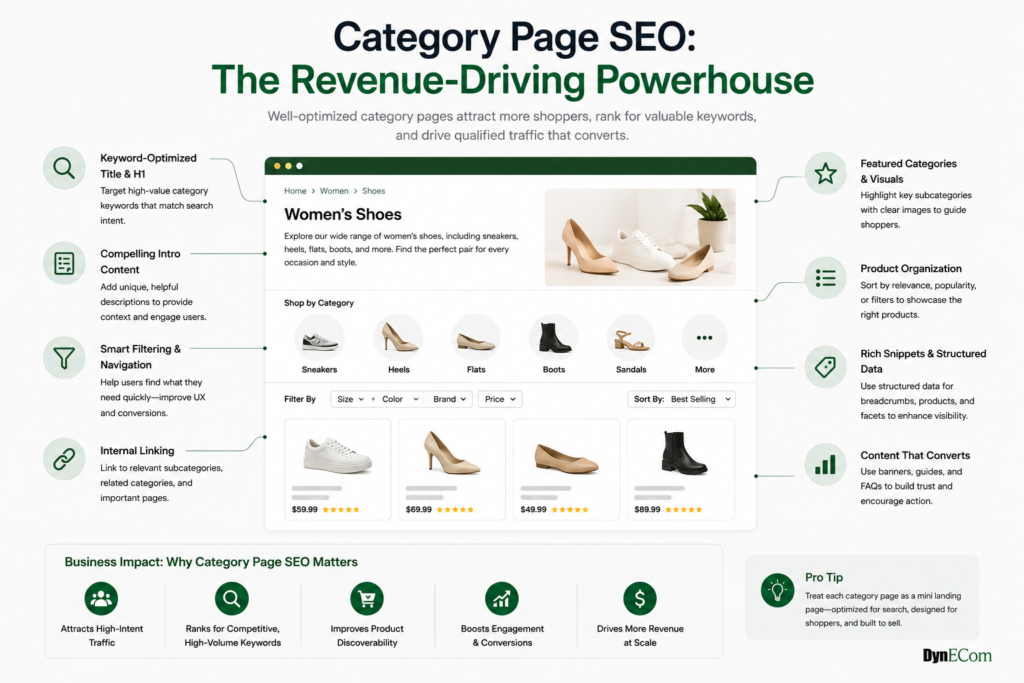
Category pages occupy a unique strategic position in eCommerce SEO. They typically target the highest-volume commercial keywords in an online store’s keyword universe, they serve as the primary entry point for broad-intent buyers who are browsing rather than searching for a specific product, and they function as the primary authority-passing hub that distributes link equity to individual product pages. Yet category pages are consistently among the most neglected pages on eCommerce sites.
The neglect typically manifests in two ways: thin or absent editorial content, and poorly managed faceted navigation that creates technical SEO complications. Both issues are solvable with systematic optimization.
Category Page Content Architecture
A high-performing category page is not simply a product grid with a headline. It is a structured content experience that serves multiple simultaneous purposes: educating buyers who are early in their research, helping buyers narrow their choices through useful guidance, surfacing the strongest product options, and establishing topical authority signals that help the page rank.
The content architecture of an optimized category page should include: an introductory section that defines the category, explains its key variants, and addresses common buyer questions (300–500 words, strategically placed either above or below the product grid depending on UX testing); a structured product grid with rich filtering options; buying guidance content that helps users identify the right product for their specific needs; and FAQ content addressing the most common category-level questions.
The introductory content is the most controversial element of category page SEO, because it introduces a perceived tension between SEO requirements and UX. Some brands worry that placing text above the product grid will impede users who just want to browse products. The resolution is user testing; measure engagement and conversion with text above versus below the fold and optimize based on actual user behavior rather than assumptions. Many brands find that contextual, genuinely useful category introductions actually improve conversion rates by setting expectations and reducing bounce—particularly for categories with complex buying decisions.
Category Pages and Commercial Investigation Queries
The highest-value evolution of category page strategy is optimizing category pages to capture commercial investigation queries—’best standing desks,’ ‘top protein powders for muscle gain,’ ‘most comfortable office chairs under $500.’ These queries traditionally drive traffic to third-party review sites and buying guides, but eCommerce brands can capture them directly by building category pages that include genuine buying guidance content, expert recommendations, and comparison frameworks alongside the product grid.
Category pages are often the most powerful pages on large eCommerce websites. These pages typically target high-volume commercial keywords. Examples:
- Running shoes
- Protein powder
- Gaming laptops
- Office desks
| DynEcom Case Study Snapshot A home office furniture brand had a ‘Standing Desks’ category page with minimal introductory text and no buying guidance. The page ranked #14 for ‘standing desks’ and captured negligible traffic from commercial investigation queries. DynEcom rebuilt the page architecture with a comprehensive buying guide section, an expert recommendation framework, FAQ content, and optimized internal linking from supporting blog content. Within 5 months, the page ranked #4 for ‘standing desks’ and began ranking in the top 10 for 14 commercial investigation variants. Organic revenue from the page increased by 218%. |
9. Internal Linking Strategies for eCommerce
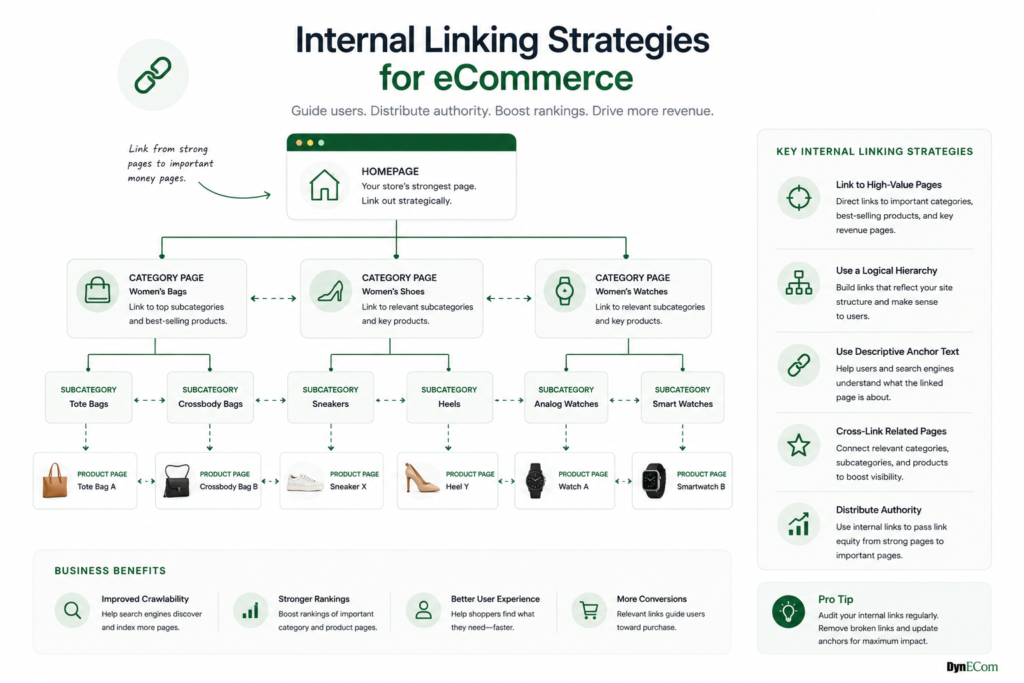
Internal linking is the most consistently underutilized eCommerce SEO lever. Unlike external link building—which depends on third-party cooperation, is expensive, and takes months to produce results—internal linking is entirely within your control, costs nothing, and can begin influencing rankings within weeks. Yet most eCommerce sites have chaotic, ad-hoc internal link structures that waste enormous amounts of the link equity they have already earned. It helps:
- Distribute authority
- Improve crawlability
- Strengthen topical relevance
- Increase page discovery
The purpose of internal linking is threefold: to help search engines discover and understand the relationship between pages; to distribute link equity (authority) from high-authority pages to pages that need ranking boosts; and to guide users toward higher purchase probability through strategic navigation.
The Hub-and-Spoke Internal Link Model
The most effective internal linking architecture for eCommerce is the hub-and-spoke model. Category pages serve as hubs, receiving internal links from supporting content (buying guides, comparison articles, informational blog posts) and distributing authority to subcategory and product pages. Product pages link back to their parent categories and to related products. Supporting content links to the most relevant category and product pages.
This circular architecture creates a self-reinforcing authority ecosystem where high-traffic informational content passes equity to commercial pages, commercial pages receive the authority they need to rank for competitive queries, and product pages benefit from both direct category authority and supporting content equity.
Example Internal Linking Structure
| Source Page | Destination |
|---|---|
| Buying guide | Category page |
| Blog post | Product page |
| Category page | Subcategory |
| Product page | Related products |
Anchor Text Strategy for eCommerce
Anchor text—the clickable text used in internal links—is a significant relevance signal that most eCommerce sites manage poorly. Generic anchor text like ‘click here,’ ‘learn more,’ or ‘shop now’ wastes an opportunity to pass topical relevance signals. Descriptive, keyword-rich anchor text like ‘shop ergonomic standing desks,’ ‘browse men’s trail running shoes,’ or ‘compare mechanical keyboards’ reinforces the topical relevance of the destination page for the linked keyword. The best practice is to maintain an anchor text map—a structured document specifying the preferred anchor text for each key page—and enforce consistency across all internal links. When blog content, product descriptions, and category pages all use consistent, descriptive anchor text pointing to the same destination pages, the cumulative relevance signal is substantially stronger than inconsistent linking.
10. Technical SEO for eCommerce
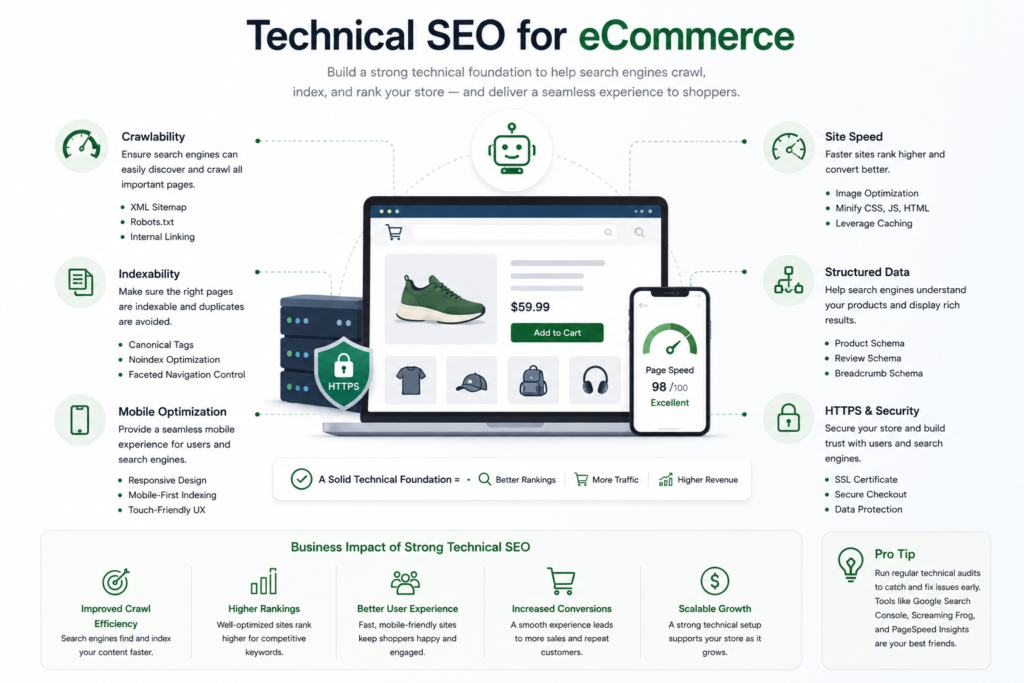
Technical SEO is the infrastructure layer that determines how efficiently search engines can discover, crawl, interpret, and index your content. For large eCommerce sites with thousands or millions of pages, technical SEO is not just important; it is the foundation upon which all content and authority investments depend. A site with brilliant product content and strong backlink profiles that is technically broken will still underperform a technically sound site with average content.
Large eCommerce websites often face technical issues due to:
- Massive URL counts
- Product variations
- Pagination
- Inventory changes
- Dynamic rendering
Issue Prioritization Matrix
| Issue | Business Risk | Priority | First Diagnostic |
|---|---|---|---|
| Important pages not indexed | Revenue loss | Critical | GSC indexing + sitemap comparison. |
| Faceted URL bloat | Crawl waste and duplicate content | Critical | Crawl parameter URLs and indexation counts. |
| Incorrect canonicals | Authority dilution | High | Canonical report by page type. |
| JavaScript-rendered links missing | Discovery failure | High | Rendered HTML crawl. |
| Product schema missing | Rich result and entity loss | Medium-high | Schema validation by template. |
| Slow PDP LCP | Lower UX and conversion | Medium-high | PageSpeed template sample. |
| Duplicate descriptions | Weak product rankings | Medium | Content duplicate audit. |
Canonical Tag Implementation
Canonical tags are the primary mechanism for managing duplicate content on eCommerce sites. Every eCommerce platform generates content duplication in some form—product pages accessible through multiple category paths, filtered pages with identical content to parent category pages, sorting and pagination variants of category pages, and print or mobile variants of core pages. Canonical tags tell search engines which version of a page to index and attribute link equity to, preventing dilution across duplicate variants.
The most common canonical tag mistake on eCommerce sites is inconsistent implementation—some pages have correct canonicals, others are missing, and some have self-referential canonicals that contradict URL parameter configurations. A canonical audit should be one of the first actions in any technical SEO engagement.
XML Sitemap Architecture
XML sitemaps are the roadmap you provide to search engines for discovering your content. For large eCommerce catalogs, sitemap architecture matters significantly. Best practice is to use indexed sitemaps with separate child sitemaps for different page types—products, categories, blog content, brand pages—allowing search engines to process them independently and allowing you to identify indexation issues by page type.
Critically, XML sitemaps should include only pages you want indexed. Including thin, low-value, or duplicate pages in your sitemap signals to search engines that you consider these pages canonical and index-worthy, which can backfire by drawing crawl attention to problematic pages. Regularly audit sitemaps to ensure they reflect your current indexation strategy.
Slow Site Speed
Site speed is a critical factor for both search engine optimization and user experience. When a website takes too long to load, visitors are more likely to leave before interacting with the content, resulting in lost traffic, leads, and sales opportunities. A slow-loading website can negatively impact:
- Search Engine Rankings: Search engines prioritize websites that provide a fast and seamless user experience. Slow page load times can limit crawl efficiency and contribute to lower rankings in search results.
- Bounce Rates: Users expect pages to load quickly. If a page takes too long to appear, visitors are more likely to abandon the site and return to search results, increasing bounce rates.
- Conversion Rates: Site speed has a direct impact on revenue and lead generation. Research consistently shows that even small delays in page load time can lead to fewer purchases, form submissions, and inquiries.
- User Satisfaction and Engagement: Fast websites create a smoother browsing experience, encouraging users to explore more pages, spend more time on the site, and engage with content.
Even a one-second delay in page load time can significantly reduce conversions and customer satisfaction. As page load times increase, the likelihood of visitors leaving the site rises dramatically. Optimizing images, reducing unnecessary scripts, leveraging browser caching, and improving server performance can help create a faster, more user-friendly website that supports stronger SEO and business results.
Duplicate Content
Duplicate content occurs when the same or very similar content appears on multiple URLs within a website. This is a common issue for eCommerce websites and can make it difficult for search engines to determine which version of a page should be indexed and ranked. As a result, ranking signals may be diluted across multiple URLs, reducing the visibility of important pages in search results. Duplicate content commonly occurs due to:
- Product Variants: Separate URLs for different sizes, colors, styles, or configurations of the same product can create multiple pages with nearly identical content.
- Filter URLs: Faceted navigation and filtering options (such as brand, color, price range, or category filters) often generate numerous URL variations containing the same core products and content.
- Session Parameters: Tracking parameters, session IDs, and marketing tags can create duplicate versions of the same page that search engines may crawl and index.
- Sorting Pages: URLs generated by sorting products by price, popularity, ratings, or newest arrivals can produce multiple versions of the same category page.
When duplicate content is not properly managed, search engines may waste crawl budget on redundant pages, struggle to identify the preferred version of a page, and distribute ranking authority across multiple URLs instead of consolidating it into a single page.
To address duplicate content issues, website owners should implement strategies such as canonical tags, proper URL parameter handling, pagination best practices, and consistent internal linking. These measures help search engines understand the primary version of a page and ensure that ranking signals are consolidated effectively, improving overall SEO performance.
Content that is provided by product manufacturers that is identical across numerous websites is another form of duplicate content. While this shouldn’t hurt or confuse the search engines, it offers no organic benefit. If traditional search engines see the same content, all things being equal, they are likely to prioritize the site that originated the content.
Technical SEO Tools
| Tool | Use Case |
|---|---|
| Screaming Frog | Site crawling |
| Sitebulb | Technical audits |
| PageSpeed Insights | Performance analysis |
| GTmetrix | Speed diagnostics |
Traditional SEO vs GEO Strategy
| Traditional SEO | GEO Strategy |
|---|---|
| Focus on keywords | Focus on entities |
| Optimize for clicks | Optimize for mentions |
| SERP rankings | AI inclusion |
| Backlinks | Topical authority |
11. Crawl Budget Optimization
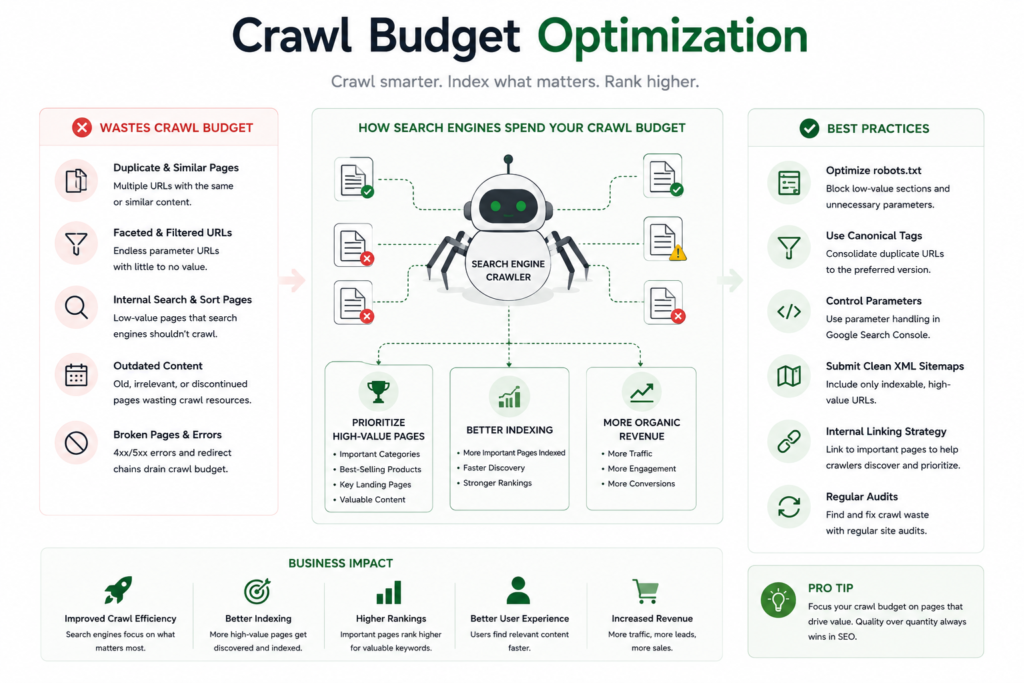
Crawl budget is the number of pages Googlebot will crawl on your site within a given time period. For small eCommerce sites with a few hundred pages, crawl budget is rarely a concern. For large eCommerce sites with tens of thousands of products, faceted navigation, and pagination, crawl budget management is a critical discipline that directly affects how quickly new and updated pages get indexed.
The primary crawl budget drain on eCommerce sites is URL proliferation—the generation of enormous numbers of unique or near-unique URLs through faceted navigation, session parameters, sorting options, pagination, and product variants. A site with 10,000 products and five common filter combinations can easily generate 50,000+ URLs, most with little or no search value. Googlebot wastes crawl resources on these low-value pages, leaving less budget for the high-value product and category pages you actually need indexed.
Crawl Budget Management Tactics
Consolidating URL variants through proper canonical tags, blocking parameter-generated URLs in robots.txt, and eliminating session ID parameters from URLs are the primary mechanisms for recovering crawl budget. Additionally, improving site speed reduces the crawl demand per page visit, effectively expanding the number of pages Googlebot can process in a given crawl session. A technically sound site that loads in under one second can be crawled approximately three times more efficiently than a slow site that takes four seconds per page.
Google allocates limited crawl resources. If your site generates millions of unnecessary URLs, important pages may not get crawled efficiently.
Solutions
- XML sitemaps
- Robots.txt management
- Canonical tags
- Proper faceted navigation
12. Faceted Navigation SEO
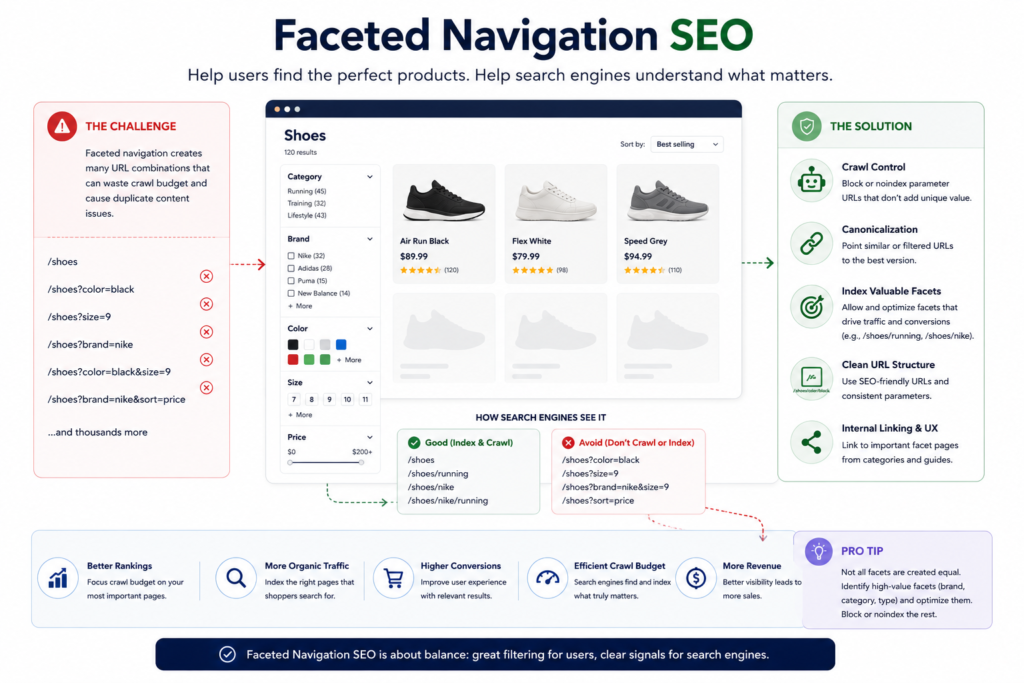
Faceted navigation – the filter systems that allow users to narrow product selections by attributes like size, color, brand, price range, and material; is one of the most technically complex challenges in eCommerce SEO. Implemented without careful SEO consideration, faceted navigation can generate hundreds of thousands of unique URL variants from a catalog of a few thousand products, overwhelming crawl budgets, creating massive duplicate content, and diluting the authority of legitimate category pages.
The fundamental challenge is that not all facet combinations are equal from an SEO perspective. Some combinations have genuine search demand – ‘red women’s running shoes’ or ‘white office chairs under $200’ – and deserve to be indexable landing pages with optimized content. Others – ‘blue, green, and red office chairs, size medium, priced between $150 and $175, in stock only’ – have no search demand and should never be indexed.
Understanding Faceted Navigation
Faceted navigation refers to a system that allows users to refine product listings based on multiple attributes. For example, a customer browsing running shoes may apply filters such as:
- Brand: Nike
- Gender: Men’s
- Color: Black
- Size: 10
- Price: Under $150
The resulting URL might look something like:
/running-shoes?brand=nike&gender=mens&color=black&size=10&price=under150
From a user perspective, this creates a highly personalized shopping experience. From an SEO perspective, however, every filter combination may represent a separate crawlable URL containing largely the same products and content. Search engines must determine:
- Which URLs deserve indexing
- Which URLs should be crawled but not indexed
- Which URLs should be ignored entirely
- Which URLs create duplicate content risks
Proper faceted navigation SEO focuses on answering these questions at scale.
The Three-Tier Faceted Navigation Strategy
DynEcom implements a three-tier approach to faceted navigation management. Tier one is indexable facet pages: these are facet combinations with demonstrated search demand, optimized with unique content, proper canonical tags, and inclusion in the XML sitemap. Examples include major attribute filters like brand, primary color, and size category. Tier two is crawlable but non-indexed pages: facet combinations that may be useful for internal navigation and crawling but lack sufficient unique content or search demand to justify indexing. These pages receive noindex tags while remaining crawlable. Tier three is blocked facet combinations: complex multi-attribute combinations with no search value are blocked entirely via robots.txt or parameter handling in Google Search Console.
Implementing this framework correctly requires collaboration between SEO, development, and UX teams. The business impact of getting it right is substantial: brands that go from unmanaged faceted navigation to properly optimized facet pages consistently see 20–40% improvements in crawl efficiency and significant expansions in rankable landing page inventory for long-tail queries.
13. Core Web Vitals for eCommerce
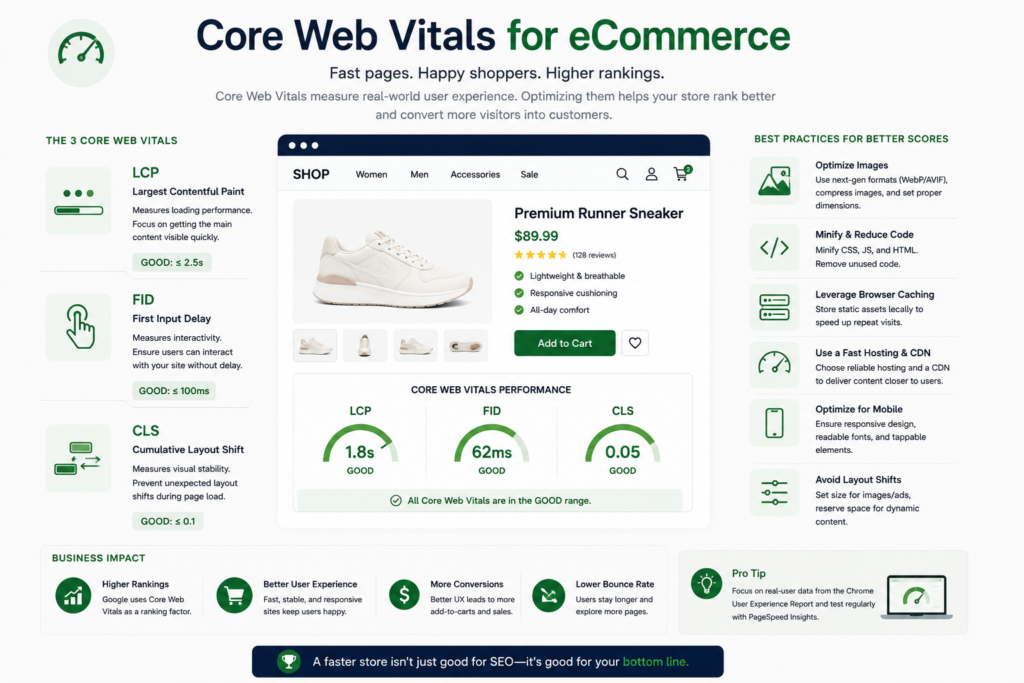
Core Web Vitals are Google’s standardized metrics for measuring the user experience quality of web pages. They directly influence search rankings through the Page Experience signal, and—more importantly from a business perspective—they have proven direct correlations with conversion rates. An eCommerce site with poor Core Web Vitals is simultaneously losing rankings and losing sales.
| Metric | What It Measures | Target | eCommerce Impact |
|---|---|---|---|
| LCP (Largest Contentful Paint) | Loading performance – time to main content | < 2.5 seconds | Directly correlates with bounce rate and purchase completion |
| INP (Interaction to Next Paint) | Responsiveness to user interaction | < 200ms | Affects add-to-cart, filter interaction, and checkout flow |
| CLS (Cumulative Layout Shift) | Visual stability during loading | < 0.1 | Layout shifts during checkout cause cart abandonment |
For eCommerce sites, LCP is often the most problematic metric because the largest contentful element is typically a hero image or product image that is large and unoptimized. Converting images to WebP or AVIF format, implementing lazy loading for below-fold images, and using a CDN for image delivery are the highest-impact LCP improvements for most eCommerce sites.
INP, which replaced FID (First Input Delay) as a Core Web Vital, measures how quickly a page responds to user interactions throughout the page lifecycle—not just on first load. For eCommerce sites with complex JavaScript-driven filtering, dynamic cart updates, and third-party widgets (review apps, chat tools, marketing overlays), INP is frequently the most difficult metric to improve and requires genuine JavaScript optimization work.
14. Content Marketing for eCommerce SEO
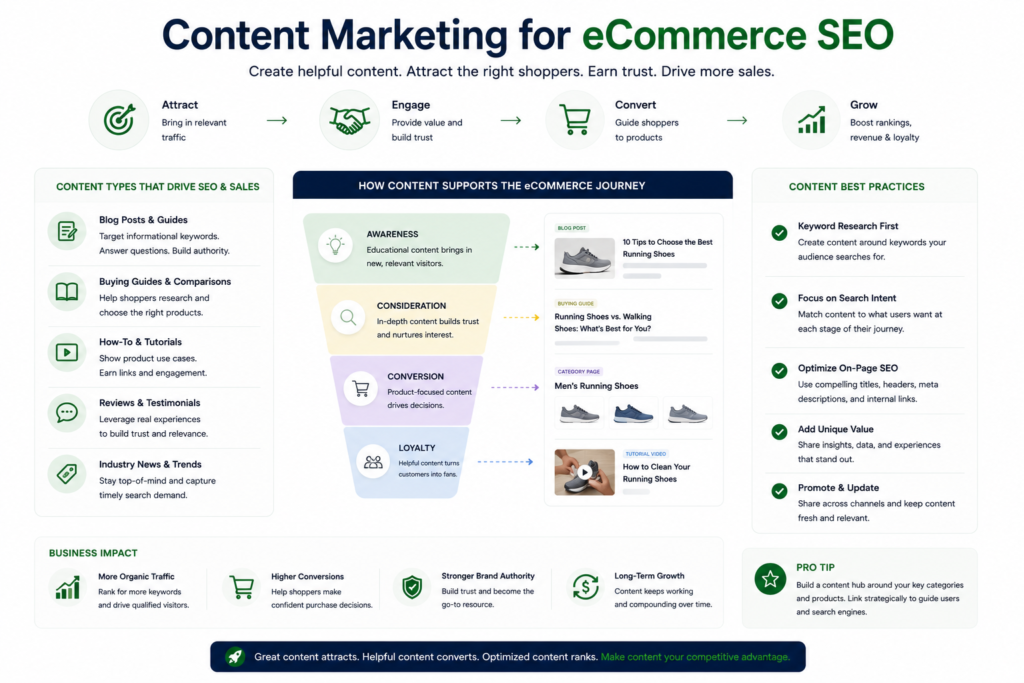
Content marketing and eCommerce SEO are often treated as separate disciplines—content marketing as a brand awareness tool and SEO as a revenue channel. This separation is a strategic mistake. When content is designed with commercial intent in mind, it serves simultaneously as topical authority building, long-tail keyword capture, AI citation opportunity, internal link infrastructure, and organic traffic acquisition—all driving measurable impact on product discovery and revenue.
Buying Guides as Category Authority Assets
Buying guides are the most powerful content type for commercial keyword capture. A comprehensive guide titled ‘How to Choose the Right Standing Desk: The Complete Buyer’s Guide’ can rank for dozens of commercial investigation queries, establish topical authority for the entire standing desk category, and drive buying-intent traffic directly to category and product pages through strategic internal linking. When a user arrives at the buying guide from a query like ‘how to choose a standing desk,’ reads the guide, clicks through to the recommended products, and converts—that buying guide generated direct revenue.
The key to effective buying guide content is genuine buying expertise. A guide that simply lists product features without helping users make decisions is a commodity. A guide that explains what specific attributes matter for different use cases, warns against common buying mistakes, and provides specific product recommendations based on budget and needs criteria is the kind of resource that earns backlinks, generates social sharing, and captures citations in AI-generated answers.
Comparison Pages as Commercial Intent Magnets
Comparison pages—'[Product A] vs. [Product B]’—capture users at the final stage of purchase deliberation. Someone searching ‘Herman Miller Aeron vs. Steelcase Leap’ is likely 24 to 72 hours away from a purchase decision. A well-constructed comparison page that provides genuinely useful comparative analysis positions your brand as a trusted advisor and naturally routes users toward the product that fits their needs—which you can sell.
15. Platform-Specific SEO
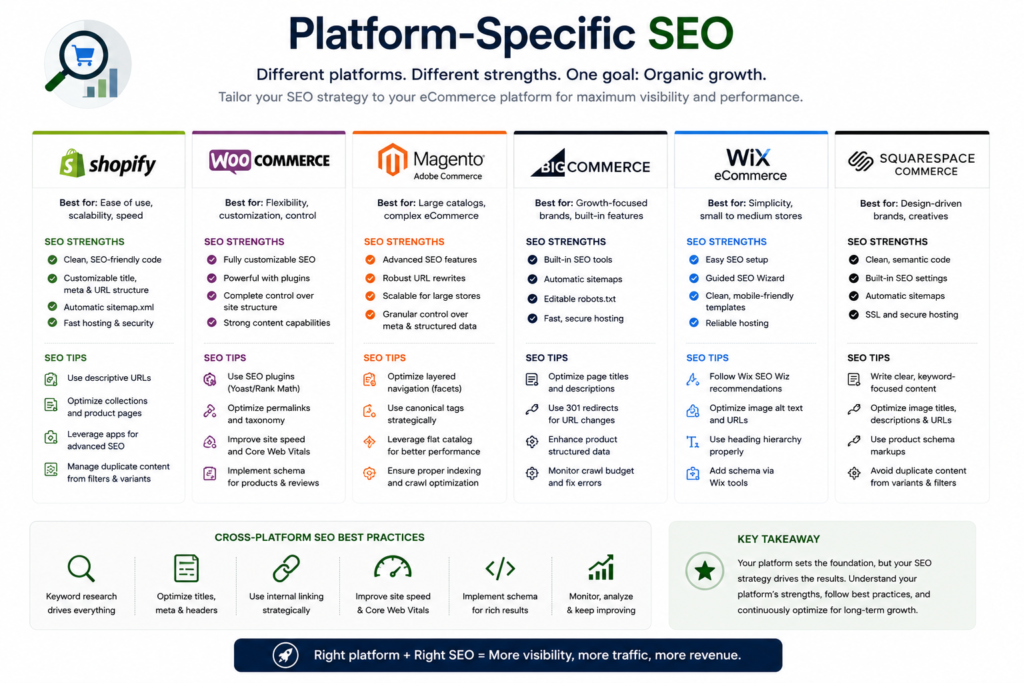
Shopify SEO Optimization
Shopify is the dominant eCommerce platform by merchant count, and its SEO characteristics are well-understood. While Shopify provides a fundamentally sound technical foundation—clean URL structures, automatic XML sitemap generation, and CDN delivery—it has specific limitations and quirks that require platform-aware optimization strategies.
A. The Duplicate URL Problem
Shopify’s most significant SEO limitation is its URL structure for product pages accessed through collections. When a product belongs to multiple collections, Shopify creates multiple accessible URLs: /products/product-name/ (the canonical product URL) and /collections/category-name/products/product-name/ (the collection-contextualized URL). Shopify does implement canonical tags pointing to the /products/ URL, but the collection variants still consume crawl budget and create potential link equity dilution if external sites link to the collection variant.
The recommended solution is to ensure all internal links point to the canonical /products/ URL, to use the Shopify-native URL redirect system when retiring product pages, and to monitor crawl coverage in Google Search Console to identify whether Googlebot is over-indexing collection-variant URLs.
B. App Bloat and Site Speed
Shopify’s app ecosystem is a double-edged sword. Apps provide powerful functionality—reviews, loyalty programs, subscriptions, upsells—but every installed app adds JavaScript and CSS to page loads. Many Shopify stores have dozens of apps, each contributing render-blocking scripts that can push LCP scores above 4 seconds and INP scores into the poor range. A systematic app performance audit—measuring the page speed impact of each app in isolation—is one of the highest-ROI technical interventions for Shopify SEO.
C. Shopify Blogging for Topical Authority
Shopify’s native blogging system is functional but limited. It lacks native support for content clustering through category taxonomies, making it difficult to build the hub-and-spoke content architecture that drives topical authority. DynEcom typically recommends supplementing Shopify’s blog with a structured content plan that uses strategic tagging and manual internal linking to create topical clusters, compensating for the platform’s structural limitations. Shopify is SEO-friendly but has limitations.
Common Shopify SEO Issues
| Issue | Solution |
|---|---|
| Duplicate collection URLs | Canonical tags |
| App bloat | Remove unnecessary apps |
| Thin category pages | Add optimized copy |
| Weak blogging structure | Build content clusters |
Magento SEO Optimization: Enterprise Power, Enterprise Complexity
Magento (Adobe Commerce) is the platform of choice for enterprise retailers with complex catalog requirements, multi-store configurations, and custom integration needs. Its flexibility is unmatched—but that flexibility comes with technical complexity that creates significant SEO challenges if not carefully managed.
Magento’s layered navigation system—its faceted filtering mechanism—is notoriously challenging to SEO-optimize. Out of the box, it generates canonical URL issues, creates enormous URL variant inventories, and has historically been one of the primary sources of crawl budget waste on large eCommerce sites. Proper Magento SEO requires either careful native configuration of layered navigation settings, implementation of third-party SEO extensions, or custom development to manage URL canonicalization, noindex application, and sitemap inclusion logic.
Page speed is another persistent Magento challenge. The platform’s PHP-based rendering architecture requires significant infrastructure investment to achieve Core Web Vitals scores comparable to cloud-native platforms. Varnish caching, Redis session management, full-page caching configuration, and CDN implementation are all standard requirements for performant Magento deployments. Magento is powerful but technically demanding.
Common Magento SEO Issues
- Duplicate content
- Complex indexing
- Slow performance
- Crawl inefficiencies
Magento stores require strong technical optimization.
BigCommerce SEO Optimization
BigCommerce offers some of the strongest native SEO capabilities among major eCommerce platforms. URL structures are fully customizable, canonical tags are properly implemented by default, faceted navigation has better SEO controls than many competitors, and the platform’s multi-CDN architecture delivers strong page speed performance out of the box.
For BigCommerce stores, SEO optimization investment is better directed toward content quality and internal linking architecture than technical remediation, since the platform handles many technical SEO requirements natively. The primary areas where BigCommerce stores commonly underperform are category page content (thin or absent editorial text), product description quality (manufacturer copy or minimal descriptions), and schema markup completeness (basic Product schema without AggregateRating, FAQ, or BreadcrumbList enhancement).
BigCommerce’s native blog functionality is more capable than Shopify’s for content clustering, supporting content categories that enable cleaner topical organization. Brands on BigCommerce should invest heavily in content marketing as a differentiation strategy, as the platform’s technical strengths mean the competitive differentiator more often comes down to content quality and topical authority. BigCommerce provides strong native SEO features.
Recommended focus areas:
- Schema enhancement
- Site speed
- Category optimization
- Structured internal linking
16. AI Search Optimization (GEO): The Next Frontier
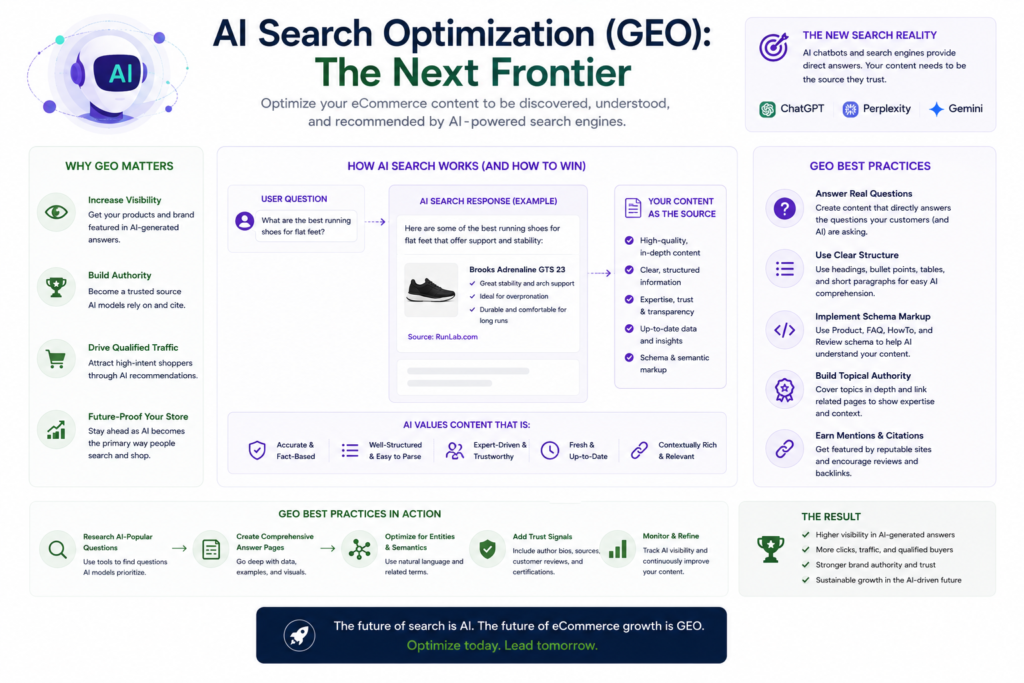
Generative Engine Optimization—the practice of optimizing content for visibility in AI-generated search experiences—is the most significant new discipline in eCommerce SEO. As ChatGPT, Google AI Overviews, and Perplexity capture increasing shares of product discovery queries, brands that understand and optimize for AI citation are building advantages that will compound over the next three to five years.
How AI Systems Select Content to Cite
Understanding the selection logic of AI systems is essential for effective GEO. LLMs are trained on massive corpora of text from across the web, and they develop weighted preferences for different content types based on their training. During inference—when generating a response to a query—modern AI search systems like ChatGPT with browsing or Perplexity retrieve current web content and synthesize it into answers. The selection of which sources to retrieve and cite is influenced by several factors: the authority and trustworthiness of the domain, the semantic relevance of the content to the specific query, the structural clarity and factual density of the content, the presence of specific, verifiable claims, and the freshness of the content.
For eCommerce brands, the practical implication is that product content quality—not just on-page SEO optimization—determines AI visibility. A brand with a high-quality product description that clearly states verifiable specifications, provides comparative context, and answers common questions in structured formats will be cited in AI responses far more frequently than a brand with thin or vague product content, regardless of the thin content’s keyword optimization.
GEO Content Strategy for eCommerce
Building an effective GEO strategy for eCommerce requires thinking about content at the brand level, not just the page level. AI systems build models of brand authority and expertise through the cumulative quality of content across an entire website. A brand that has published 50 high-quality buying guides, product comparisons, and expert product reviews has a stronger AI citation profile than a brand with the same domain authority but thin product content and no editorial resources.
Specific GEO tactics for eCommerce include: building expert author profiles and displaying expertise credentials on product and guide content; creating data-driven original research that AI systems prefer to cite; structuring product content with explicit factual claims rather than vague benefit statements; and actively claiming and optimizing brand entity profiles across platforms that AI systems crawl, including Google Business Profile, industry directories, and brand Wikipedia entries where warranted.
17. Conversational Commerce Optimization
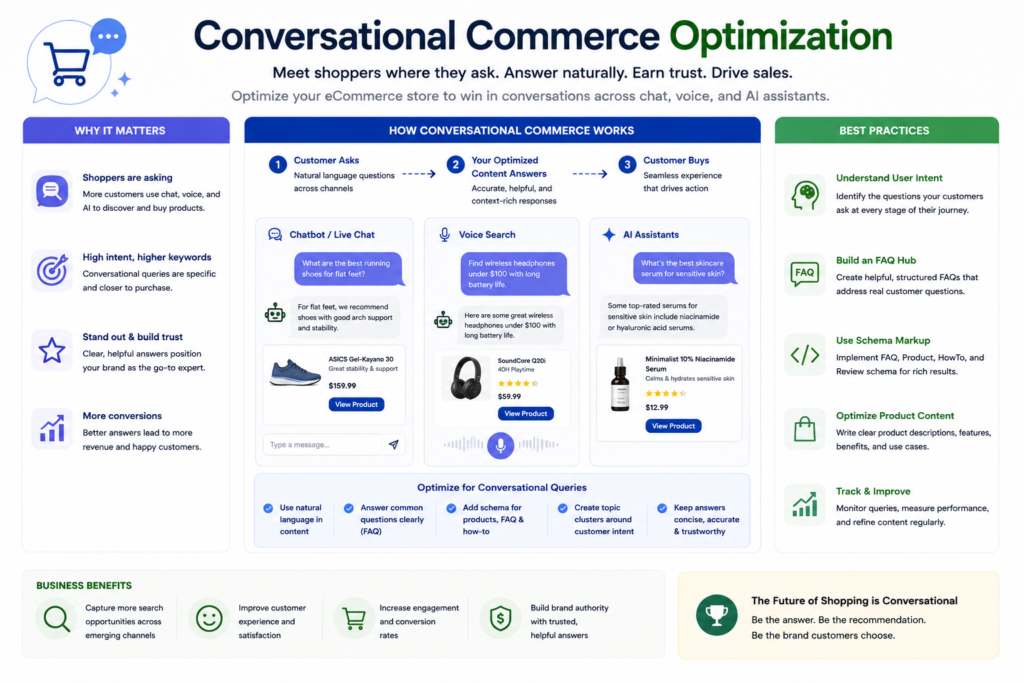
Conversational commerce—the use of AI chat interfaces, voice assistants, and messaging platforms to facilitate product discovery and purchase—is moving from an emerging trend to a mainstream channel. Brands that optimize their product and category content for conversational interfaces will capture a growing share of the consumers who prefer asking questions to typing queries.
The key distinction between conversational search and traditional search is specificity of intent expression. When a user types ‘office chairs’ into Google, their intent is ambiguous—they might be browsing, comparing, or ready to buy. When a user asks ChatGPT ‘What’s the best ergonomic office chair for a 6’2″ person who works from home and has chronic lower back pain, with a budget of $800?’ the intent is extraordinarily specific. The AI response must match the product recommendation to a very specific set of stated requirements.
Optimizing for this specificity means ensuring your product content includes information about who each product is for, what specific problems it solves, what user characteristics affect suitability (height, weight, body proportions for ergonomic products; fitness level and goals for equipment; technical skill level for electronics), and what the specific limitations of the product are. This level of product intelligence—typically found only in the most premium buying guides—is what AI systems need to match products to highly specific conversational queries.
18. Entity SEO for eCommerce Brands
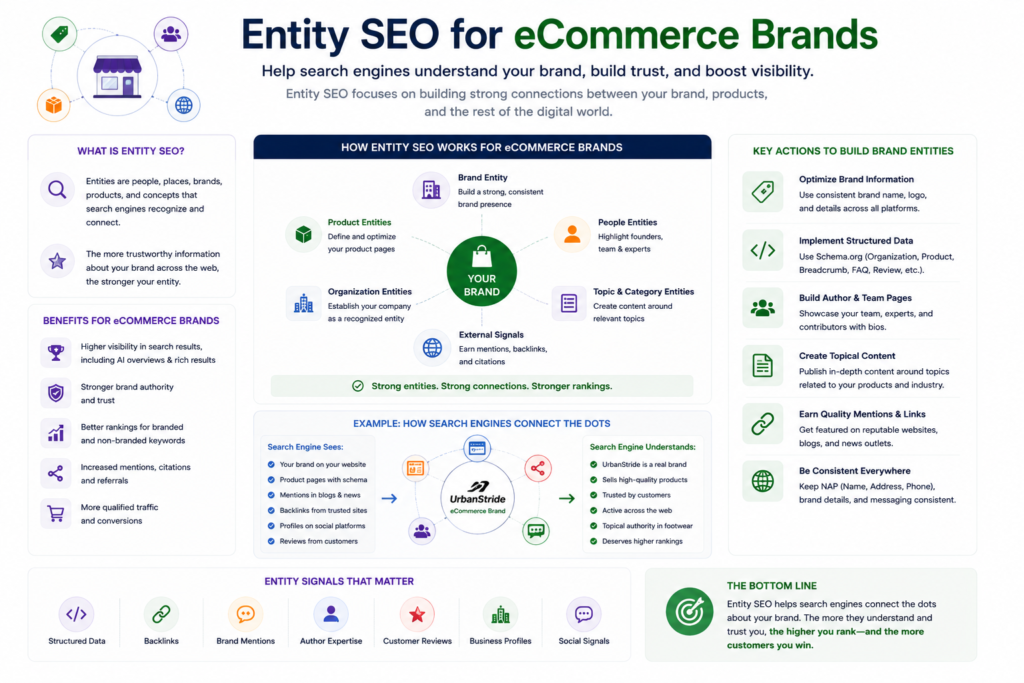
Entity SEO is the practice of establishing your brand, products, and expertise as clearly defined entities within search engine knowledge systems. Google’s Knowledge Graph represents the web not as a collection of pages but as a network of entities—people, places, organizations, products, and concepts—with defined attributes and relationships. Brands and products that are well-defined entities within this system receive privileged treatment in search results, AI-generated answers, and voice search responses.
For eCommerce brands, entity establishment means ensuring that your brand is consistently identified and attributed across the web: your Google Business Profile is complete and verified, your brand name appears consistently across all web properties, your key products are listed in structured product databases, your brand is referenced in authoritative third-party sources, and your schema markup consistently identifies your brand as a named entity with specific attributes.
Products can also be established as entities in their own right. A product with a distinct model name, consistent attributes, and widespread third-party references—reviews, comparisons, mentions in buying guides—develops a strong entity profile that AI systems recognize and cite confidently. Brands can accelerate entity development by maintaining consistent product information across all distribution channels, encouraging third-party reviews and comparisons of specific named products, and ensuring that product schema uses standardized identifiers (GTIN, MPN) that link to global product databases.
19. International SEO for Global eCommerce Brands
International SEO is the process of making an eCommerce website discoverable, indexable, and commercially relevant across multiple countries, languages, currencies, and regional search environments. For global retailers, international SEO is not simply a translation project. It is a market-entry framework that connects regional demand, localized product data, technical architecture, and culturally relevant merchandising.
The strongest international eCommerce strategies begin with market-specific intent mapping. A product category that performs well in the United States may be searched differently in the United Kingdom, Canada, Australia, Germany, or India. Searchers may use different product names, sizing systems, seasonality patterns, currency expectations, delivery concerns, trust signals, and comparison criteria. Literal translation rarely captures these differences.
| Architecture Model | Example | Best For | SEO Consideration |
|---|---|---|---|
| ccTLD | example.de | Large brands with dedicated country teams and regional authority goals | Strong geo signal but authority is split by domain. |
| Subdomain | de.example.com | Brands with operational separation by region | Moderate separation; requires careful authority and hreflang management. |
| Subdirectory | example.com/de/ | Brands wanting consolidated authority and simpler governance | Often easiest to scale; requires clear localization and hreflang discipline. |
Implementation checklist:
- Create separate keyword maps for each target country and language.
- Use hreflang annotations with reciprocal references and self-referencing tags.
- Keep canonical tags aligned to the equivalent regional URL, not to a different language version.
- Localize metadata, category copy, FAQs, size guides, shipping information, currency, and returns language.
- Avoid automatically translating product descriptions without editorial review.
- Segment XML sitemaps by region and language so indexation can be monitored separately.
- Track regional rankings, clicks, revenue, and conversion rate independently.
The most common international SEO failure is treating hreflang as the strategy. Hreflang only helps Google understand equivalent pages. It does not create localized relevance. A German category page must still be useful to German buyers, use German search terminology, reflect regional shipping realities, and answer regional purchase objections.
20. Merchant Center Optimization for Organic and AI Shopping Visibility
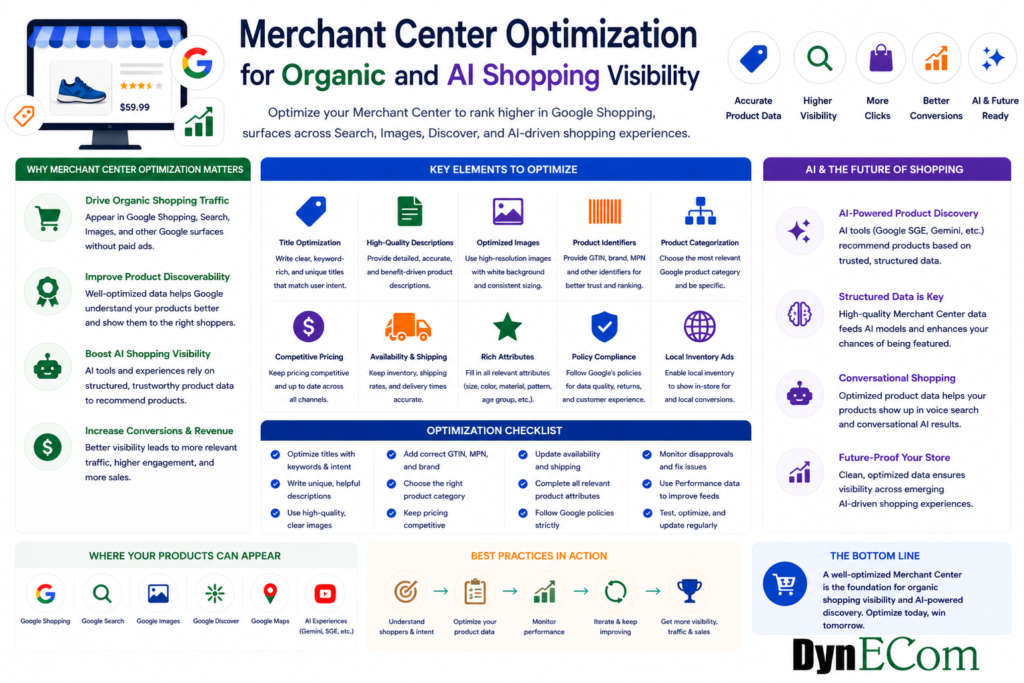
Merchant Center optimization is the discipline of maintaining accurate, complete, and commercially useful product data so Google can match products to the right queries across Shopping surfaces, free listings, product results, and AI-assisted experiences. In modern eCommerce SEO, Merchant Center should be treated as a core organic visibility system, not only a paid media tool.
| Feed Area | SEO / Discovery Value | Optimization Requirement |
|---|---|---|
| Product title | Improves query matching and listing relevance | Use brand + product type + key attribute + size/color/model where relevant. |
| GTIN / MPN | Improves product entity matching | Use valid identifiers; avoid placeholder or recycled GTINs. |
| Google product category | Improves product classification | Map to the most specific supported taxonomy. |
| Availability | Supports trust and accuracy | Sync frequently and avoid mismatches between feed and PDP. |
| Image link | Impacts visual discovery and listing quality | Use high-resolution, clean, product-focused images. |
| Price | Supports eligibility and trust | Match landing page price exactly, including sale logic. |
21. Product Feed SEO: The Structured Commerce Layer
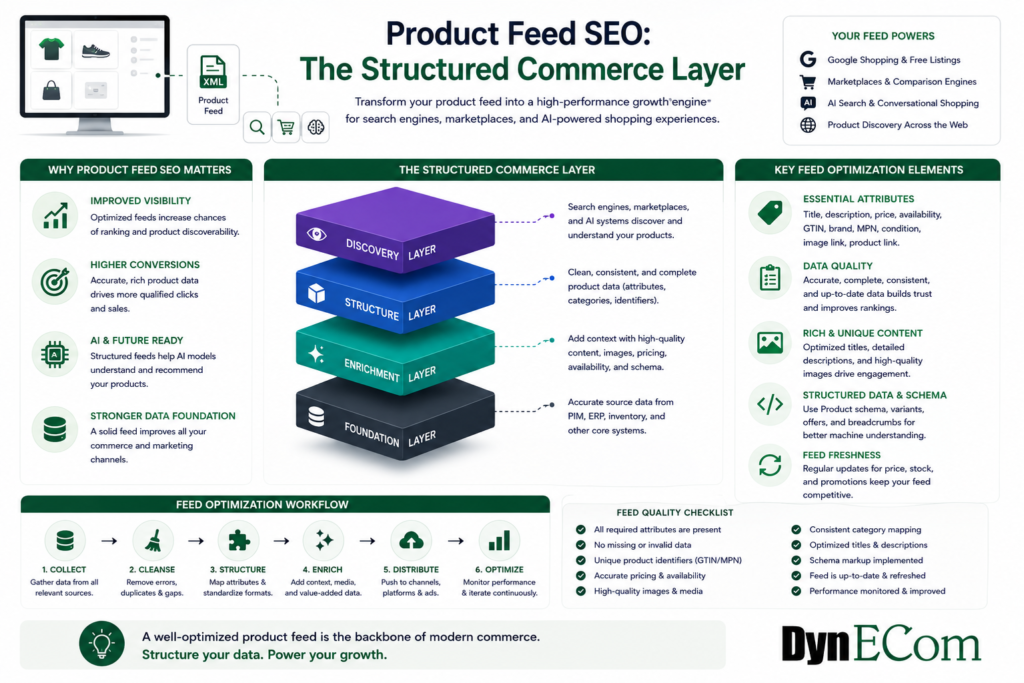
Product feed SEO improves the structured data layer that search engines, shopping platforms, marketplaces, and AI commerce systems use to understand products. Feed optimization is especially important for large catalogs because it provides machine-readable consistency at a scale that page-level editorial work cannot always achieve.
A strong feed should be complete, accurate, fresh, and aligned with the product page. Product titles should be descriptive without keyword stuffing. Product descriptions should summarize the product clearly, match page content, and avoid promotional claims that can trigger disapprovals. Variant products should share a consistent item group ID while maintaining unique variant attributes such as color, size, material, pattern, capacity, or count.
| Priority | Attribute | Audit Question |
|---|---|---|
| Critical | id | Is every product ID stable over time? |
| Critical | title | Does the title match how buyers search and what the PDP says? |
| Critical | link | Does the landing page resolve without redirects or errors? |
| Critical | availability | Does feed availability match the PDP and inventory system? |
| High | brand | Is brand naming consistent across site, schema, and marketplaces? |
| High | gtin | Are identifiers valid and unique? |
| High | item_group_id | Are variants grouped correctly? |
| Medium | custom_label | Are margin, seasonality, bestseller, or campaign groups defined? |
22. Product Variant SEO: When to Index, Consolidate, or Group Variants
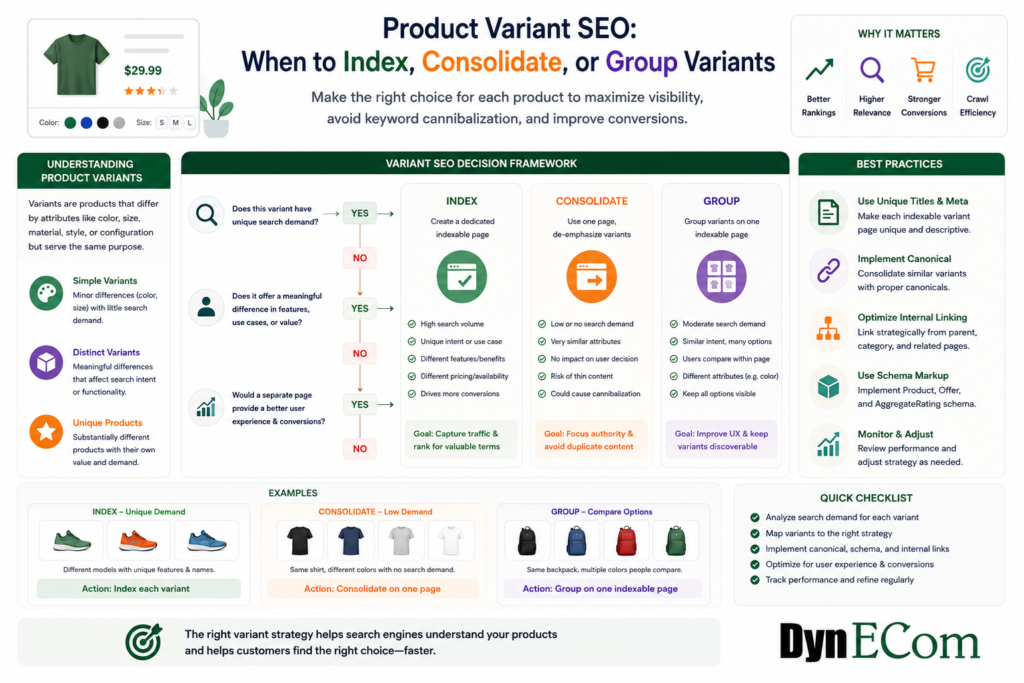
Product variants create one of the most difficult SEO decisions in eCommerce: should each variant have its own URL, or should variants live on one parent product page? The answer depends on search demand, differentiation, inventory, and user behavior.
| Variant Scenario | Recommended SEO Treatment | Example |
|---|---|---|
| Only size changes | One canonical product page with selectable size options | Running shoe sizes 8-12 |
| Color has meaningful search demand | Indexable color variant or optimized parent with strong color selectors | Black leather office chair |
| Material changes product intent | Consider unique indexable variant page | Oak dining table vs walnut dining table |
| Technical model changes | Separate indexable product pages | iPad 64GB Wi-Fi vs 256GB Cellular |
| Minor pack count changes | Usually grouped unless demand is distinct | 2-pack vs 4-pack replacement filters |
Implementation framework: keep variants consolidated when the difference is minor and user intent is shared. Create distinct URLs when the variant has unique search demand, unique imagery, unique price positioning, unique reviews, or materially different specifications. Use structured data to clarify parent-child relationships and avoid duplicate descriptions across variants.
23. Out-of-Stock, Discontinued, and Product Lifecycle SEO
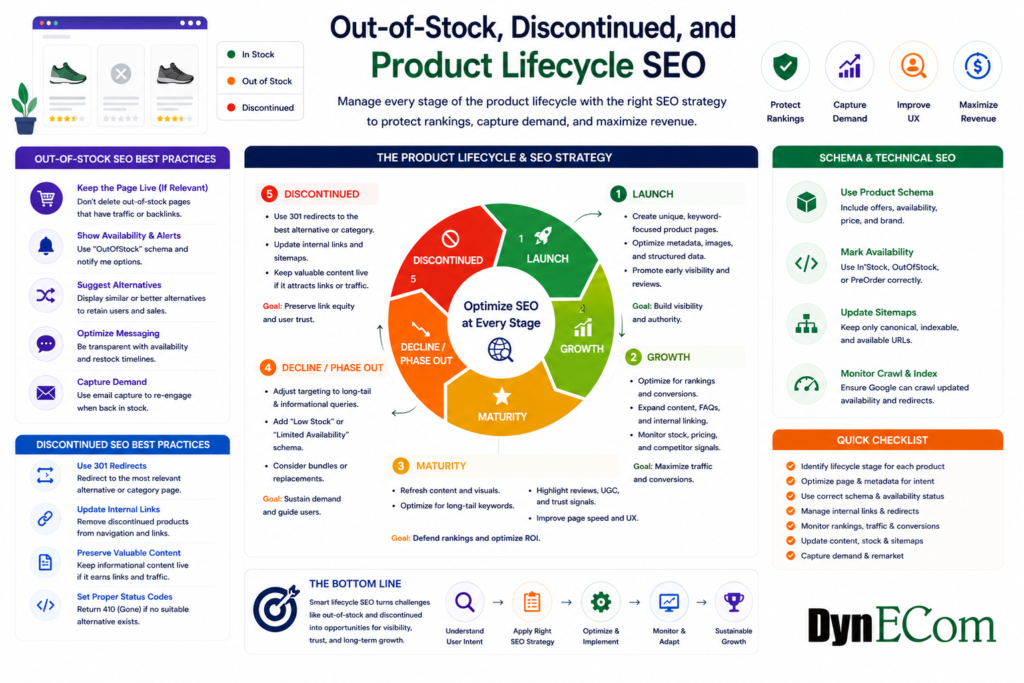
A product URL often earns rankings, links, reviews, and behavioral history over time. Deleting that URL the moment inventory changes wastes accumulated authority. Product lifecycle SEO protects organic value while providing a clear customer experience.
| Status | SEO Action | UX Action |
|---|---|---|
| Temporary out of stock | Keep URL live and indexable | Show restock date, email alert, and alternatives. |
| Seasonal out of stock | Keep URL live if product returns | Explain seasonal availability and link to related products. |
| Backorder | Keep live with accurate availability schema | Clarify estimated ship date. |
| Discontinued with replacement | 301 redirect to closest replacement after a short transition period | Show replacement message if keeping page temporarily. |
| Discontinued with no replacement | Keep page if it has search demand; otherwise 410 or redirect category | Offer category alternatives and buying guidance. |
The right decision is rarely “delete the product.” The right decision is based on whether the URL still satisfies demand. A discontinued product with significant brand/model searches can remain useful as a comparison, support, or alternative recommendation page.
24. Programmatic SEO for eCommerce Catalogs
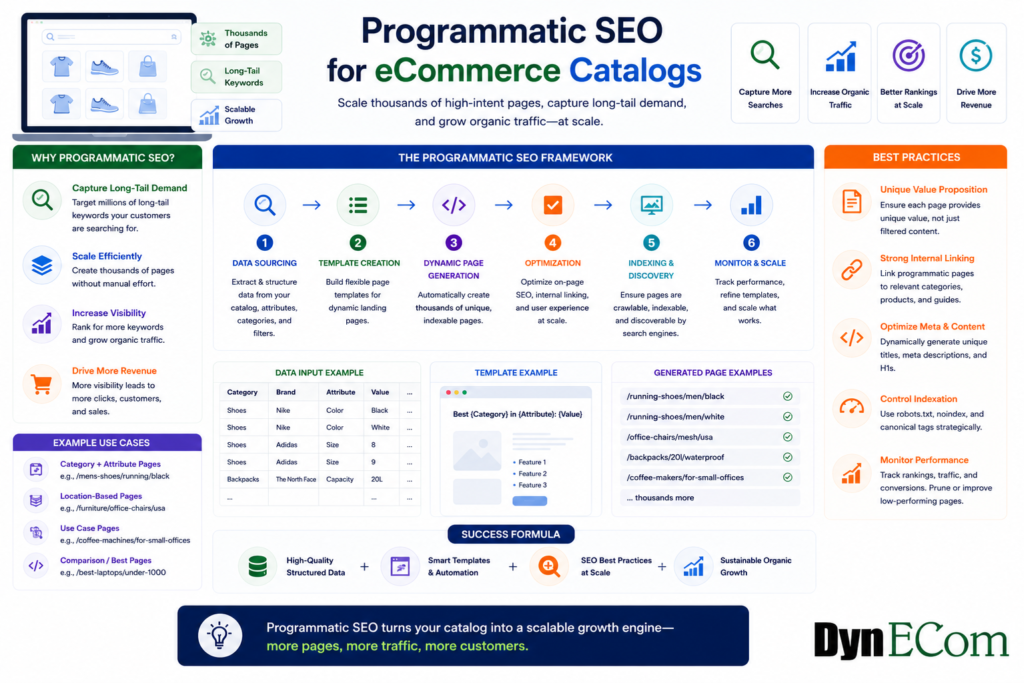
Programmatic SEO uses structured data and reusable templates to create useful landing pages at scale. For eCommerce, this can include brand-category pages, attribute-category pages, comparison pages, “best for” pages, location/category pages, and seasonal collection pages. The risk is thin content; the opportunity is scalable long-tail coverage.
- Start with real keyword demand and SERP validation.
- Define page types that map to distinct user intent.
- Require unique data, products, recommendations, FAQs, and internal links for every generated page.
- Set indexation thresholds based on inventory count, search demand, content uniqueness, and conversion value.
- Monitor crawl budget, duplicate titles, thin pages, and low-quality indexed pages monthly.
| Page Type | Example | Index Only If |
|---|---|---|
| Brand + category | Nike running shoes | Inventory is stable and search demand exists. |
| Attribute + category | white standing desks | Products, copy, and FAQs are unique. |
| Use case | office chairs for tall people | Page contains genuine fit guidance. |
| Comparison | Aeron vs Leap | Content provides specific comparison criteria. |
| Seasonal | Father’s Day grilling gifts | Seasonal demand and inventory justify the page. |
25. Headless Commerce and JavaScript SEO
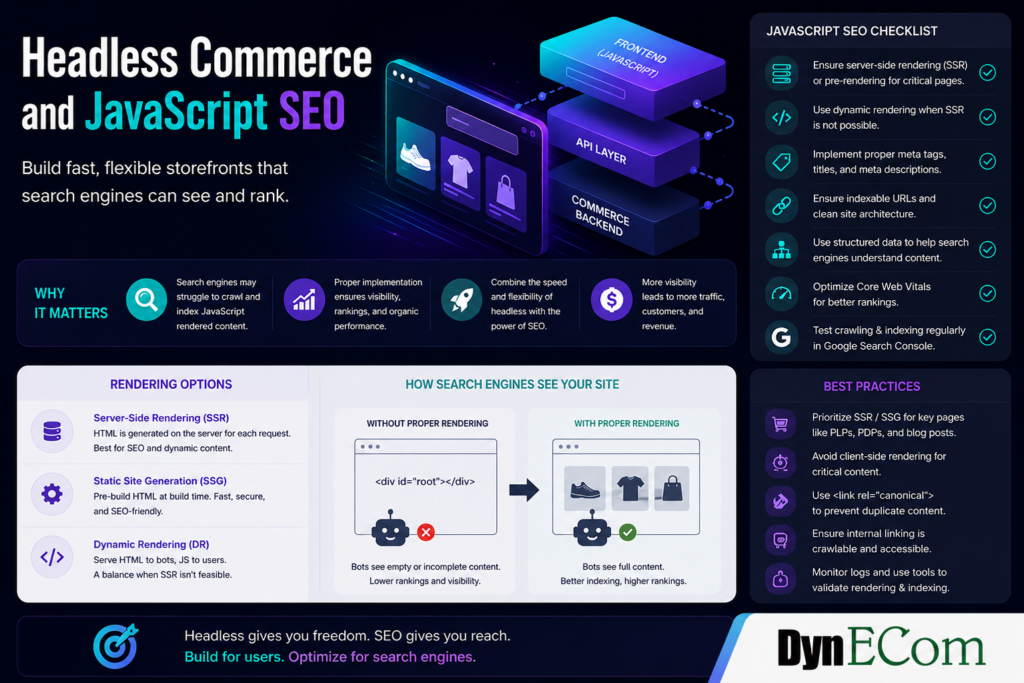
Headless commerce separates the frontend experience from the backend commerce system. It gives brands design flexibility and performance potential, but it also creates SEO risk when critical content, links, metadata, canonicals, schema, or product data depend on client-side rendering.
The rule is simple: the rendered HTML available to crawlers must contain the same commercially important content that users need to make a purchase decision. That includes title, product description, price, availability, reviews, internal links, canonical tags, hreflang, breadcrumb links, and structured data.
- Use server-side rendering or static generation for category and product pages whenever possible.
- Validate HTML before and after JavaScript rendering.
- Ensure internal links are real anchor links, not click-only JavaScript events.
- Render schema server-side or verify that dynamically injected schema is visible to Google.
- Monitor hydration errors that remove or duplicate metadata.
- Avoid blocking critical JavaScript, CSS, or API endpoints required for rendering.
26. Edge SEO for Enterprise eCommerce
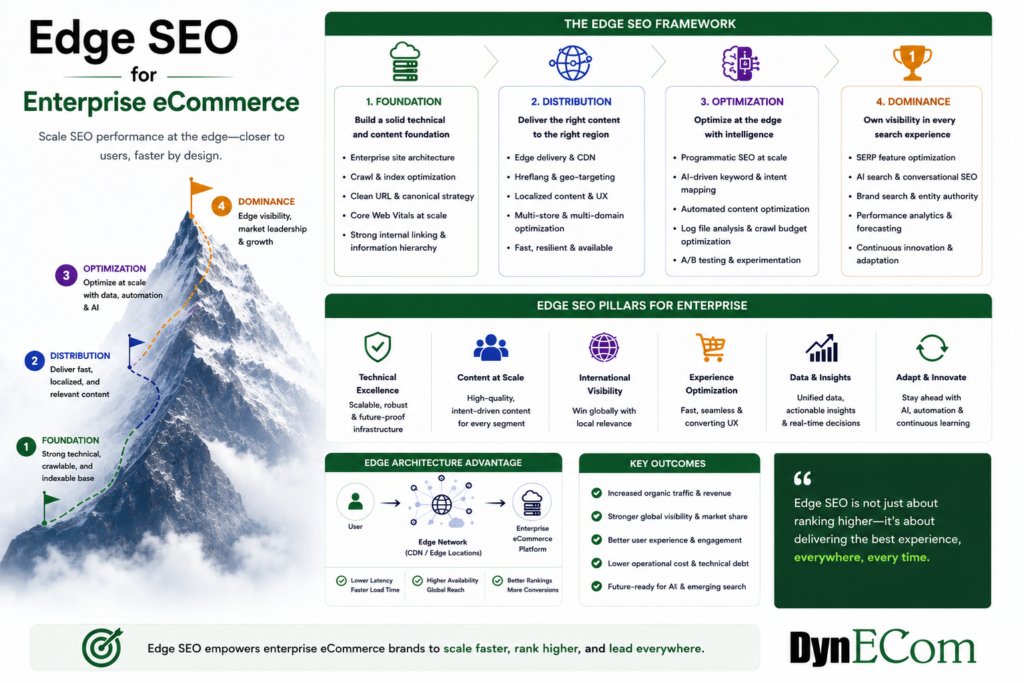
Edge SEO uses CDN or edge-layer logic to make SEO changes closer to the user and crawler, often without waiting for full platform releases. It can be useful for redirects, header rules, temporary canonical fixes, A/B routing, log enrichment, and emergency technical patches.
| Use Edge SEO For | Avoid Edge SEO For |
|---|---|
| Emergency redirect fixes | Permanent substitute for platform-level architecture. |
| Header-level noindex or canonical experiments | Large content rewrites without CMS governance. |
| Legacy URL migrations | Fixing poor data models that should be solved upstream. |
| Temporary rendering or cache rules | Untracked changes that developers cannot audit. |
Governance requirement: every edge rule should have an owner, deployment date, rollback plan, business reason, QA checklist, and review date. Edge SEO without governance becomes invisible technical debt.
27. Marketplace SEO and Omnichannel Search Alignment
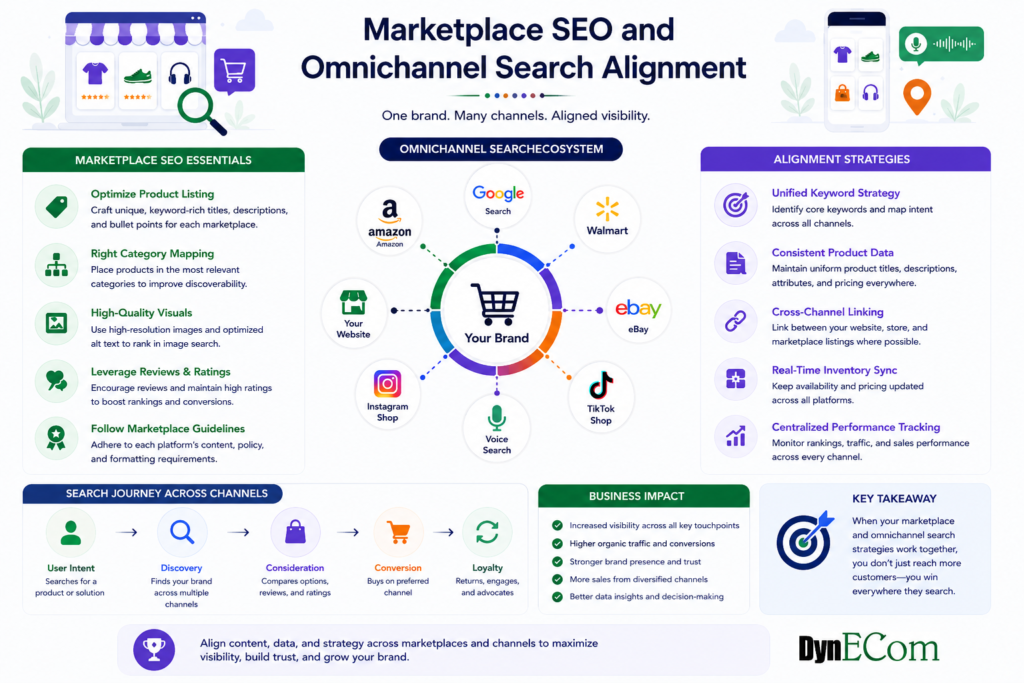
Modern eCommerce brands do not compete only on their own website. Product discovery also happens on Amazon, Walmart, Target, eBay, TikTok Shop, YouTube Shopping, Google Shopping, and retail media ecosystems. Marketplace SEO should align with website SEO so that brand, product, attribute, and review signals reinforce each other instead of fragmenting authority.
| Channel | Primary Ranking Inputs | SEO Alignment Opportunity |
|---|---|---|
| Amazon | Relevance, sales velocity, conversion, reviews, availability | Use consistent titles, attributes, bullets, and comparison language. |
| Walmart | Content quality, attributes, price, availability, performance | Align item attributes and product claims with site content. |
| Google Shopping | Feed quality, landing page quality, identifiers | Maintain feed-site-schema consistency. |
| TikTok / YouTube | Engagement, watch behavior, creator authority | Use product-led educational video content. |
28. AI Search Measurement and Governance
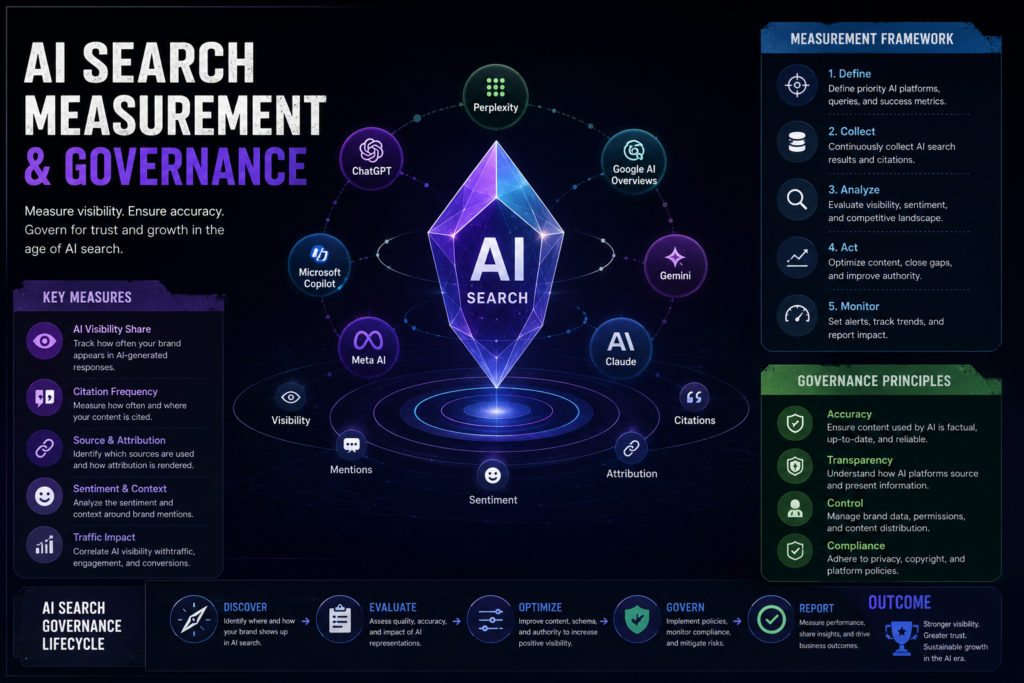
AI search visibility cannot be managed with rank tracking alone. Brands need recurring prompt-set monitoring to understand when and how their products appear in AI-generated answers. A prompt set should include category prompts, comparison prompts, problem-solution prompts, brand prompts, competitor prompts, and bottom-funnel purchase prompts.
| Metric | Definition | Why It Matters |
|---|---|---|
| AI mention rate | Percentage of monitored prompts where brand/product is mentioned | Measures visibility in AI answers. |
| Citation rate | Percentage of prompts where site is cited or linked | Measures source authority. |
| Recommendation position | Where brand appears in ranked AI recommendations | Approximates consideration-set strength. |
| Answer accuracy | Whether AI describes product correctly | Protects brand trust. |
| Competitor overlap | Which competitors appear in the same answers | Identifies strategic threats. |
29. Vector Search and Semantic Search
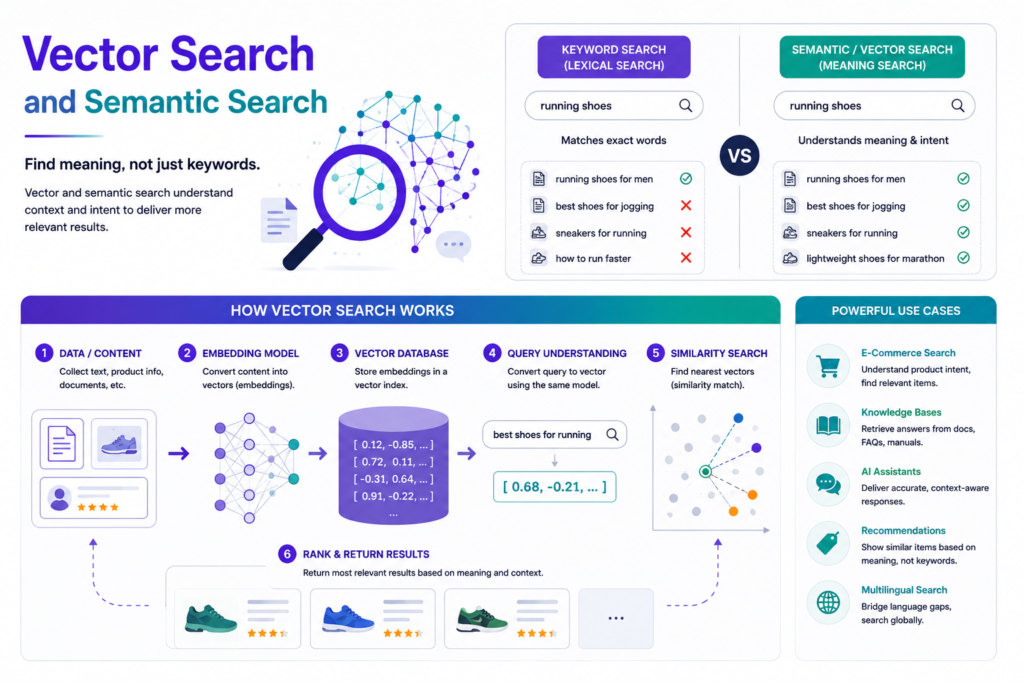
The underlying technology powering modern AI-driven search has shifted from keyword matching to vector-based semantic search. In vector search, content is represented as high-dimensional mathematical vectors—points in a conceptual space—rather than as collections of keywords. Queries are similarly vectorized, and search results are determined by the similarity between query vectors and content vectors, not by keyword occurrence.
The practical implication for eCommerce content is significant. In a vector search environment, a product page that clearly and comprehensively describes a product’s purpose, use cases, user benefits, and contextual applications will match a wider range of queries than a page optimized for a narrow set of exact-match keywords. The semantic neighborhood of your content—the concepts, attributes, and contexts you cover—determines the range of queries your page can satisfy.
This fundamentally validates the semantic expansion approach to product content optimization. A running shoe product page that discusses terrain types, gait patterns, arch support, heel-to-toe drop, cushioning technology, and use cases for road running vs. trail running occupies a richer semantic vector space than a page that simply states the product name, color options, and price. In a semantic search environment, the richer content systematically attracts more diverse and relevant query traffic.
For eCommerce brands, investing in semantic richness is not a luxury—it is a structural requirement for long-term organic discoverability as search technology continues its migration toward pure semantic matching.
30. Conversion Optimization and SEO: The Unified Framework
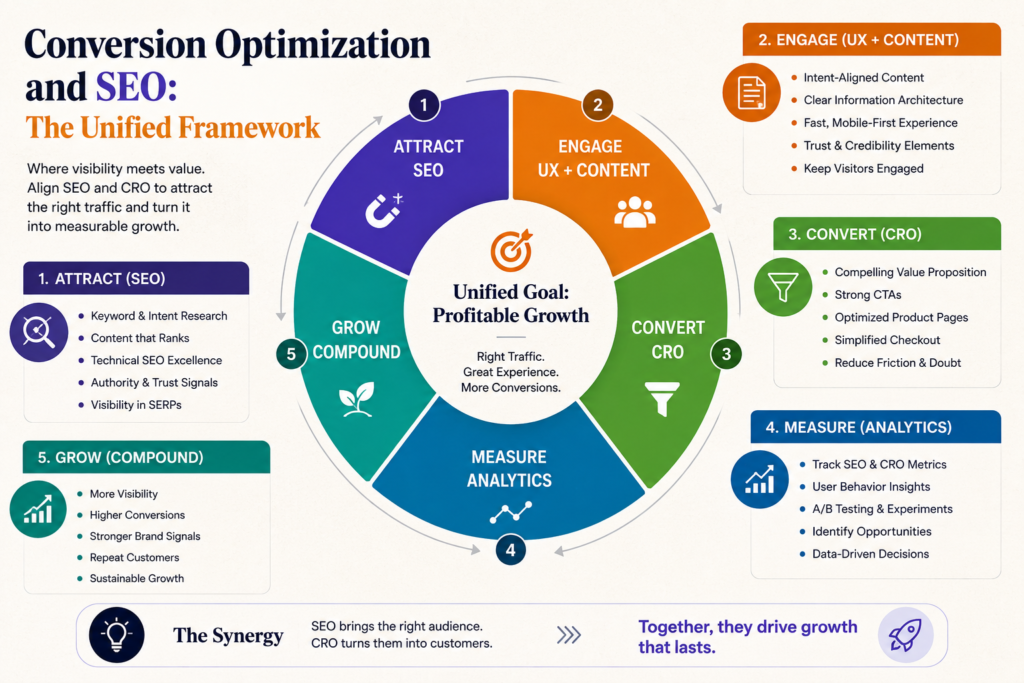
The traditional separation between SEO (traffic acquisition) and CRO (conversion rate optimization) is a false dichotomy that leads to suboptimal decisions on both sides. In reality, the elements that make a product page rank well—comprehensiveness, semantic richness, trust signals, user engagement, question-answering content—are the same elements that convert browsers into buyers. Optimizing for one systematically should improve the other.
Consider the data: a product page that achieves a 4% conversion rate from organic traffic is generating 33% more revenue per visitor than a page with the same rankings and a 3% conversion rate. Over a year of organic traffic, the difference compounds significantly. For high-traffic category pages, a single percentage point improvement in conversion rate can represent hundreds of thousands of dollars in additional revenue—often more than an equivalent improvement in rankings. Traffic alone is not enough. SEO should improve:
- revenue
- conversion rates
- lead quality
- average order value
Sites that incorporate customer questions, likely objections, and then proceed to overcome those objections should enjoy higher conversion rates. Any good sales rep will work hard to uncover potential objections, but within eCommerce sites there is typically no human interaction. As a result, modern eCommerce sites will proactively raise common objections and then overcome those objections. By acknowledging that it is normal to have objections, sites are able to both resolve the objection and raise the overall customer trust level.
The Psychology of Conversion-Focused SEO
Every element of conversion-optimized product content is rooted in buyer psychology. Uncertainty is the primary enemy of conversion: the more uncertainty a buyer experiences about whether a product is right for them, the more likely they are to abandon the page without purchasing. Comprehensive product content that preemptively answers questions, provides detailed specifications, offers comparison context, and includes genuine customer reviews systematically reduces uncertainty at every stage of the evaluation process.
Social proof operates through a specific psychological mechanism—people use others’ choices and experiences to reduce the cognitive load of decision-making. Product pages with substantial, recent, relevant reviews convert better not just because reviews signal quality, but because they allow buyers to find someone ‘like them’ who made the same purchase and was satisfied. A review from a ‘6-foot-tall remote worker with lower back issues’ on an office chair product page will directly convert buyers who share those characteristics, because the social proof is perfectly contextually aligned.
31. eCommerce SEO KPIs: Measuring What Actually Matters
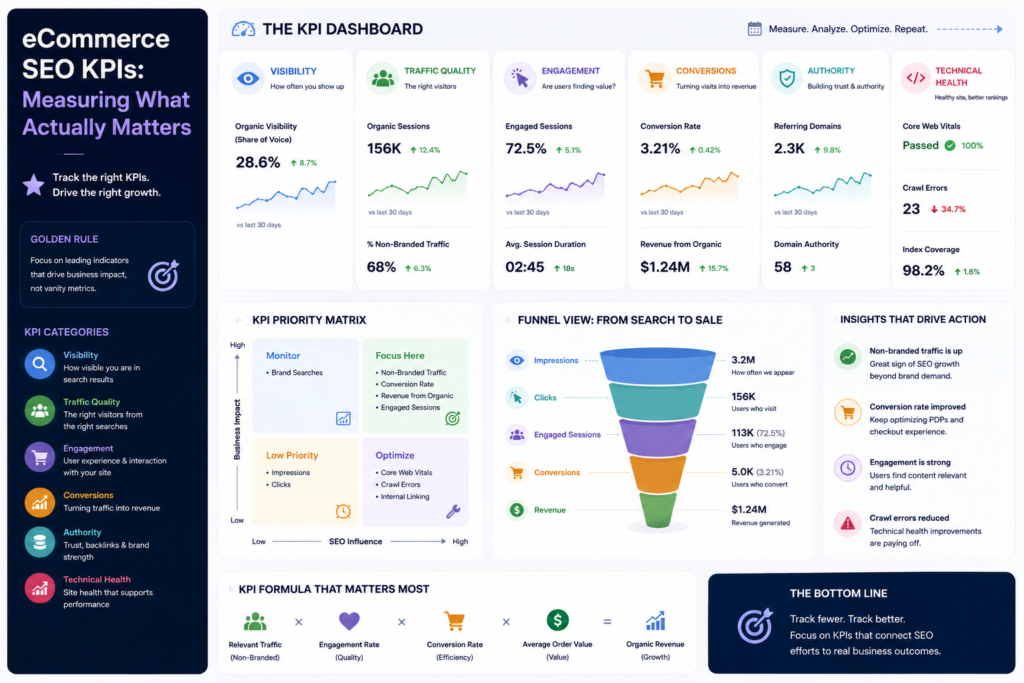
SEO measurement for eCommerce should be anchored in business outcomes—revenue, customer acquisition cost, and return on investment—not just vanity metrics like keyword rankings and raw traffic volume. Rankings and traffic are leading indicators, but they only matter insofar as they translate into qualified buyers and revenue.
| KPI | What It Measures | Why IT Matters | Benchmark Target |
|---|---|---|---|
| Organic Revenue | Revenue attributed to organic search | Primary business outcome of SEO | Grow 20–40% YoY |
| Organic Conversion Rate | % of organic visitors who purchase | Quality of organic traffic | > Category benchmark |
| Organic Traffic | Visitor volume from search | Reach and visibility growth | Grow consistently |
| Keyword Rankings | SERP positions for target keywords | Directional visibility indicator | Top 10 for priorities |
| Indexed Page Count | Pages discoverable in search | Crawl efficiency health | Match target page set |
| Click-Through Rate | % of impressions resulting in clicks | SERP snippet effectiveness | > Industry average |
| Core Web Vitals Pass Rate | % of pages meeting CWV thresholds | UX & ranking factor | > 75% Good |
| AI Citation Rate | Frequency of brand/product AI mentions | GEO visibility indicator | Track & grow |
| Return on Content Spend | Similar to return on ad spend or ROAS, this metric measures the incremental return on investing in eCommerce content. | There are limited investment dollars and in many cases investing in content will far outperform spending money on ads. | >20x |
DynEcom’s reporting framework always connects SEO performance metrics to business outcomes. Rather than reporting ‘organic traffic increased 25%,’ our reporting contextualizes: ‘Organic traffic increased 25%, driving a 31% increase in organic revenue, reducing blended customer acquisition cost by 18% as paid ad dependency decreased.’
32. Common eCommerce SEO Mistakes (and How to Fix Them)
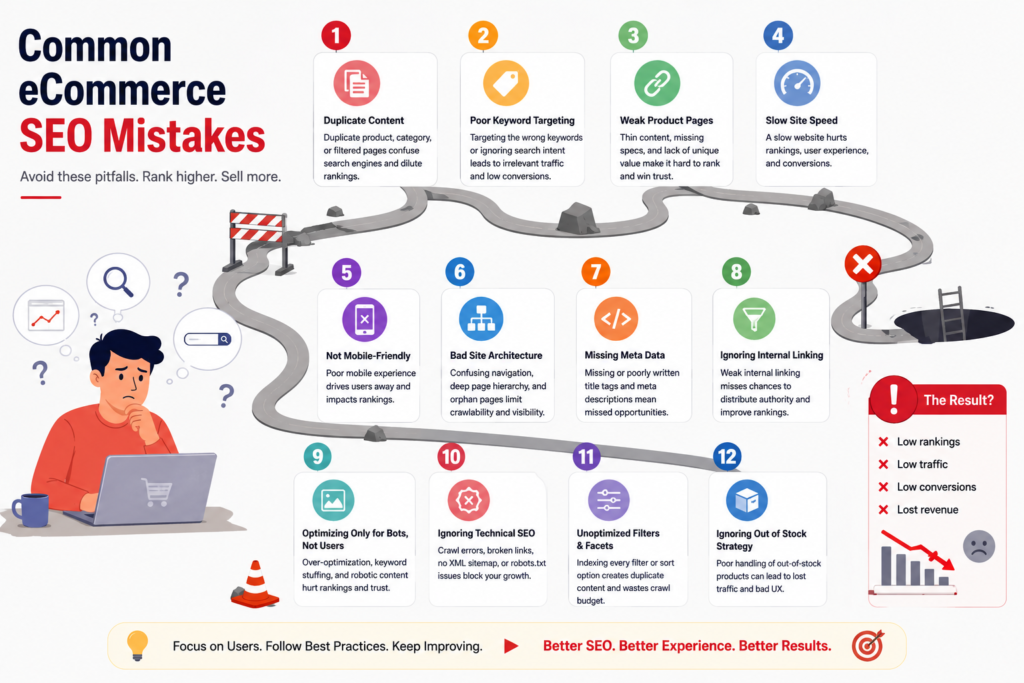
Understanding what not to do is as valuable as knowing what to do. These are the most damaging and most common SEO mistakes DynEcom encounters in eCommerce audits.
Mistake 1: Manufacturer Description Dependency
The most widespread content problem in eCommerce: using manufacturer-provided descriptions across an entire catalog creates massive duplicate content overlap with every other retailer selling the same products. Search engines have no incentive to rank any particular retailer’s version of identical content. The fix is systematic content differentiation—creating unique, benefits-focused, semantically rich descriptions that provide distinct value beyond the manufacturer’s copy.
Mistake 2: Ignoring Crawl Budget on Large Catalogs
Sites with tens of thousands of products that allow unmanaged faceted navigation, session parameters, and sorting variants to generate millions of crawlable URLs are effectively hiding their most important pages from efficient indexing. Googlebot crawls what is available; if the crawlable universe is dominated by low-value URLs, high-value pages get indexed less frequently. The fix is URL rationalization: identify and eliminate or canonicalize low-value URL variants before expanding content investment.
Mistake 3: Treating Category Pages as Product Containers
Category pages that consist only of product grids with no editorial content, no buying guidance, and no FAQ sections are missing enormous ranking potential. The fix is building category pages as genuine buying resources—not just product containers—with 300 to 500 words of useful, expert buying guidance positioned strategically around the product grid.
Mistake 4: No Internal Linking Strategy
New products added to catalogs that receive zero internal links from any other page are effectively invisible to search engines until they accumulate external links—which may never happen. The fix is a systematic internal linking protocol: every new product and category page receives internal links from at least three to five relevant pages immediately upon launch.
Mistake 5: Separating SEO and CRO
Teams that treat SEO and conversion optimization as separate workstreams with separate KPIs and separate page ownership consistently underperform teams that take an integrated approach. The fix is organizational: create a unified product page performance team that owns both organic traffic and conversion outcomes, measured on organic revenue rather than siloed metrics.
33. eCommerce SEO Workflow
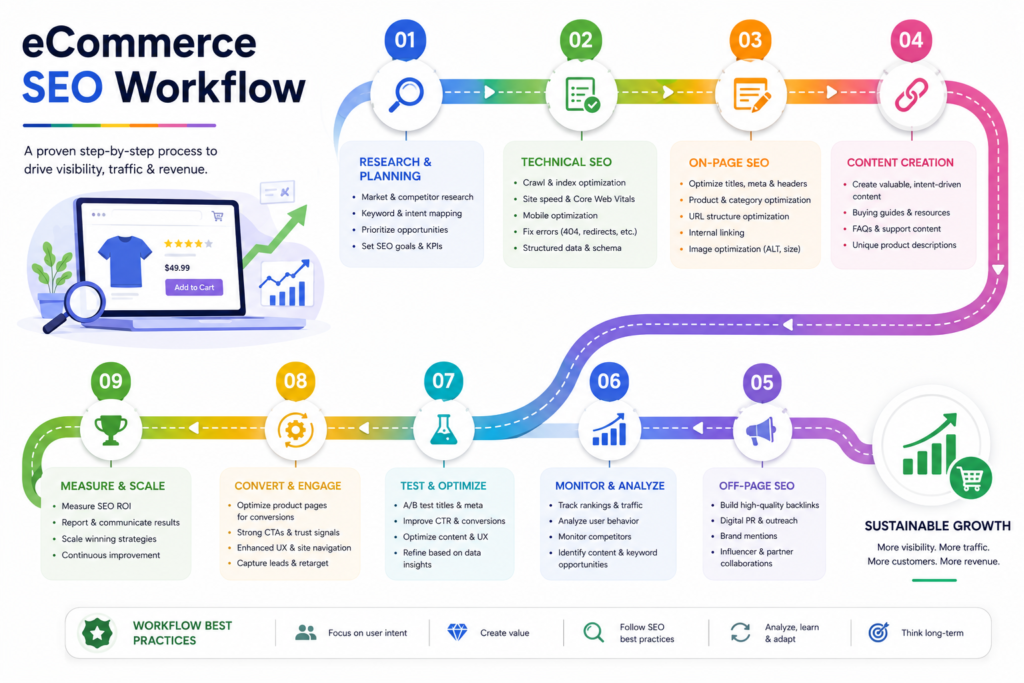
SEO success doesn’t happen overnight. Most successful eCommerce SEO campaigns follow a structured process that prioritizes technical foundations, content optimization, and authority building. While timelines vary depending on website size, competition, and resources, the following example demonstrates a typical 90-day SEO implementation roadmap.
Month 1: Research, Auditing & Foundation Building
The first month focuses on understanding the current state of the website and identifying the highest-impact opportunities.
A: Technical SEO Audit
A comprehensive technical audit is conducted to identify issues that may prevent search engines from effectively crawling and indexing the website. Areas reviewed include:
- Crawlability and indexability
- XML sitemaps
- Robots.txt configuration
- Core Web Vitals
- Mobile usability
- Site speed performance
- Canonicalization issues
- Redirect chains and loops
- Duplicate content
- Faceted navigation management
- Broken internal links
B: Keyword Research & Search Intent Analysis
Keyword research goes beyond finding high-volume terms. The objective is to understand how potential customers search throughout the buying journey. Keyword categories typically include:
- Transactional Keywords
- Commercial Investigation Keywords
- Informational Keywords
- Brand Keywords
C: Competitor SEO Analysis
The next step is understanding why competitors rank higher and where opportunities exist. Analysis includes:
- Competitor keyword rankings
- Content gaps
- Category page structure
- Internal linking strategies
- Backlink profiles
- Technical SEO strengths
Month 2: On-Page SEO & Content Optimization
Once the foundation is established, optimization efforts focus on pages that generate the highest revenue potential.
A: Category Page Optimization
Category pages often represent the largest revenue opportunity. Optimization includes:
- Title tag improvements
- Meta description enhancements
- H1 optimization
- Introductory content creation
- Internal linking improvements
- Schema markup implementation
B: Product Page Optimization
Product pages are enhanced to improve relevance, conversions, and visibility. Optimization areas include:
- Product Titles
- Product Descriptions
- Product Key Features
- Product Specifications
- Product Attributes
- Product FAQs
- Schema Markup
Month 3: Authority Building & Scaling
With technical and content foundations in place, focus shifts toward authority growth and performance monitoring.
- Publish supporting content
- Build topical authority
- Improve Core Web Vitals
- Start link acquisition
34. The Future of eCommerce SEO
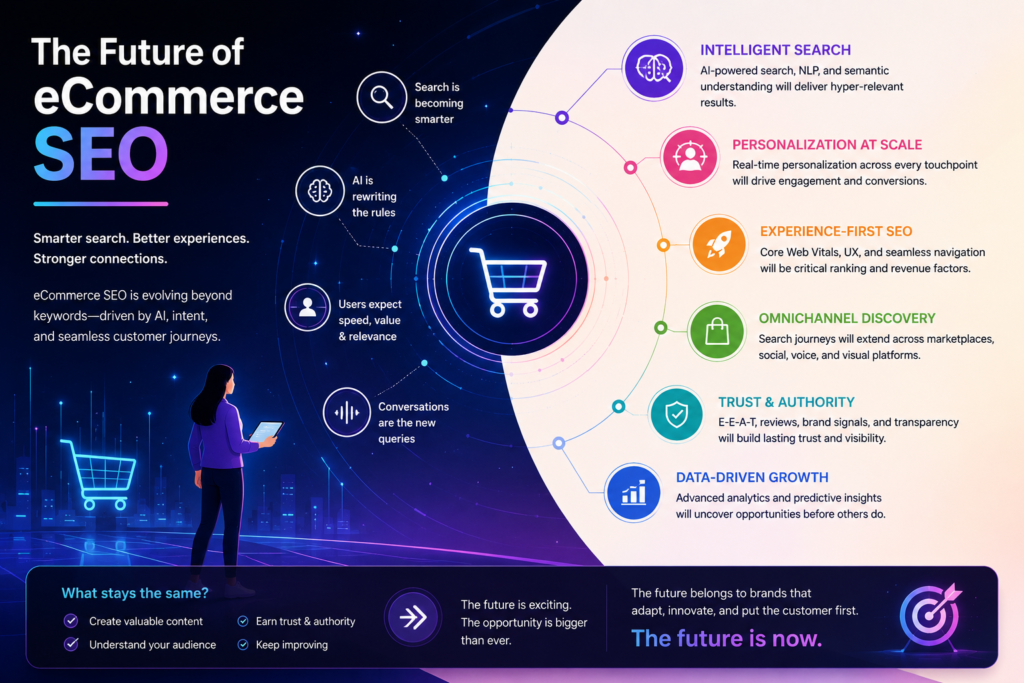
Predicting the future of SEO with precision is impossible, but the directional trends are clear enough to make high-confidence strategic investments. The brands that thrive over the next three to five years will be those that build now for where search is going, not where it has been.
AI-Mediated Commerce Will Expand
The integration of AI into the purchase funnel will deepen. Voice-initiated shopping, AI-assisted product selection, and conversational checkout will move from novelty to mainstream across demographic groups. Brands that have invested in AI-readable product content, clear entity definitions, and structured product data will have the content infrastructure to participate in these channels without rebuilding from scratch.
Visual and Multimodal Search
Google Lens and similar visual search tools are already used by hundreds of millions of users monthly to identify products from images. The integration of multimodal AI—systems that process text, images, video, and audio simultaneously—will expand the search modalities through which products are discovered. eCommerce brands that invest in high-quality, descriptive product imagery with proper alt text and structured image data will be better positioned to capture this visual search opportunity.
Personalization at Scale
Search engines are increasingly personalizing results based on user history, preferences, and context. For eCommerce, this means that aggregate keyword rankings will become less meaningful as an indicator of actual visibility—what matters is whether your products appear in personalized results for your target customer segments. Building rich customer context signals through owned data, structured reviews, and detailed product-customer matching content will become increasingly important for personalized search visibility.
Zero-Click Experiences and Answer Engine Optimization
As AI Overviews and conversational AI responses capture more queries without click-through, eCommerce brands must think beyond traffic as the primary SEO metric. Brand mention in AI-generated answers—even without a click—builds the consideration set presence that influences eventual purchase decisions. Optimizing for AI mention frequency, not just traffic generation, will be a defining competitive differentiator. The future of SEO is:
- AI-driven
- Intent-focused
- Entity-based
- Conversational
- Personalized
Winning brands will combine:
- Technical SEO
- Content optimization
- AI discoverability
- Conversion optimization
- Semantic relevance
SEO is no longer just a traffic channel. It is becoming the foundation of digital commerce visibility.
35. Why Leading eCommerce Brands Partner with DynEcom
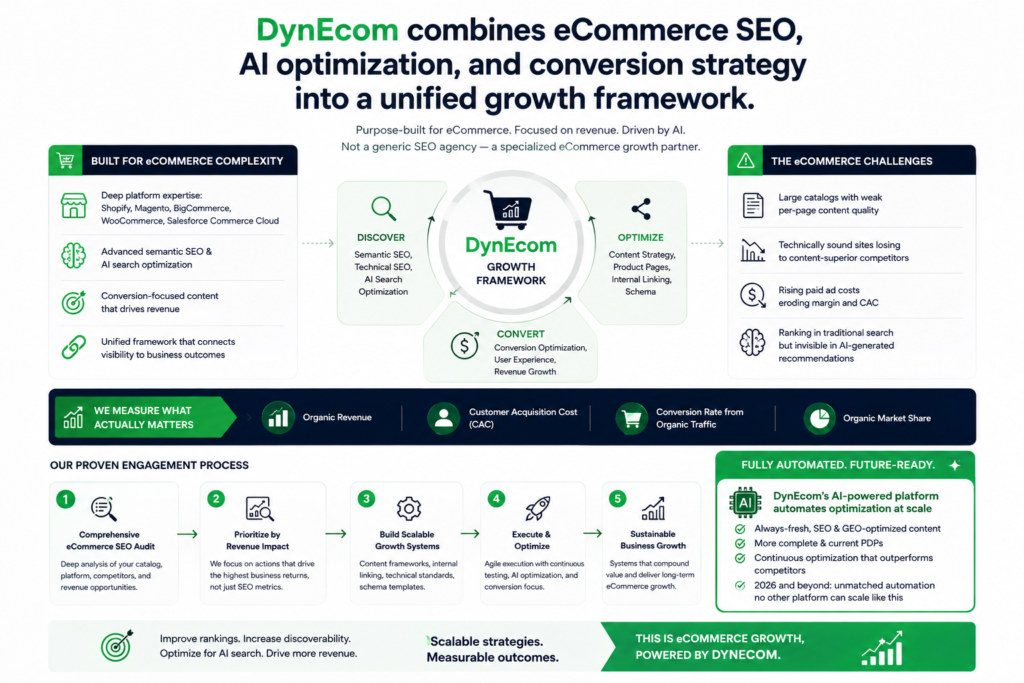
DynEcom combines eCommerce SEO, AI optimization, and conversion strategy into a unified growth framework.
DynEcom was built specifically for the complexity of modern eCommerce; not as an adaptation of a generic SEO agency, but as a purpose-built eCommerce growth partner. Our team combines deep eCommerce platform expertise (Shopify, Magento, BigCommerce, WooCommerce, Salesforce Commerce Cloud), advanced semantic SEO methodology, AI search optimization capabilities, and conversion-focused content strategy into a unified framework that drives measurable business outcomes.
The brands that benefit most from DynEcom’s approach are those facing one of several common challenges: large product catalogs with weak per-page content quality; technically sound sites that are losing market share to content-superior competitors; growing paid advertising costs that are eroding margin and creating unsustainable CAC; and sites that rank well in traditional search but are invisible in AI-generated product recommendations.
What differentiates DynEcom from general SEO agencies is our commitment to eCommerce specificity. We do not apply the same framework across healthcare, SaaS, and retail. We apply a continuously refined eCommerce framework that accounts for the unique dynamics of product catalog SEO, faceted navigation, conversion-focused content, and AI product discovery. Our KPIs are business KPIs: organic revenue, customer acquisition cost, conversion rate from organic traffic, and organic market share.
Our engagements begin with a comprehensive eCommerce SEO audit that identifies the specific highest-impact opportunities unique to each client’s catalog, competitive position, and platform. We prioritize actions by revenue impact rather than SEO metric impact, ensuring that every investment produces measurable business returns. We then build scalable systems; content frameworks, internal linking protocols, technical SEO standards, schema templates; that continue to generate value long after the initial engagement.
Whether you are looking to improve rankings, increase product discoverability, optimize for AI search, or drive more revenue from organic traffic, DynEcom provides scalable strategies tailored for long-term eCommerce growth.
DynEcom employs a fully automated approach designed to keep content fresh, optimized for both SEO and GEO, and deliver optimized product detail pages that are more complete and more current than competitors. In 2026 no other AI content platforms can scale this level of automation and optimization.
36. Final Thoughts
eCommerce SEO in 2026 requires more than basic optimization. Brands that dominate organic search today invest heavily in:
- Technical excellence
- Product content quality
- Structured data
- Internal linking
- AI search optimization
- User experience
- Conversion-focused SEO
The businesses that adapt early to AI-powered discovery systems will gain long-term competitive advantages while reducing dependency on rising advertising costs.
SEO is no longer optional for eCommerce growth. It is one of the most scalable and sustainable acquisition channels available.
37. Frequently Asked Questions
Q: What is eCommerce SEO in simple terms?
eCommerce SEO is the process of improving an online store so search engines and shoppers can find its product, category, brand, and content pages. The goal is not only traffic but qualified visitors who are likely to purchase.
Q: How long does eCommerce SEO take to show results?
A: Most eCommerce websites begin seeing measurable improvements in organic traffic and rankings within 3 to 6 months of consistent, well-executed SEO work. However, the timeline varies significantly based on competitive intensity, website authority, the volume and severity of existing technical issues, and content investment level. Category pages targeting high-competition keywords may take 6 to 12 months to reach top-5 positions, while product pages targeting specific long-tail queries can rank within 4 to 8 weeks. The key distinction is that SEO results compound over time—a 12-month SEO investment does not deliver 12 months of benefit, it delivers years of compounding organic traffic growth.
Q: What is the difference between traditional SEO and GEO?
A: Traditional SEO optimizes content to rank in search engine results pages, with success measured in keyword rankings, organic traffic, and click-through rates. GEO (Generative Engine Optimization) optimizes content for visibility and citation within AI-generated answers produced by systems like ChatGPT, Google AI Overviews, and Perplexity. GEO success is measured in AI citation frequency, brand mention rates in AI responses, and ultimately in the attribution of AI-influenced purchases. The disciplines are complementary: content that ranks well in traditional search tends to be cited in AI responses, and AI-optimized content tends to have the semantic richness and structural clarity that improves traditional rankings.
Q: How does DynEcom approach product description optimization at scale?
A: DynEcom’s product content optimization at scale uses a tiered prioritization model: first identifying the top revenue-driving and highest-traffic-potential products for full custom optimization; then applying a systematic semantic framework to mid-tier products that expands descriptions with use-case content, FAQ sections, and semantic variants; and finally implementing platform-level structural improvements that improve even minimally-optimized product pages. For catalogs with tens of thousands of SKUs, we develop content production systems—templates, briefs, quality standards—that enable efficient scaled content production without sacrificing the quality standards required for genuine ranking performance.
Q: Is eCommerce SEO still worth investing in given the rise of AI search?
A: The rise of AI search makes eCommerce SEO more valuable, not less. AI systems do not generate their own product knowledge; they synthesize, cite, and recommend based on the web content they access. Brands with authoritative, comprehensive, well-structured product content are the brands that get cited and recommended by AI systems. The fundamental activities of eCommerce SEO; building topical authority, creating comprehensive product content, earning trust signals, structuring data for machine readability; are precisely the activities that also build AI search visibility. Brands that neglect SEO in the AI era will be invisible in both traditional and AI-generated discovery surfaces.
Q: What are the most important technical SEO priorities for large eCommerce sites?
A: For large eCommerce sites, the highest-priority technical SEO initiatives are: canonical tag implementation to resolve duplicate content from URL variants; faceted navigation management to control URL proliferation and crawl budget drain; XML sitemap architecture to ensure comprehensive coverage of high-value pages; Core Web Vitals optimization focused on LCP (image optimization) and INP (JavaScript efficiency); and structured data implementation for Product, AggregateRating, BreadcrumbList, and FAQ schema. The sequence matters; address duplicate content and crawl efficiency before investing in content expansion, since content investment on a technically broken site produces significantly lower returns.
Q: Which eCommerce platform is best for SEO?
A: All major eCommerce platforms; Shopify, Magento, BigCommerce, WooCommerce; can achieve strong SEO performance when properly optimized. Platform selection should be based on overall business requirements, not SEO considerations alone. That said, for pure SEO efficiency, BigCommerce offers the strongest native technical SEO foundation with the fewest structural limitations. Shopify requires specific attention to duplicate URL management and app-driven page speed issues. Magento provides maximum flexibility but requires the most technical SEO investment to realize its potential. What matters more than platform selection is the quality of SEO implementation; a well-optimized Shopify store will consistently outperform a poorly optimized Magento deployment.
Q: What is competitive content?
A: Competitive content is content designed not merely to describe a product, service, or topic, but to win against the other content a buyer, search engine, or AI answer engine could choose instead. It involves monitoring competitors, crawling their sites, and identifying content gaps to create more complete product presentations.
Q: What is conversion rate optimization (CRO)?
A: As traditional organic traffic declines in favor of AI chatbots, it becomes more important for sites to be efficient with the traffic that they receive. Conversion rate optimization is the process of deploying techniques designed to help customers decide to purchase. These might include raising and overcoming likely objections, providing answers to common questions, and including all the information a customer will want to feel confident about their purchase.
Q: How does internal linking impact eCommerce SEO?
A: Internal linking is one of the highest-ROI SEO activities for eCommerce sites because it is entirely within your control and produces results quickly. Effective internal linking distributes link equity from high-authority pages (typically homepage, popular category pages, high-traffic blog content) to pages that need ranking support (new products, subcategory pages, conversion-important landing pages). It also helps search engines understand the topical relationships between pages, which strengthens topical authority signals at the category and site level. A systematic internal linking audit and improvement program can produce measurable ranking improvements within 30 to 60 days for pages that were previously under-linked.
Q: What role does schema markup play in AI search visibility?
A: Schema markup provides a machine-readable layer of structured information that both traditional search engines and AI systems use to understand and categorize content. For eCommerce, Product schema with complete attribute coverage; name, description, offers, ratings, identifiers, and brand; gives AI systems the clean, structured product data they need to accurately recommend products in response to specific queries. FAQ schema on product and category pages creates a structured question-answer layer that AI systems are particularly prone to cite when generating buying recommendations. Brands with comprehensive schema implementation consistently demonstrate higher AI citation rates than comparable brands with minimal or absent structured data.
Q: How is eCommerce SEO different from SEO for service-based businesses?
A: While both disciplines rely on technical SEO, content optimization, and authority building, eCommerce SEO introduces a much greater level of complexity due to the scale of product catalogs and transactional search intent. A service website may have a few dozen pages, whereas an enterprise eCommerce store can contain thousands or even millions of URLs across product, category, filter, brand, and informational pages. The primary objective of eCommerce SEO is not simply driving traffic; it is attracting visitors who are actively researching or purchasing products. This requires optimizing category pages for broad commercial keywords, product pages for specific purchase-intent searches, and informational content for awareness-stage queries. As search engines increasingly focus on user experience and product understanding, successful eCommerce SEO requires close collaboration between SEO teams, merchandising departments, developers, and content strategists.
Q: What role do category pages play in eCommerce SEO?
A: Category pages are often the most valuable organic traffic drivers for eCommerce websites because they typically target high-volume commercial-intent keywords. For example, while an individual product page may rank for a keyword such as “Nike Air Zoom Pegasus 41,” a category page can rank for broader searches like “running shoes” or “men’s running shoes.” These broader keywords generally attract significantly more search volume and potential customers. Many eCommerce businesses focus heavily on product pages while neglecting category optimization. However, category pages often generate the majority of non-branded organic revenue because they align closely with how users search during the consideration and comparison stages.
Q: How important are product reviews for eCommerce SEO?
A: Product reviews have become one of the most influential ranking and conversion factors in modern eCommerce SEO. Reviews provide a continuous stream of user-generated content that helps search engines better understand products while simultaneously increasing buyer confidence. From a conversion perspective, reviews reduce uncertainty and improve trust, often leading to higher conversion rates. Stores that actively collect, moderate, and showcase authentic customer reviews typically outperform competitors that rely solely on manufacturer descriptions. The key is authenticity. Search engines are increasingly capable of detecting low-quality or manipulated review content, making genuine customer feedback more valuable than ever.
Q: How many product pages should be optimized first on a large eCommerce website?
A: Not all product pages provide equal business value. A data-driven prioritization framework is essential. Most successful SEO teams focus first on Highest revenue products, Highest margin products, Best-selling products, Products with strong search demand, Strategic growth categories, and more. The 80/20 rule frequently applies. A relatively small percentage of products often generates the majority of organic revenue. Prioritizing these products allows businesses to maximize ROI before expanding optimization efforts across the entire catalog.
Q: What KPIs should businesses track to measure eCommerce SEO success?
A: Not all product Many businesses focus solely on rankings, but rankings alone do not accurately reflect SEO performance. A comprehensive measurement framework should include Organic impressions, Keyword rankings, Share of voice, Indexed pages, New users, Category page traffic, Product page traffic, Click-through rate, Bounce rate, Session duration, Pages per session, Organic revenue, Transactions, Conversion rate, Revenue per visitor, and Return on SEO investment. Ultimately, successful eCommerce SEO should be measured by its contribution to business growth rather than rankings alone.
Q: Can eCommerce SEO replace paid advertising?
A: SEO and paid advertising should work together rather than compete against each other. SEO offers Long-term traffic growth, Lower acquisition costs over time, Sustainable visibility, and Greater brand authority. Paid advertising offers Immediate visibility, Faster testing opportunities, Product launch support, and Demand capture for competitive terms. The strongest eCommerce growth strategies integrate both channels. Paid search can generate short-term sales while SEO builds long-term organic visibility and customer acquisition efficiency.
Q: Why is eCommerce SEO different from regular SEO?
A: eCommerce SEO deals with product catalogs, category pages, faceted navigation, product variants, reviews, inventory changes, schema, product feeds, and conversion paths. Regular SEO often focuses more on articles, service pages, or lead generation.
Q: What pages matter most for eCommerce SEO?
A: Category pages, product pages, collection pages, brand pages, buying guides, comparison pages, and high-intent informational content usually matter most because they map directly to product discovery and purchase decisions.
Q: Should every product page be optimized manually?
A: No. Prioritize products with revenue potential, search demand, margin, inventory stability, or strategic importance. Use scalable templates and briefs for lower-priority products while investing custom work into top SKUs.
Q: How long should product descriptions be for SEO?
A: There is no universal length. The description should be long enough to answer buyer questions, explain key attributes, differentiate the product, and support search intent without filler. Complex products usually need more detail than simple commodities.
Q: Are manufacturer descriptions bad for SEO?
A: They are usually weak because many retailers use the same copy. Unique descriptions that translate specifications into buyer benefits and answer real questions are more likely to rank and convert.
Q: Do category pages need content?
A: Yes. Category content helps explain the product range, target commercial keywords, answer buyer questions, and build topical authority. The content should be useful and positioned in a way that does not hurt shopping UX.
Q: How much text should a category page include?
A: Many category pages benefit from 300-700 words of useful content split across introductions, buying guidance, FAQs, and comparison modules. The right amount depends on category complexity and user behavior.
Q: Should faceted navigation pages be indexed?
A: Only facets with real search demand, unique intent, useful product sets, and unique supporting content should be indexed. Low-value combinations should usually be canonicalized, noindexed, or blocked depending on the technical scenario.
Q: What is crawl budget in eCommerce SEO?
A: Crawl budget is the amount of crawling search engines allocate to a site. Large catalogs can waste crawl budget on filters, parameters, and duplicates, causing important products or categories to be discovered slowly.
Q: What is Product schema?
A: Product schema is structured data that helps search engines understand product details such as name, image, brand, price, availability, reviews, SKU, GTIN, and offers.
Q: What is ProductGroup schema?
A: ProductGroup schema helps identify products that are variants of the same parent product, such as items that vary by color, size, material, or pattern.
Q: How should out-of-stock products be handled?
A: Temporary out-of-stock pages should usually remain live with restock information and alternatives. Permanently discontinued products should be redirected to the closest replacement or handled based on search demand.
Q: Should discontinued product pages be deleted?
A: Not automatically. If the page has backlinks, traffic, or demand, it may be better to redirect, repurpose, or keep it as an alternative recommendation page.
Q: What is Merchant Center optimization?
A: Merchant Center optimization improves the accuracy, completeness, and quality of product data used by Google for Shopping surfaces, free listings, ads, and product discovery.
Q: Does product feed quality affect SEO?
A: Product feed quality can affect product visibility across Google surfaces and commerce systems. Accurate identifiers, categories, availability, prices, and images help platforms match products to relevant queries.
Q: What is GEO in eCommerce SEO?
A: GEO, or Generative Engine Optimization, is the practice of improving visibility in AI-generated answers and conversational search experiences. It relies on helpful content, entity clarity, product data, and technical accessibility.
Q: Is GEO separate from SEO?
A: GEO is best treated as an extension of SEO. Strong technical SEO, helpful content, structured product data, and brand authority support both traditional rankings and AI visibility.
Q: How do AI Overviews affect eCommerce SEO?
A: AI Overviews can reduce some clicks but increase the importance of being cited, mentioned, or recommended in AI-generated answers. Brands need content that is useful, accessible, and product-data rich.
Q: How can product pages appear in AI recommendations?
A: They need clear product facts, use-case information, comparisons, reviews, structured data, accurate product feeds, and strong brand/entity signals across the web.
Q: What is answer engine optimization?
A: AEO focuses on structuring content so it answers specific questions clearly. For eCommerce, this includes product FAQs, buying guide answers, comparison tables, and concise definitions.
Q: What is entity SEO for eCommerce?
A: Entity SEO clarifies the relationships between brands, products, categories, attributes, authors, reviews, and organizations so search systems can understand and trust the content.
Q: What is vector search?
A: Vector search matches meaning rather than exact keywords. Product pages with rich use cases, attributes, and contextual explanations can match more long-tail searches.
Q: How does internal linking help eCommerce SEO?
A: Internal links distribute authority, help crawlers discover pages, clarify topical relationships, and guide users from informational content to commercial pages.
Q: What anchor text should eCommerce sites use?
A: Use descriptive anchor text that explains the destination page, such as “shop ergonomic office chairs” rather than generic text like “click here.”
Q: What is the best Shopify SEO priority?
A: For many Shopify stores, priorities include collection page content, product content, canonical URL consistency, app bloat reduction, image optimization, and internal linking.
Q: How should Shopify stores handle duplicate collection product URLs?
A: Internal links should generally point to canonical product URLs, and stores should monitor whether collection-context URLs are being crawled or indexed unnecessarily.
Q: What are Shopify metafields useful for in SEO?
A: Metafields can store structured product details, FAQs, materials, compatibility information, care instructions, or comparison attributes that improve PDP richness.
Q: What is the biggest Magento SEO issue?
A: Layered navigation and URL duplication are often major issues. Magento also requires strong caching, performance optimization, and multi-store governance.
Q: How can Magento improve crawl efficiency?
A: Control layered navigation, segment sitemaps, use clean canonicals, optimize pagination, improve server performance, and audit parameter URLs regularly.
Q: Is BigCommerce good for SEO?
A: BigCommerce has strong native SEO features, but success still depends on content quality, internal linking, schema completeness, and category/product optimization.
Q: What is headless commerce SEO?
A: Headless commerce SEO ensures that decoupled frontends still render crawlable content, metadata, canonicals, schema, internal links, and product data correctly.
Q: Is JavaScript bad for eCommerce SEO?
A: JavaScript is not inherently bad, but SEO risk increases when important content or links are unavailable in rendered HTML or delayed by client-side rendering issues.
Q: What is server-side rendering?
A: Server-side rendering generates HTML on the server before the page reaches the browser or crawler, making important content easier to access and index.
Q: What is edge SEO?
A: Edge SEO uses CDN or edge-layer rules to deploy technical SEO changes such as redirects, headers, or temporary fixes without changing the core platform immediately.
Q: What is programmatic SEO for eCommerce?
A: Programmatic SEO creates useful landing pages at scale using structured data and templates, such as brand-category pages, attribute pages, or comparison pages.
Q: Is programmatic SEO risky?
A: Yes, if it creates thin, duplicate, or low-value pages. It works only when each page has unique value, clear demand, strong data, and indexation governance. DynEcom’s solution, however, is automated but not programmatic.
Q: How should eCommerce sites measure SEO success?
A: Measure organic revenue, conversions, assisted revenue, organic conversion rate, category visibility, product clicks, indexed page quality, and customer acquisition cost impact.
Q: What is AI citation rate?
A: AI citation rate is the percentage of monitored AI prompts where your website is cited or linked as a source.
Q: What is AI mention rate?
A: AI mention rate measures how often your brand or product is mentioned in AI-generated answers, even when there is no direct citation.
Q: How often should eCommerce content be refreshed?
A: High-value category and guide content should be reviewed quarterly or seasonally. Product pages should be updated when attributes, inventory, reviews, pricing, or models change.
Q: What is content decay?
A: Content decay occurs when pages lose rankings, clicks, freshness, or conversion relevance over time. It is common in buying guides, seasonal pages, and competitive categories.
Q: How should seasonal pages be managed?
A: Use evergreen URLs, refresh early, update inventory and internal links before demand peaks, and keep the page live after the season if demand recurs annually.
Q: Should eCommerce blogs link to product pages?
A: Yes. Informational content should include natural links to relevant categories and products so educational traffic can move toward purchase.
Q: What is a buying guide in eCommerce SEO?
A: A buying guide helps shoppers choose the right product by explaining criteria, use cases, comparisons, common mistakes, and recommended product types.
Q: Do reviews help SEO?
A: Reviews can add unique user language, trust signals, freshness, and long-tail relevance. They also reduce purchase uncertainty and can improve conversion rates.
Q: How do Core Web Vitals affect eCommerce?
A: Core Web Vitals influence user experience and can affect conversion. Slow product images, layout shifts, and delayed interactions can increase abandonment.
Q: What is the best first step in an eCommerce SEO audit?
A: Start with crawlability, indexation, canonicalization, sitemap quality, and high-value page performance before expanding content.
Q: How should enterprise SEO teams prioritize work?
A: Use a scoring model based on revenue impact, search demand, confidence, effort, and technical dependency. Fix high-revenue technical blockers before lower-impact content tasks.
Q: Can SEO reduce paid media dependency?
A: Yes. Strong organic visibility can lower blended acquisition costs over time, but SEO and paid media usually work best together rather than as substitutes.
About DynEcom
DynEcom is a purpose-built eCommerce SEO and AI Search Optimization consultancy helping online brands improve organic visibility, increase product discoverability, and drive sustainable revenue growth. From Shopify merchants to enterprise Magento deployments, DynEcom provides the strategic expertise, technical depth, and content capabilities that modern eCommerce brands need to compete and win in an increasingly AI-driven discovery environment.
© 2026 DynEcom. All rights reserved. | The Ultimate eCommerce SEO Guide for 2026

Dharmendra Tripathi is a Senior Digital Marketing & Customer Success leader with deep expertise in eCommerce SEO, performance marketing, and marketplace growth. With years of experience managing SEO and advertising campaigns across Google, Meta, Amazon, Walmart, and Shopify, he helps brands improve search visibility, maximize advertising ROI, and accelerate online sales. Passionate about AI-powered search, content optimization, and analytics, Dharmendra regularly shares actionable insights to help eCommerce businesses stay ahead in an evolving digital landscape.