
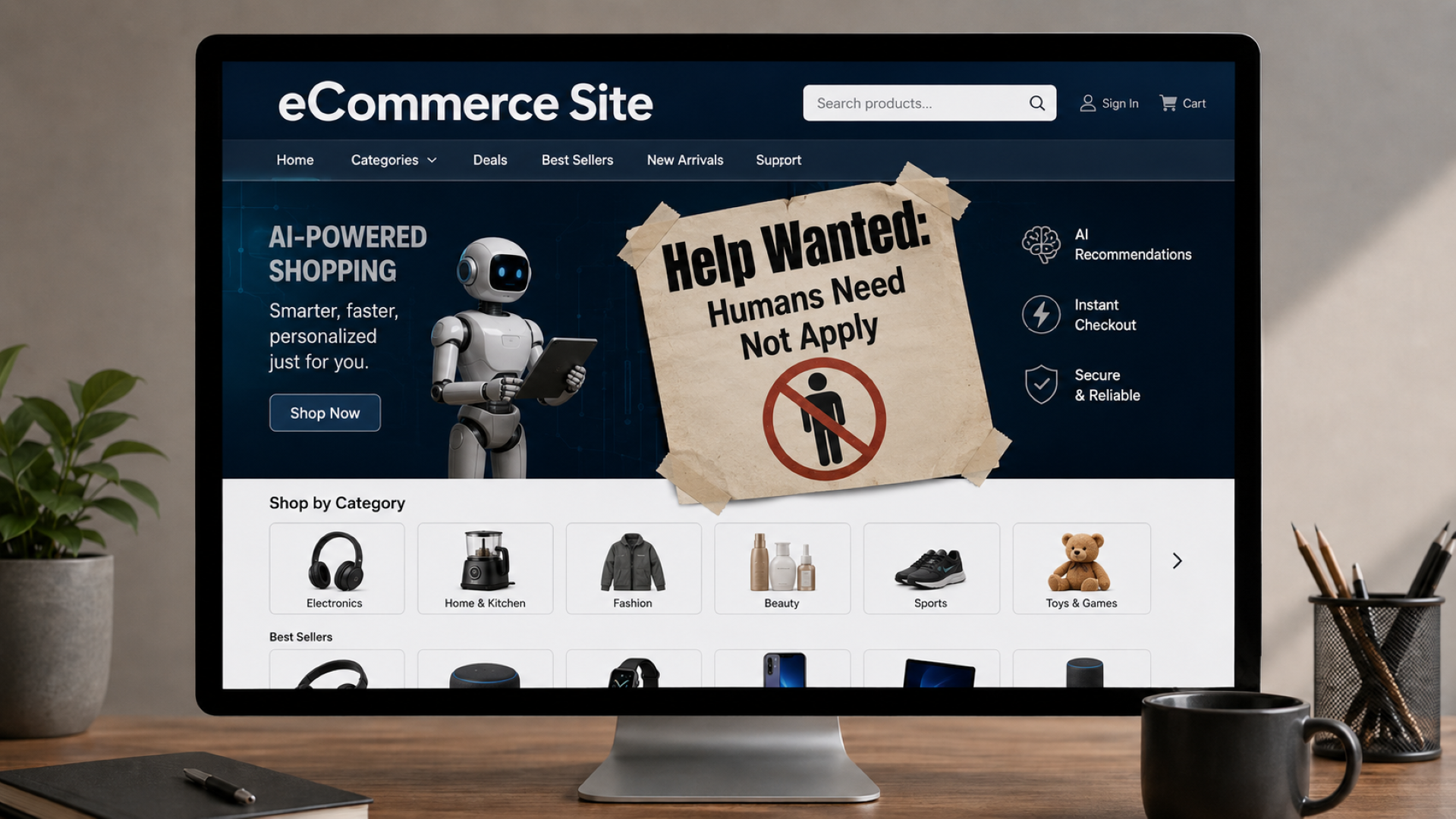
Therapists who support technology professionals have noticed a recent spike in anxiety among knowledge workers who fear that artificial intelligence is coming for their jobs. eCommerce companies are fully embracing AI. Anyone looking into their crystal ball will see dramatic change ahead in the eCommerce industry, but should eCommerce professionals be worried about their jobs? The short answer is that change is accelerating and that everyone needs to embrace some new realities.
Similar to how the nineteenth-century town lamplighter must have felt when electric light became a reality, there is a real fear that the work of eCommerce professionals may no longer be a job for humans. Today, we shed few tears for the lamplighters of yesteryear, but the threat to careers within the eCommerce community is alive and well. Customer service representatives, inventory managers, content creators, and product managers alike are being asked to incorporate AI technologies with no guarantee that their services will be needed in the future.
eCommerce employees may be more vulnerable than employees in other industries. eCommerce automates the purchase process, making it a natural for AI to help improve the way companies promote products, communicate with customers, engage shoppers, provide support, and process a sale. Most eCommerce strategies haven’t changed much over the last few decades, but it’s easy to predict that AI will have a significant impact on the industry’s workflow. Change creates some professional risk.
It seems clear that shoppers will benefit from AI. It’s equally clear that AI can help eCommerce teams elevate their ability to attract, engage, and close customers. Finally, it should not be a surprise that eCommerce professionals will need to evolve how they deliver value to their organizations.
This article attempts to address a few questions eCommerce professionals are asking:
- How aggressive should we be at adopting AI into our jobs?
- What’s the role for humans as AI plays a larger role?
- How can we protect our careers?
This article has not been written by AI. The themes and ideas were inspired, researched, and written by real humans. That said, AI absolutely played a supporting role in writing this article, but humans are responsible for the analysis and recommendations.
The Beauty of AI
There is little question that AI has only just begun to reinvent the way people shop, and eCommerce sites will certainly need to embrace the technology and rethink the way they interact with shoppers. This new technology has the potential to deliver a more personalized shopping experience, provide more answers to pre-sales questions, and become something akin to the best possible sales associate you have ever encountered.
While customer-facing AI capabilities will clearly raise the eCommerce game, AI will also play a large role behind the scenes supporting business processes. As recently as a year ago, teams needed an army of technology leaders and programmers to implement software functionality that today might be developed by simply describing the required functionality to AI.
Most of us are still discovering just how powerful AI has become. While it may not appear to be a direct threat to eCommerce careers today, it’s clear that much of what humans do today will be managed by machines in our future. Children born today will marvel that there was a day when humans had to do so many jobs that are clearly better performed by computers.
It’s increasingly clear that AI’s strengths will soon reshape most eCommerce shops, but before we can build an AI-proof career plan, we need to be clear about AI’s weaknesses.
AI Weaknesses
Neither humans nor AI are perfect. Even as AI evolves, its imperfections are not likely to disappear because its weaknesses are closely tied to its strengths.
It’s well documented that AI can hallucinate and jump to conclusions that are not well-founded in fact. This is especially concerning in an eCommerce environment where customers expect product descriptions to be accurate.
Part of intelligence is recognizing that mistakes are possible, but AI struggles to differentiate between a verified conclusion and a guess. Sometimes it feels like AI is that know-it-all sitting at the end of the bar. The smartest humans have something called “intellectual humility” which recognizes that our beliefs and conclusions could be wrong. This helps us to ask more questions and be open to change.
Even if AI is correct 95% of the time, that still means it makes mistakes one out of 20 times. When it comes to product descriptions, attributes, compatibility or customer commitments, this may represent an unacceptable risk. Yet unless instructed to ask questions, AI rarely says things like “I’m not sure” or “I need to ask more questions before I can help.”
Traditional search provides trusted sources of information and lets you come to your own conclusions, but AI goes beyond that. AI can infer, brainstorm, generalize, analogize, and imagine, delivering very human-like results. These same strengths also create potential weaknesses and opportunities to make mistakes that are especially risky in an eCommerce environment.
Artificial intelligence may sometimes feel like one of the company’s strongest contributors, but like any employee, AI needs a human to provide context, establish guidelines, identify communication gaps, deliver feedback, and insert the intellectual humility that AI needs to deliver higher-confidence results.
While AI has well-understood weaknesses, that won’t stop it from dominating this industry.
The Shifting Purchase Journey
The way people search and shop is fundamentally changing. Customers have historically spent most of their purchase journey on eCommerce sites, getting educated on the category, comparing solutions, identifying products, and making a final purchase choice.
Consider the example of a customer searching for a laser printer. On a typical eCommerce site today, a strong query might be “wireless monochrome duplex laser printer,” which would produce a list of possible options. But not every customer knows that “duplex” means two-sided printing, and even that search may not fully capture the customer’s actual requirements. With an AI chatbot, the customer might instead ask, “Recommend a wireless monochrome laser printer that prints on both sides, has a 250-sheet paper tray, and is fast enough to support a small medical office.” That kind of interaction gets the customer to a smaller and more relevant set of options faster because the buyer is no longer just searching by keyword; they are describing the job the product needs to perform.
As buyers embrace AI, customers will spend more of their purchase journey with AI. That means they will come to eCommerce sites later in the process having likely already narrowed their purchase options.
If customers arrive later in the purchase journey, then eCommerce homepages, category pages, buying guides and comparison matrices are all likely to have less impact and get fewer eyeballs. Compared to AI chatbots, many eCommerce site search experiences feel antiquated. As buyers increasingly use AI to help narrow their purchase options, the eCommerce product detail pages (PDPs) will increasingly become the site’s most important pages. As traffic declines and concentrates around the PDP, eCommerce teams will need to employ new optimization strategies and improve their ability to convert the referral traffic that they get.
If AI narrows the buyer’s options before the customer even arrives at your site, then the PDP has to work harder. It may need to address concerns, answer final questions, demonstrate compatibility, confirm an application, establish trust and close the sale all on one page.
This article only scratches the surface of changes that will need to come to every eCommerce site. Beyond any AI tools eCommerce teams embrace internally, these changes to the shopping world will require sites to fundamentally rethink their product detail pages to be relevant in an AI world.
What AI Won’t Change
What will not change is the bundle of human considerations that customers make on their way to a purchase.
Convincing someone to buy online typically requires winning both a human’s head and heart. Said another way, buyers need both the rational validation and the emotional conviction to place an order. The head is the analytical side that considers the facts, feeds, and figures. The heart, however, reflects the desire, urgency, trust, and confidence. AI is not human, has no heart and likely needs human help to deliver a complete strategy.
Purchases happen when a buyer is convinced that the product will accomplish the buyer’s needs, but that purchase decision also requires convincing a human that this is their best option, that the seller is trustworthy, and that it’s worth the price. AI isn’t going to recognize when a site looks “sketchy” where trust falls, but humans know sketchy when they see it.
We’ve reviewed AI’s strengths, weaknesses and have some sense of both the opportunities AI creates and the potential threats it brings. Our next step is to build a career plan for eCommerce professionals.
An eCommerce Professional’s Game Plan
Let’s look at the role for humans in an AI-dominated world. Humans don’t want to cling to duties that AI does really well. Instead, humans need to position themselves as a necessary component to successfully implementing AI.
The benefits of being human:
- eCommerce buyers are human and humans can do a better job of helping a site connect with customers.
- Humans can drive the unique elements that give a site its personality and its competitive differentiation that drives buyer loyalty. Any industry dominated by AI runs the risk of becoming homogenized if AI is calling all the shots.
- Humans can provide AI with the leadership it needs to provide context, prioritize objectives, set guidelines and guardrails. Humans can provide the judgment and decision-making required to deploy AI with confidence.
The advice that follows is appropriate for all eCommerce professionals, but it will need to be customized to the individual.
- Embrace AI. Don’t find yourself on the wrong side of AI. It’s coming and you need to embrace it. While AI may come with some personal threat to your career, it’s better to be a change leader than to be led by change.
- Move from execution to direction. Humans will win by becoming AI leaders who define the strategy, set the standards, and direct the execution. This requires that the humans become both business and AI experts. It’s important to understand how AI works, what it’s capable of and where its weaknesses are.
- Develop your prompt prowess. Writing AI prompts is something anyone can do and yet there are real skills required to ensure that AI performs to expectations. In one recent test two people were asked to rewrite some PDP content using AI. One person’s prompt was just a paragraph long while the other wrote 7 pages and 1,500 words. The longer version delivered error-free results while the shorter version had numerous errors. Longer doesn’t always win but experimenting with different prompt strategies will.
- Become the customer expert. No machine can replace the human ability to identify purchase obstacles, appreciating customer concerns, and incorporating competitive alternatives into the purchase calculus that all humans make.
- Amplify your judgment. It’s not enough to have expertise in areas where AI shows weakness, you need to be prepared to disagree and overrule AI when its nonhuman approach misses the mark. Questions about purchase risk, trust elements, differentiation, customer targeting and branding will require a heavy human hand. It’s not going to be enough to think an AI result misses the mark, your value will only be recognized when you forcefully and confidently implement your judgment.
- Reinvent your role. This may be both the hardest career move and the most important. This requires that you anticipate the roles that AI will play, figure out how you can lead AI, and convince others that you will play a critical role in the success of implementing these automated solutions.
- Be in a hurry. One thing is clear, the shift toward AI solutions is moving at a pace faster than anything we’ve seen in our industry. Change is always difficult, but success requires that we embrace this change with a sense of urgency.
If your job is task oriented today, you need to elevate the strategic elements of your role. AI will continue to cannibalize much of what humans have historically done and it’s important to pivot in your career to become an AI leader and not simply an organizational follower. The future for eCommerce professionals is unlikely to look like the past. You should try to play a role in redesigning your own role for the organization’s future.
Think about your career as you might think about a product for sale online. It’s important that your personal features and benefits stand out relative to alternatives. Think about differentiating yourself as you might a product.
Finally, it is important for humans to think of machines as the tools that they are. Instead of a mindset designed to beat AI, we humans need to think about how to leverage AI to make humans more valuable. Make AI a part of your personal success.
The future does not belong to eCommerce professionals who try to work harder than AI. It belongs to those who know how to direct it, challenge it, and integrate human judgment to earn customer trust, improve engagement, address customer concerns and convert more shoppers.
About the Author
Greg Harris is the President of DynEcom, where he helps eCommerce firms use AI to optimize their product content, raise their search visibility, and convert more site visitors. He began his career as a direct marketing specialist before evolving into an eCommerce executive. Greg has over 25 years of experience building, optimizing and growing eCommerce sites before specializing in AI for eCommerce.

Greg Harris is the President of DynEcom and an eCommerce marketing strategist focused on product content, competitive research, SEO, AI search visibility, and conversion. His work emphasizes the role of product pages as both discovery assets and decision-support systems. Greg has specialized in direct marketing and eCommerce techniques for over forty years. He has helped more than 50 eCommerce businesses improve their online visibility, traffic, and revenue.