
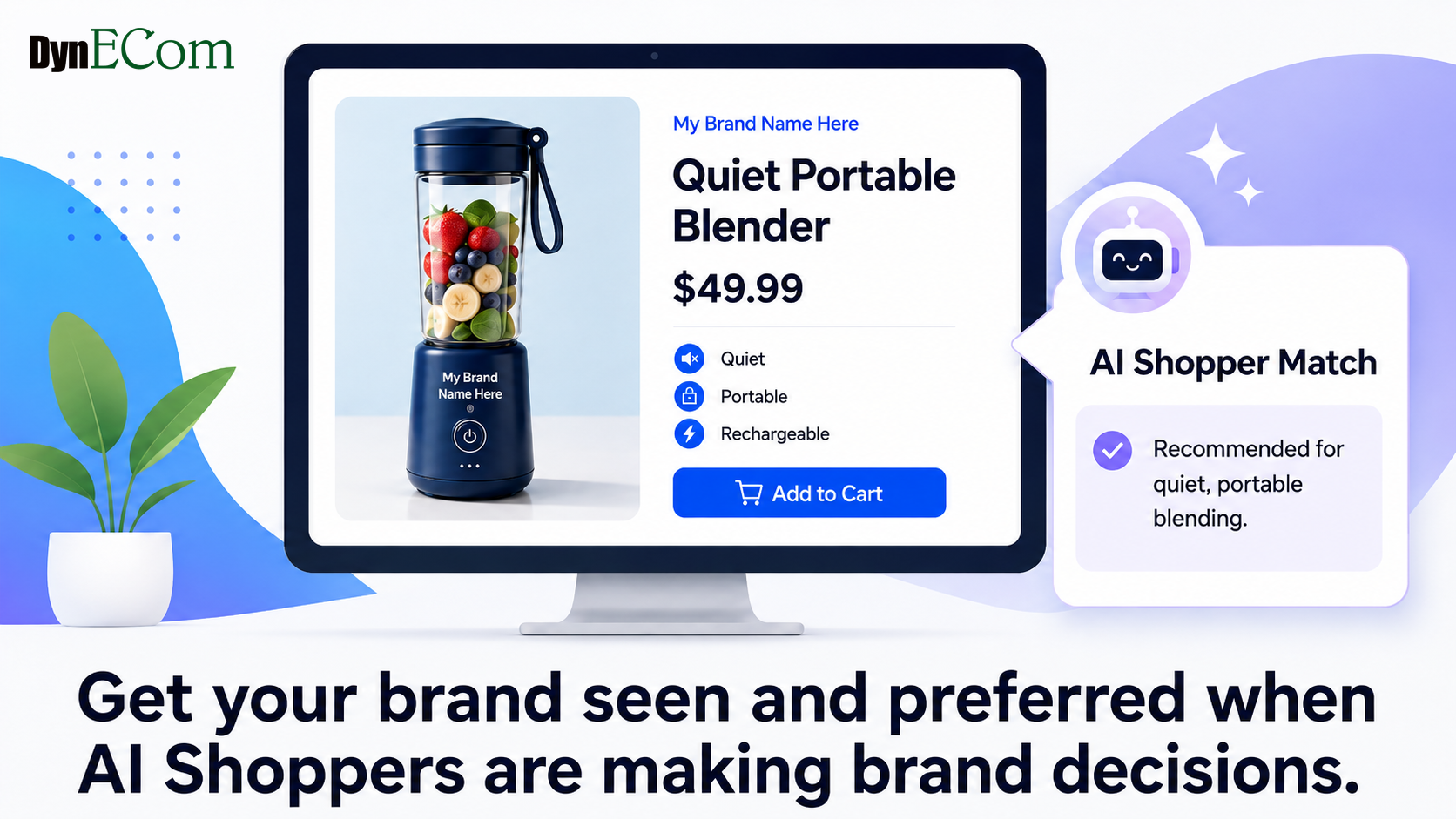
Position Your Products for AI When Shoppers Are Deciding What to Buy
AI chatbots are changing where brand selection happens. A shopper no longer has to begin with a search for a specific manufacturer or model. They can ask, “What’s the best lightweight portable generator for camping that is quiet enough for a campground?” and let an AI system help identify requirements, compare options, and narrow the field.
For eCommerce sites that largely sell their own brand, that creates both a risk and an opportunity. If AI systems do not have enough information to understand where your products fit, competitors may enter the consideration set first. Complete product pages can help AI introduce your brand before the shopper has decided what brand to buy.
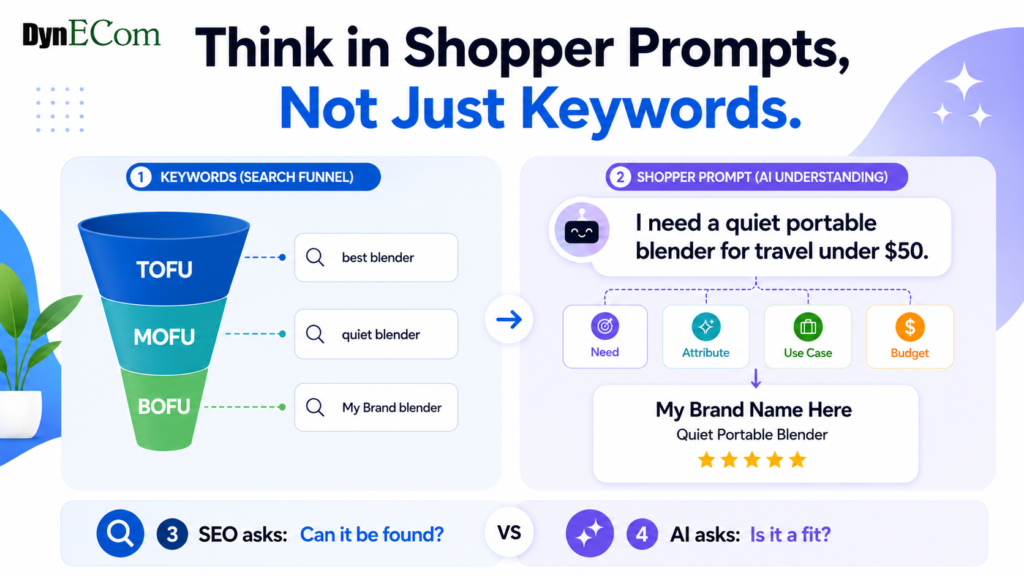
Traditional SEO asks, “Can the search engine find this product?” AI optimization increasingly asks, “Does the AI have enough evidence to decide that this is the right product for this particular shopper?”
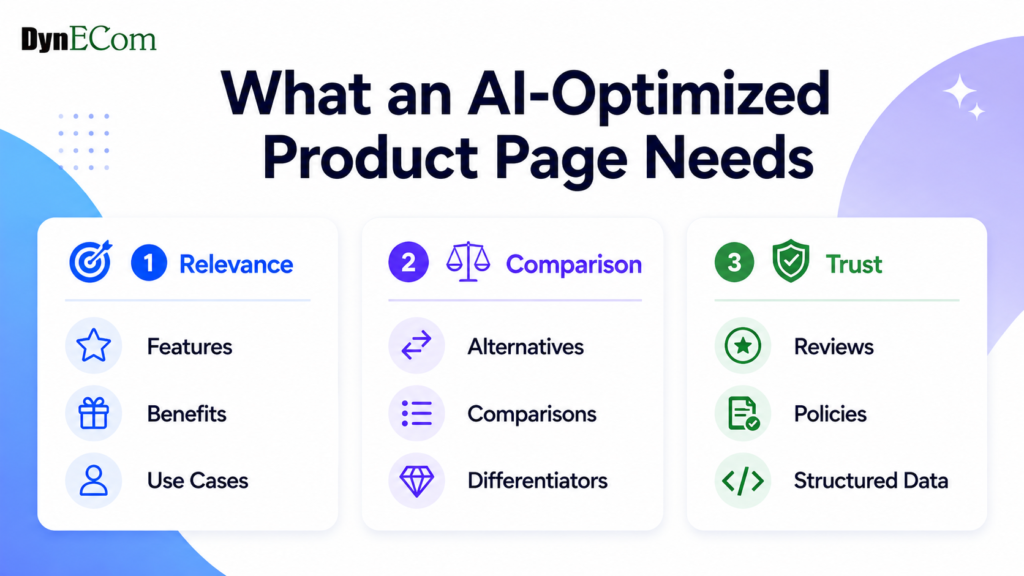
Expand Your Product’s Relevance
Many eCommerce product pages are built primarily for bottom-of-funnel searches: “Acme Model 500,” “Acme Model 500 price,” or “buy Acme Model 500.” Those searches matter, but they assume the shopper already knows the brand and product.
AI creates an opportunity to compete earlier, particularly in the middle of the funnel. A shopper may know the type of solution needed without knowing the brand or model. Their request might be “best generator for RV camping,” “portable generator under $1,000,” or “alternative to Brand X.”
The objective is product relevance expansion: give AI enough legitimate information to connect a product to more needs, applications, attributes, audiences, and buying criteria. That matters especially for own-brand products with limited third-party information online.
Stop Thinking Only in Keywords. Start Thinking in Shopper Prompts
Keyword research remains important, but conversational AI lets shoppers express several buying criteria at once. “Portable generator” can become: “I need a generator for a travel trailer that two people can lift, is quiet enough for a campground, can run an air conditioner, and costs under $1,200.”
That changes content planning. Brands should consider prompt families built around how shoppers evaluate products: product plus application, problem plus desired outcome, product plus audience, required attributes, compatibility, price, multiple constraints, competitor alternatives, and “best for” scenarios.
This is where a mid-funnel keyword strategy becomes a mid-funnel intent strategy. The goal is not to stuff conversational phrases into a PDP. It is to provide the facts and context AI needs to evaluate product fit.
Give AI Enough Information to Understand the Product
Many PDPs contain specifications without explaining what those specifications mean. “12 lb.” is data. “At 12 lb., this product is designed for applications where portability matters” establishes relevance.
A strong product page should clearly communicate product category and subcategory, primary function, important specifications, features, benefits, applications, appropriate audiences, compatibility, limitations, requirements, and variants. Relevant category-level knowledge should also appear on the PDP rather than assuming the shopper arrived through a category page or buying guide.
AI needs facts, but it also needs relationships between facts. The more clearly a page explains those relationships, the easier it becomes to understand product fit.
Translate Features Into Needs, Benefits, and Use Cases
An own-brand product can satisfy a shopper’s requirement without ever saying so explicitly. An IP67 enclosure is a product fact. A shopper may instead ask whether the product can be used outdoors in bad weather.
A useful content framework is:
Attribute -> Capability -> Benefit -> Application -> Customer
This turns raw product data into feature-and-benefit bullets, application content, customer scenarios, FAQs, and product descriptions while creating scalable SKU-level differentiation.
The objective is not to invent more claims to make a product appear relevant. It is to surface legitimate relevance that may currently be hidden inside technical specifications or assumed product knowledge.
Compete Before the Shopper Knows Your Brand
For reseller products, competitive content can be created by comparing identical products sold across multiple sites. Own-brand products require a different approach because exact matches may not exist.
DynEcom’s approach is to create Competitive Gap Content and Competitive Comparison Content.
Competitive Gap Content starts with important mid-funnel searches and shopper prompts. Identify the brands and products that already appear for those needs, then analyze their content. What applications do they discuss? Which benefits and attributes do they emphasize? What selection criteria, audiences, questions, and concerns do they address?
The goal is not to copy competitor claims. Use competitors to identify legitimate questions your own content has failed to answer, then research, verify, and fill those gaps.
Borrow Competitor Visibility Through Direct Comparisons
Competitive Comparison Content takes the strategy one step further. If shoppers and AI systems already recognize leading competing brands, use that existing visibility to establish where your product fits.
Create substantiated “Brand A vs. Brand B,” “alternative to Brand B,” comparison-table, and product-selection content. Near-match products can be compared on objective criteria such as dimensions, capacity, materials, features, warranty, application, and price/value.
The strongest comparison is not simply “ours is better.” It explains why differences matter and when your product is the better choice. That gives AI useful information for questions such as “What are alternatives to Brand B?” or “Which product is better for my particular requirements?”
Give AI Reasons to Trust Your Claims
A manufacturer claiming its own product is superior is naturally self-interested. Strong PDPs therefore need to prioritize proof over promotion.
Trust can be strengthened with customer reviews, certifications, testing data, warranty information, manuals, specifications, demonstrations, original imagery and video, independent reviews, awards, clearly documented policies, and consistency throughout the site.
Keep product information current. Prices, availability, specifications, warranty terms, comparisons, and policies that contradict other sources can undermine confidence. Fresh content that is current and up to date is a trust signal that it’s accurate, consistent, and verifiable product information.
Make the Product Machine-Readable
The PDP is only one representation of the product. Visible copy should align with product schema, merchant feeds, product titles, SKU and model identifiers, pricing, availability, variants, images, shipping, and returns.
AI needs both product knowledge – the content explaining what the product does and why it is relevant – and product access through structured, distributed information that systems can ingest and interpret.
A strong product-information architecture supports both traditional search and emerging AI shopping experiences.
Optimize the PDP for the Shopper AI Sends You
AI may perform a larger share of the research and comparison process before the shopper clicks. That can produce visitors who arrive directly on a PDP with more knowledge, a narrower consideration set, fewer pageviews, and higher expectations.
The PDP therefore has to carry more of the selling burden. It should explain why to buy the product, why to buy the brand, and why to buy directly from the manufacturer. Manufacturer advantages can include technical expertise, authoritative specifications, a complete assortment, replacement parts, warranty authority, customer support, and product-selection expertise.
Add price and value justification, shipping, returns, availability, reviews, FAQs, common concerns, compatibility information, and a clear call to action. In other words, bring site-level trust down to the SKU level. Do not assume the shopper visited the homepage, About page, category page, or buying guide first.
Optimize for Selection, Not Just Citation
AI citation, AI visibility, AI consideration, AI referral, and AI conversion are different outcomes. Being cited is useful, but it is not the business objective.
For an eCommerce brand, success means increasing the likelihood that a product becomes one of the recommended solutions, earns the click when a click is required, and converts the resulting high-intent shopper.
That requires more than promotional copy. Brands need to be more relevant, more complete, and more credible than the products competing for the same AI-mediated buying decision.
Your PDP Is Becoming a Sales Pitch to Both the Shopper and AI
Own-brand eCommerce sites can no longer optimize only for customers who already know their brand. Each PDP should establish what the product is, which needs it addresses, who it is for, why it belongs in the consideration set, how it compares, why its claims should be trusted, and why the shopper should purchase.
The brands that provide the clearest evidence for recommending their products have an opportunity to gain access to buyers before those buyers have decided which brand to buy.
Worry less about promotional volume and more about useful information with strong trust signals. Deliver more complete product information than the brands competing with you for AI visibility. Keep it accurate and current. Brand sites will want to give the customer the information they are seeking when they narrowing their options but before they settle on a specific solution.
Rethink Marketplace & Reseller Strategies
Many companies provide product content to both Marketplaces and eCommerce resellers. The default mode for most is to create manufacture approved content that gets used and reused across their sales channels. The better strategy is to customize this strategy and deliver custom content to every sales channel partner. AI Chatbots are optimized for long-tail queries that are specific to the shopper. It’s difficult to optimize for every possible query on a single product page but spread across a many sites, it gives manufacturers an opportunity to dramatically expand their relevance, raise the value of the content they provide and increase the brand’s visibility.
- Duplicative content has little search value for either AI or traditional search. In both cases these search engines value and reward original content.
- Using different variants of keywords, use cases, and customer inspired content can dramatically expand the brand’s visibility across its sales channels.
Be more relevant. Be more complete. Be more credible.
Learn more about Competitive Content for brands by contacting DynEcom.com/contact-us.

Greg Harris is the President of DynEcom and an eCommerce marketing strategist focused on product content, competitive research, SEO, AI search visibility, and conversion. His work emphasizes the role of product pages as both discovery assets and decision-support systems. Greg has specialized in direct marketing and eCommerce techniques for over forty years. He has helped more than 50 eCommerce businesses improve their online visibility, traffic, and revenue.