
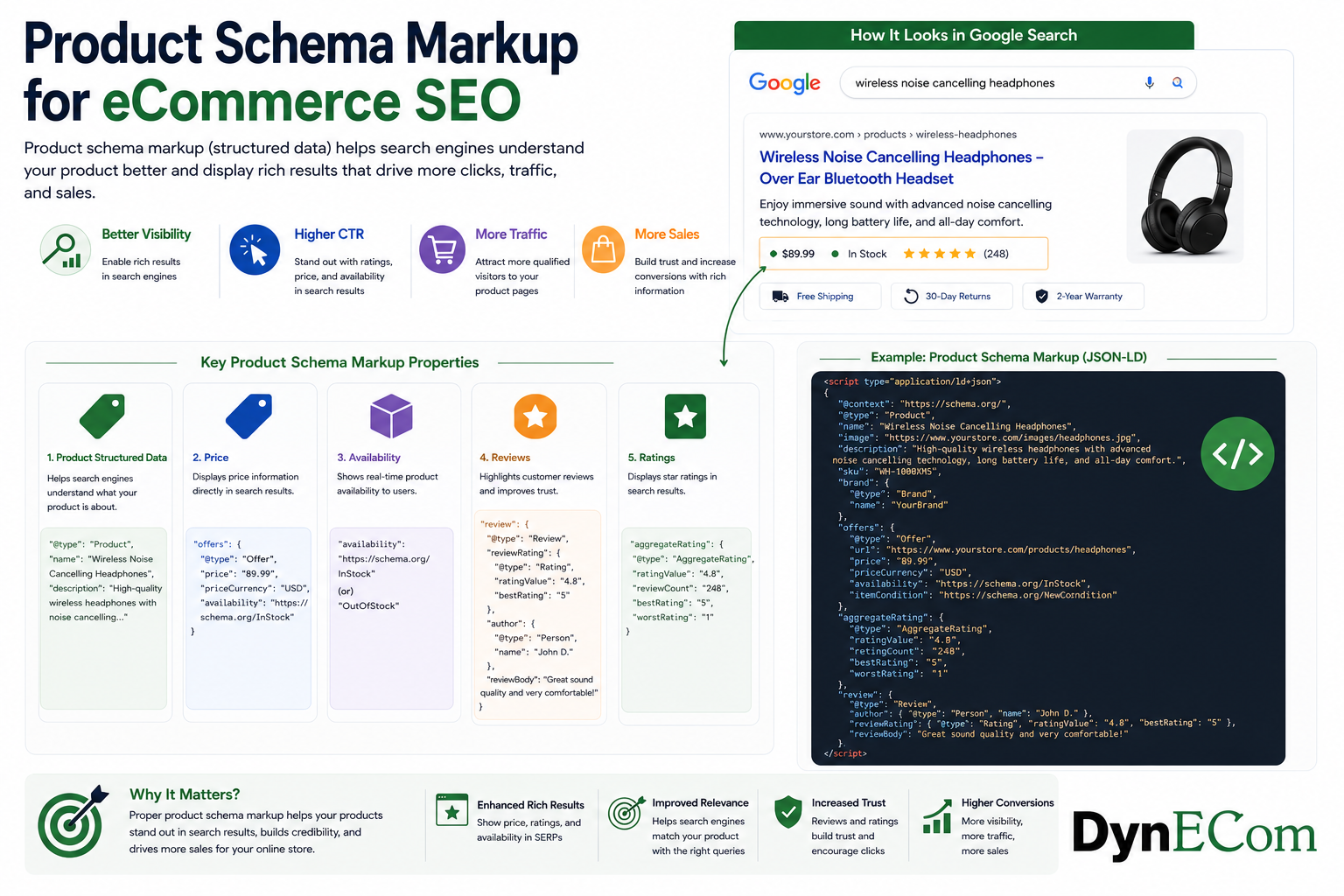
Why Product Schema Markup Matters in eCommerce SEO
Search engines are becoming increasingly sophisticated, but they still need help understanding the information on web pages. An online store may clearly display a product name, price, availability, and customer reviews, but search engines need structured information to interpret these details correctly.
This is where product schema markup becomes important.
Product schema markup is a type of structured data that helps search engines understand product information and display enhanced search results, also known as rich results.
For eCommerce businesses, schema markup can help search engines identify:
- Product names
- Brands
- Prices
- Availability
- Reviews
- Ratings
- Product variations
When implemented correctly, product schema markup can improve:
- Search visibility
- Click-through rates
- Customer trust
- Organic traffic
- Product discoverability
Whether you operate a Shopify store, WooCommerce website, Amazon brand store, Walmart Marketplace presence, or DTC website, structured product data plays an important role in modern eCommerce SEO.
What Is Product Schema Markup?
Product schema markup is a structured data format that provides search engines with detailed information about a product.
It uses a standardized vocabulary called Schema.org and is usually implemented using JSON-LD (JavaScript Object Notation for Linked Data).
Instead of search engines trying to interpret information manually, schema provides clear signals.
For example:
Without schema:
Running Shoes
$99.99
Available
⭐ 4.7 rating
Search engines may understand this information differently.
With product schema:
{
 "@type": "Product",
 "name": "Running Shoes",
 "brand": "Example Brand",
 "offers": {
   "price": "99.99",
   "availability": "InStock"
 },
 "aggregateRating": {
   "ratingValue": "4.7"
 }
}- This is a product
- The price is $99.99
- The product is available
- Customers rated it 4.7 stars
Why Product Schema Markup Is Important for eCommerce SEO
1. Improves Search Result Appearance
One of the biggest benefits of product schema markup is enhanced search listings.
Instead of a standard search result:
Ergonomic Office Chair | Brand Website
Google may display:
Ergonomic Office Chair
⭐ 4.8 (850 reviews)
$199.99
In Stock
These enhanced results are called rich results.
They provide shoppers with more information before clicking.
2. Increases Click-Through Rate (CTR)
Search results with:
- Ratings
- Prices
- Availability
- Product information
are more attractive to users.
Example:
Result A:
Wireless Headphones
Result B:
Wireless Headphones
⭐ 4.7 rating
$79.99
Free Shipping
Many shoppers are more likely to click Result B because they immediately see important purchase information.
3. Helps Search Engines Understand Products
Large eCommerce websites often contain thousands of pages.
Search engines need help understanding:
- Product relationships
- Variations
- Pricing
- Inventory status
- Reviews
Schema markup creates clearer communication between websites and search engines.
Key Elements of Product Structured Data
Product schema markup includes multiple important fields.
The most important elements for eCommerce SEO are:
- Product information
- Price
- Availability
- Reviews
- Ratings
1. Product Structured Data
Product structured data tells search engines what the product is.
Important fields include:
Product Name
Example:
Ergonomic Office Chair with Lumbar Support
This helps search engines identify the product.
Brand Information
Example:
Brand: Chromcraft
Brand information helps connect products with brand searches.
Product Description
The description provides additional context.
Example:
Adjustable office chair designed for comfortable home and professional workspaces.
Product Identifier
Useful identifiers include:
- SKU
- GTIN
- UPC
- MPN
Example:
SKU: CHAIR-12345
GTIN: 008123456789
These help search engines distinguish products.
Product Schema Example
A basic product schema may include:
{
 "@context": "https://schema.org",
 "@type": "Product",
 "name": "Ergonomic Office Chair",
 "brand": {
   "@type": "Brand",
   "name": "Example Brand"
 },
 "description": "Ergonomic office chair with adjustable lumbar support"
}
2. Price Schema Markup
Price information is one of the most important elements for eCommerce websites.
Customers want to know:
- How much does it cost?
- Is it within my budget?
- Is there a discount?
Product schema can communicate:
- Current price
- Currency
- Price range
- Sale price
Example:
Product:
Wireless Earbuds
Schema information:
Price: $49.99
Currency: USDPrice Schema Best Practices
✅ Keep prices updated
✅ Include correct currency
✅ Match website price
✅ Update sale prices correctly
Incorrect pricing information can create trust issues and may prevent rich result eligibility.
3. Availability Schema Markup
Availability tells search engines whether customers can purchase a product.
Common availability values:
- InStock
- OutOfStock
- PreOrder
- LimitedAvailability
Example:
Availability: InStockWhy Availability Matters
Imagine a customer clicks a product expecting availability but finds:
Out of Stock
This creates a poor experience.
Accurate availability schema helps search engines provide better information.
Availability Best Practices
✅ Update inventory status frequently
✅ Remove unavailable products properly
✅ Use accurate availability values
✅ Avoid showing false availability
4. Review Schema Markup
Customer reviews are powerful trust signals.
Review schema helps search engines understand:
- Number of reviews
- Review content
- Review authors
- Review dates
Example:
Product:
Running Shoes
Reviews:
“Very comfortable for long-distance running.”
Schema communicates:
Review:
Rating: 5
Author: Customer
Benefits of Review Schema
Reviews can improve:
- Search appearance
- Customer confidence
- Click-through rates
Products with ratings often attract more attention compared to products without review information.
Review Schema Best Practices
✅ Use genuine customer reviews
✅ Display reviews visibly on pages
✅ Match schema data with visible content
✅ Avoid fake reviews
5. Rating Schema Markup
Rating information summarizes customer satisfaction.
Common rating fields:
- Average rating
- Total reviews
- Rating scale
Example:
Rating Value: 4.8
Best Rating: 5
Review Count: 1250
Search engines may display:
⭐ 4.8 (1,250 reviews)
in search results.
Product Schema Markup Example
A complete product page may include:
{
 "@type": "Product",
 "name": "Wireless Headphones",
 "brand": "Example Brand",
 "offers": {
   "@type": "Offer",
   "price": "79.99",
   "priceCurrency": "USD",
   "availability": "https://schema.org/InStock"
 },
 "aggregateRating": {
   "@type": "AggregateRating",
   "ratingValue": "4.7",
   "reviewCount": "850"
 }
}
Product Schema Markup for Different eCommerce Platforms
Shopify Product Schema
Shopify themes often include basic product schema automatically.
However, brands should verify:
- Product details
- Reviews
- Pricing
- Availability
Additional apps or custom implementation may improve schema coverage.
WooCommerce Product Schema
WooCommerce provides built-in structured data, but businesses should check:
- Product variations
- Inventory status
- Review markup
- Price accuracy
Amazon Product Listings
Amazon sellers cannot directly control traditional website schema, but they optimize equivalent structured product information through:
- Product titles
- Bullet points
- Attributes
- Backend data
- A+ Content
Walmart Marketplace
Walmart sellers improve product discoverability through:
- Complete attributes
- Accurate specifications
- Rich content
- Reviews
- Product information quality
While marketplace sellers may not directly implement schema, accurate structured product data improves marketplace understanding.
Common Product Schema Markup Mistakes
1. Incorrect Price Information
Problem:
Website price:
$99
Schema price:
$79
This creates inconsistency.
2. Missing Availability Updates
A product marked “In Stock” when unavailable creates poor customer experience.
3. Fake Reviews or Ratings
Search engines require review markup to represent genuine customer feedback.
4. Missing Product Identifiers
Adding:
- SKU
- GTIN
- Brand
improves product understanding.
5. Implementing Schema Incorrectly
Common technical issues:
- Invalid JSON-LD
- Missing required fields
- Incorrect formatting
Always validate schema before publishing.
How to Test Product Schema Markup
Brands can validate structured data using tools such as:
- Google Rich Results Test
- Schema Markup Validator
- Google Search Console enhancements report
Check:
✅ Product eligibility
✅ Missing fields
✅ Errors
✅ Warnings
Product Schema Markup SEO Checklist
| Element | Optimization Check |
|---|---|
| Product Name | Accurate and keyword optimized |
| Brand | Correct brand information |
| Description | Unique product description |
| Price | Matches website price |
| Currency | Correct currency format |
| Availability | Updated inventory status |
| Reviews | Genuine customer reviews |
| Ratings | Accurate rating values |
| SKU/GTIN | Added where applicable |
| Validation | Tested with schema tools |
Future of Product Schema Markup and AI Search
As search engines and AI shopping assistants become more advanced, structured product data will become increasingly important.
AI systems need reliable information to answer questions like:
- “Which laptop is best under $1,000?”
- “Show me highly rated office chairs available today.”
- “Compare these three products.”
Brands with complete and accurate product data will have a better chance of being recommended.
Final Thoughts
Product schema markup is a critical component of modern eCommerce SEO.
It helps search engines understand product information and allows brands to create richer, more informative search experiences.
By optimizing:
- Product structured data
- Prices
- Availability
- Reviews
- Ratings
eCommerce businesses can improve visibility, increase click-through rates, and create stronger connections with potential customers.
For Shopify brands, Amazon sellers, Walmart sellers, and DTC businesses, structured product data is no longer an advanced SEO tactic — it is a fundamental requirement for competing in today’s digital commerce landscape.
Looking to dive deeper into eCommerce SEO? Our Ultimate eCommerce SEO & GEO Guide for 2026 is a complete resource packed with actionable strategies, best practices, and real-world examples to help online stores improve rankings, traffic, and revenue. Read it here: https://dynecom.com/the-ultimate-ecommerce-seo-geo-guide-for-2026/

Dharmendra Tripathi is a Senior Digital Marketing & Customer Success leader with deep expertise in eCommerce SEO, performance marketing, and marketplace growth. With years of experience managing SEO and advertising campaigns across Google, Meta, Amazon, Walmart, and Shopify, he helps brands improve search visibility, maximize advertising ROI, and accelerate online sales. Passionate about AI-powered search, content optimization, and analytics, Dharmendra regularly shares actionable insights to help eCommerce businesses stay ahead in an evolving digital landscape.