
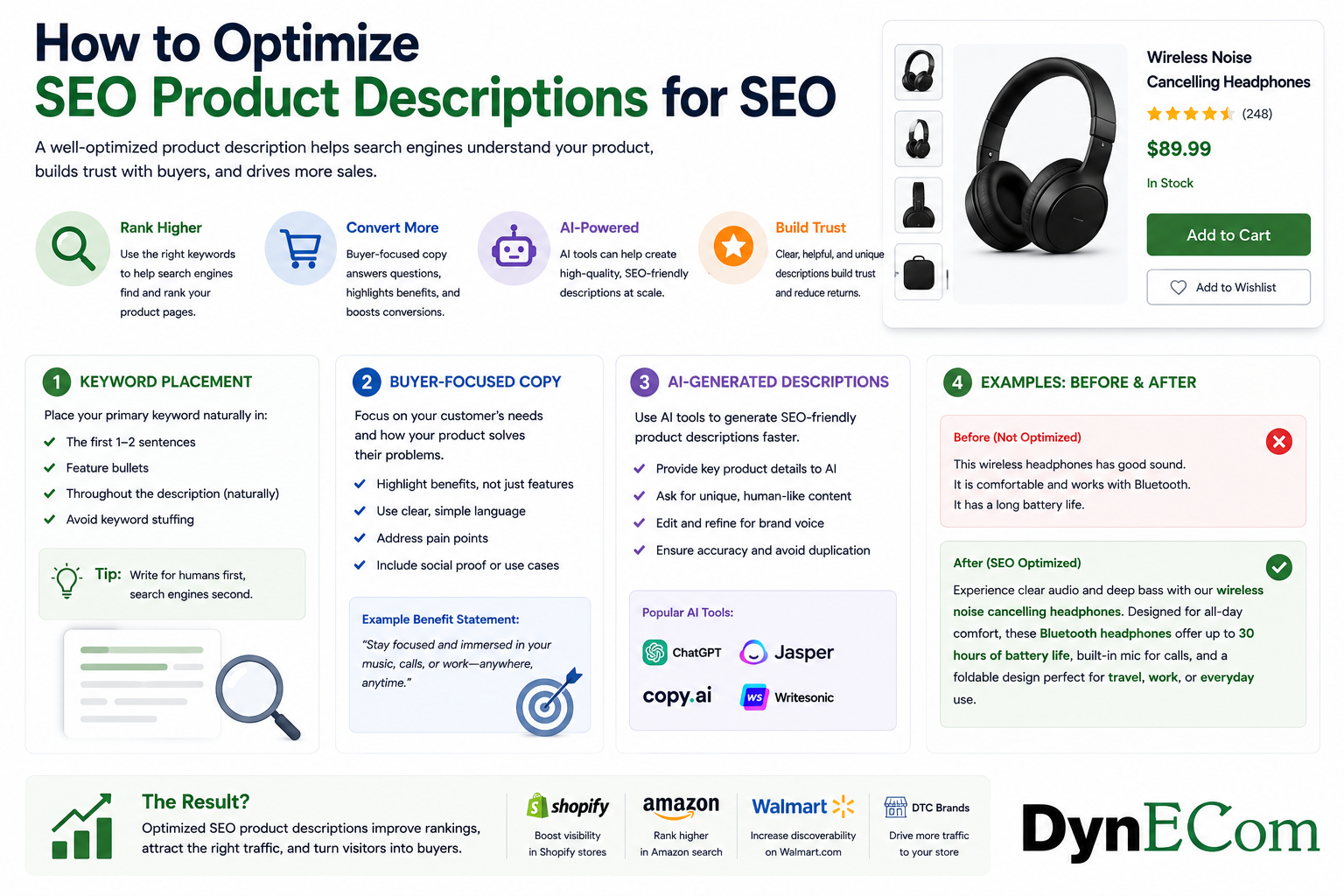
Why SEO Product Descriptions Matter
In eCommerce, a product description is more than just a list of features. It is a critical element that helps search engines understand your product and helps customers decide whether to buy.
A well-written SEO product description can:
- Improve organic search rankings
- Increase product visibility
- Target high-intent keywords
- Answer customer questions
- Build purchase confidence
- Improve conversion rates
Many online stores lose potential sales because their product descriptions are written only for search engines or copied directly from manufacturers. Modern SEO requires a different approach — creating content that satisfies both algorithms and customers.
The best SEO product descriptions combine:
- Keyword optimization
- Clear product benefits
- Customer-focused messaging
- Search intent alignment
- Unique brand positioning
Whether you sell through:
- Shopify
- Amazon
- Walmart Marketplace
- WooCommerce
- DTC websites
optimized product descriptions can significantly impact your organic growth.
What Are SEO Product Descriptions?
SEO product descriptions are product descriptions optimized with relevant keywords, useful information, and persuasive copy to help products rank higher in search results while encouraging customers to purchase.
A traditional product description may only explain:
“This chair features a padded seat and adjustable height.”
An SEO-focused description explains:
“Designed for modern home offices, this ergonomic office chair features adjustable lumbar support, breathable mesh material, and a padded seat to provide comfortable support during long work sessions.”
The second version:
- Includes relevant search terms
- Explains customer benefits
- Matches buyer intent
- Improves conversion potential
Why SEO Product Descriptions Are Important
1. Help Search Engines Understand Your Product
Search engines need context to determine:
- What your product is
- Who should see it
- Which searches it matches
A detailed description provides additional ranking signals.
Example:
A product page selling headphones should include relevant terms like:
- Wireless headphones
- Bluetooth headphones
- Noise cancelling headphones
- Long battery life
This helps search engines connect the product with relevant searches.
2. Capture Long-Tail Search Traffic
Many customers search using specific phrases.
Examples:
Broad keyword:
Office chair
Long-tail keyword:
Ergonomic office chair with lumbar support for home office
Long-tail searches often have:
- Lower competition
- Higher purchase intent
- Better conversion rates
SEO product descriptions allow brands to naturally target these valuable queries.
3. Improve Conversion Rates
SEO brings visitors, but descriptions help convert them into buyers.
Customers want answers:
- Does this solve my problem?
- Is it worth the price?
- How is it different?
- Is it suitable for my needs?
A strong description reduces uncertainty and improves purchase confidence.
How to Write SEO Product Descriptions
A high-performing product description follows three principles:
- Be discoverable
- Be helpful
- Be persuasive
1. Keyword Placement Strategy
Keyword placement is one of the most important parts of SEO product descriptions.
However, keywords should be included naturally — not forced.
Search engines are now better at understanding context and user intent.
Where to Place Keywords in Product Descriptions
Product Title
The title should contain the primary keyword.
Example:
Keyword:
Stainless steel water bottle
Title:
Stainless Steel Water Bottle with Leak-Proof Lid, 32 oz Insulated Design
First 100 Words
The beginning of the description carries strong relevance.
Example:
This insulated stainless steel water bottle keeps beverages cold for up to 24 hours and is designed for everyday hydration at work, travel, and outdoor activities.
Keywords included:
- stainless steel water bottle
- insulated water bottle
- hydration
Product Features
Use secondary keywords naturally.
Example:
Product:
Running shoes
Include:
- lightweight running shoes
- breathable athletic footwear
- cushioned running sneakers
FAQs
FAQs are excellent opportunities for long-tail keywords.
Example:
Question:
Are these running shoes suitable for long-distance running?
Answer:
Yes, these lightweight running shoes feature cushioned support designed for long-distance comfort.
Keyword Placement Example
Target Keyword:
“Ergonomic Office Chair”
Poor Keyword Usage:
Buy the best ergonomic office chair ergonomic chair office chair ergonomic furniture office chair.
This looks unnatural and hurts user experience.
Better Keyword Usage:
This ergonomic office chair is designed for professionals who need comfortable support during long working hours. The adjustable lumbar support and breathable mesh back help create a healthier workspace.
Natural, useful, and optimized.
2. Write Buyer-Focused Product Copy
One of the biggest mistakes brands make is writing descriptions that only describe features.
Customers buy benefits, not specifications.
Feature vs Benefit Writing
Example 1: Furniture
Feature:
Memory foam seat cushion
Buyer-focused:
The memory foam seat cushion provides enhanced comfort and support, making it ideal for long dining sessions or extended work periods.
Example 2: Electronics
Feature:
5000mAh battery
Buyer-focused:
The high-capacity battery provides extended usage throughout the day, reducing the need for frequent charging.
Example 3: Skincare
Feature:
Contains hyaluronic acid
Buyer-focused:
Formulated with hyaluronic acid to help maintain skin hydration and support a smoother, refreshed appearance.
Use the Customer’s Language
Good product descriptions reflect how customers think.
Instead of:
“Advanced thermal insulation technology”
Use:
“Keeps your drink cold all day, even during outdoor activities.”
The second version connects better with buyers.
3. Structure Product Descriptions for Maximum Impact
A strong product description structure:
Section 1: Product Introduction
Explain what the product is.
Example:
Designed for professionals working from home, this ergonomic office chair provides adjustable comfort and support.
Section 2: Key Benefits
Explain why customers need it.
Example:
- Supports comfortable sitting
- Reduces pressure during long work hours
- Adjusts to different body positions
Section 3: Features and Specifications
Include:
- Materials
- Dimensions
- Compatibility
- Technical details
Section 4: Use Cases
Explain where it fits.
Example:
Perfect for:
- Home offices
- Corporate workspaces
- Study areas
4. AI-Generated Product Descriptions: Benefits and Best Practices
Artificial intelligence has changed how brands create product content.
AI tools can help generate:
- Product descriptions
- Bullet points
- SEO content
- FAQs
- Comparison tables
However, AI-generated content still requires human review.
Benefits of AI Product Descriptions
Faster Content Creation
A brand with 5,000 products can create optimized drafts faster using AI.
Consistent Brand Voice
AI can help maintain consistent formatting across thousands of listings.
Keyword Optimization
AI tools can incorporate:
- Target keywords
- Related terms
- Search intent
Example AI Workflow
Input:
Product details:
- Product name
- Features
- Specifications
- Target audience
- Keywords
AI generates:
- SEO title
- Description
- FAQs
- Key benefits
Human review improves:
- Accuracy
- Brand tone
- Compliance
- Customer appeal
AI Product Description Mistakes to Avoid
1. Publishing AI Content Without Editing
AI may create:
- Incorrect claims
- Generic language
- Missing product details
Always review.
2. Overusing Keywords
AI should support SEO, not create keyword-stuffed content.
3. Losing Brand Personality
Customers connect with brands, not robotic descriptions.
Before and After SEO Product Description Examples
Example 1: Office Chair
Before:
Comfortable office chair with adjustable features. Made with quality materials. Good for home and office use.
Problems:
- Generic
- No keywords
- No customer benefits
After:
Upgrade your workspace with this ergonomic office chair designed for comfortable daily use. Featuring adjustable lumbar support, breathable mesh material, and customizable height settings, it helps create a supportive seating experience for home offices, professional workspaces, and study areas.
Benefits:
- Keyword optimized
- Customer-focused
- Better search relevance
Example 2: Water Bottle
Before:
Premium bottle made from stainless steel. Keeps drinks cold.
After:
Stay hydrated throughout the day with this insulated stainless steel water bottle featuring a leak-proof design and double-wall construction. Built for work, travel, fitness, and outdoor activities, it keeps beverages cold for hours while providing a durable reusable hydration solution.
Benefits:
- Includes search terms
- Explains use cases
- Improves purchase intent
Example 3: Amazon/Walmart Marketplace Listing
Before:
Wireless earbuds with good sound quality.
After:
Experience clear audio anywhere with wireless Bluetooth earbuds featuring noise reduction technology, comfortable ear fit, and long-lasting battery performance. Designed for music, calls, workouts, and everyday use, these earbuds provide reliable wireless connectivity throughout your day.
SEO Product Description Checklist
Before publishing, verify:
| Element | Completed |
|---|---|
| Primary keyword included naturally | ✅ |
| Product benefits explained | ✅ |
| Unique description created | ✅ |
| Customer questions answered | ✅ |
| Features converted into benefits | ✅ |
| Relevant secondary keywords included | ✅ |
| No keyword stuffing | ✅ |
| Mobile-friendly formatting | ✅ |
| Brand tone maintained | ✅ |
Product Description SEO for Different Platforms
Shopify Stores
Focus on:
- Google rankings
- Keyword targeting
- Content depth
- Brand storytelling
Amazon Sellers
Focus on:
- Search relevance
- Customer conversion
- Backend keywords
- Bullet optimization
Walmart Sellers
Focus on:
- Item relevance
- Attributes
- Search discoverability
- Conversion signals
Final Thoughts
Optimized SEO product descriptions are one of the most valuable assets for eCommerce brands.
A great product description does three things:
- Helps search engines understand the product
- Helps customers understand the value
- Helps businesses generate more sales
The best-performing brands do not simply add keywords to descriptions. They create customer-focused content that answers questions, highlights benefits, builds trust, and matches search intent.
Whether you are a Shopify brand, Amazon seller, Walmart seller, or DTC company, investing in high-quality SEO product descriptions can create sustainable organic growth and reduce long-term dependence on paid advertising.
Want to master eCommerce SEO? Explore our comprehensive guide, The Ultimate eCommerce SEO & GEO Guide for 2026, where we cover everything from technical SEO and product page optimization to AI search, Google Shopping, Amazon, Walmart, Shopify SEO, and the latest GEO (Generative Engine Optimization) strategies. Read the complete guide here: https://dynecom.com/the-ultimate-ecommerce-seo-geo-guide-for-2026/

Dharmendra Tripathi is a Senior Digital Marketing & Customer Success leader with deep expertise in eCommerce SEO, performance marketing, and marketplace growth. With years of experience managing SEO and advertising campaigns across Google, Meta, Amazon, Walmart, and Shopify, he helps brands improve search visibility, maximize advertising ROI, and accelerate online sales. Passionate about AI-powered search, content optimization, and analytics, Dharmendra regularly shares actionable insights to help eCommerce businesses stay ahead in an evolving digital landscape.