
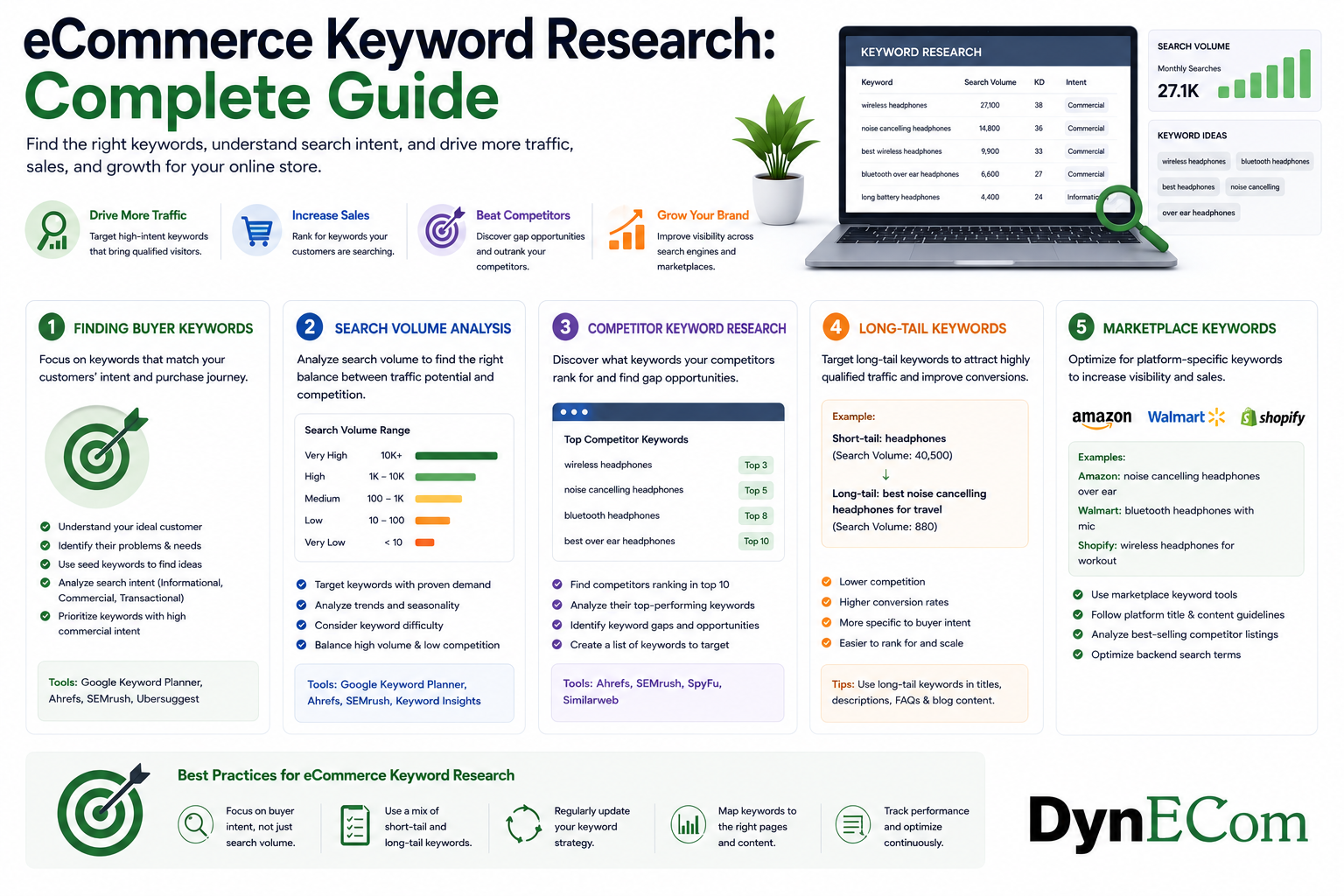
Why eCommerce Keyword Research Matters
In eCommerce, visibility is everything.
A brand can have the best product, competitive pricing, and excellent customer reviews — but if customers cannot find the product, sales opportunities are lost.
This is why eCommerce keyword research is one of the most important foundations of SEO and marketplace optimization.
eCommerce keyword research is the process of identifying the search terms customers use when looking for products online and strategically using those keywords across:
- Product pages
- Category pages
- Blog content
- Marketplace listings
- Paid advertising campaigns
The goal is not simply to find keywords with high search volume. The real objective is to discover keywords that connect customer intent with products that solve their needs.
For example:
A user searching:
“how to clean leather shoes”
is looking for information.
A user searching:
“buy leather cleaning kit”
has purchase intent.
Both searches matter, but the second keyword is more valuable for generating sales.
A strong keyword strategy helps brands capture customers at every stage of the buying journey.
What Is eCommerce Keyword Research?
eCommerce keyword research is the process of identifying, analyzing, and selecting search terms that potential customers use when searching for products online.
It helps businesses understand:
- What customers are searching for
- How often they search
- How competitive keywords are
- Which keywords generate purchases
- How competitors attract traffic
Effective keyword research combines:
- Search volume analysis
- Buyer intent analysis
- Competitor research
- Long-tail keyword discovery
- Marketplace keyword optimization
Why Keyword Research Is Important for eCommerce SEO
1. Helps Customers Discover Products
Search engines and marketplaces use keywords to understand product relevance.
Example:
A customer searches:
“waterproof hiking backpack”
A product page optimized only for:
“backpack”
may not rank well because it lacks specific relevance.
A product optimized for:
“waterproof hiking backpack with laptop compartment”
has a better chance of matching the customer’s search intent.
2. Improves Organic Rankings
Search engines rank pages based on relevance and usefulness.
Using the right keywords helps search engines understand:
- Product category
- Features
- Customer use cases
- Product benefits
This improves ranking opportunities.
3. Increases Conversion Rates
Not all traffic is valuable.
A keyword bringing 10,000 visitors may generate fewer sales than a keyword bringing 500 highly targeted visitors.
Example:
| Keyword | Monthly Searches | Purchase Intent |
|---|---|---|
| Shoes | 100,000 | Low |
| Best running shoes for women | 20,000 | Medium |
| Buy women’s running shoes size 8 | 2,000 | Very High |
High-intent keywords often generate better conversions.
Understanding Search Intent in eCommerce Keyword Research
Before selecting keywords, understand why customers search.
There are four major search intents:
1. Informational Intent
Customer wants information.
Examples:
- How to choose an office chair
- Benefits of collagen supplements
- Best laptop features
Best content type:
- Blogs
- Guides
- FAQs
2. Commercial Investigation Intent
Customer is comparing options.
Examples:
- Best wireless headphones
- Amazon vs Walmart products
- Best office chairs under $300
Best content type:
- Comparison pages
- Buying guides
- Reviews
3. Transactional Intent
Customer is ready to purchase.
Examples:
- Buy ergonomic office chair
- Discount running shoes
- Stainless steel bottle online
Best content type:
- Product pages
- Category pages
4. Navigational Intent
Customer searches for a specific brand or product.
Examples:
- Nike running shoes
- Apple AirPods
- Chromcraft dining chairs
Step 1: Finding Buyer Keywords
Buyer keywords are search terms used by customers who are close to making a purchase.
These keywords usually include:
- Product names
- Features
- Specifications
- Buying terms
Examples of Buyer Keywords
Furniture Category
Generic keyword:
Chair
Buyer keywords:
- ergonomic office chair with lumbar support
- office chair for back pain
- leather executive chair
Electronics Category
Generic:
Headphones
Buyer keywords:
- wireless noise cancelling headphones
- Bluetooth headphones under $100
Beauty Category
Generic:
Serum
Buyer keywords:
- vitamin C serum for sensitive skin
- anti aging serum with retinol
Buyer Keyword Modifiers
Customers often use specific words indicating purchase intent.
Examples:
| Modifier | Example |
|---|---|
| Buy | buy office chair online |
| Best | best standing desk |
| Discount | discounted headphones |
| Review | Dyson vacuum review |
| Near me | furniture store near me |
| Price | laptop price |
Step 2: Search Volume Analysis
Search volume tells you how frequently people search for a keyword.
However, high search volume does not always mean high value.
High Volume vs High Intent Keywords
Example:
Keyword:
Shoes
High volume:
100,000 searches/month
Problem:
Very broad.
Keyword:
Waterproof hiking shoes for men
Lower volume:
8,000 searches/month
Advantage:
Much stronger purchase intent.
Important Keyword Metrics
Search Volume
Number of searches per month.
Higher volume = more potential traffic.
Keyword Difficulty
Measures competition.
Example:
A new brand may struggle ranking for:
laptops
but can compete for:
lightweight laptops for college students
Cost Per Click (CPC)
Higher CPC often indicates commercial value.
Advertisers pay more for keywords that generate sales.
Conversion Potential
The most important metric.
A keyword should answer:
“Will this search bring customers who want to buy?”
Step 3: Competitor Keyword Research
Competitor keyword research helps brands discover opportunities already working for competitors.
Instead of starting from zero, analyze:
- Which keywords competitors rank for
- Which products receive traffic
- Which topics generate sales
How to Perform Competitor Keyword Research
Step 1: Identify Competitors
Find:
- Top Google-ranking stores
- Amazon best sellers
- Walmart top-ranked products
- Industry leaders
Step 2: Analyze Their Keywords
Look for:
- Product titles
- Category pages
- Blog topics
- Product descriptions
Example:
Competitor product title:
Women’s Waterproof Hiking Boots Lightweight Trail Shoes
Keyword opportunities:
- waterproof hiking boots
- lightweight hiking shoes
- women’s trail shoes
Competitor Keyword Gap Analysis
A keyword gap identifies keywords competitors rank for but your brand does not.
Example:
Competitor ranks for:
- ergonomic desk chair
- office chair with headrest
- mesh office chair
Your store ranks only for:
- office chair
Opportunity:
Create optimized pages targeting missing keywords.
Step 4: Long-Tail Keyword Research
Long-tail keywords are longer, more specific search phrases.
They usually have:
- Lower competition
- Higher purchase intent
- Better conversion rates
Examples
Short keyword:
Coffee maker
Long-tail:
Programmable coffee maker with thermal carafe
Short keyword:
Dog food
Long-tail:
Grain free dog food for small breed puppies
Why Long-Tail Keywords Matter
Customers using detailed searches usually know what they want.
Example:
Search:
black leather office chair with wheels under $300
This customer likely has a buying decision in mind.
Long-Tail Keyword Sources
Find long-tail keywords from:
Google Search Suggestions
Example:
Search:
“office chair”
Suggestions:
- office chair for tall people
- office chair for home office
- office chair with footrest
People Also Ask
Google provides related questions.
Examples:
- What is the best office chair for long hours?
- How much should an office chair cost?
Customer Reviews
Reviews contain real customer language.
Example:
Customer writes:
“Perfect chair for working 8 hours from home.”
Keyword opportunity:
- chair for working from home
Step 5: Marketplace Keyword Research
Marketplace search engines work differently from Google.
Platforms like:
- Amazon
- Walmart
- Etsy
have their own ranking algorithms.
Marketplace SEO depends heavily on:
- Search relevance
- Conversion rate
- Sales history
- Reviews
- Product information
Amazon Keyword Research
Amazon keywords come from:
- Search bar suggestions
- Competitor listings
- Product reviews
- Brand analytics
- Keyword tools
Example:
Product:
Wireless earbuds
Keywords:
- bluetooth earbuds
- noise cancelling earbuds
- wireless headphones
- earbuds with microphone
Optimization areas:
- Title
- Bullet points
- Backend keywords
- A+ Content
Walmart Keyword Research
Walmart SEO focuses on:
- Product relevance
- Item attributes
- Content quality
- Search behavior
Keyword sources:
- Walmart search suggestions
- Competitor products
- Category terms
- Customer questions
Optimization areas:
- Product title
- Key features
- Description
- Attributes
Shopify Keyword Research
Shopify stores rely heavily on Google traffic.
Keyword opportunities include:
- Product keywords
- Category keywords
- Blog keywords
- Comparison keywords
Example:
A skincare brand can target:
Product page:
Vitamin C Serum
Blog:
Benefits of Vitamin C for Skin
Category:
Natural Skincare Products
Keyword Mapping Strategy for eCommerce Websites
After finding keywords, assign them to the correct pages.
Example:
| Keyword | Best Page |
|---|---|
| office chair | Category page |
| ergonomic office chair | Product/category page |
| how to choose office chair | Blog |
| best office chair under $300 | Buying guide |
Common eCommerce Keyword Research Mistakes
1. Targeting Only High-Volume Keywords
High volume does not always mean high sales.
Focus on intent.
2. Ignoring Long-Tail Keywords
Long-tail keywords often bring highly qualified customers.
3. Using Competitor Keywords Without Strategy
Not every competitor keyword matches your products.
Always evaluate relevance.
4. Forgetting Marketplace Keywords
Amazon and Walmart require separate keyword strategies.
eCommerce Keyword Research Checklist
| Task | Completed |
|---|---|
| Identify buyer keywords | ✅ |
| Analyze search intent | ✅ |
| Check search volume | ✅ |
| Review competition | ✅ |
| Analyze competitors | ✅ |
| Find long-tail keywords | ✅ |
| Research marketplace terms | ✅ |
| Map keywords to pages | ✅ |
| Monitor performance | ✅ |
Future of eCommerce Keyword Research
Keyword research is evolving with AI-powered search.
Future strategies will focus on:
- Conversational queries
- User intent
- Product entities
- Customer problems
- AI shopping assistants
Instead of only targeting individual keywords, brands will need to build complete topical authority.
Example:
Instead of targeting only:
office chair
A stronger strategy covers:
- Best office chairs
- Ergonomic chair guides
- Office chair comparisons
- Chair maintenance tips
- Workspace setup ideas
Final Thoughts
eCommerce keyword research is the foundation of successful online visibility.
Finding the right keywords helps brands:
- Reach customers earlier
- Improve organic rankings
- Increase product visibility
- Reduce wasted advertising spend
- Drive higher-quality traffic
The best eCommerce brands do not simply chase keywords with the highest search volume. They understand customer intent, analyze competitors, target long-tail opportunities, and optimize their products for every stage of the buying journey.
A strong keyword strategy turns search data into business growth.
This article covers just one aspect of eCommerce SEO. If you’re looking for a complete roadmap—from keyword research and technical SEO to AI-powered search optimization, Amazon SEO, Walmart SEO, Shopify SEO, and conversion optimization—check out our Ultimate eCommerce SEO & GEO Guide for 2026.

Dharmendra Tripathi is a Senior Digital Marketing & Customer Success leader with deep expertise in eCommerce SEO, performance marketing, and marketplace growth. With years of experience managing SEO and advertising campaigns across Google, Meta, Amazon, Walmart, and Shopify, he helps brands improve search visibility, maximize advertising ROI, and accelerate online sales. Passionate about AI-powered search, content optimization, and analytics, Dharmendra regularly shares actionable insights to help eCommerce businesses stay ahead in an evolving digital landscape.