
Why eCommerce SEO Tools Matter
Running a successful online store requires more than just adding products and waiting for customers to find them.
Modern eCommerce SEO requires businesses to understand:
- What customers are searching for
- Which keywords competitors rank for
- Why some products perform better than others
- Which technical issues impact rankings
- How product pages can be optimized
This is where eCommerce SEO tools become essential.
eCommerce SEO tools help online businesses analyze search performance, discover keyword opportunities, optimize product pages, monitor competitors, and improve organic visibility.
Whether you operate a:
- Shopify store
- WooCommerce website
- Amazon storefront
- Walmart Marketplace account
- DTC brand
the right SEO tools can help you make data-driven decisions instead of relying on assumptions.
What Are eCommerce SEO Tools?
eCommerce SEO tools are software platforms designed to help online businesses improve search engine visibility and increase organic sales.
These tools provide insights into:
- Keyword rankings
- Search volume
- Competitor strategies
- Backlinks
- Technical SEO issues
- Product opportunities
- Marketplace search trends
A strong SEO tool stack helps brands answer questions like:
- Which keywords should my products target?
- Why is my competitor ranking higher?
- Which pages are losing traffic?
- What technical issues are hurting SEO?
- Which products have growth opportunities?
Why eCommerce Brands Need SEO Tools
1. Data-Driven Keyword Research
Without keyword data, brands often optimize products based on assumptions.
SEO tools reveal:
- Search volume
- Keyword difficulty
- Related keywords
- Search trends
- Competitor rankings
Example:
A furniture brand may think customers search:
dining chair
But keyword research may reveal stronger opportunities:
- dining chairs with wheels
- ergonomic dining chair
- comfortable kitchen chairs
2. Competitor Analysis
Competitors are already ranking for valuable keywords.
SEO tools help identify:
- Competitor keywords
- Top-performing pages
- Backlink sources
- Content gaps
Example:
A skincare brand discovers competitors rank for:
- best vitamin C serum
- skincare routine guide
- anti-aging ingredients
The brand can create content targeting similar opportunities.
3. Technical SEO Improvements
Large eCommerce websites often have thousands of pages.
Common SEO issues include:
- Broken links
- Duplicate pages
- Slow pages
- Indexing problems
- Missing metadata
Technical SEO tools help identify and fix these issues.
4. Marketplace Optimization
Traditional SEO tools focus on Google.
However, marketplace sellers need specialized tools for:
- Amazon keyword research
- Product ranking analysis
- Competitor listings
- Search term optimization
Tools like Helium10 help sellers optimize marketplace visibility.
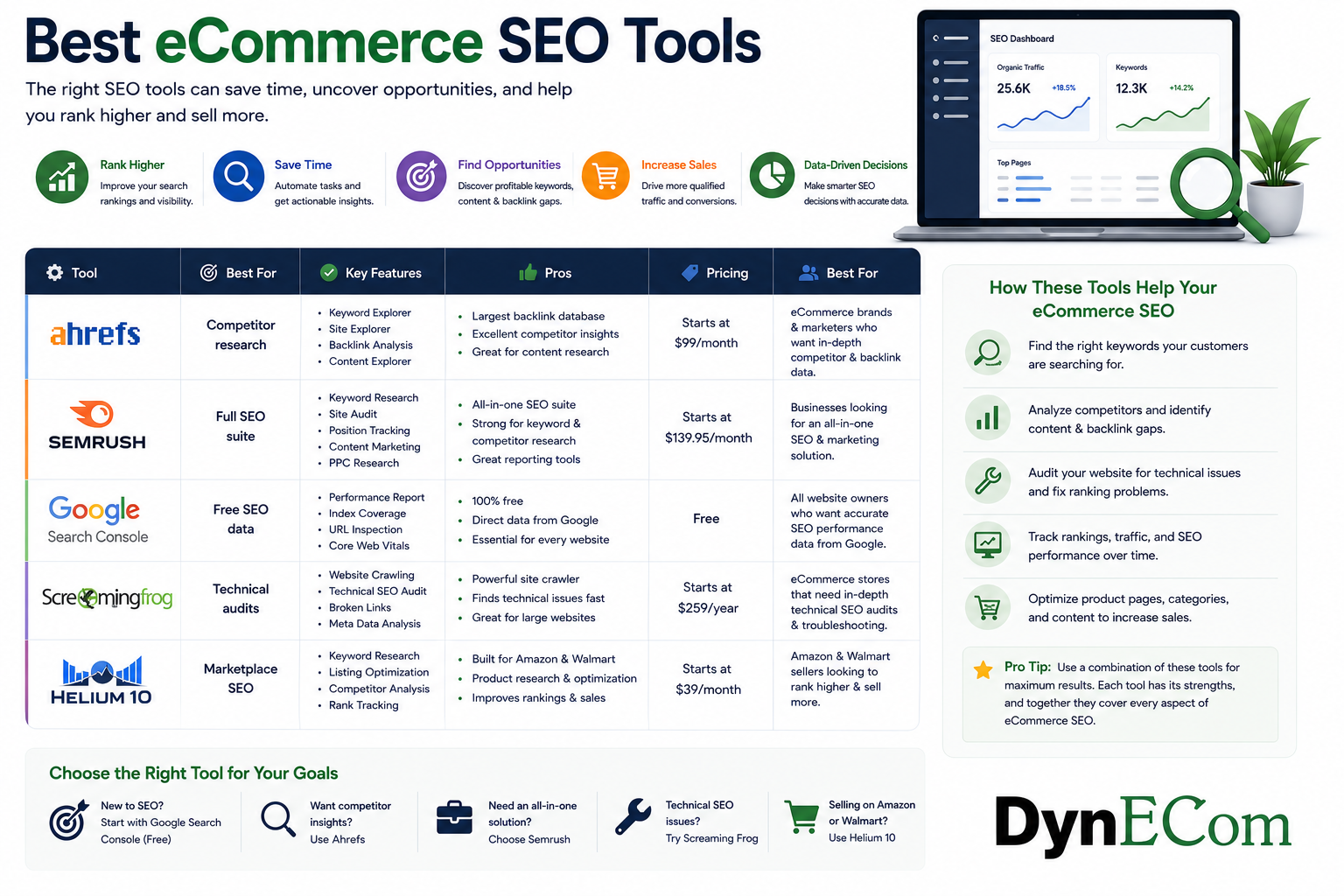
Best eCommerce SEO Tools Comparison
| Tool | Best For | Main Use Cases |
|---|---|---|
| Ahrefs | Competitor research | Backlinks, keywords, competitor analysis |
| Semrush | Full SEO suite | SEO, PPC, content, competitor research |
| Google Search Console | Free SEO data | Search performance monitoring |
| Screaming Frog | Technical audits | Website crawling and SEO issues |
| Helium10 | Marketplace SEO | Amazon keyword and listing optimization |
1. Ahrefs
Best For:
Competitor research and backlink analysis
Ahrefs is one of the most popular SEO platforms for understanding how websites gain organic visibility.
Key Features
Competitor Keyword Research
Find:
- Keywords competitors rank for
- Traffic-driving pages
- Ranking opportunities
Example:
A shoe brand can analyze a competitor and discover they rank for:
- waterproof hiking shoes
- lightweight trail shoes
- men’s outdoor footwear
Backlink Analysis
Ahrefs helps identify:
- Websites linking to competitors
- Authority-building opportunities
- Content promotion opportunities
Keyword Explorer
Provides:
- Search volume
- Keyword difficulty
- Click potential
- Related terms
Best Use Cases for eCommerce
Ahrefs is ideal for:
- Finding competitor keywords
- Discovering content opportunities
- Building SEO strategies
- Analyzing market gaps
Limitations
- Higher cost compared to beginner tools
- Primarily focused on Google SEO
- Does not specialize in marketplace SEO
2. Semrush
Best For:
Complete SEO and marketing suite
Semrush is an all-in-one platform used by businesses, agencies, and enterprise brands.
Key Features
Keyword Research
Find:
- Keyword volume
- Competition level
- Search trends
Competitor Analysis
Analyze:
- Competitor traffic sources
- Ranking keywords
- Advertising strategies
Content Optimization
Semrush helps brands:
- Identify content gaps
- Optimize existing pages
- Build topic clusters
Position Tracking
Monitor:
- Keyword rankings
- Competitor movements
- SEO growth
Best Use Cases for eCommerce
Semrush is ideal for:
- Large SEO campaigns
- Content strategies
- Competitor monitoring
- SEO + PPC analysis
Limitations
- Many features require higher-tier plans
- Can be overwhelming for beginners
3. Google Search Console
Best For:
Free SEO performance data
Google Search Console is one of the most important free SEO tools available.
It provides direct data from Google.
Key Features
Search Performance Reports
Shows:
- Search queries
- Clicks
- Impressions
- CTR
- Average position
Example:
An online store discovers:
Keyword:
“ergonomic office chair”
Impressions:
50,000
Clicks:
1,500
CTR:
3%
The brand can optimize the page to improve performance.
Index Coverage Reports
Identify:
- Pages not indexed
- Crawl issues
- Technical problems
Core Web Vitals
Monitor:
- Page speed
- User experience
- Mobile performance
Best Use Cases for eCommerce
Google Search Console is ideal for:
- Monitoring organic traffic
- Finding ranking opportunities
- Identifying technical issues
- Measuring SEO performance
Limitations
- No competitor analysis
- Limited keyword discovery
- Requires existing website traffic
4. Screaming Frog SEO Spider
Best For:
Technical SEO audits
Screaming Frog is a website crawling tool that analyzes websites like search engine bots.
Key Features
Website Crawling
Find:
- Broken links
- Missing metadata
- Duplicate pages
- Redirect issues
Metadata Analysis
Check:
- Missing title tags
- Duplicate descriptions
- Incorrect headings
Large Website Audits
Especially useful for:
- Large catalogs
- Enterprise eCommerce websites
- Thousands of product pages
Example
A website with:
50,000 products
may discover:
- 10,000 duplicate titles
- 5,000 broken links
- Missing descriptions
Screaming Frog helps identify these issues.
Best Use Cases
Ideal for:
- Technical SEO audits
- Large websites
- Website migrations
- Finding crawl issues
5. Helium10
Best For:
Marketplace SEO and Amazon optimization
Helium10 is specifically designed for marketplace sellers.
It helps brands optimize Amazon listings and discover product opportunities.
Key Features
Keyword Research
Find:
- Amazon search terms
- Keyword volume
- Competitor keywords
Competitor Listing Analysis
Analyze:
- Product titles
- Bullet points
- Keywords
- Reviews
Listing Optimization
Improve:
- Product titles
- Bullet points
- Descriptions
- Backend keywords
Example:
A supplement brand selling collagen powder can discover customers search:
- collagen peptides powder
- grass fed collagen
- unflavored collagen supplement
Then optimize product listings accordingly.
Best Use Cases
Ideal for:
- Amazon sellers
- Marketplace brands
- Product listing optimization
- Keyword discovery
Additional eCommerce SEO Tools Worth Considering
Google Analytics
Best for:
- Traffic analysis
- Customer behavior
- Conversion tracking
Yoast SEO
Best for:
- Shopify/WooCommerce content optimization
Moz Pro
Best for:
- Beginner-friendly SEO management
Surfer SEO
Best for:
- AI-assisted content optimization
Ubersuggest
Best for:
- Beginner keyword research
How to Choose the Right eCommerce SEO Tool
The best tool depends on your business model.
For Shopify and DTC Brands
Recommended stack:
| Need | Tool |
|---|---|
| Keyword research | Semrush / Ahrefs |
| Technical SEO | Screaming Frog |
| Performance tracking | Google Search Console |
| Content optimization | Surfer SEO |
For Amazon Sellers
Recommended stack:
| Need | Tool |
|---|---|
| Keyword research | Helium10 |
| Competitor analysis | Helium10 |
| Listing optimization | Helium10 |
| Performance tracking | Amazon Brand Analytics |
For Walmart Marketplace Sellers
Recommended approach:
Focus on:
- Marketplace keyword research
- Product content optimization
- Competitor analysis
- Conversion metrics
Useful tools:
- Helium10 (Amazon keyword insights)
- Google Trends
- Marketplace analytics platforms
eCommerce SEO Tool Selection Checklist
Before choosing a tool, evaluate:
| Requirement | Important |
|---|---|
| Keyword research | ✅ |
| Competitor analysis | ✅ |
| Technical audits | ✅ |
| Rank tracking | ✅ |
| Content optimization | ✅ |
| Marketplace support | ✅ |
| Reporting | ✅ |
Common Mistakes When Using SEO Tools
1. Focusing Only on Search Volume
High-volume keywords may not generate sales.
Always consider:
- Intent
- Competition
- Conversion potential
2. Collecting Data Without Taking Action
SEO tools provide insights, but results come from implementation.
Example:
Finding a keyword opportunity is useless unless you:
- Optimize the page
- Create content
- Improve ranking signals
3. Using Too Many Tools
More tools do not always mean better SEO.
A focused tool stack is usually more effective.
The Future of eCommerce SEO Tools
SEO tools are becoming more AI-driven.
Future capabilities will include:
- Automated keyword clustering
- AI content optimization
- Search intent prediction
- Competitor strategy recommendations
- Marketplace intelligence
Brands will increasingly rely on tools that combine SEO data with business insights.
Final Thoughts
Choosing the right eCommerce SEO tools can dramatically improve an online store’s ability to attract customers and grow organically.
The best tools help businesses:
- Discover profitable keywords
- Understand competitors
- Fix technical issues
- Optimize products
- Improve marketplace visibility
For most brands, a combination of tools works best:
- Ahrefs or Semrush for SEO strategy
- Google Search Console for performance tracking
- Screaming Frog for technical audits
- Helium10 for marketplace SEO
The goal is not to collect more data — it is to use SEO insights to create better products, better content, and better shopping experiences.
Continue Your eCommerce SEO Journey: Discover our Ultimate eCommerce SEO & GEO Guide for 2026, an in-depth resource covering technical SEO, on-page optimization, product page SEO, category page SEO, schema markup, AI search optimization, Google Merchant Center, Amazon SEO, Walmart SEO, Shopify SEO, and much more. Read the complete guide: https://dynecom.com/the-ultimate-ecommerce-seo-geo-guide-for-2026/

Dharmendra Tripathi is a Senior Digital Marketing & Customer Success leader with deep expertise in eCommerce SEO, performance marketing, and marketplace growth. With years of experience managing SEO and advertising campaigns across Google, Meta, Amazon, Walmart, and Shopify, he helps brands improve search visibility, maximize advertising ROI, and accelerate online sales. Passionate about AI-powered search, content optimization, and analytics, Dharmendra regularly shares actionable insights to help eCommerce businesses stay ahead in an evolving digital landscape.