
Why SEO Is Changing for eCommerce Brands
Search visibility has always been a critical factor for online success. Whether a customer is searching on Google, Amazon, Walmart, or another marketplace, the goal remains the same: appear in front of the right customer at the right time.
However, the way search engines rank content has changed significantly.
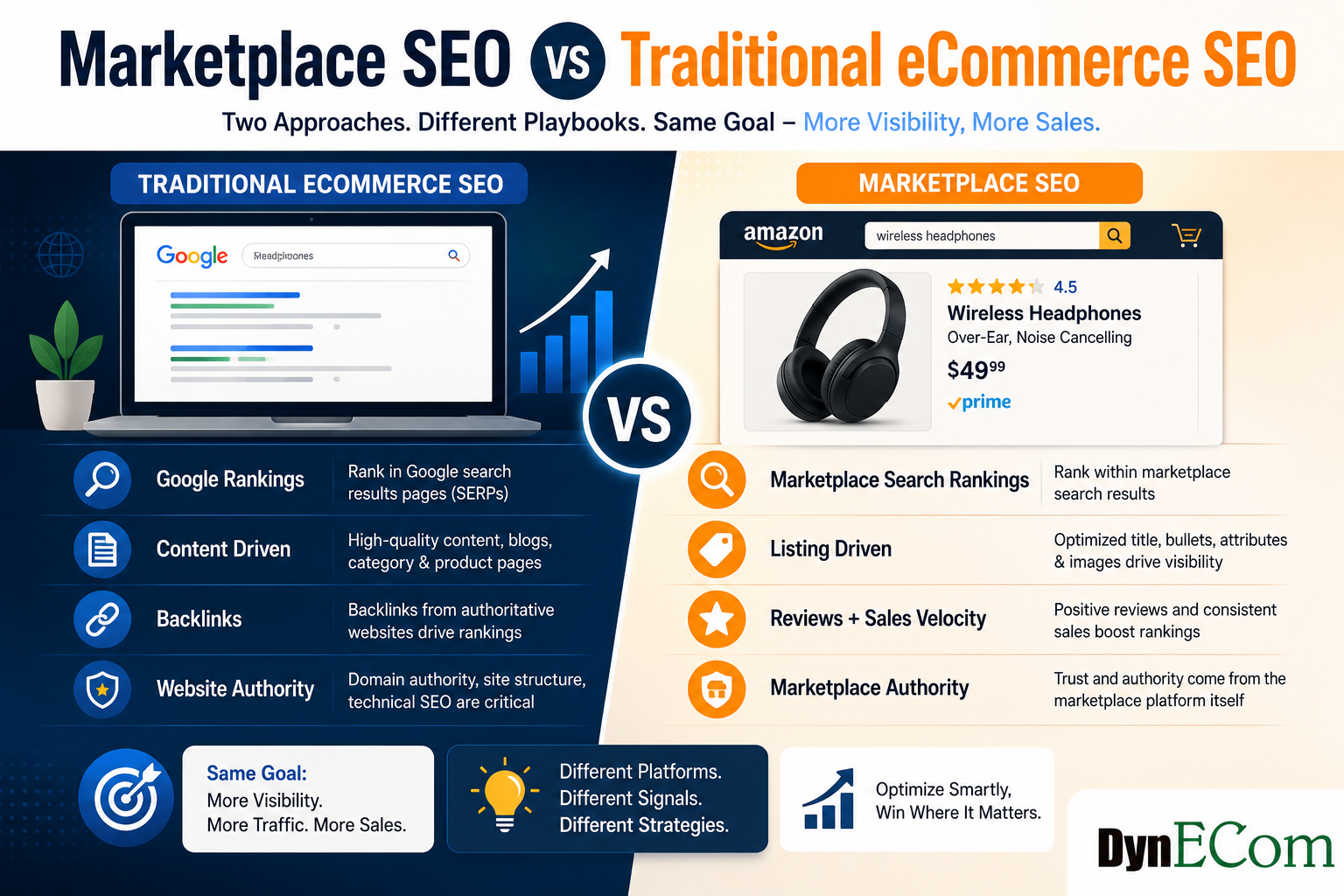
Traditional eCommerce businesses often focus on improving their website rankings on Google through content marketing, technical SEO, and backlinks. In contrast, marketplace sellers need a different approach focused on product listings, customer behavior, sales performance, and marketplace algorithms.
This is where Marketplace SEO becomes essential.
Marketplace SEO is the process of optimizing product listings, keywords, customer signals, and marketplace performance factors to improve visibility and rankings within platforms such as Amazon, Walmart, Target Plus, and other online marketplaces.
While traditional SEO helps websites rank on search engines, marketplace SEO helps products rank where customers are already ready to purchase.
What Is Traditional eCommerce SEO?
Traditional SEO focuses on improving a website’s visibility in search engines like Google and Bing.
The objective is to attract users searching for:
- Information
- Solutions
- Products
- Services
A successful traditional SEO strategy helps websites rank higher through:
- Content creation
- Technical optimization
- Backlinks
- Website authority
- User experience improvements
Example:
A customer searches Google: “Best office chairs for back pain”
A website ranking through traditional SEO may provide:
- Buying guides
- Product comparisons
- Expert reviews
- Blog content
The goal is to attract traffic and eventually convert visitors into customers.
What Is Marketplace SEO?
Marketplace SEO focuses on improving product visibility inside eCommerce platforms.
Customers searching on marketplaces usually have stronger purchase intent.
Example:
A customer searches: “Ergonomic office chair with wheels”
Marketplace SEO helps a product appear higher in search results by optimizing:
- Product title
- Keywords
- Attributes
- Images
- Reviews
- Pricing
- Sales history
- Conversion rate
The goal is not only visibility but generating purchases.
Marketplace SEO vs Traditional SEO: Key Differences
| Factor | Traditional SEO | Marketplace SEO |
|---|---|---|
| Primary Goal | Rank websites on search engines | Rank products inside marketplaces |
| Search Platform | Google, Bing | Amazon, Walmart, Target, eBay |
| Ranking Focus | Website relevance and authority | Product relevance and sales performance |
| Main Asset | Website pages | Product listings |
| Keyword Strategy | Content-based keywords | Buyer-intent product keywords |
| Ranking Signals | Backlinks, content quality, domain authority | Reviews, sales velocity, conversion rate |
| Conversion Goal | Generate leads or purchases | Drive immediate product sales |
| Authority Signal | Website authority | Marketplace authority |
Ranking Factors Comparison
1. Google Rankings vs Marketplace Search Rankings
Traditional SEO:
Google evaluates:
- Website quality
- Content relevance
- Backlinks
- Domain authority
- Page experience
- Technical SEO
Example:
A website publishing detailed articles about fitness equipment may rank higher because it has strong content authority.
Marketplace SEO:
Marketplaces evaluate:
- Product relevance
- Sales history
- Conversion rate
- Customer reviews
- Pricing competitiveness
- Inventory availability
Example:
A product with thousands of sales and strong reviews may rank higher even if another seller has more detailed content.
2. Content Driven vs Listing Driven
Traditional SEO is Content Driven
Content plays a major role.
Examples:
- Blog posts
- Guides
- Articles
- Landing pages
- Educational content
Google uses content to understand:
- Expertise
- Relevance
- Authority
Example:
A website article: “10 Best Hiking Shoes for Beginners”
can rank organically and bring traffic.
Marketplace SEO is Listing Driven
The product listing is the primary ranking asset. Optimization focuses on:
Product Title Includes:
- Brand
- Product type
- Main keywords
- Key features
Bullet Points Explain:
- Benefits
- Features
- Use cases
Images Improve:
- Click-through rate
- Conversion rate
Attributes Improve:
- Search matching
- Filter visibility
3. Backlinks vs Reviews and Sales Velocity
Traditional SEO Ranking Signals:
Backlinks are one of the strongest authority signals. A website gains authority when trusted websites link to it.
Example: A health website linking to a fitness brand increases credibility.
Marketplace SEO Ranking Signals:
Marketplaces prioritize customer signals. Important factors include:
Reviews
More positive reviews create trust.
Example:
Product A:
- 4.8 stars
- 2,000 reviews
Product B:
- 4.2 stars
- 50 reviews
Product A is more likely to convert.
Sales Velocity
Sales velocity refers to how quickly a product generates sales. Marketplaces reward products that consistently sell. Higher sales velocity can lead to:
- Better ranking
- More visibility
- More organic sales
4. Website Authority vs Marketplace Authority
Website Authority
Traditional SEO builds authority through:
- Domain age
- Backlinks
- Content quality
- Industry expertise
Example:
A well-known industry blog can rank for thousands of keywords because Google trusts the domain.
Marketplace Authority
Marketplace authority is built through:
- Strong sales history
- Positive reviews
- High conversion rate
- Low return rate
- Product availability
A marketplace rewards sellers who provide a good customer experience.
Keyword Strategy Differences
Traditional SEO Keywords
Focus on informational intent.
Examples:
- Best office chairs
- How to choose running shoes
- Benefits of standing desks
Users may still be researching.
Marketplace SEO Keywords
Focus on purchase intent.
Examples:
- Buy ergonomic office chair
- Women’s running shoes size 8
- Wireless earbuds noise cancelling
Users are closer to buying.
Conversion Rate Matters More in Marketplace SEO
A major difference between traditional SEO and marketplace SEO is the importance of conversion. Google can rank an article even if users do not immediately purchase. Marketplaces prioritize products that sell.
Example:
Product A:
- 10,000 impressions
- 1% conversion rate
Product B:
- 5,000 impressions
- 10% conversion rate
Marketplace algorithms may favour Product B because it creates more sales.
The Role of Advertising in Marketplace SEO
Traditional SEO generally separates paid advertising from organic rankings. Marketplace SEO is different. Advertising can influence organic growth.
The cycle: Sponsored Ads → More Sales → Better Ranking → More Organic Traffic → Lower Advertising Dependency
For marketplaces like Amazon and Walmart, advertising helps generate:
- Initial visibility
- Sales velocity
- Keyword ranking signals
How Brands Should Combine Both Strategies
Successful brands should not choose between traditional SEO and marketplace SEO. They should use both.
| Strategy | Purpose |
|---|---|
| Website SEO | Build brand awareness and authority |
| Marketplace SEO | Capture high-intent shoppers |
| Content Marketing | Educate customers |
| Listing Optimization | Improve conversion |
| Paid Advertising | Accelerate growth |
| Reviews | Build marketplace trust |
Marketplace SEO Checklist
Product Listing Optimization
✅ Keyword-rich title
✅ Optimized bullet points
✅ Detailed descriptions
✅ Complete attributes
✅ High-quality images
Performance Optimization
✅ Improve conversion rate
✅ Increase sales velocity
✅ Generate reviews
✅ Maintain inventory
✅ Optimize pricing
Advertising Optimization
✅ Identify converting keywords
✅ Scale profitable campaigns
✅ Reduce wasted spend
✅ Support organic ranking growth
Common Marketplace SEO Mistakes
1. Treating Marketplace Listings Like Websites
A marketplace listing is not a blog page. Customers need:
- Clear benefits
- Fast decision-making information
- Purchase confidence
2. Focusing Only on Keywords
Keywords create visibility, but conversion creates ranking. A product must satisfy customers after they click.
3. Ignoring Customer Reviews
Reviews are one of the strongest marketplace trust signals.
4. Not Monitoring Sales Performance
Marketplace rankings change constantly based on:
- Sales trends
- Competition
- Pricing
- Reviews
Final Thoughts
Marketplace SEO requires a different mindset from traditional SEO.
Traditional SEO is primarily about building:
- Content authority
- Website trust
- Search engine visibility
Marketplace SEO is about building:
- Product relevance
- Customer trust
- Sales momentum
- Marketplace authority
The brands that succeed understand that ranking is not only about being found — it is about converting shoppers once they arrive.
By combining strong listing optimization, keyword strategy, reviews, advertising, and sales velocity, brands can improve marketplace rankings and create sustainable eCommerce growth.
Looking to dive deeper into eCommerce SEO? Our Ultimate eCommerce SEO & GEO Guide for 2026 is a complete resource packed with actionable strategies, best practices, and real-world examples to help online stores improve rankings, traffic, and revenue. Read it here: https://dynecom.com/the-ultimate-ecommerce-seo-geo-guide-for-2026/

Dharmendra Tripathi is a Senior Digital Marketing & Customer Success leader with deep expertise in eCommerce SEO, performance marketing, and marketplace growth. With years of experience managing SEO and advertising campaigns across Google, Meta, Amazon, Walmart, and Shopify, he helps brands improve search visibility, maximize advertising ROI, and accelerate online sales. Passionate about AI-powered search, content optimization, and analytics, Dharmendra regularly shares actionable insights to help eCommerce businesses stay ahead in an evolving digital landscape.