
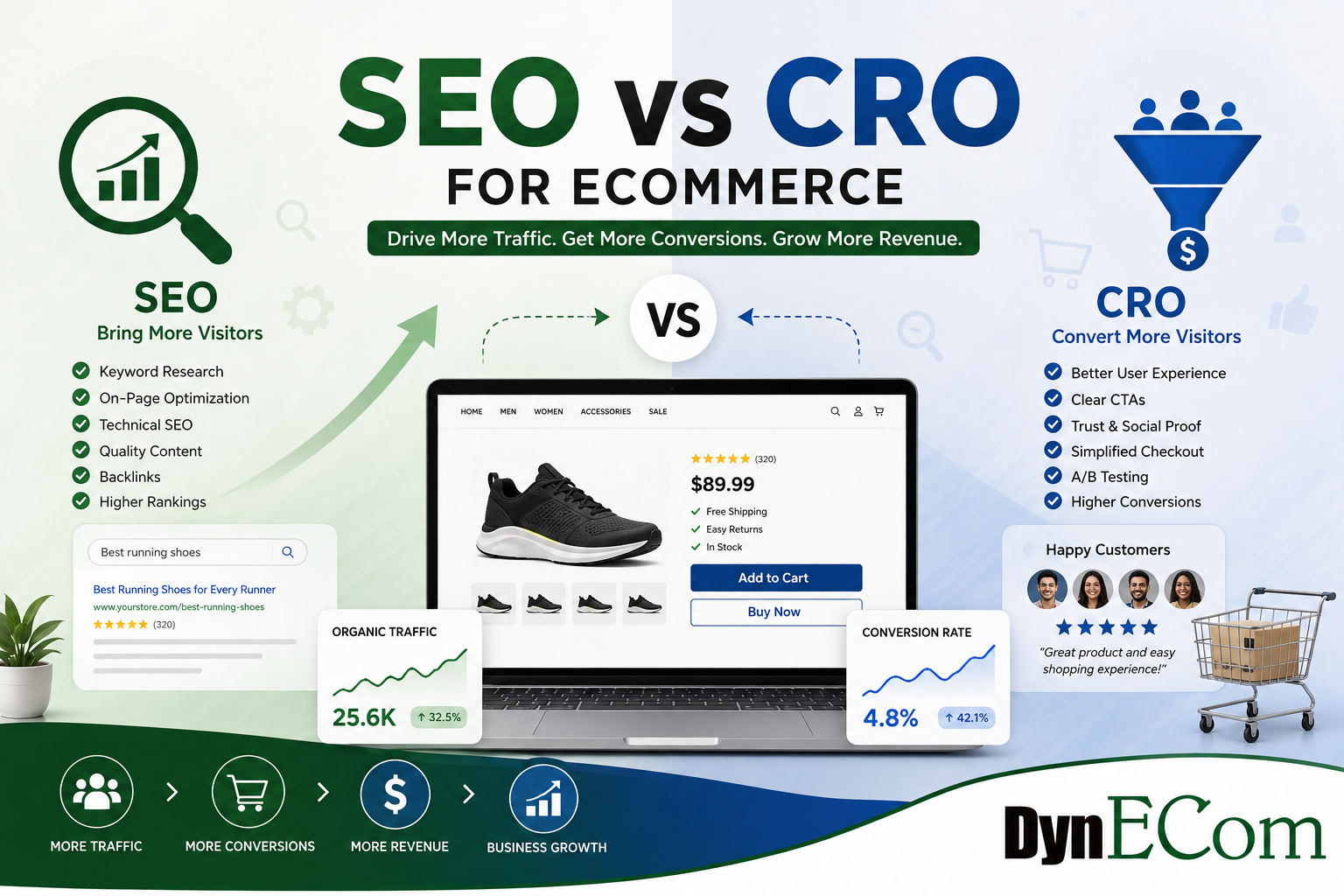
Many eCommerce businesses invest heavily in driving traffic but overlook what happens once visitors land on their website. While Search Engine Optimization (SEO) focuses on attracting qualified visitors from search engines, eCommerce CRO (Conversion Rate Optimization) ensures those visitors take meaningful actions, such as making a purchase, signing up for a newsletter, or adding products to their cart.
The question isn’t whether you should choose SEO or CRO—it’s how to balance both. SEO brings people to your store, while CRO turns those visitors into paying customers. A successful eCommerce growth strategy requires both working together.
In this guide, we’ll explore the differences between SEO and eCommerce CRO, their unique benefits, and how to create a strategy that maximizes both traffic and conversions.
What is SEO?
Search Engine Optimization (SEO) is the process of improving your online store’s visibility in search engines like Google, Bing, and AI-powered search platforms. The goal is to attract qualified organic traffic by optimizing your website’s technical foundation, content, and authority.
SEO activities include:
- Keyword research
- Product page optimization
- Category page optimization
- Technical SEO
- Internal linking
- Content marketing
- Structured data
- Core Web Vitals
- Link building
- AI Search Optimization (GEO)
Primary Goal: Increase qualified organic traffic.
What is eCommerce CRO?
eCommerce CRO (Conversion Rate Optimization) is the practice of improving your website to increase the percentage of visitors who complete a desired action.
These actions may include:
- Purchasing a product
- Adding items to cart
- Starting checkout
- Creating an account
- Downloading a buying guide
- Joining an email list
Rather than increasing traffic, CRO helps generate more revenue from the traffic you already have.
SEO vs eCommerce CRO
| SEO | eCommerce CRO |
|---|---|
| Focuses on acquiring traffic | Focuses on converting visitors |
| Improves search rankings | Improves user experience |
| Targets search engines and users | Targets user behavior |
| Long-term investment | Can produce faster improvements |
| Increases visibility | Increases revenue per visitor |
| Optimizes content and site structure | Optimizes landing pages, checkout, and UX |
Think of SEO as bringing customers into a physical store, while CRO helps convince them to make a purchase once they’re inside.
Why SEO Alone Isn’t Enough
Many online stores rank well but struggle with sales because visitors encounter friction after arriving.
Common conversion barriers include:
- Slow-loading pages
- Confusing navigation
- Weak product descriptions
- Poor product images
- Hidden shipping costs
- Complicated checkout
- Lack of trust signals
- Unclear calls-to-action
Without CRO, even high organic traffic may fail to deliver strong business results.
Why CRO Needs SEO
A beautifully optimized website won’t generate sales if no one visits it.
SEO supplies a steady stream of qualified visitors by targeting users actively searching for products or solutions.
For example:
- SEO helps your “Best Office Chair” buying guide rank on Google.
- CRO ensures visitors easily compare products, trust your brand, and complete their purchase.
Both disciplines are interdependent.
Key SEO Strategies for eCommerce
Keyword Research
Target keywords based on user intent.
Examples:
- Informational
- Commercial
- Transactional
- Local
Product Page Optimization
Optimize:
- Titles
- Meta descriptions
- Product descriptions
- Images
- Structured data
- Internal links
Category Page SEO
Category pages often target high-volume keywords and can become major traffic drivers.
Content Marketing
Create:
- Buying guides
- Comparison pages
- Educational blogs
- FAQs
- Product tutorials
These assets attract users at every stage of the buying journey.
Technical SEO
Improve:
- Site speed
- Mobile usability
- Crawlability
- Indexing
- XML sitemaps
- HTTPS
- Core Web Vitals
Key eCommerce CRO Strategies
Improve Product Pages
High-converting product pages include:
- Clear headlines
- High-quality images
- Videos
- Benefits-focused descriptions
- Reviews
- FAQs
- Trust badges
- Delivery information
Optimize Calls-to-Action
Use clear CTAs like:
- Add to Cart
- Buy Now
- Get Free Shipping
- Compare Products
Make them visually prominent and easy to find.
Simplify Checkout
Reduce friction by:
- Offering guest checkout
- Minimizing form fields
- Supporting multiple payment options
- Displaying shipping costs early
- Showing progress indicators
Build Trust
Increase buyer confidence with:
- Customer reviews
- Verified ratings
- Secure payment icons
- Return policies
- Money-back guarantees
- Contact information
Improve Mobile Experience
Since most shoppers browse on mobile devices, ensure your store offers:
- Responsive design
- Fast page speed
- Large tap targets
- Easy navigation
- Mobile-friendly checkout
SEO Metrics vs CRO Metrics
| SEO Metrics | CRO Metrics |
|---|---|
| Organic traffic | Conversion rate |
| Keyword rankings | Add-to-cart rate |
| Click-through rate | Checkout completion |
| Backlinks | Revenue per visitor |
| Indexed pages | Average order value |
| Impressions | Cart abandonment rate |
Together, these metrics provide a comprehensive view of your store’s performance.
How SEO and CRO Work Together
Imagine an online furniture store.
SEO brings visitors searching for:
- Best ergonomic office chair
- Standing desk buying guide
- Office chair comparison
Once they arrive, CRO helps convert them through:
- Clear product benefits
- Comparison tables
- Customer reviews
- Fast checkout
- Trust signals
- Personalized recommendations
SEO fills the funnel, while CRO improves its efficiency.
Common Mistakes
Avoid these common pitfalls:
- Focusing only on rankings instead of revenue
- Ignoring user experience
- Optimizing for keywords but not search intent
- Running CRO tests without sufficient traffic
- Neglecting mobile optimization
- Failing to analyze user behavior
- Not tracking conversions alongside traffic
Best Practices
- Treat SEO and CRO as complementary strategies.
- Match landing pages with search intent.
- Improve page speed and Core Web Vitals.
- Continuously test product pages and checkout flows.
- Use customer feedback to identify friction points.
- Create content that educates and converts.
- Track both traffic and conversion metrics.
- Update content and user experience regularly based on performance data.
The Future of SEO and eCommerce CRO
As AI-powered search, voice search, and personalized shopping experiences continue to evolve, SEO and CRO will become even more interconnected. Search engines increasingly reward websites that provide exceptional user experiences, while consumers expect seamless, trustworthy, and personalized shopping journeys.
Businesses that combine strong SEO foundations with continuous CRO improvements will be better positioned to attract qualified visitors, increase conversion rates, and maximize long-term revenue.
Conclusion
The debate between SEO and eCommerce CRO isn’t about choosing one over the other. SEO helps customers discover your online store, while CRO ensures they have a smooth and persuasive experience that leads to conversions.
If your goal is sustainable growth, invest in both. Build an SEO strategy that attracts high-intent traffic, then optimize every stage of the customer journey to turn that traffic into loyal customers. Together, SEO and eCommerce CRO create a scalable framework for increasing visibility, improving user experience, and driving higher sales.
Looking for the Complete Picture?
This article covers one important aspect of eCommerce SEO, but it’s only one piece of the puzzle. For a complete roadmap to improving rankings, increasing organic traffic, and optimizing your online store for both traditional search engines and AI-powered search, visit our comprehensive pillar guide.
📖 The Ultimate eCommerce SEO Guide for 2026

Dharmendra Tripathi is a Senior Digital Marketing & Customer Success leader with deep expertise in eCommerce SEO, performance marketing, and marketplace growth. With years of experience managing SEO and advertising campaigns across Google, Meta, Amazon, Walmart, and Shopify, he helps brands improve search visibility, maximize advertising ROI, and accelerate online sales. Passionate about AI-powered search, content optimization, and analytics, Dharmendra regularly shares actionable insights to help eCommerce businesses stay ahead in an evolving digital landscape.