
How to create complete, competitive, current product and category content that earns visibility, strengthens paid and social performance, and converts more shoppers
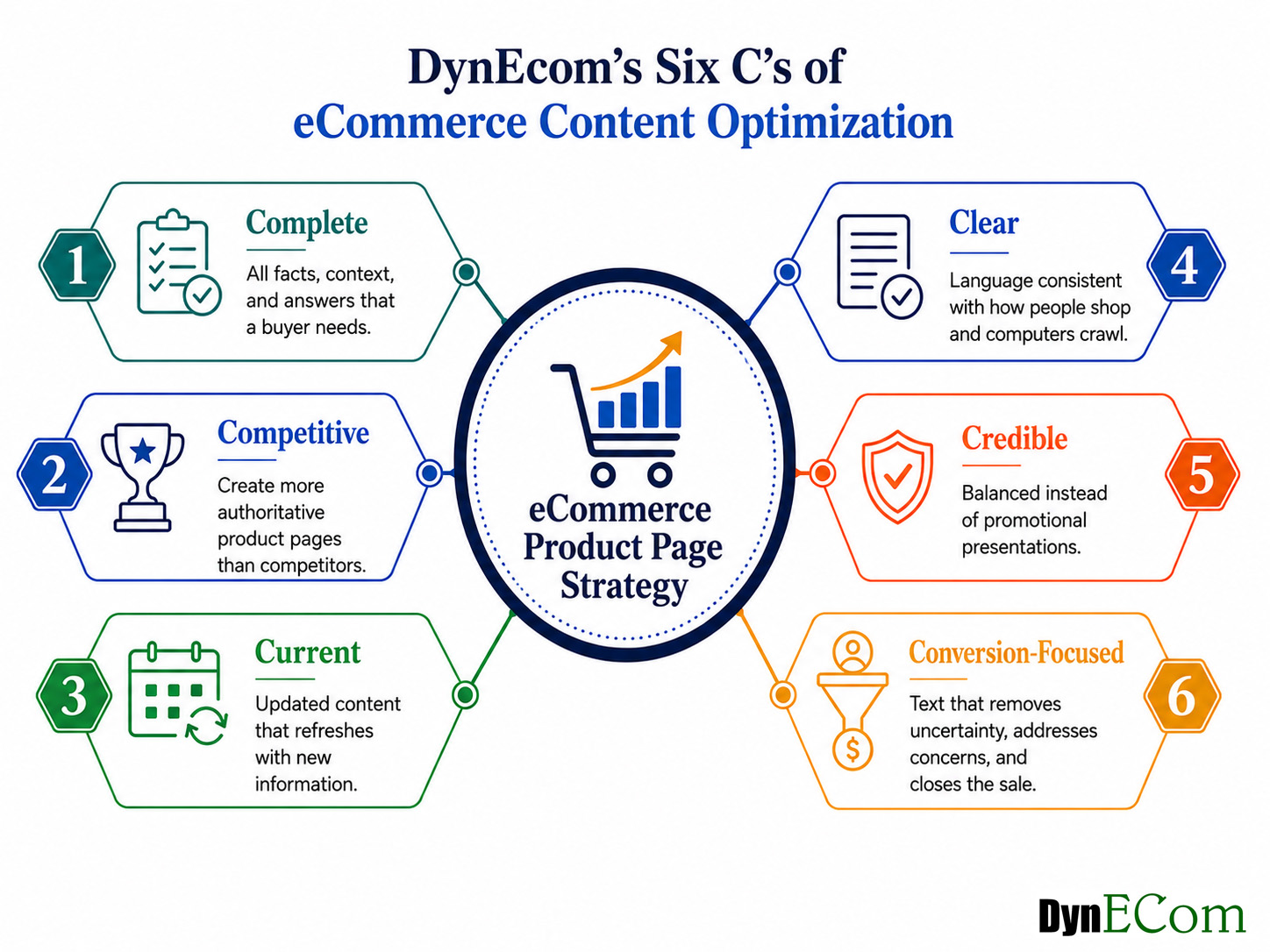
| DynEcom’s Six C’s
Complete • Competitive • Current • Clear • Credible • Conversion-Focused |
Prepared for eCommerce marketing professionals
July 2026
Contents
- Executive Summary
- Part 1: eCommerce Content Optimization Foundations
- Part 2: Why eCommerce Content Must Be Rethought in 2026
- Part 3: Choosing the Right Content Strategy
- Part 4: Building the Product-Information Foundation
- Part 5: Product Page Content Optimization
- Part 6: Category, Collection, and Brand Page Optimization
- Part 7: Building the Supporting Content Ecosystem
- Part 8: Optimizing for Traditional SEO and AI Search Together
- Part 9: Adapting Content Across Owned Sites, Marketplaces, PPC, and Social
- Part 10: Conversion Optimization for Higher-Intent and Later-Stage Shoppers
- Part 11: Scaling eCommerce Content With AI, Workflow, Quality, and Governance
- Part 12: Technical Requirements That Allow Content to Perform
- Part 13: Measuring eCommerce Content Performance
- Applying the Six C’s: Three Practical Content Audits
- Part 14: A 90-Day Implementation Roadmap
- eCommerce Content Optimization Checklist
- Frequently Asked Questions
- About DynEcom and the Author
- Sources and Further Reading
Executive Summary
eCommerce content optimization is the continuous process of improving product, category, and supporting content so it becomes easier to discover, understand, trust, compare, and act upon. Optimizing content is especially important in 2026 as eCommerce shoppers increasingly use AI chatbots for product discovery and research. These systems may recommend and refer users to specific websites in ways that differ from traditional search engines.
eCommerce content optimization is not limited to inserting keywords into product descriptions. It includes the product facts a retailer publishes, the way those facts are organized, the questions the page answers, the evidence used to support claims, the media that demonstrates the product, the structured data and feeds that carry the information to other platforms, and the processes used to keep everything accurate and current.
Search is no longer one experience. A shopper may begin with a traditional Google query, ask a conversational question in ChatGPT, compare products through an AI research tool, search within Amazon or Walmart, discover an item through social media, click a shopping ad, or use an on-site chatbot. Each system interprets product information differently, but all of them depend on the same foundation: accurate, complete, clearly structured product knowledge.
Google explicitly says that the same foundational SEO practices remain relevant to AI Overviews and AI Mode. Pages still need to be crawlable, indexed, useful, reliable, and available in understandable text. Google also says there is no separate AI schema or special machine-readable file required for inclusion in its AI search features. Its newer guidance for generative search emphasizes non-commodity content, original points of view, useful organization, and media that adds real value. The implication for eCommerce marketers is not that SEO has been replaced. It is that the standard for being useful has risen.
At the same time, product discovery is becoming more feed-driven. Google uses Merchant Center data and on-page structured data to understand products, offers, variants, availability, shipping, returns, and other commercial information. OpenAI now uses merchant product data, public product information, and retail sources in shopping research, while its Agentic Commerce Protocol allows participating merchants to provide catalogs and promotions for product discovery in ChatGPT. Marketplaces such as Walmart evaluate content quality alongside price, shipping, availability, and reviews. Product content therefore must function as both a persuasive customer experience and a dependable data system.
DynEcom’s central position is that best practices are only the starting point. A page can follow every standard recommendation and still lose if a competing page is more complete, easier to understand, more credible, or more useful. Effective optimization must be competitive. It should identify what customers can learn from other visible pages, find the information gaps that remain, verify the facts, and create a stronger decision-making experience.
This guide uses DynEcom’s Six C’s of eCommerce Content Optimization:
- Complete: Does the content provide the material facts, applications, proof, and decision support a qualified customer needs?
- Competitive: Is the page more useful and decision-ready than the alternatives competing for the same customer?
- Current: Are the facts, comparisons, availability, media, and customer questions reviewed and refreshed?
- Clear: Can customers and machines understand the product without ambiguity?
- Credible: Are claims accurate, supportable, specific, and reinforced by evidence and trust signals?
- Conversion-Focused: Does the content reduce uncertainty and help the customer take the appropriate next step?
These six principles apply across product pages, category pages, buying guides, comparison pages, marketplaces, feeds, paid landing pages, social commerce, and post-purchase content. They also apply whether the site owns the brand or resells products available from many competitors.
That ownership distinction changes the strategic emphasis. A house brand is often engaged in a market-expansion exercise. The company must create awareness, educate shoppers about the problem or use case, establish why the product deserves consideration, and build demand for a name customers may not yet know. House-brand content should therefore place relatively more emphasis on mid-funnel, problem-based, application, benefit, and category searches.
A reseller is more often engaged in a market-share exercise. Demand for the brand, model, or manufacturer part number already exists, and many sellers may offer the same item. Reseller content should place relatively more emphasis on exact-product, identifier, compatibility, replacement, availability, price, and bottom-of-funnel searches. The product facts may be common across competitors, but the buying experience does not have to be.
The goal is not maximum traffic at any cost. It is qualified discovery followed by confident product selection. As AI and zero-click experiences answer more early-stage questions before a customer visits a retailer, some visitors may arrive later in the journey, often directly on a product page. That visitor may never see the homepage, company story, category education, or sitewide value proposition. The product page must therefore do more: establish identity, demonstrate fit, communicate value, explain limitations, reinforce seller credibility, and remove the risks that prevent purchase.
The result is a different view of content. Product content is not copy added after the product data is complete. It is the product-information and decision-support layer connecting SEO, AI search, on-site search, marketplaces, product feeds, paid advertising, social commerce, conversion, customer confidence, and long-term satisfaction.
Part 1: eCommerce Content Optimization Foundations
What Is eCommerce Content Optimization?
eCommerce content optimization is the process of improving the information and media associated with products, categories, brands, applications, and buying decisions so that customers and digital systems can understand them more accurately and usefully. The goal is to align the content with what the shopper is looking for.
A product title, for example, can be accurate but poorly aligned with the language customers use. A specification table can be complete but difficult to interpret. A category description can rank for a keyword but fail to help shoppers select among products. A feed can contain required fields but omit the attributes that differentiate one variant from another. Optimization addresses these gaps.
For eCommerce, the process should improve five outcomes simultaneously:
- Discovery: Can the product or category appear for relevant traditional, AI, marketplace, social, and on-site searches?
- Understanding: Can a customer quickly determine what the product is, what it does, and whether it fits the need?
- Confidence: Does the page provide enough education, evidence, and reassurance to reduce perceived risk?
- Action: Does the content move the customer toward a purchase, a quote request, a comparison, or another appropriate next step?
- Reuse: Can the underlying information be adapted accurately across feeds, marketplaces, ads, social content, support tools, and future channels?
This is broader than SEO, but SEO remains essential. Google’s Search Essentials still recommend using the words people use to find content in prominent places such as titles, headings, alt text, and link text. The difference is that keyword use is now one component of a larger information strategy rather than the entire strategy.
Content Creation, Optimization, Enrichment, SEO, GEO, CRO, and Merchandising
Several disciplines overlap on an eCommerce site.
Content creation
Content creation produces new titles, descriptions, bullets, images, videos, guides, comparisons, FAQs, schema markup, and other assets. Creation answers: What should we publish?
Content optimization
Content optimization improves an existing or planned asset based on intent, customer needs, competitive benchmarks, accuracy, channel requirements, and performance. Optimization answers: How can this content do its job better than others?
Product and attribute data enrichment
Product-data enrichment fills or improves structured fields such as material, size, compatibility, capacity, voltage, finish, application, or package quantity. It answers: What factual properties describe this product?
Search engine optimization
SEO helps search engines discover, understand, index, and rank pages for relevant queries. It includes content, internal links, structured data, technical accessibility, and site architecture. It answers: How can this page become eligible and relevant for traditional search demand?
Generative engine or AI search optimization
GEO focuses on improving the likelihood that content is retrieved, interpreted accurately, cited, summarized, or used in AI-assisted answers and shopping experiences. For Google’s AI search features, the foundational requirements remain conventional SEO and helpful content rather than a separate technical playbook. GEO is therefore best treated as an extension of a strong product-information strategy, not a replacement for SEO. It answers: How can this content become more discoverable and useful for detailed chatbot queries?
Conversion optimization
Conversion rate optimization (CRO) improves the percentage of qualified visitors who complete an intended action. Content contributes by reducing uncertainty, clarifying value, overcoming objections, and presenting the next step. It answers: What prevents a qualified visitor from acting, and how can content remove that barrier?
Marketplace listing optimization
Marketplace optimization adapts product information to the fields, algorithms, policies, shared-detail-page rules, and competitive environment of platforms such as Amazon and Walmart. It answers: How should the same product truth be presented inside the sales channels we do not control?
Product-feed optimization
Feed optimization improves the structured product data sent to Google, OpenAI, Meta, affiliates, marketplaces, and other systems. It answers: What machine-readable information will help the platform identify, match, filter, and present this product?
Digital merchandising
Digital merchandising determines how products are grouped, prioritized, promoted, filtered, compared, and recommended. Content supports merchandising by making differences understandable. It answers: Which products should shoppers see, in what context, and why?
A successful program coordinates all of these disciplines. The product facts should be consistent, while each surface uses the information differently.
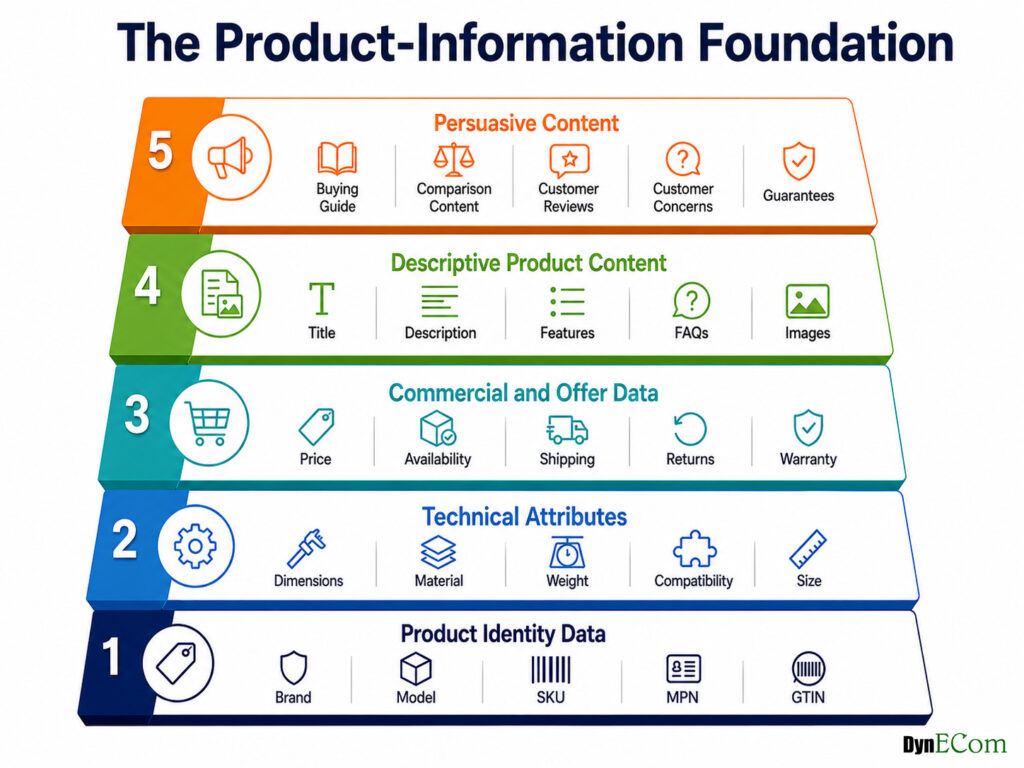
The Six Layers of eCommerce Product Information
Product content can be better described as six layers.
1. Product identity data
Identity data establishes exactly which product is being discussed:
- Brand or supplier
- Manufacturer part number
- Model or version
- SKU
- GTIN, UPC, or EAN
- Product family
- Variant
- Pack quantity
- Revision or generation
Identity data is especially important for reseller products. A page that does not clearly distinguish between similar models may attract traffic but send customers the wrong item. Product identifiers also help external systems reconcile data. Google, for example, recommends supplying accurate GTINs when available because identifiers help it understand exactly which product is being offered.
2. Technical product attributes
Attributes, sometimes called specifications or parameters, are objective properties such as:
- Dimensions
- Material
- Weight
- Capacity
- Color
- Finish
- Compatibility
- Voltage
- Mounting method
- Connection type
- Performance rating
- Certification
- Package contents
Attributes are typically presented in structured tables and can support search filters, comparisons, on-site search, feeds, AI retrieval, and purchasing decisions. An attribute record typically includes an attribute name, a value, and, when applicable, a unit of measure. These elements should be consistent and unambiguous across a product catalog.
3. Commercial and offer data
Offer data describes the transaction rather than the physical product:
- Price
- Availability
- Seller
- Shipping
- Delivery estimate
- Return eligibility
- Warranty
- Quantity pricing
The distinction matters because one product can have many offers. A manufacturer may be authoritative about the product, while a retailer is authoritative about its own price, availability, fulfillment, and return policies.
4. Descriptive product content
Descriptive content explains the facts and helps the customer interpret them:
- Product title
- Short value statement
- Overview
- Key features
- Functions
- Benefits
- Applications
- Compatibility guidance
- Limitations
- FAQs
- Comparisons
- Images
- Video
- Technical-document summaries
A specification states that a glove is 6 mil thick. Descriptive content explains what that thickness means for dexterity, durability, and appropriate use. A title states the model number. Descriptive content explains why that model is the right choice.
5. Marketing content
Marketing content builds awareness, preference, and demand through:
- Campaign pages
- Brand stories
- Social posts
- Advertising
- Seasonal promotions
- Customer stories
- Editorial articles
These six layers should share a common source of truth, but they should not be identical. A marketplace description may prohibit seller-specific language that belongs on the retailer’s own page. A paid landing page may lead with the promise made in the ad. A social video may demonstrate one benefit in ten seconds. The facts remain stable; the presentation changes.
6. User-Generated and User-Inspired Content
User reviews are the most common form of user-generated content. Retailers can also create user-inspired content based on recurring customer language, questions, and concerns, provided it is not presented as customer-authored.
- Reviews
- Testimonials
- Social shares
- Video reviews
- Q&As
- Original summaries of recurring themes found in appropriately sourced external reviews
On-page links to technical resources, comparison products, educational materials, and other relevant parts of the site should also be incorporated into the product-page content strategy.
Product Content Versus General Content Marketing
Many eCommerce content programs begin with a blog calendar because blogs are familiar, easy to commission, and visibly connected to SEO. That sequence is often backwards.
A retailer can publish dozens of educational articles while the pages closest to revenue remain incomplete. The blog may attract visitors, but the product page fails to confirm fit. The category page ranks, but its filters use inconsistent attributes. The buying guide recommends products that have gone out of stock. The campaign generates interest that the commerce experience cannot convert.
A commerce-first content hierarchy generally begins with:
- Product pages: The exact facts, value, evidence, and objections associated with the item.
- Category and collection pages: The structure that helps shoppers understand and narrow the assortment.
- Brand and solution pages: The context that explains manufacturers, house brands, applications, industries, and use cases.
- Buying and comparison content: The decision tools that help shoppers select.
- Informational articles: The educational content that creates awareness and supports the commercial architecture.
This does not make blogs unimportant. It gives them a defined role. Every supporting article should answer four questions:
- Which customer decision does this content support?
- Which product, category, or solution page should receive the next click?
- What unique information does the article provide?
- How will success be measured beyond pageviews?
The blog should support commerce rather than operate as a separate publishing business.
The Problem With Manufacturer-Supplied and Duplicative Content
Manufacturer-supplied content is useful because manufacturers are often the strongest source for product identity, specifications, intended use, safety information, warranties, and product documentation. The problem begins when every reseller publishes the same limited block of copy without adding value.
It is important to separate four concepts.
Duplicated facts
Facts should be consistent. A product does not become a different length because a retailer wants unique content. Accuracy requires the same verified dimensions, material, certification, and compatibility wherever the product is sold.
Duplicated wording
Identical wording can make pages interchangeable. It may also prevent the retailer from addressing its own customers’ questions, terminology, applications, and reasons for buying from that seller.
Commodity content
Commodity content contains information that could appear on almost any competing page. It may be accurate but offers little reason to prefer one source. A generic paragraph that says a product is “high quality, durable, and easy to use” is commodity content even if no sentence is literally duplicated.
Original decision-support content
Original decision support adds verified context:
- What the specification means
- Who should choose the product
- Which applications fit
- Which applications do not
- How the model differs from alternatives
- What is included
- What else is required
- What customers commonly misunderstand
- Why the seller is a credible source
Google’s people-first content guidance asks whether a page provides original information, substantial coverage, insightful analysis, and meaningful additional value rather than simply copying or rewriting other sources. That is the right standard for reseller differentiation. The goal is not to make facts artificially unique. It is to make the buying experience uniquely useful.
Mapping Content to the Purchase Journey
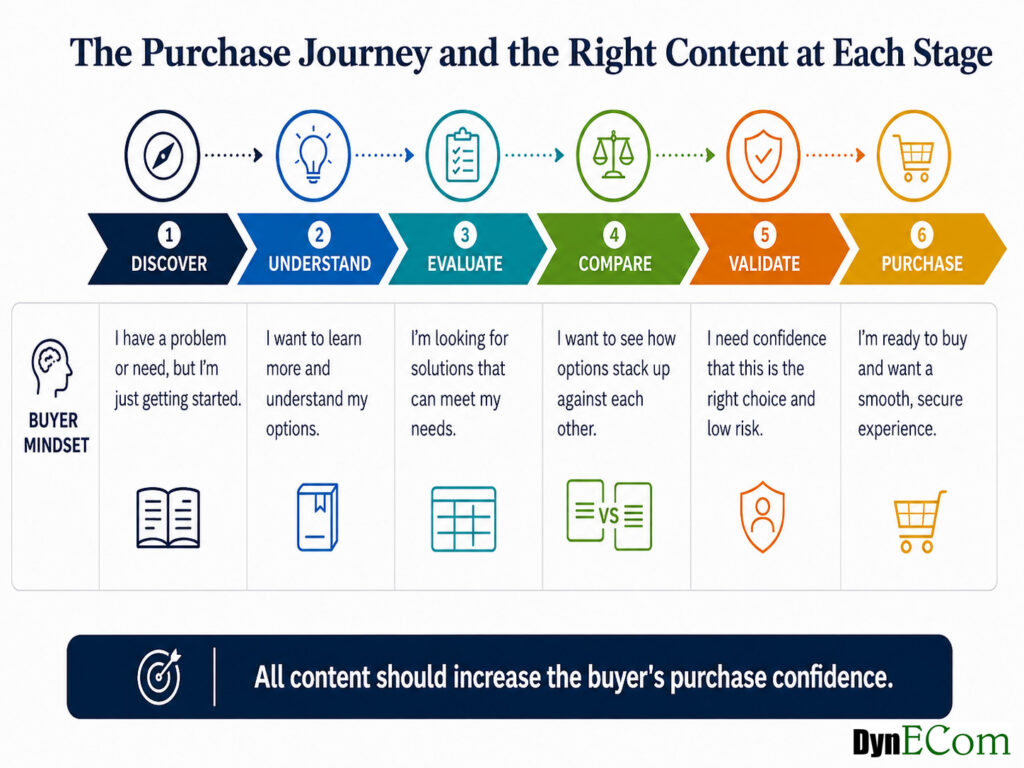
The traditional sales funnel is often drawn as awareness, consideration, and conversion. For eCommerce content planning, a more operational journey is useful.
Discover
The customer recognizes a need or encounters a possible solution.
Typical content:
- Problem-based articles
- Social content
- Application pages
- Category pages
- House-brand education
Typical questions:
- What type of product solves this problem?
- What options exist?
- What terminology should I use?
Understand
The customer learns how the category works.
Typical content:
- Buying guides
- Attribute explainers
- Category education
- Videos
- Glossaries
Typical questions:
- Which features matter?
- What do the specifications mean?
- What trade-offs should I expect?
Evaluate
The customer develops a shortlist.
Typical content:
- Category pages
- Collection pages
- Brand pages
- Product cards
- Good-better-best guides
Typical questions:
- Which products meet my requirements?
- Which brands should I consider?
- What is the difference between entry-level and premium options?
Compare
The customer weighs specific choices.
Typical content:
- Product comparisons
- Model comparison tables
- Product detail pages
- Review summaries
- Alternative recommendations
Typical questions:
- Which model is better for my use?
- What do I gain by paying more?
- What limitations does each option have?
Validate
The customer checks risk, fit, and seller credibility.
Typical content:
- Compatibility information
- Dimensions
- FAQs
- Reviews
- Warranty and returns
- Delivery information
- Authorized seller information
Typical questions:
- Will it fit?
- Is this the correct model?
- Can I return it?
- When will it arrive?
- Can I trust this seller?
Purchase
The customer takes action.
Typical content:
- Price and availability
- Variant selection
- Calls to action
- Quantity information
- Accessories
- Bundles
Use and repurchase
The customer wants to succeed with the product and may need support, supplies, or replacements.
Typical content:
- Setup
- Installation
- Maintenance
- Troubleshooting
- Reordering
- Replacement schedules
- Accessories
The most effective architecture links these stages. A buying guide should not stop after education. It should route the shopper to a useful category or product set. A product page should link to installation and maintenance information. Post-purchase content should help the customer find compatible supplies and replacement parts.
Part 2: Why eCommerce Content Must Be Rethought in 2026
The Traditional Content Playbook
For years, the standard eCommerce content program was relatively predictable:
- Conduct keyword research.
- Assign a primary keyword to each page.
- Add the phrase to the title, heading, description, and metadata.
- Import or lightly rewrite manufacturer copy.
- Publish category descriptions.
- Create blog posts to attract links and informational traffic.
- Update pages when a product changes.
- Measure rankings, sessions, and revenue.
Each activity can still be useful. The weakness is treating them as a complete strategy.
A keyword can tell you how people phrase demand, but not whether the page answers the decision behind the query. A manufacturer description can establish basic facts, but not why a customer should choose one reseller. A blog can generate traffic, but not repair an incomplete product page. A ranking can increase while conversion falls because the query is poorly matched to the product.
The old playbook also assumed that the search result was the primary interface. The user typed a short query, reviewed a list of links, visited several sites, and assembled the answer. That journey still exists, but it is no longer the only one.
In 2026, shoppers are increasingly using AI chatbots to conduct product research, changing how they discover and evaluate products. Optimizing for AI-assisted discovery adds incremental requirements to established SEO and content practices. Wise eCommerce teams will begin by rethinking their content optimization strategies.
What No Longer Works Well
Keyword stuffing
Repeating a phrase does not create relevance when the page fails to address the underlying need. Modern systems can understand close variants, entities, attributes, and context. Google specifically warns against creating many pages for every possible search variation and says its systems can understand relevance without exact phrase matching.
Writing to arbitrary word counts
There is no universal ideal length for a product description or category page. Google explicitly says it does not have a preferred word count. A simple commodity product may need concise content. A technical product with compatibility, installation, safety, and selection issues may require far more. Completeness should be determined by the decision, not a target number.
Thin manufacturer descriptions
A short block of manufacturer copy may identify the product without helping customers evaluate it. It is particularly weak when competitors publish the same paragraph.
Superficial paraphrasing
Changing sentence structure while preserving the same limited information does not create competitive value. It may produce unique wording without unique usefulness.
Blog-first strategies disconnected from products
Traffic-producing content that does not route customers toward relevant commercial pages becomes an isolated media program. Its success may not improve product discovery or revenue.
One-time optimization projects
Product content ages. Competitors add information. Customer questions change. New reviews reveal problems. Specifications, availability, and replacement relationships evolve. Optimization must be an operating process.
Mass AI content without evidence
Google permits AI-assisted content, but warns that generating many pages without added value may violate scaled-content policies. It recommends focusing on accuracy, quality, relevance, and useful context about how automation was used. The risk is not that AI touched the content. The risk is publishing low-effort, low-originality, or inaccurate content at scale.
Measuring traffic without measuring value
A content program can increase impressions and sessions while attracting low-intent visitors. Measurement must include product-page entry quality, add-to-cart rate, conversion, revenue per session, return rate, margin, and content cost.
Copying competitors
Competitive research should reveal information gaps, not provide text to copy. The objective is a verified information advantage.
Treating every channel identically
An owned product page, Amazon listing, Merchant Center feed, paid landing page, and Instagram product post have different constraints and jobs. The facts should agree, but the presentation should not be identical.
Treating SEO and GEO as separate universes
For Google, the same fundamentals support both conventional results and AI features. For other AI environments, complete public product information, structured merchant data, and credible supporting content all contribute. The right strategy is a shared product-information foundation, not two conflicting versions of the truth.
Traditional Search Versus AI-Assisted Search
Traditional search usually begins with a query and returns ranked links, product units, images, videos, maps, and other result types. The user performs much of the synthesis.
AI-assisted search can perform more synthesis before the click. A user may ask:
| “I need chemical-resistant disposable gloves for a small medical office. They must be latex-free, comfortable for extended wear, and available in multiple sizes. What should I compare?” |
That request contains product type, material constraint, application, comfort requirement, organizational context, and comparison intent. An AI system may break it into related searches, gather product facts, compare options, and return a summarized answer. Google says AI Mode and AI Overviews may use query fan-out to issue multiple related searches across subtopics and sources. OpenAI’s shopping research similarly asks follow-up questions and can compare attributes, prices, features, reviews, and constraints using merchant data and public information.
The practical differences include:
- Longer queries: Users can describe needs in natural language.
- Follow-up interaction: The system can clarify preferences.
- Pre-click synthesis: The user may receive an initial comparison before visiting a merchant.
- Different visibility: A site may be cited, mentioned, linked, or used as a data source without occupying one conventional rank.
- More complex measurement: Referrals, citations, product cards, and brand mentions do not all appear in the same analytics system.
The common requirement is sufficient product information. If a page says only “premium nitrile gloves,” it cannot reliably answer questions about thickness, cuff style, chemical resistance, accelerator use, sizing, or suitable applications.
How Major Discovery Environments Differ
Google Search, AI Overviews, and AI Mode
Google integrates traditional results, merchant listings, images, videos, and AI-generated experiences. Pages must be indexable and eligible for a snippet to appear as supporting links in AI features. Google says no special schema is required, but recommends accessible text, internal links, a good page experience, relevant media, consistent structured data, and current Merchant Center information.
ChatGPT shopping and research
ChatGPT shopping experiences may use merchant data, public product information, and other retail sources. OpenAI states that merchants can provide direct product feeds, while participating platforms and merchants can connect catalogs through ACP. Shopping research can compare products across multiple constraints and refine recommendations through follow-up questions.
Perplexity and Claude
These systems may use live retrieval, cited web sources, or other connected data depending on the product and mode. The site owner generally controls the underlying accessibility and quality of public content, but not the exact retrieval or ranking formula.
Marketplace search
Amazon, Walmart, and other marketplaces use their own listing data, categories, attributes, behavior, price, availability, fulfillment, reviews, and policies. Walmart’s Listing Quality tools, for example, evaluate content quality alongside price, shipping, in-stock status, and ratings.
On-site search and chatbots
Retailer-owned search may use exact matching, synonyms, filters, behavioral ranking, embeddings, or conversational retrieval. The retailer has more control, but results are only as good as the product attributes, taxonomy, descriptions, and relationships available to the system.
Why AI May Change the Point of Entry
A traditional retail journey often began on a homepage or category page. The customer explored navigation, read a guide, compared products, and eventually reached a PDP.
AI can compress the early stages. A customer may arrive directly on a product page after an external system has already:
- Defined the category
- Explained the important attributes
- Recommended several options
- Narrowed the customer’s requirements
- Compared price ranges
That visitor may be more informed, but also more demanding. The page must confirm the facts supplied by the AI, establish whether the exact product fits, and provide information the AI could not guarantee, such as current availability, delivery, return policy, seller credibility, or variant selection.
This shift should be treated as a hypothesis to test rather than a universal claim. Examine:
- Growth in product pages as organic landing pages
- AI referral conversion rates
- Query specificity
- Reduced navigation depth before purchase
- Higher or lower time on page
- Changes in assisted conversions
The strategic implication is still important: every product page should be capable of serving as a self-contained entry point.
Search Is Becoming Multimodal and Multichannel
Customers increasingly combine:
- Typed queries
- Voice input
- Product photos
- Screenshots
- Barcode or visual search
- Social videos
- Marketplace filters
- Conversational questions
- On-site chat
This does not require a separate content strategy for every interface. It requires product information that can be expressed in multiple forms.
A dimension should appear as a structured attribute, visible text, and—when useful—a labeled image. A demonstration should include video, captions, and a transcript. A compatibility relationship should be available in the product data and explained in plain language. A key objection should be addressed on the page and adaptable into a social video or chatbot answer.
Why Content Is More Important Even When Clicks Decline
A page can influence the customer before the visit. Its information may determine:
- Whether a brand enters an AI-generated consideration set
- Whether a product is matched to a specific constraint
- Whether a retailer is shown as a merchant
- Whether the system describes the product accurately
- Whether the customer arrives qualified
After the click, content determines whether the page confirms or undermines the customer’s confidence.
The future is not a choice between visibility and conversion. eCommerce content must do both.
Part 3: Choosing the Right Content Strategy
The Central Difference: Market Expansion Versus Market Share
The strategic starting point is whether the company owns the brand or resells a product with established demand.
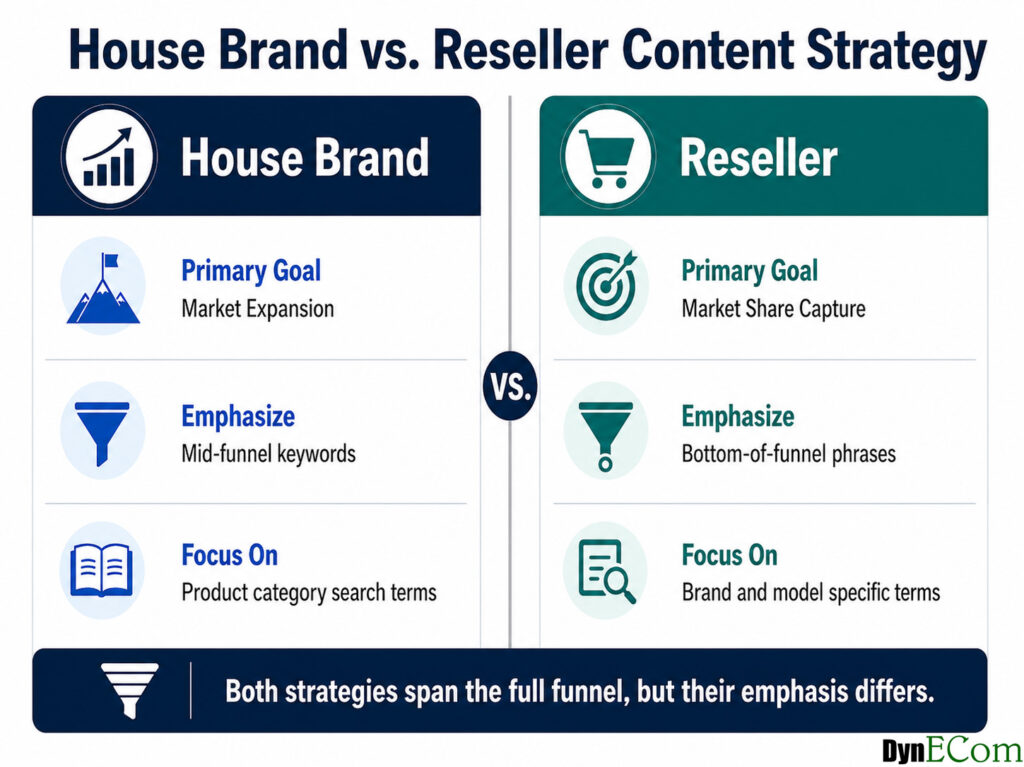
The distinction is not absolute. House brands need bottom-of-funnel pages, and resellers need educational content. The difference is the relative emphasis.
House brands: a market-expansion challenge
A house brand may compete in a familiar category, but customers often do not search for its product name. The brand must create awareness and enter the consideration set.
The content program should place relatively greater emphasis on:
- Category searches
- Problem-based searches
- Application searches
- Use-case searches
- Benefit-oriented searches
- Customer-type searches
- Educational questions
- Comparison with established alternatives
- Why the product deserves consideration
Consider a retailer introducing its own line of surgical gloves. Customers may already search for “powder-free nitrile exam gloves,” “latex-free gloves for dental offices,” or “chemical-resistant disposable gloves.” They may not search for the new house-brand model. The content must connect the unfamiliar product to familiar needs.
That requires more than inserting the brand name into a product title. The site needs category education, application pages, buying guides, comparisons, original evidence, and explanations of why the product differs. House-brand content is partly a demand-creation system.
Reseller products: a market-share challenge
A reseller offering a widely distributed product enters a different competition. Customers may already search for the exact brand, model, part number, or replacement.
The content program should place relatively greater emphasis on:
- Exact product name
- Brand and model
- Manufacturer part number
- SKU or identifier
- Compatibility
- Cross reference
- Replacement
- Product plus attribute
- Product plus availability
- Product plus price
- “Buy” and “in stock” language where appropriate
The customer has often decided what to buy and is deciding where to buy it. The reseller must capture a greater share of existing demand.
That does not mean the product page should be a bare inventory record. Competing sellers may carry the same item, but they can differ in completeness, explanation, shipping, trust, returns, support, documentation, comparisons, and alternatives.
The strategy in one sentence
| House-brand content should place greater emphasis on expanding the market and creating consideration, while reseller content should place greater emphasis on capturing exact-product demand and winning market share. |
Content Strategy for House Brands
House-brand owners have more control and more responsibility. They can create the authoritative source, but only if the content is supported by evidence.
Build the category before promoting the SKU
The product page should connect to a broader content system:
- What problem does the category solve?
- Which customers have the problem?
- Which attributes determine success?
- What alternatives exist?
- Why was the house-brand product designed this way?
A new product cannot depend entirely on branded search demand that does not yet exist.
Emphasize use cases and outcomes
House-brand content should explain where the product belongs in the customer’s work or life. Useful use-case content includes:
- The customer type
- The environment
- The task
- The required performance
- The relevant constraints
- The expected outcome
The claims must remain supportable. “Designed for long shifts” requires a basis such as material, fit, testing, or documented user research. Generic benefit language without evidence weakens credibility.
Produce original evidence
House brands can create content resellers usually cannot:
- First-party testing
- Product-development rationale
- Original photography
- Demonstrations
- Engineering explanations
- Material sourcing
- Quality-control processes
- Design trade-offs
- Comparison criteria
This is valuable for both traditional and generative search because it is non-commodity information. Google’s generative-search guidance specifically encourages unique points of view and content based on firsthand experience rather than summaries that could be produced by anyone.
Explain why the brand deserves trust
A new or unfamiliar name creates risk. House-brand pages should clarify:
- Who stands behind the product
- How quality is controlled
- What warranty applies
- How support works
- What testing or certifications exist
- How replacements and supplies will remain available
Avoid house-brand overreach
The brand should not manufacture demand through exaggeration. Avoid:
- Unsupported “best” claims
- Vague “revolutionary” language
- Implying universal suitability
- Hiding situations where the product is not appropriate
- Comparing against competitors using unverified information
Credibility is a long-term market-expansion asset.
Content Strategy for Resellers
Resellers often begin with a product they did not design and content they did not create. Their opportunity is to become the most useful buying source.
Win exact-product recognition
The page should clearly state:
- Brand
- Exact model
- Manufacturer number
- Product type
- Distinguishing attributes
- Pack quantity
- Variant
- Replacement relationship
The title should help a customer recognize the item immediately. The page should avoid placing promotional language before the identity information.
Add context without changing facts
A reseller should not invent a new specification or broaden an application beyond manufacturer support. It can add value through:
- Plain-English explanations
- Application guidance
- Compatibility across brands
- Cross references
- Alternatives
- Required accessories
- Product comparisons
- Technical-document summaries
- Customer-service insights
- Shipping and return clarity
Compete on confidence
When many sellers offer the same product, the page should answer why the customer should purchase here:
- Is the seller authorized?
- Is the product in stock?
- When will it arrive?
- Can a specialist answer questions?
- Are returns understandable?
- Are technical documents available?
- Can the customer find a replacement or alternative?
Use category expertise as original content
A specialist distributor may know more about selection across brands than any one manufacturer. That expertise can appear in:
- Cross-brand comparisons
- “Choose this when” guidance
- Replacement charts
- Compatibility matrices
- Application-specific recommendations
- Category FAQs
The reseller is not more authoritative about the manufacturer’s design. It may be more useful in helping the customer select among available products.
House-Brand Versus Reseller Keyword Strategy
A practical keyword plan should reflect the type of demand being pursued.
House-brand emphasis
House-brand content tends to prioritize:
- Product-category terms
- Problem and need-state terms
- Applications
- Benefits
- Industries
- Customer personas
- “Best product for” searches
- Comparison searches
- Educational questions
Example themes:
- gloves for handling solvents
- best disposable gloves for dental offices
- how to choose nitrile glove thickness
- latex-free gloves for sensitive skin
- exam gloves for extended wear
Reseller emphasis
Reseller content tends to prioritize:
- Exact brand and model
- Manufacturer part number
- Product identifier
- Replacement product
- Compatibility
- Product plus dimension, material, or pack quantity
- Product plus availability
- Product plus price
- Product plus seller or location
Example themes:
- Brand X 12345 nitrile gloves
- Brand X 12345 medium 100 count
- replacement for Brand X 12345
- Brand X 12345 in stock
- buy Brand X 12345 case
Both strategies span the funnel
A house brand still needs exact model pages. A reseller can use educational content to capture customers before product selection. The distinction is a budgeting and emphasis decision, not a prohibition.
Building a Full-Funnel Portfolio Without Losing Strategic Emphasis
The distinction between market expansion and market-share capture should guide resource allocation, but it should not trap either business model in one stage of the funnel. A house brand eventually needs exact-product demand, and a reseller can create new category demand. The strategic question is where each company must work hardest.
The house-brand progression
A new or lightly recognized house brand often begins with a demand deficit. Few customers search for the exact brand or model because they do not yet know it exists. The content system must therefore connect the product to needs customers already recognize.
A useful progression is:
- Define the problem. Create category, application, and solution content around the customer’s need.
- Explain the decision. Show which attributes, trade-offs, and product types matter.
- Introduce the house brand. Present it as a relevant option within an honest comparison set.
- Prove the fit. Use specifications, testing, applications, media, reviews, and limitations to substantiate the recommendation.
- Build branded demand. As awareness grows, strengthen brand, model, and exact-product pages so later searches lead directly to the correct offer.
This progression prevents a common mistake: launching a proprietary product with only a polished PDP and expecting customers to search for it. The PDP may be excellent, but it cannot capture demand that has not yet formed. Category education, buying guidance, problem-based content, social demonstrations, paid campaigns, and marketplace exposure may all be required to create the initial consideration.
House-brand content should also clarify why the product exists. A credible reason might be a better configuration for a defined application, a simpler assortment, more reliable availability, a more useful bundle, or a different value position. “Exclusive” is not itself a customer benefit. The content must connect the exclusivity to a decision-relevant advantage.
The reseller progression
A reseller typically begins with a different opportunity. Customers may already search for the brand, product name, model, manufacturer number, or replacement part. The immediate task is to become the best destination for that known demand.
A useful progression is:
- Capture exact identity demand. Make brand, model, manufacturer number, variant, and pack quantity unmistakable.
- Confirm the purchase. Provide the specifications, compatibility, availability, delivery, and seller information needed for validation.
- Differentiate the buying experience. Add clearer explanations, comparisons, documents, support, returns, and relevant accessories.
- Expand adjacent demand. Build category, application, replacement, and alternative content that reaches shoppers before they select the exact model.
- Earn repeat preference. Use reliable fulfillment, account tools, support, replenishment content, and post-purchase resources to make the reseller the preferred source.
This progression prevents another common mistake: publishing an exact manufacturer description and assuming availability alone will win the order. When many sellers carry the same item, the customer may compare them on confidence and effort as well as price. The reseller that verifies identity fastest, explains fit most clearly, and presents the least risky transaction can win without changing the product facts.
Allocate content by the demand gap
The appropriate balance can be diagnosed by examining where demand is being lost.
For a house brand, ask:
- Do customers search the problem but not the brand?
- Does the category page explain why the product deserves consideration?
- Can a shopper compare the house brand with familiar alternatives?
- Is there enough evidence to support the claimed differentiation?
- Are paid and social campaigns creating interest that the site fails to convert into branded demand?
For a reseller, ask:
- Does the site appear for exact manufacturer numbers and model searches?
- Can the customer verify variant, quantity, fit, and availability immediately?
- Does the page add any useful information beyond the shared manufacturer paragraph?
- Are competitors winning because they provide better documentation, delivery clarity, or technical support?
- Does the site connect exact products to replacements, alternatives, and related categories?
The answers should determine the content mix. A house brand with strong awareness may shift more resources toward bottom-of-funnel model pages. A reseller with exceptional exact-product coverage may invest more heavily in category education and applications to enlarge its addressable market. The framework remains directional, not rigid.
Coordinate paid, organic, marketplace, and social demand
The funnel is not owned by one channel. A house-brand application article may earn organic visibility, supply a paid landing page, inspire a demonstration video, and introduce the product on a marketplace. A reseller’s exact-product page may capture organic searches, receive Shopping traffic, support an account manager, and answer an AI-generated product query.
For that reason, keyword strategy should not be a list owned only by SEO. It should be a shared demand map showing:
- The customer problem
- The stage of the decision
- The page or channel responsible for answering it
- The product or category that should receive the next click
- The proof required to make the answer credible
- The metric that indicates progress
This creates a full-funnel system while preserving the central distinction: house brands generally invest more heavily in creating consideration, while resellers generally invest more heavily in capturing and converting demand that already exists.
Brand Authority Versus Retailer Authority
Authority is contextual.
A manufacturer or brand owner is usually the strongest source for:
- Product specifications
- Product design
- Intended use
- Safety
- Warranty
- Material composition
- Test results
- Certifications
A specialist retailer may be the stronger source for:
- Selection among brands
- Availability
- Fulfillment
- Returns
- Compatibility across manufacturers
- Cross references
- Alternatives
- Category-wide comparisons
- Real customer questions
The page should make these roles clear. A reseller can say, “Customers choosing between these models should consider…” based on category expertise. It should not rewrite a safety limitation or claim a performance rating the manufacturer does not support.
Owned Website Versus Marketplace
The next strategic question is where the content will appear.
An owned site provides:
- Flexible modules
- Internal links
- Supporting guides
- Full analytics
- Seller-specific benefits
- More control over brand voice
- More room for technical documents and comparisons
A marketplace provides:
- Built-in demand
- Prescribed fields
- Shared product pages
- Policy limitations
- Limited external linking
- Platform-managed trust and fulfillment signals
The same source of truth should serve both environments, but the content must adapt to each channel’s rules and customer context.
Large Catalogs Versus Small Catalogs
A small catalog can support handcrafted depth on every product. A large catalog requires a system.
Large-catalog optimization needs:
- Category-specific templates
- Controlled vocabularies
- Attribute normalization
- Product segmentation
- Automated validation
- Exception handling
- Competitive monitoring
- Refresh workflows
- Governance
The objective is not to force every product into identical copy. It is to standardize the process while preserving the differences customers need to understand.
Products can be segmented into:
- Protect: High-performing pages that must be monitored and kept current
- Improve: Valuable pages with obvious content gaps
- Expand: Products with demand or application opportunities not yet covered
- Test: Products suitable for controlled experiments
- Maintain: Long-tail pages requiring accurate minimum coverage
- Retire: Discontinued or low-value pages requiring consolidation or redirection
Product Lifecycle Strategy
Content changes with the product lifecycle.
New products
Explain the product, establish its identity, create demand, and connect it to existing categories and problems.
Mature products
Maintain accuracy, strengthen comparisons, add customer insights, and monitor competitors.
Seasonal products
Update applications, availability, media, and internal links without changing dates merely to appear fresh.
Temporarily unavailable products
Preserve the page when demand remains, explain availability honestly, and offer notifications or alternatives.
Discontinued products
Identify replacements, preserve support information, and redirect only when the replacement satisfies the same intent.
Variants
Clarify which facts are shared and which differ. Avoid attaching one variant’s images, price, or specifications to another.
A content strategy is strongest when it begins with these commercial realities rather than applying one template to every SKU.
Part 4: Building the Product-Information Foundation
Content Quality Begins Before Writing
The visible product page is the end of a chain. Before a writer produces a sentence, someone must identify the product, gather sources, resolve contradictions, define attributes, and decide which claims are permitted. If those inputs are weak, polished prose can make the error more convincing without making it less wrong.
This is especially dangerous at scale. A single incorrect mapping between a manufacturer number and a product record can spread into:
- The product title
- The description
- Structured data
- Shopping feeds
- Marketplace listings
- Paid ads
- Customer-service tools
- AI-generated answers
The foundation should therefore be treated as an evidence system rather than a pile of URLs.
Establish a Source Hierarchy
Not all sources deserve equal weight. A practical hierarchy begins with the most product-specific and authoritative evidence available.
1. Exact manufacturer product page
An exact page tied to the manufacturer number or model is usually the best public starting point. Confirm that the page describes the same variant, pack quantity, revision, market, and product status.
2. Exact manufacturer technical document
Data sheets, engineering drawings, manuals, catalogs, safety documents, and warranty files may contain details absent from the marketing page. The document should explicitly apply to the exact product, not merely a similar series.
3. Verified first-party business data
An eCommerce company may have supplier files, ERP records, purchase data, internal testing, or customer-service knowledge unavailable publicly. These sources can be highly valuable if ownership and recency are clear.
4. Authorized distributor information
Authorized distributors may provide reliable packaging, fulfillment, compatibility, and regional availability information. They are less authoritative than the manufacturer for product design unless they cite the manufacturer.
5. Reliable reseller information
Other sellers can reveal attributes and customer questions, but their facts must be verified. Multiple resellers often copy the same original error.
6. Customer-generated evidence
Reviews and questions help identify experience, concerns, and real applications. They are not automatically reliable for technical specifications, safety, or universal suitability.
7. Controlled inference
Inference should be explicit, limited, and avoided for material claims. A standard connector shape may suggest compatibility, but it does not prove compatibility. A family name may suggest material, but it does not establish the material of every model.
Search results and AI outputs are excellent discovery tools. They can point to documents and contradictions. They should not become the final source merely because they present an answer confidently.
Product Identification and Exact Matching
The first research question is not “What can we say about this product?” It is “Which exact product is this?”
A robust identity record may include:
- Supplier or brand
- Manufacturer part number
- Model
- GTIN, UPC, or EAN
- Retailer SKU
- Product family
- Variant attributes
- Pack count
- Revision
- Country or market version
- Replacement or supersession status
Common matching failures
Similar model contamination
A page for model 12345 may inherit dimensions from model 12345A because the names look related.
Series-level overreach
A series brochure says products are available in aluminum or steel. The exact SKU is then described as aluminum without evidence.
Pack-quantity confusion
A marketplace listing describes a case, while the retailer sells one unit.
Replacement confusion
A discontinued part is replaced by a newer model, but the newer model’s specifications are attached to the old product page.
Regional variation
A product name is shared across markets while voltage, certifications, packaging, or included accessories differ.
Exact matching is not a clerical detail. It is the condition that makes every later optimization valid.
Attribute Extraction and Normalization
Attributes should be designed by category rather than gathered as an unstructured list.
A category-specific attribute model defines:
- Attribute name
- Definition
- Data type
- Unit of measure
- Allowed values
- Whether multiple values are permitted
- Whether the field is required, recommended, or optional
- Whether it belongs to the product or offer
- Display order
- Source requirements
For example, “length” should specify whether the measurement describes the entire product, usable area, cable, handle, or package. “Capacity” should identify volume, weight, electrical load, or another quantity. “Compatibility” should distinguish tested compatibility from a customer-reported use.
Normalize without erasing meaning
Normalization makes data comparable, but it should preserve relevant distinctions.
Useful normalization includes:
- Converting equivalent units consistently
- Standardizing brand names
- Mapping synonyms to a controlled value
- Separating multiple values
- Distinguishing “not applicable” from “unknown”
- Preserving manufacturer terminology when customers search for it
Do not convert an uncertain value into a precise one. “Approximately 10 in.” should not become “10.00 in.” merely to fit a data type.
Treat missing values honestly
A blank field may mean:
- The value is unknown
- The attribute does not apply
- The source does not publish it
- The research is incomplete
- The product has multiple values
These states should not be collapsed. An AI system asked to “fill every field” may invent an answer unless the workflow explicitly permits blanks and confidence levels.
Taxonomy and Product Relationships
A product rarely exists alone. The content system should represent relationships such as:
- Product and variant
- Product and category
- Product and brand
- Product and application
- Product and accessory
- Product and required component
- Product and replacement
- Product and compatible system
- Product and alternative
- Product and bundle
- Product and technical document
- Product and review
- Product and question
Relationships create discovery and decision support. They power filters, internal links, recommendations, knowledge graphs, chatbots, and comparisons.
Consider a replacement part. The customer may search the old manufacturer number, the new number, the equipment model, the product type, or a competitor cross reference. A flat description cannot serve all those paths as effectively as a structured relationship model supported by clear visible text.
Competitive Content-Gap Analysis
Traditional content audits ask whether required elements are present. Competitive analysis asks whether the page is better than the pages already winning attention.
A repeatable process includes:
Step 1: Identify visible competitors
Search the important product, category, application, and identifier terms. Include traditional results, marketplace listings, manufacturer pages, and AI-cited sources where observable.
Step 2: Extract information, not wording
Record:
- Product identifiers
- Attributes
- Benefits
- Applications
- Compatibility
- Media
- FAQs
- Comparisons
- Technical documents
- Seller assurances
- Limitations
Step 3: Normalize overlap
Competitors may describe the same attribute differently. Normalize them so the comparison measures information coverage rather than phrase count.
Step 4: Identify gaps and contradictions
Ask:
- What useful information appears elsewhere but not on our page?
- What does our page explain better?
- Where do sources disagree?
- Which questions remain unanswered everywhere?
- Which competitor claims lack support?
Step 5: Verify the information superset
The combined list is a research agenda, not publishable truth. Validate facts against authoritative sources.
Step 6: Organize around decisions
Do not publish a database dump. Place the information where it helps the customer identify, evaluate, validate, and purchase.
Step 7: Monitor and refresh
Competitive advantage is temporary. A strong page today can become ordinary as others improve.
This is the essence of Competitive Content: not copying the leader, but creating a verified and more useful information experience.
Sources of Customer Language and Questions
Competitors are only one source of insight. Customer language can be found in:
- Search Console queries
- Paid search terms
- On-site search logs
- Chatbot conversations
- Customer-service transcripts
- Sales-call notes
- Product questions
- Reviews
- Returns and cancellations
- Support cases
- Marketplace reviews
- Social comments
Each source reveals a different type of gap.
Search terms reveal vocabulary. Returns reveal failed expectations. Customer service reveals ambiguity. Reviews reveal experience. Paid search terms reveal demand the company is already buying. On-site search reveals what visitors cannot find through navigation.
Create a recurring process that converts these signals into:
- New FAQs
- Revised descriptions
- Better attribute labels
- Compatibility clarifications
- New comparisons
- New media
- Category guidance
Product Content Briefs and Style Guides
A scalable program requires more than a prompt. It needs a content brief and a style guide.
The brief should define:
- Exact product identity
- Audience
- Search and purchase intent
- Required facts
- Required modules
- Important customer concerns
- Permitted claims
- Prohibited claims
- Source hierarchy
- Competitive gaps
- Internal links
- CTA
The style guide should define:
- Terminology
- Brand voice
- Sentence style
- Units
- Capitalization
- Attribute formatting
- Product-title rules
- Number formatting
- Treatment of uncertainty
- Required disclosures
- Review and approval process
A good style guide increases consistency without making every page sound the same.
Part 5: Product Page Content Optimization
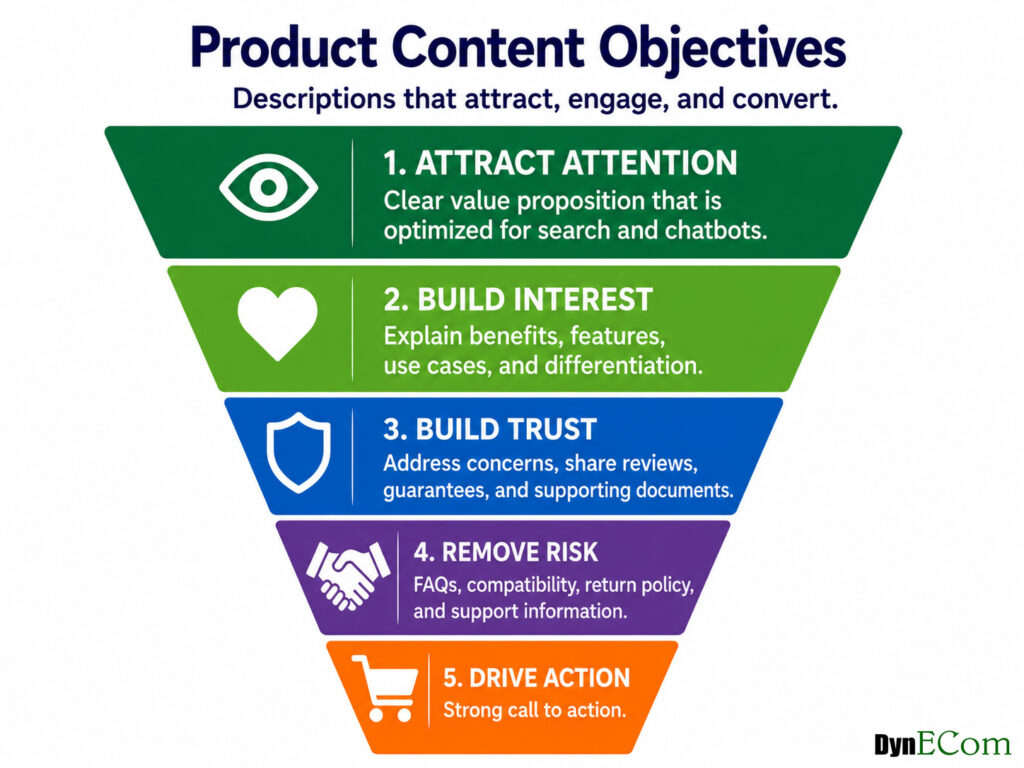
The Changing Job of the Product Page
The product detail page once functioned primarily as the final step before add to cart. It now has to perform many jobs:
- Match exact and descriptive search demand
- Communicate with AI and shopping systems
- Confirm product identity
- Establish fit and compatibility
- Explain value
- Reduce purchase risk
- Support comparison
- Demonstrate seller credibility
- Provide current offer information
- Connect to technical and post-purchase resources
In many cases, the PDP may be the visitor’s first and only exposure to the company. A shopper arriving from an AI answer, shopping ad, marketplace comparison, social post, or exact-part-number search may never see the homepage. The page must represent the product and the seller without forcing the customer to reconstruct essential context elsewhere.
Product Page Information Hierarchy
A useful hierarchy answers questions in the order they typically arise.
1. Identity
What exactly is this?
Include:
- Clear product title
- Brand
- Model or manufacturer number
- Product type
- Variant
- Pack quantity
2. Availability and price
Can I buy it, at what price, and when can I get it?
3. Primary value
Why should this product be considered?
4. Key differentiators
What distinguishes it from similar options?
5. Critical specifications
Does it meet the minimum requirements?
6. Fit and compatibility
Will it work in the intended environment or with the intended system?
7. Benefits and applications
What does it help the customer accomplish?
8. Trust and proof
Why should the customer believe the claims and trust the seller?
9. Supporting details
What else might affect the decision?
10. Alternatives and complements
What should the customer choose if this product does not fit, and what else is required?
11. Technical resources
Where can the customer verify or implement the purchase?
The exact order will vary. A fashion page may lead with visual presentation and fit. An industrial replacement part may lead with model number, compatibility, dimensions, and documentation. Hierarchy should reflect decision risk.
Adjusting Content Depth to Product Complexity
A complete product page is not necessarily a long product page. Content depth should reflect the number and seriousness of the questions the customer must resolve before acting. The page should be more complete and useful than competing pages, but that should not be confused with meeting a specific word count. Depending on the product and competitive environment, a long page may be appropriate.
A low-cost, familiar, low-risk product may require only:
- Exact identity
- A clear image
- A few differentiating attributes
- Quantity and variant information
- Price, availability, and delivery
- A concise description
- A straightforward return policy
A complex, expensive, regulated, configurable, or compatibility-dependent product may require substantially more:
- Detailed specifications
- Applications and exclusions
- Compatibility evidence
- Installation requirements
- Drawings and technical documents
- Comparisons
- Certifications
- Warranty and service information
- Expert support
- Configuration guidance
- Multiple CTAs, such as request a quote, download a drawing, or confirm fit
The content team should therefore estimate decision complexity, not simply assign a standard word count by template.
Five factors that increase decision complexity
- Consequence of choosing incorrectly A decorative item with easy returns creates less risk than an electrical component that can delay a repair or an industrial part that can damage connected equipment. As the consequence rises, content should become more explicit about fit, limitations, and verification.
- Number of meaningful alternatives A product with many similar models requires stronger differentiation. The page may need a comparison table, a selection guide, or an explanation of why one attribute changes suitability.
- Technical knowledge required When customers must interpret ratings, materials, protocols, dimensions, or standards, the page should combine specifications with plain-language explanations. A glossary link alone may not be enough if the term materially affects selection.
- Configuration and compatibility Products that depend on model year, system type, connector, voltage, mounting pattern, size, or accessory require explicit relationship language and a reliable fit workflow. Compatibility content should identify both what is supported and the evidence behind the statement.
- Purchase process A self-service purchase requires different content from a negotiated B2B quote. A quote page may need to establish technical suitability and collect configuration details before price is available. The CTA and content hierarchy should reflect the real next step.
Create content tiers rather than one universal template
A scalable program can establish tiers such as:
Tier 1: Transaction confirmation For familiar, low-risk products. Focus on identity, variant, price, availability, essential attributes, and concise benefits.
Tier 2: Guided selection For products with moderate differentiation or application questions. Add use cases, FAQs, comparisons, richer images, and clearer attribute explanations.
Tier 3: Technical validation For compatibility-dependent, expensive, or high-consequence products. Add documentation, drawings, limitations, installation requirements, cross references, and expert support.
Tier 4: Solution selling For configurable systems, complex B2B products, or emerging house brands. Connect the PDP to solution pages, application guides, consultation, case evidence, and a structured quote process.
Tiers should determine required modules and review rigor—not merely the quantity of prose. A Tier 3 page may contain a concise description but extensive structured specifications, drawings, and compatibility logic. A Tier 2 consumer product may rely more heavily on images, comparisons, and review themes.
Distinguish missing content from intentionally concise content
A page is not thin merely because it is short. It is thin when material questions remain unanswered. Conversely, a long page can still be thin if it repeats generic benefits without clarifying identity, fit, or evidence.
A practical review asks:
- What decision could a qualified customer not make from this page?
- What question would force the customer to leave the page or contact support?
- Which facts are present but difficult to find?
- Which claims create a need for proof that is not supplied?
- Which content modules exist because the template requires them rather than because the customer needs them?
This approach protects usability. It encourages deep content where complexity justifies it and restraint where the customer needs a fast, confident confirmation.
Product Title Optimization
The product title has three jobs:
- Identify the product accurately.
- Help the right customer recognize it.
- Connect the page to relevant search language.
A strong owned-site title usually combines:
- Product type
- Brand
- Model or manufacturer number
- One or more critical differentiators
- Variant information when necessary
House-brand title strategy
A house-brand title should not lead with an unfamiliar brand and assume customers understand the product. It often benefits from establishing the product type and value-relevant differentiators early.
Weak:
| DynEcom ProGuard X7 |
Stronger:
| Powder-Free Nitrile Exam Gloves, 6 Mil, Textured Fingertips – DynEcom ProGuard X7 |
The stronger version connects the product to category and attribute demand while retaining the proprietary model.
Reseller title strategy
A reseller title should make exact identification easy.
Weak:
| High-Quality Industrial Connector |
Stronger:
| BrandName 12345 Weatherproof 7-Pin Trailer Connector – Black |
The exact model and product type help customers recognize the item and reduce mismatches.
Title rules
- Put the most decision-relevant terms early.
- Avoid promotional claims such as “best,” “amazing,” or “lowest price.”
- Do not repeat the same keyword unnaturally.
- Distinguish variants.
- Use consistent order within a category.
- Preserve meaningful manufacturer terminology.
- Do not make the title carry every available attribute.
Marketplace and feed titles may require different lengths or field rules. Google Merchant Center recommends specific and accurate titles, placing important details early because users may see only the beginning of the title.[21]
Above-the-Fold Product Content
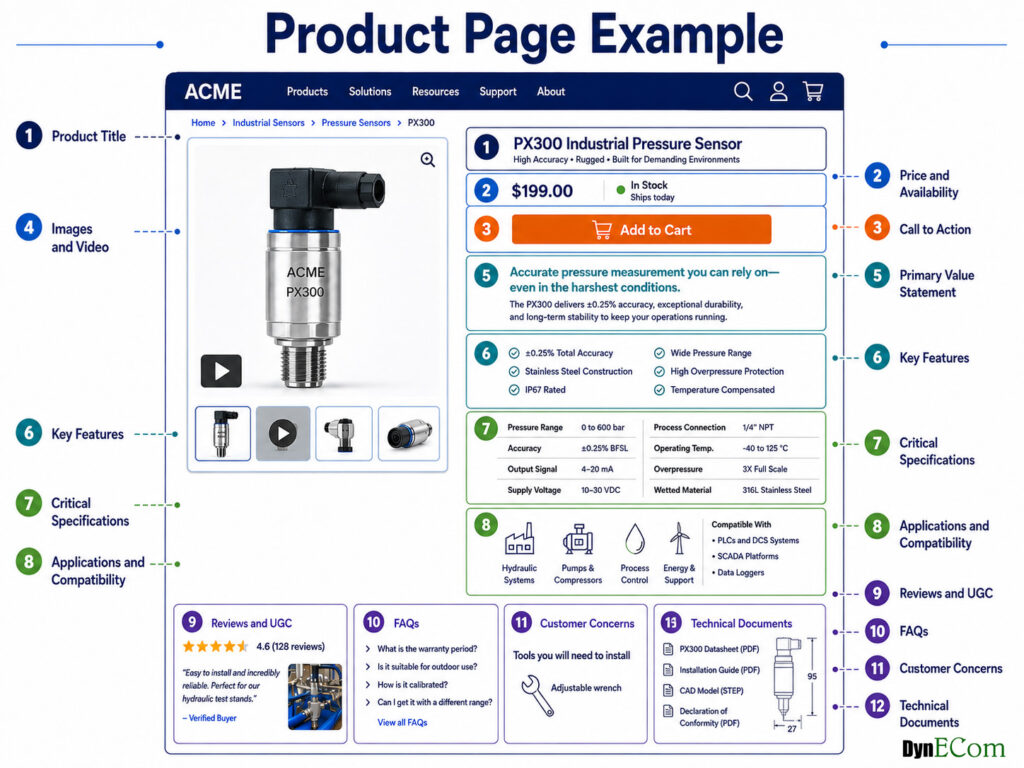
Above-the-fold content should answer the minimum questions required to keep a qualified visitor engaged.
Include as appropriate:
- Product title
- Product identifier
- Primary image
- Price
- Availability
- Delivery estimate
- Rating and review count
- Variant selection
- Three to five critical facts
- Short value statement
- Primary CTA
- Return or trust summary
The goal is not to compress the entire product page into the first screen. It is to prevent immediate uncertainty.
The short value statement
A useful value statement explains the product’s role in one or two sentences.
Generic:
| A high-quality glove designed for professional use. |
Useful:
| A powder-free, latex-free nitrile exam glove designed for users who need textured grip, extended cuff coverage, and dependable barrier protection during routine clinical tasks. |
The second statement provides product type, material, use context, and differentiators without unsupported hype.
Key Features and Bullet Points
Bullets are often the most-read descriptive content on a PDP. They should translate facts into meaning.
A useful pattern is:
| Feature — function — benefit — use context. |
Example:
| Textured fingertips: Improve grip when handling small instruments or working in damp conditions without adding texture across the full glove. |
This is more useful than:
| Textured fingertips for superior performance. |
Good bullet practices
- Lead with the customer-relevant concept.
- Explain technical terms.
- Include an application when supported.
- State limitations when they affect selection.
- Keep each bullet focused on one idea.
- Use parallel structure.
Common bullet failures
- Repeating the title
- Listing unexplained specifications
- Using every bullet for a superlative
- Making unsupported durability or performance claims
- Writing dense paragraphs with bullet symbols
- Inserting keywords that do not fit the meaning
Product Description Optimization
The description should create context rather than duplicate the title, bullets, and specification table.
A strong description answers:
- What is the product?
- Who is it for?
- What does it do?
- What distinguishes it?
- How is it used?
- What should the customer verify before buying?
- What evidence supports the claims?
Recommended structure
Opening: identity and value
State what the product is and the main reason it belongs in the consideration set.
Middle: applications and differentiation
Explain how the important attributes affect use.
Validation: fit, limitations, and proof
Clarify compatibility, package contents, required accessories, limitations, or documentation.
Close: next step
Direct the customer toward selection, comparison, quote request, or purchase.
Write for humans and machines
Clear writing helps both.
Use:
- Explicit product names instead of ambiguous pronouns
- Clear relationships such as “compatible with” and “replacement for”
- Specific factual statements
- Descriptive headings
- Natural buyer language
- Consistent terminology
- Short, complete paragraphs
Avoid forcing every sentence into an unnatural “AI-friendly” pattern. Google says pages do not need special formatting or markup to appear in its AI features.[1] Structure should serve the customer first.
Features, Functions, Benefits, Use Cases, and Outcomes
These terms are often used interchangeably, but they describe different information.
Feature
What the product has.
| 6 mil nitrile construction |
Function
What the feature does.
| Creates a thicker disposable barrier than many lightweight exam gloves. |
Benefit
Why the function matters.
| Helps balance durability with the dexterity needed for routine clinical tasks. |
Use case
Where or when the benefit matters.
| Useful for examination, sanitation, sample handling, and other tasks requiring frequent glove changes. |
Outcome
What the customer can accomplish.
| Staff can complete routine tasks with fewer interruptions caused by tears, while retaining tactile control. |
The chain must remain grounded in facts. A thicker glove may support durability, but it does not automatically prove chemical resistance or puncture resistance for every application. Benefits should not outrun evidence.
Product Specifications and Attributes
Specifications support filtering, comparison, machine understanding, and customer validation. They should be:
- Complete enough for the decision
- Consistent across products in the category
- Clearly defined
- Presented in logical groups
- Matched to the correct variant
- Expressed in standard units
- Consistent with feeds and structured data
Group specifications by customer logic
Rather than one alphabetical list, consider sections such as:
- Dimensions
- Materials and construction
- Performance
- Compatibility
- Electrical characteristics
- Packaging
- Certifications
Explain unfamiliar attributes
A table entry may link to a glossary or include a brief explanation.
| Ingress protection: IP67 – protected against dust and temporary immersion under the conditions defined by the rating standard. |
Do not imply a broader protection claim than the rating supports.
Handle conflicts visibly in the workflow
If the manufacturer page and technical document disagree:
- Do not choose the more convenient value.
- Check document dates and revisions.
- Escalate material conflicts.
- Record the source used.
- Consider omitting the value until resolved.
The customer sees the final answer; the organization needs the evidence trail.
Applications and Compatibility
Compatibility content can be one of the largest sources of long-tail discovery and one of the largest sources of liability.
Useful compatibility content includes:
- Compatible models
- Supported systems
- Required dimensions
- Connector or thread type
- Environmental conditions
- Required accessories
- Installation constraints
- Incompatible uses
- Replacement relationships
- Cross references
Use explicit relationship language
There is a difference between:
- “Designed for Model X”
- “Compatible with Model X”
- “Commonly used with Model X”
- “May fit Model X; verify dimensions”
The wording should reflect the evidence.
Avoid compatibility inference
Visual similarity or matching dimensions may suggest a possible fit, but it is not enough for a definitive compatibility claim. The cost of an incorrect fit can include returns, downtime, safety issues, and loss of trust.
Product Comparison and Selection Support
Comparison content helps customers decide without leaving the site.
Useful formats include:
- Good-better-best tables
- Model comparison charts
- “Choose this product when…” sections
- House brand versus established alternative
- Upgrade and downgrade paths
- Replacement-product tables
- Accessory compatibility matrices
Define comparison criteria
A fair comparison should state what is being evaluated:
- Price
- Material
- Capacity
- Performance
- Warranty
- Intended use
- Compatibility
- Included components
Avoid selecting criteria solely to make one product appear superior.
Explain trade-offs
The most credible comparison acknowledges that the “best” choice depends on the need.
| Choose Model A when low weight and portability matter most. Choose Model B when higher capacity is more important than weight. |
This is more persuasive than claiming one model is universally better.
Product FAQs
FAQs should answer actual questions, not manufacture a block of keyword-rich text.
Sources include:
- Search queries
- Customer service
- Sales teams
- Reviews
- Returns
- Product documentation
- Marketplace questions
- Social comments
Organize questions by purpose:
Product facts
- What is included?
- What material is used?
- What are the dimensions?
Fit and compatibility
- Will it fit Model X?
- Which size should I choose?
- Is an adapter required?
Use
- Can it be used outdoors?
- Is it reusable?
- How should it be cleaned?
Shipping and seller
- Is it in stock?
- Is the seller authorized?
- Can it be returned?
Troubleshooting
- Why is the product not connecting?
- Which replacement part is required?
Keep answers direct. Link to deeper support content when the answer requires a procedure.
Identifying Customer Concerns and Overcoming Objections
Every unanswered material concern is a conversion leak.
Common concerns include:
- Will it fit?
- Is it durable enough?
- Is it difficult to install?
- Is the price justified?
- What is included?
- What happens if it fails?
- Can it be returned?
- Is this the latest model?
- Is the seller legitimate?
Address objections with information, not pressure.
Weak objection handling
| Don’t worry—this premium product is perfect for everyone. |
Strong objection handling
| This model is intended for systems using a 7-pin round connection. It is not a direct replacement for flat 7-way connectors. Verify the connector style and mounting dimensions before ordering. |
The stronger answer may exclude some buyers, but it increases conversion quality and reduces returns.
Reviews and User-Generated Content
Reviews add firsthand experience, social proof, customer language, and evidence about real use. They can also reveal product limitations and content gaps.
Useful review elements include:
- Rating distribution
- Verified purchase status
- Written reviews
- Customer images
- Customer video
- Product Q&A
- Most-helpful reviews
- Seller responses
- Attribute-level themes
Analyze reviews, do not merely display them
Review analysis can reveal recurring themes such as:
- Sizing runs small
- Installation requires an unlisted tool
- Packaging creates damage risk
- Customers use the product in an unexpected application
- A specification is frequently misunderstood
The response should not be to hide the issue. Improve the content, product, packaging, or process.
Use external review research responsibly
External reviews, forums, and marketplace questions can help identify customer concerns when on-site review volume is low. Use them as research inputs to create original FAQs and guidance.
Do not:
- Present external reviews as first-party reviews
- Combine third-party ratings into an on-site score
- Republish protected text without permission
- Attach a review to the wrong model or variant
- Treat anecdotal experience as a verified specification
Product Image Optimization
Images answer questions text cannot answer efficiently.
A complete image set may include:
- Clean primary image
- Alternate angles
- Detail views
- Scale reference
- Dimension diagram
- Packaging
- Included components
- Application image
- Lifestyle image
- Comparison graphic
- Feature callout
Image accuracy
The image must show the product and variant being sold. Avoid:
- Showing accessories not included without clarification
- Using a different color or model
- Creating AI imagery that changes product geometry
- Adding a scale that misrepresents size
Image SEO and accessibility
Use:
- Descriptive file names
- Accurate alt text
- Responsive images
- Compression that preserves important detail
- Captions where context matters
Alt text should describe the image’s useful content, not repeat a list of keywords.
Benefit callouts
Text on images can explain:
- Dimensions
- Included parts
- Material layers
- Controls
- Application
Keep callouts readable on mobile and consistent with visible page claims.
Product Video Optimization
Video is especially useful for movement, setup, scale, sound, workflow, and comparison.
Useful formats include:
- Product overview
- Demonstration
- Installation
- Comparison
- Troubleshooting
- Technical explanation
- Short-form social version
Support video with:
- Descriptive title
- Thumbnail
- Captions
- Transcript
- Summary in HTML
- Relevant structured data
The transcript improves accessibility and makes the information available to systems that cannot interpret every visual detail.
Trust and Credibility Content
Persuasive content is not the same as promotional content.
Promotional copy asks the customer to believe a claim because the seller says it confidently. Credible copy provides a specific claim, evidence, context, and limitations.
Trust content may include:
- Warranty
- Returns
- Shipping
- Availability
- Authorized reseller status
- Certifications
- Support
- Contact information
- Expert assistance
- Authenticity guarantee
- Replacement-parts availability
- Company experience
Avoid overselling
Overselling can increase short-term clicks while reducing long-term conversion quality. A product page should be willing to say:
- This product is not intended for…
- An adapter is required for…
- Choose another model if…
- This rating does not cover…
Specific limitations can increase trust because they demonstrate product understanding.
Technical Documents and PDFs
Technical documents often contain the most authoritative detail, but customers should not be forced to search a 70-page PDF for essential purchase information.
Use documents such as:
- Data sheets
- Manuals
- Safety documents
- Compatibility lists
- Certificates
- Engineering drawings
- Warranty files
Best practices:
- Summarize purchase-critical information in HTML.
- Link to the complete file.
- Describe what the file contains.
- Show file type and size.
- Maintain version control.
- Remove obsolete documents.
- Keep the document accessible.
The PDF supports the page; it should not replace the page.
Product Variants
Variants may differ by:
- Color
- Size
- Material
- Capacity
- Pack count
- Voltage
- Model
- Configuration
Clarify:
- Which content is shared
- Which specifications change
- Which image applies
- Which offer is selected
- Whether each variant has a unique URL
Google recommends making product variants identifiable and provides structured-data guidance for variant relationships.[5] Technical implementation should reflect the site’s search and merchandising strategy, but the visible customer experience must make the selected variant unmistakable.
Out-of-Stock and Discontinued Products
Do not treat every unavailable product the same.
Temporary stockout
Keep the page when demand remains. Show:
- Honest availability
- Expected timing if reliable
- Notification option
- Alternatives
Backorder
Explain the expected fulfillment process and avoid presenting a speculative date as guaranteed.
Discontinued product
Preserve useful product and support information when customers still search for it. Identify:
- Replacement model
- Differences from replacement
- Compatible accessories
- Support documents
Redirect only when the destination satisfies the same intent. A discontinued technical product page may remain valuable for years.
Mobile Product Content and Progressive Disclosure
Mobile optimization does not mean deleting information. It means prioritizing and revealing it well.
Use:
- Short summaries
- Accordions
- Anchored navigation
- Sticky purchase controls
- Expandable specifications
- Readable tables
- Comparison drawers
- Clear tap targets
Place critical identity, price, availability, fit, and CTA information early. Allow customers to expand technical depth without turning the page into an endless undifferentiated scroll.
The principle is simple:
| Do not remove important information for mobile users. Prioritize it and progressively reveal it. |
Part 6: Category, Collection, and Brand Page Optimization
The Role of the Category Page
A product page answers, “Is this the right product?” A category page answers, “Which type of product should I consider?”
The category page must balance discovery, education, navigation, and conversion. It should:
- Match broad commercial intent
- Define the assortment
- Explain meaningful differences
- Provide useful filters
- Route shoppers to appropriate products
- Link to deeper buying guidance
- Introduce house brands
- Support reseller brand discovery
Category content should not be a block of SEO copy placed where customers cannot use it. It should improve selection.
Category Search Intent
Category pages can serve several types of demand.
Broad category
| nitrile gloves |
The shopper may need education and filtering.
Attribute-specific
| 6 mil black nitrile gloves |
The page should expose the relevant attribute and product set.
Application
| disposable gloves for automotive work |
The page should explain which properties matter for the application.
Problem-based
| latex-free gloves for sensitive skin |
The content should define the constraint and appropriate alternatives without making unsupported medical claims.
Brand-category
| Brand X nitrile gloves |
The page should combine brand context with assortment navigation.
Local or availability
| nitrile gloves in stock near me |
Offer and location data become important.
Map each meaningful intent to the right page. Do not create a thin landing page for every filter combination.
Category Naming, Titles, and Headings
The category name should use terminology customers understand while remaining consistent with the taxonomy.
Consider:
- Common buyer language
- Industry terminology
- Singular and plural forms
- Attribute modifiers
- Brand names
- Application names
- Overlap with adjacent categories
A label such as “Protection Solutions” may fit internal merchandising language but provide little search or selection clarity. “Disposable Exam Gloves” is more explicit.
The title tag and H1 should summarize the category accurately. Avoid stuffing a long list of modifiers into the heading.
Category Introduction Content
The introduction should answer:
- What products are included?
- Who are they for?
- What problems do they solve?
- What are the primary differences?
- What should the shopper consider first?
An effective introduction may be only a few sentences. Deeper education can appear below the grid or in expandable modules.
Example:
| Shop powder-free nitrile exam gloves for clinical, laboratory, sanitation, and general-use applications. Compare glove thickness, cuff length, texture, color, accelerator formulation, and package quantity. Use the filters below to narrow the selection, or review the buying guide for help choosing the right level of protection and dexterity. |
This content defines the assortment and helps the customer act.
Product Grid Content
Product cards are miniature product pages. They should provide enough differentiation for the customer to decide which products deserve further review.
Useful card elements include:
- Clear title
- Brand and model
- Important variant
- Two or three differentiating attributes
- Price
- Availability
- Rating
- Shipping information
- Comparison control
- Relevant badge
Avoid badges that create clutter or vague urgency. “Best Seller” is useful only if it means something. “Premium” without a defined distinction does not help selection.
Category Buying Guidance
The category page can include concise guidance such as:
- Which attributes matter most
- What common specifications mean
- When to choose one product type over another
- Compatibility considerations
- Common mistakes
- Good-better-best recommendations
- Decision tree
For a house brand, this guidance can expand demand by helping the customer understand the problem. For a reseller, it can establish category expertise and route exact-product buyers efficiently.
Category FAQs
Category FAQs should answer assortment-level questions:
- What is the difference between nitrile and latex gloves?
- Which thickness is appropriate for extended wear?
- How should glove sizes be selected?
- What does powder-free mean?
Product-specific questions belong on the PDP. Keeping the distinction clear prevents duplicate content and improves intent alignment.
Faceted Navigation and Filter Content
Filters translate the taxonomy into customer choices.
A useful filter should:
- Represent a meaningful decision factor
- Use understandable labels
- Contain normalized values
- Return enough products to be useful
- Avoid impossible or contradictory combinations
Common failures include:
- Duplicate values such as “Black,” “black,” and “BLK”
- Technical terms customers do not understand
- Filters based on missing data
- Empty combinations
- Hundreds of low-value indexable URLs
From a content perspective, each indexable facet should represent distinct demand and provide a useful product set. From a technical perspective, crawl and canonical controls should prevent uncontrolled URL multiplication.
Collection and Curated Landing Pages
A curated collection deserves a permanent URL when it serves recurring intent and can remain useful over time.
Examples:
- Best sellers
- New products
- Products for a specific application
- Products under a price threshold
- Sustainable options
- Professional-grade products
- House-brand alternatives
- In-stock products
- Fast-shipping products
A collection should explain the selection criteria. “Expert Picks” is more credible when the page states who selected the products and why.
Brand Pages
Brand pages can support both owned and reseller strategies.
Useful elements include:
- Brand overview
- Product categories
- Popular products
- Brand-specific applications
- Warranty and support
- Authorized reseller status
- Brand FAQs
- Alternative brands
- Comparison content
A house-brand page should introduce the brand’s reason for existing and support market expansion. A reseller brand page should help customers navigate the assortment and understand the retailer’s relationship with the brand.
Category-Level Internal Linking
A strong category page connects:
- Parent category
- Subcategories
- Brands
- Applications
- Buying guides
- Comparisons
- Product pages
- Related categories
- Glossary terms
Use descriptive anchor text. “Learn how to choose nitrile glove thickness” is more useful than “Read more.”
Category Page Conversion Optimization
Category conversion depends on content and interface working together.
Content-related priorities include:
- Clear filter labels
- Differentiated product cards
- Comparison support
- Availability clarity
- Shipping information
- Category-level trust
- Buying guidance
- Mobile filtering
The category page should reduce the effort required to find a viable product. Its success is not only whether the visitor clicks a PDP, but whether the visitor reaches the right PDP.
Part 7: Building the Supporting Content Ecosystem
Move Beyond the Isolated Blog
Supporting content should not be measured only by whether it attracts traffic. Every asset should have a defined role in the buying system.
Before publishing, identify:
- The intended audience
- The purchase stage
- The question being answered
- The commercial destination
- The products or categories supported
- The internal-link path
- The update owner
- The success measure
A guide about choosing industrial enclosures should link to the relevant enclosure categories, attribute explainers, comparison tools, and products. A social post about glove puncture resistance should connect to the correct product evidence and should not make a claim the PDP cannot support.
The best supporting content increases the usefulness of the commercial pages around it.
Buying Guides
A buying guide helps customers make a category-level decision. It should explain:
- How the category works
- Which attributes matter
- How products differ
- Which trade-offs exist
- Which use cases require which features
- Common mistakes
- What to do next
A strong guide is not a list of products preceded by an SEO introduction. It teaches a repeatable decision method.
Example buying-guide structure
- Define the product category.
- Identify the main customer types and applications.
- Explain the critical attributes.
- Show trade-offs.
- Provide a selection framework.
- Recommend appropriate product groups.
- Link to categories, comparisons, and exact products.
Buying guides are especially valuable for house brands. They allow the brand to create demand around a problem or application before asking the customer to consider an unfamiliar product.
Comparison Content
Comparison content supports shoppers who have narrowed the choice.
Useful formats include:
- Product A versus Product B
- Model comparison
- Brand comparison
- House brand versus established alternative
- Material comparison
- Technology comparison
- Good-better-best
- New model versus previous model
Comparison principles
- State the comparison criteria.
- Use current exact-product data.
- Distinguish fact from judgment.
- Explain which customer each product fits.
- Acknowledge trade-offs.
- Update the page when products change.
A comparison that always declares the house brand the winner will not build trust. A better conclusion may be:
| The house-brand model is the stronger choice for buyers prioritizing price and routine use. The established brand remains preferable for customers who require the longer warranty and documented compatibility with System X. |
That conclusion can still sell the house brand because it helps the right customer choose it.
How-To and Application Guides
How-to content connects the product with successful use.
Topics include:
- Selection
- Installation
- Setup
- Operation
- Maintenance
- Troubleshooting
- Replacement
- Safety
The content should distinguish pre-purchase and post-purchase intent.
A pre-purchase guide might explain what installation requires so the customer can evaluate complexity. A post-purchase guide may provide detailed steps. Both can link to products, tools, accessories, and support.
Avoid giving instructions that exceed available expertise or contradict manufacturer documentation. High-risk products may require professional installation or consultation.
Solution and Use-Case Pages
Solution pages organize products around the customer’s context rather than the retailer’s taxonomy.
They may target:
- Industry
- Job role
- Application
- Environment
- Customer type
- Problem
- Desired outcome
Examples:
- Disposable gloves for dental practices
- Electrical enclosures for outdoor installations
- Trailer lighting for fleet maintenance
- Packaging supplies for cold-chain shipping
A solution page should do more than collect products. It should explain:
- What the use case requires
- Which attributes matter
- What common mistakes occur
- Which products fit different scenarios
- Which limitations apply
These pages are central to house-brand market expansion because they connect a lesser-known product to recognized needs.
Seasonal, Event-Based, and Curated Content
Seasonal content extends beyond consumer gift guides.
B2C examples include:
- Holiday gifts
- Back-to-school collections
- Summer outdoor products
- Winter maintenance
B2B examples include:
- Budget-year purchasing
- Industry event preparation
- Seasonal facility maintenance
- Weather-driven applications
- Regulatory deadlines
- Model-year changes
- Replenishment cycles
Use recurring URLs where the underlying intent returns annually. Update the inventory, recommendations, dates, and supporting guidance rather than creating a new weak page each year.
Do not change the “updated” date without meaningful revision. Google specifically warns that changing dates or adding content merely to appear fresh is not a useful strategy.[3]
Glossaries and Attribute Explainers
Technical terms can create friction. Glossary content should explain concepts customers need to understand across many products.
Examples:
- Ingress protection ratings
- Glove thickness
- Thread size
- Working load limit
- Color temperature
- Connector types
An attribute explainer can support:
- Product pages
- Category pages
- Filters
- Buying guides
- On-site search
- AI retrieval
- Customer service
Link the explanation at the point of confusion. Do not force the customer to leave the product page for a basic definition if a short tooltip will work.
Post-Purchase Content
Content should continue after checkout.
Useful post-purchase content includes:
- Setup
- Installation
- Maintenance
- Training
- Troubleshooting
- Replacement schedules
- Reordering
- Accessories
- Warranty process
This content can:
- Improve satisfaction
- Reduce returns
- Lower support costs
- Increase repeat purchase
- Improve reviews
- Support lifetime value
Accurate expectations before purchase and useful support after purchase are part of the same content system.
Part 8: Optimizing for Traditional SEO and AI Search Together
One Content Foundation, Multiple Discovery Systems
The objective is not to write one product page for Google and another for AI. It is to build a reliable source of product knowledge that can perform across both.
Google’s official position is explicit: the foundational SEO practices used for conventional Search remain relevant for AI Overviews and AI Mode, and no additional technical requirements or special schema are needed.[1] Google’s generative-search guidance also places the greatest emphasis on unique, compelling, non-commodity content that helps people.[2]
Other systems may use different retrieval methods, merchant data, feeds, or product databases. That makes structured product information more important, but it does not justify contradictory versions of the product.
A unified foundation includes:
- Exact identity
- Complete material attributes
- Clear descriptive content
- Original decision support
- Accessible HTML
- Relevant media
- Structured data
- Accurate feeds
- Credible sources
- Current offer information
Search Intent and Page-Type Alignment
The page type should match the decision.
Informational intent
The customer wants to learn.
Best page types:
- Guide
- Glossary
- How-to article
- Educational video
Commercial investigation
The customer is evaluating options.
Best page types:
- Category page
- Buying guide
- Comparison page
- Brand page
- Solution page
Transactional intent
The customer is ready to act.
Best page types:
- Product page
- Collection page
- Quote page
- Marketplace listing
Navigational intent
The customer wants a specific brand, model, or site.
Best page types:
- Brand page
- Exact product page
- Support page
Support intent
The customer already owns or uses the product.
Best page types:
- Manual
- Troubleshooting guide
- Replacement page
- FAQ
Misalignment creates poor results. A blog post may rank for an exact product query but frustrate a shopper who wants price and availability. A product page may struggle for “how to choose” demand if it does not explain the category.
Keyword Optimization Without Keyword Stuffing
Keywords remain useful because they reveal how customers describe needs. Google’s Search Essentials recommend using the words people would use in prominent page locations.[20]
A complete keyword set may include:
- Product type
- Brand
- Model
- Manufacturer number
- Attributes
- Applications
- Problems
- Compatibility
- Alternatives
- Questions
- Purchase modifiers
Place terms where they help
Use important language naturally in:
- Title tag
- H1
- Product title
- Introductory description
- Attribute labels
- Subheadings
- Alt text
- Internal links
- Feed fields
Do not force every variant into the same paragraph.
House-brand keyword emphasis
Prioritize category, problem, application, benefit, and comparison language to create awareness and consideration.
Reseller keyword emphasis
Prioritize exact identity, manufacturer numbers, compatibility, replacement, availability, and high-intent product modifiers.
Semantic Completeness
Semantic completeness means covering the concepts needed to understand and evaluate the product.
A page about a circuit enclosure may need:
- Material
- Dimensions
- Ingress protection
- Mounting
- Environment
- Included hardware
- Applications
- Compatibility
- Certifications
- Alternatives
Repeating “circuit enclosure” ten times does not replace these concepts.
Completeness should be category-specific. A customer buying a greeting card does not need the same information depth as an engineer buying an enclosure for outdoor equipment.
Entity Clarity
An entity is a distinct thing or concept. eCommerce content should make relationships clear among:
- Organization
- Brand
- Product
- Model
- Variant
- Category
- Seller
- Offer
- Application
- Review
- Technical document
Ambiguity occurs when a page uses “it,” “this model,” and “the unit” without clearly identifying the product, or when structured data describes an offer that does not match the selected variant.
Use explicit language:
| The Brand X Model 123 enclosure is compatible with Mounting Kit Y. |
rather than:
| It works with the kit. |
Clear relationships help customers, search engines, feeds, and AI systems.
Content Structure and Extractability
Well-structured content is easier to scan, interpret, and reuse.
Use:
- Descriptive headings
- Direct definitions
- Short answer passages
- Lists
- Tables
- Clearly labeled specifications
- Comparison matrices
- FAQs
- Captions
- Transcripts
Structure should follow customer logic, not an assumed AI formula.
There is no magic paragraph length that guarantees citation. A direct answer is useful when it answers a direct question. A detailed explanation is useful when the decision is complex.
Original, Non-Commodity Information
The strongest long-term advantage is information competitors cannot easily duplicate.
Examples include:
- Original testing
- First-party data
- Expert analysis
- Customer-service insights
- Unique comparisons
- Product-selection frameworks
- Original images and video
- Implementation experience
- Compatibility expertise
- Transparent methodology
Google’s guidance says unique points of view and firsthand experience are likely to matter more over time than generic summaries.[2] This aligns with Competitive Content: the page should contribute something, not merely repackage what already exists.
Authority, Trust, and Source Attribution
A credible site should make the “who, how, and why” of important content understandable. Google recommends clear authorship and context about how content was created, including when automation played a material role.[3][4]
Useful trust elements include:
- Author or reviewer
- Relevant credentials
- Editorial policy
- Source methodology
- Published and reviewed dates
- Correction process
- Company experience
- Contact information
- Original research method
For product pages, full bylines may not always be practical. The site can still document its product-research and QA process at the site or category level.
Schema and Structured Data
Structured data provides standardized machine-readable information about the page.
Relevant types may include:
- Product
- Offer
- AggregateRating
- Review
- BreadcrumbList
- Organization
- Article
- VideoObject
Google distinguishes merchant listings—where customers can purchase the product—from product snippets used on other product-related pages.[5][6] Merchant listing markup can include price, availability, shipping, and return information.[6]
Important principles:
- Markup should match visible content.
- Use the correct product and variant.
- Do not create ratings that are not visible or legitimate.
- Validate required and recommended properties.
- Do not treat schema as a substitute for page content.
- Do not claim schema guarantees a rich result or AI citation.
Google recommends putting Product structured data in the initial HTML when possible for merchant shopping experiences, noting that dynamically generated markup can make crawls less reliable for fast-changing price and availability.[6]
Product Feeds as a Separate Discovery Layer
A product feed is not simply a copy of the webpage. It is a structured submission designed for a platform.
Common destinations include:
- Google Merchant Center
- OpenAI and ACP integrations
- Amazon
- Walmart
- Meta catalogs
- Affiliate networks
Feed fields may include:
- ID
- Title
- Description
- Brand
- GTIN
- Manufacturer number
- Price
- Availability
- Image
- Product type
- Attributes
- Shipping
Google’s product-detail attribute allows merchants to submit additional structured technical details and states that these details can improve product discovery across AI-driven and traditional surfaces.[7]
OpenAI states that ACP enables merchants to share product feeds and promotions for discovery in ChatGPT, while shopping research may use merchant product data and public retail information.[11][12]
Feed-to-page consistency
The feed and landing page should refer to the same:
- Product
- Variant
- Price
- Availability
- Color
- Size
- Image
Google recommends matching product data to the landing page because inconsistency creates a poor shopping experience and can cause account issues.[22]
How an AI Answer Reconstructs the Product Decision
An AI-generated shopping or research answer may combine information from several layers rather than reproduce one page. It may identify the product from a feed, retrieve specifications from a merchant or manufacturer page, summarize applications from editorial content, incorporate availability from an offer, and use reviews or other public material to describe customer experience. The exact process varies by system, but the content implication is consistent: the product must remain coherent when its information is separated and recombined.
Make every important fact self-identifying
A human reader can infer context from page layout. A retrieved passage may lose that context. A sentence such as “It includes a stainless-steel bracket” is less robust than “The Brand X Model 123 enclosure includes a stainless-steel mounting bracket.” The second sentence identifies the subject and relationship even when extracted from the surrounding page.
This does not mean repeating the complete product name in every sentence. It means avoiding passages that depend entirely on vague pronouns, visual proximity, or an unlabeled table.
Important claims should make clear:
- Which product or variant they describe
- Whether the statement is a product fact, seller offer, customer opinion, or recommendation
- Which condition or application limits the statement
- Whether an accessory is included, required, or optional
- Whether compatibility is confirmed or merely possible
Keep the evidence chain intact
AI systems can amplify ambiguity. If one page says a product is “waterproof,” a data sheet provides only a narrower ingress rating, and a marketplace listing says “water resistant,” a generated answer may select or blend the terms. The retailer reduces this risk by using consistent, supportable language across the visible page, structured data, feeds, documents, and channel listings.
A strong evidence chain has four parts:
- Identity: the exact product and variant are known.
- Claim: the fact is stated precisely.
- Source: the organization can identify the evidence behind it.
- Condition: limitations, test conditions, or applicability are preserved.
This structure benefits traditional search and customer trust as much as AI retrieval.
Design useful answer units
Customers often ask questions that can be answered in one clear passage before they need the full page. Useful answer units include:
- A direct definition followed by detail
- A specification with a plain-language explanation
- A concise “choose this when” statement
- A compatibility statement with qualifications
- A short comparison based on named criteria
- An FAQ answer tied to the exact product or category
- A caption explaining what an image proves
The answer unit should be complete enough to stand alone but connected to deeper evidence on the page. It should not be manufactured solely to target a chatbot prompt. The best units are already useful to customers scanning the page.
Separate product truth from seller truth
A product can remain the same while the offer changes. AI systems and customers need to distinguish:
Product truth
- Brand
- Model
- Dimensions
- Material
- Performance
- Compatibility
- Included components from the manufacturer
Seller truth
- Price
- Availability
- Delivery
- Seller-added bundle contents
- Returns
- Support
- Installation services
- Authorized status
Mixing the two creates errors. A reseller-added accessory should not be described as a standard manufacturer inclusion. A seller warranty should not be presented as the manufacturer warranty. Structured data and feeds should maintain the same distinction.
Build corroboration without creating duplication
Important facts may appear in several places because each serves a different purpose. Dimensions may appear in a specification table, an image, a drawing, and structured data. That is useful corroboration when the values agree and each representation helps the customer.
Unhelpful duplication occurs when the same generic paragraph is copied into the description, bullets, FAQ, and category page without adding context. The goal is not to state a keyword repeatedly. It is to express the same product truth in the formats required for discovery, understanding, and validation.
Anticipate synthesis errors
Before publishing, review how a third party might misread the page:
- Could a limitation be separated from the claim it qualifies?
- Could a series-level statement be mistaken for an exact-model fact?
- Could a customer review be interpreted as a technical specification?
- Could an optional accessory be mistaken for an included component?
- Could an old document conflict with the current page?
- Could the selected variant display another variant’s image or schema?
- Could a reseller assurance be attributed to the manufacturer?
These are not exclusively AI problems. They are content architecture and governance problems that AI makes more visible.
Optimize for accurate reuse, not merely citation
A citation is valuable, but it is not the only outcome. A system may mention the brand without linking, include the product in a comparison, populate a product card, or use a fact to answer a question. The content strategy should therefore optimize for accurate identification and useful reuse across formats.
The most durable approach is to make the site a dependable product-information source: exact identity, complete material facts, clear relationships, original decision support, accessible evidence, accurate feeds, and current offer data. That foundation improves the probability that both traditional and generative systems represent the product correctly.
AI Citations, Mentions, Recommendations, and Merchant Listings
AI visibility is not one outcome.
A company may receive:
- A linked citation
- An unlinked mention
- A product recommendation
- A product card
- A merchant listing
- A summarized fact
- A comparison inclusion
Each has different value and measurability.
The strategy should increase the likelihood that systems can:
- Identify the product
- Understand its properties
- Match it to a need
- Verify the source
- Find a current offer
Do not promise control over exact rankings or recommendations.
AI Crawler and Retrieval Access
Content cannot be retrieved if it is inaccessible.
Review:
- Robots directives
- CDN or security blocking
- Index eligibility
- Snippet controls
- JavaScript rendering
- Internal links
- Text availability
- Crawler-specific policies
For Google AI features, a page must be indexed and eligible to appear with a snippet.[1] Site owners can use standard preview controls such as nosnippet, data-nosnippet, max-snippet, and noindex to limit presentation.[1]
What Not to Overemphasize
Avoid building the strategy around:
- AI keyword stuffing
- Hundreds of near-duplicate question pages
- Hidden text
- Artificial citations
- Unsupported ranking-factor lists
- Special AI schema claims
- “LLM.txt solves GEO” claims
- Formulaic content chunking
- Mass production without original value
Google says sites do not need new AI text files or special markup to appear in AI Overviews or AI Mode.[1] The more durable strategy is useful content, accessible information, and accurate product data.
Competitive Benchmarking: Best Practices Are Only the Starting Point
Best practices establish eligibility. Competitors establish the practical standard the page must exceed.
Benchmark:
- Identity clarity
- Attribute coverage
- Applications
- Compatibility
- Comparisons
- FAQs
- Reviews
- Images
- Video
- Technical documents
- Freshness
- Trust
- Seller information
The objective is not to copy. It is to create a verified information advantage.
A page that follows a generic checklist may still be less useful than a competitor that has a compatibility table, dimension drawing, installation video, and direct answers to the questions customers ask. Optimization is competitive because customers and search systems choose among alternatives.
Part 9: Adapting Content Across Owned Sites, Marketplaces, PPC, and Social
One Source of Truth, Different Channel Presentations
The product should have one truth and many presentations.
A hub-and-spoke model includes:
- Product identity master
- Technical attributes
- Commercial offer data
- Master descriptive content
- Owned-site modules
- Marketplace fields
- Product feeds
- Paid landing pages
- Social assets
- Email content
- Customer-service answers
The facts should remain consistent. The channel determines:
- Length
- Order
- Formatting
- Media
- Seller-specific language
- CTA
- Links
Owned-Site Content Versus Marketplace Content
Owned-site advantages
The retailer controls:
- Page layout
- Content depth
- Internal links
- Comparison tools
- Supporting guides
- Technical documents
- Seller story
- Analytics
- Personalization
Marketplace constraints
The marketplace may control:
- Required fields
- Character limits
- Shared product pages
- Category mapping
- Search algorithm
- Policy
- Reviews
- Fulfillment signals
- Seller information
Marketplace content should not simply be copied from the website. Seller-specific returns, contact details, or promotional language may be prohibited or inappropriate on a shared detail page. The marketplace may also use attributes that the owned site does not display visibly.
Marketplace Content Optimization Principles
Priorities include:
- Correct category
- Complete attributes
- Accurate title
- Clear bullets
- Useful description
- High-quality images
- Correct variants
- Availability
- Price
- Fulfillment
- Reviews
- Policy compliance
Marketplace optimization is both content and offer optimization. Walmart’s Listing Quality framework, for example, evaluates content quality, price competitiveness, shipping, stock status, and ratings.[14]
Amazon Content Optimization
Amazon product pages typically include:
- Title
- Bullet points
- Description
- Attributes
- Images
- Video
- A+ Content where eligible
- Variations
- Reviews and questions
The ability to control a detail page can depend on the seller’s relationship to the product and Amazon’s catalog rules. Amazon also provides generative tools to help sellers create titles, descriptions, and attributes, but generated content still requires factual review.[15]
Keep this pillar focused on principles:
- Identify the exact product.
- Follow current category-specific policies.
- Use attributes fully.
- Separate product facts from seller offer information.
- Avoid unsupported promotional claims.
- Monitor changes to shared content.
Walmart Content Optimization
Walmart’s content-quality measures include the item name, description, key features, and images.[14]
Optimize:
- Product type and categorization
- Item name
- Description
- Key features
- Attributes
- Images
- Variants
- Reviews
Use Listing Quality recommendations as diagnostics, but do not optimize the score in isolation. The customer still needs an accurate and compelling page.
Why Marketplace Copy Should Not Duplicate the Website
The same product may require different content because the environment differs.
Owned site
The page can discuss:
- Seller expertise
- Site benefits
- Internal comparisons
- Related guides
- Support services
- Broader assortment
Marketplace
The listing may need to emphasize:
- Product identity
- Category attributes
- Platform search terms
- Marketplace media
- Platform compliance
- Variant relationships
The facts agree; the experience adapts.
Supporting PPC With Better Product and Category Content
Paid advertising can deliver qualified traffic quickly, but the landing page must continue the promise.
Google describes landing-page experience as one component of Quality Score and evaluates whether the page is relevant and useful to the person who clicked.[9] Google also recommends matching the ad’s language and intent to the landing page.[10]
Optimized content can support:
- Keyword-to-page relevance
- Message continuity
- Product understanding
- Conversion
- Shopping feeds
- Dynamic remarketing
- Audience segmentation
It should not be claimed that adding more words automatically lowers CPC. The business benefit may come from better conversion, more relevant traffic, stronger ad quality, or improved product-feed matching.
Choosing the Right PPC Landing Experience
Use an existing product page when:
- The ad targets an exact product.
- The page matches the promise.
- Price, availability, and CTA are clear.
Use a category page when:
- The query represents a product class.
- The customer needs choice and filtering.
Use a buying guide or comparison when:
- The ad targets research intent.
- The visitor needs education before selection.
Use a dedicated landing page when:
- The campaign promise is specialized.
- The audience requires different proof.
- The offer is a bundle or collection.
- Existing pages contain distracting choices.
The dedicated page should still align with canonical product information and avoid contradictory claims.
Supporting Social Media With Product and Category Content
A complete product-content system provides raw material for social content:
- Feature demonstrations
- FAQ videos
- Comparison posts
- Application examples
- Product carousels
- Review themes
- Attribute explainers
- Seasonal use cases
- Short-form scripts
Instead of inventing a social calendar separately, mine the product and category content for customer-relevant ideas.
Social Insights as a Research Source
Comments, questions, saves, and shares reveal:
- Confusing features
- Objections
- Desired applications
- Vocabulary
- Misconceptions
- Content formats customers prefer
Feed these insights back into:
- PDP FAQs
- Descriptions
- Category guidance
- Comparisons
- Images
- Videos
Social media should improve the commerce content, not merely distribute it.
Meta and Social Catalogs
Meta commerce experiences use catalogs and can support products, variants, shops, and advertising. Meta’s shop setup guidance includes catalog selection, product variants, ratings and reviews, and offer information.[16]
Catalog optimization should maintain accurate:
- Product identifiers
- Titles
- Descriptions
- Images
- Price
- Availability
- Variants
- Landing pages
The catalog and website should represent the same product and offer.
Commerce Platform Considerations
The content principles remain stable across Shopify, WooCommerce, BigCommerce, Adobe Commerce, headless systems, and custom platforms.
What varies is:
- Template flexibility
- Attribute model
- Rendering
- Structured data
- Feed integrations
- Workflow
- Governance
- Publishing automation
Platform-specific implementation belongs in cluster content. The pillar’s concern is whether the platform can deliver the information customers and machines need.
Part 10: Conversion Optimization for Higher-Intent and Later-Stage Shoppers
Qualified Traffic Is More Valuable Than Maximum Traffic
The objective of content is not to create the largest possible audience. It is to attract and convert the appropriate audience.
A highly specific product page may receive fewer visits than a broad guide but produce more revenue per session. A page that clearly explains incompatibility may reduce add-to-cart volume while reducing returns and support costs.
Measure:
- Qualified product discovery
- Purchase confidence
- Product-selection accuracy
- Revenue per visitor
- Return rate
- Margin
The page should answer the questions a knowledgeable, consultative salesperson would address before recommending a purchase.
Designing for Visitors Who Bypassed the Traditional Journey
A direct product-page visitor may not know:
- Who the company is
- Why it is credible
- What services it provides
- How the product category works
- Which site benefits apply
The PDP should efficiently communicate:
- Seller identity
- Product identity
- Fit
- Value
- Evidence
- Availability
- Returns
- Support
Do not turn every page into a copy of the homepage. Use concise, relevant trust modules.
The Purchase-Confidence Framework
Customers need confidence in eight areas.
1. Product identity
Is this the exact product, model, variant, and quantity?
2. Fit or compatibility
Will it work for the intended use or system?
3. Performance
Will it accomplish the required task?
4. Value
Is the price justified relative to alternatives and risk?
5. Seller credibility
Is the seller legitimate, knowledgeable, and able to support the purchase?
6. Availability and delivery
Can the customer obtain it when needed?
7. Protection
What warranty, return, and support options exist?
8. Successful use
Can the customer install, operate, maintain, or reorder it?
A content audit should evaluate each dimension.
Content That Reduces Purchase Risk
Use:
- Exact specifications
- Fitment information
- Sizing
- Comparison tables
- Included components
- Installation requirements
- Warranty
- Returns
- Reviews
- Product limitations
- Support
Risk reduction is not only reassurance. It is clarity. A clear warning about a required adapter can increase confidence because it prevents a surprise.
Content Psychology
Content affects how difficult and risky the purchase feels.
Cognitive load
Group information and use clear hierarchy. Do not present every detail with equal emphasis.
Choice overload
Use filters, recommendations, and comparison criteria to narrow options.
Uncertainty
Replace vague claims with specific facts.
Social proof
Use authentic reviews and evidence from comparable customers.
Authority
Show expertise, sources, certifications, and transparent methodology.
Specificity
“Ships in 1–2 business days” is more useful than “ships fast” when accurate.
Risk reversal
Explain returns, warranties, samples, trials, or expert support without hiding conditions.
Avoid dark patterns, false scarcity, hidden costs, and manipulative urgency.
Calls to Action
The CTA should match the decision and product type.
Examples:
- Add to cart
- Select size
- Check compatibility
- Compare models
- Request a quote
- Download specifications
- Ask an expert
- Find a replacement
- Notify me
- Subscribe and save
Content should answer the questions that logically precede the CTA.
Increasing Average Order Value
Content can support relevant additions:
- Required accessories
- Complementary products
- Bundles
- Upgrades
- Quantity breaks
- Replenishment
- Installation
- Protection plans
Explain why the item is recommended.
Weak:
| Customers also bought these products. |
Stronger:
| This mounting bracket is required when installing the enclosure on a round pole. It is not included with the enclosure. |
Relevance protects trust.
Supporting Lifetime Value
Content contributes to lifetime value indirectly through:
- Better product selection
- Accurate expectations
- Successful setup
- Maintenance
- Replenishment
- Accessories
- Support
- Lower returns
Do not claim that longer descriptions automatically increase lifetime value. The relationship depends on whether the content improves the experience.
Personalized Content Presentation
Content may be adapted by:
- Industry
- Application
- Geography
- Account type
- Previous purchases
- Product ownership
- Traffic source
A returning business customer may see reorder information. A new visitor may see more education. An installer may see technical documentation early.
The product facts should not change. Presentation and recommendations can.
A/B Testing Content
Test meaningful hypotheses:
- Does a clearer value statement increase qualified add-to-cart rate?
- Does compatibility guidance reduce returns?
- Does video improve conversion for complex products?
- Does an open specification table outperform a collapsed one?
- Does a comparison module improve selection?
Possible test elements:
- Headlines
- Bullets
- Images
- Video
- FAQ placement
- Trust content
- Comparison modules
- CTA language
- Accordion defaults
Measure revenue, margin, return rate, and product-selection quality—not only clicks.
Part 11: Scaling eCommerce Content With AI, Workflow, Quality, and Governance
The Correct Role of AI
AI has made it possible to research, structure, draft, and review content across catalogs that would have been prohibitively expensive to address manually. That does not make AI the product expert or the source of truth.
AI is well suited to:
- Organizing research
- Extracting attributes
- Comparing sources
- Normalizing terminology
- Identifying content gaps
- Classifying products
- Drafting from approved facts
- Reformatting content for channels
- Translating
- Running repeatable QA checks
- Monitoring changes
- Analyzing performance
AI is less reliable when asked to:
- Identify an ambiguous product without evidence
- Resolve conflicting specifications from memory
- Infer compatibility
- Create safety claims
- Fill every blank field
- Decide which source is authoritative without rules
- Validate its own output
The correct model is not “AI writes product descriptions.” It is “AI participates in an evidence-controlled content operation.”
A Recommended End-to-End Workflow
Step 1: Identify the exact product
Confirm brand, manufacturer number, model, variant, pack quantity, revision, and market.
Step 2: Gather current authoritative sources
Crawl or retrieve the exact manufacturer page, documents, verified internal data, and other approved sources.
Step 3: Extract facts
Separate identity, technical attributes, commercial information, descriptive claims, relationships, and documents.
Step 4: Normalize data
Apply the category attribute model, units, controlled values, and field definitions.
Step 5: Identify conflicts and gaps
Flag contradictory dimensions, materials, applications, model numbers, and pack quantities.
Step 6: Analyze competitive content
Identify information and presentation opportunities without copying wording.
Step 7: Analyze customer questions
Use search, customer service, reviews, returns, and sales data.
Step 8: Create the content brief
Define required modules, intent, key claims, customer concerns, sources, and CTA.
Step 9: Draft
Generate content only from the approved evidence and rules.
Step 10: Validate factual claims
Check every material claim against current, product-specific sources. Do not treat agreement among AI models as evidence.
Step 11: Use additional models for challenge, not proof
A second system can identify missing questions, inconsistent numbers, vague wording, or suspicious claims. Its suggestions return to the evidence workflow.
Step 12: Validate structure and field placement
Check that dimensions, identifiers, compatibility, offer data, and claims appear in the correct fields.
Step 13: Conduct risk-based human review
High-risk categories, safety claims, regulated products, compatibility, and unresolved conflicts require expert attention.
Step 14: Publish and distribute
Push approved information to the site, feeds, marketplaces, and other channels with channel-specific transformations.
Step 15: Measure
Track content quality, visibility, engagement, conversion, customer outcomes, and economics.
Step 16: Refresh
Monitor product sources, competitors, questions, reviews, inventory, and performance.
Why Current Source Retrieval Matters
A language model may know a product family without knowing the current version, discontinued status, revised dimensions, or latest technical document.
Relying on model memory can introduce:
- Outdated specifications
- Mixed variants
- Discontinued information
- Incorrect package quantities
- Unsupported applications
- Confidently stated source errors
The workflow should retrieve current information rather than ask the model to remember it.
Search snippets are also insufficient. They may be truncated, outdated, or detached from context. Use them to locate the source, then review the source itself.
Hallucination Controls
A scalable system should include controls before and after drafting.
Exact matching rules
Do not proceed when product identity is unresolved.
Source-level evidence
Attach material facts to the source used during research.
Claim-by-claim validation
Identify the evidence behind specifications, performance claims, compatibility, certifications, and applications.
Confidence levels
Use structured statuses such as:
- Verified
- Supported with qualification
- Conflicting
- Inferred
- Unknown
Only publish according to the organization’s policy for each status.
Prohibited inference rules
Examples:
- Do not infer material from appearance.
- Do not infer compatibility from similar dimensions.
- Do not expand a series certification to every SKU.
- Do not convert a customer review into a technical claim.
Numeric checks
Compare dimensions, units, capacities, temperature ranges, and package quantities across fields.
Variant checks
Confirm that the title, description, images, price, availability, and structured data refer to the same selected variant.
Exception queues
Do not force ambiguous products through the automated workflow. Route them to research or human review.
Multiple Models and Independent QA
Multiple models can improve review coverage because they make different mistakes and may notice different issues. They can help answer:
- Is a claim unsupported by the source set?
- Do two fields contradict one another?
- Is the title ambiguous?
- Does the description overstate suitability?
- Is a likely customer question missing?
But model agreement is not factual verification. Models can share the same training error, rely on the same copied reseller data, or reinforce one another’s inference.
Prioritize:
- Authoritative sources
- Deterministic validation
- Category rules
- Human review
- Product-specific evidence
Human and AI Responsibilities
AI strengths
- Scale
- Speed
- Extraction
- Pattern recognition
- Reformatting
- Comparison
- Drafting
- Repeatable checks
Human strengths
- Strategy
- Evidence standards
- Ambiguous conflicts
- Customer empathy
- Brand judgment
- Legal and safety review
- Final accountability
The most effective division is not “AI writes and humans proofread.” Humans should design the system, define the standards, review high-risk exceptions, and own the outcome.
Brand Voice at Scale
Brand voice should be operational, not subjective.
Define:
- Formality
- Sentence length
- Technical depth
- Preferred terminology
- Claim style
- Use of second person
- Treatment of limitations
- Formatting
- Prohibited phrases
House-brand and reseller content may use different emphasis.
House-brand voice may include more explanation of design intent, brand promise, and use cases. Reseller voice may emphasize exact identity, selection expertise, availability, and support.
Both should remain credible and specific.
Content Freshness
AI-assisted search can make current information more important because some systems retrieve live web and merchant data.[1][12] Content should be updated when facts, customer needs, or competitive conditions change. Freshness should mean meaningful current value, not cosmetic date changes.
Refresh triggers include:
- Product revision
- New manufacturer document
- New replacement model
- Availability change
- Competitor improvement
- New customer question
- Repeated return reason
- New review theme
- Search decline
- Conversion decline
- Marketplace policy change
- Feed error
Not every trigger requires rewriting the full description. A refresh may update:
- Compatibility
- FAQ
- Comparison
- Image
- Document
- Availability explanation
- Alternative recommendation
Google warns against changing dates or adding/removing content merely to make a site seem fresh.[3] The objective is substantive accuracy and usefulness.
Risk-Tiered Quality Assurance
Not every content field creates the same risk. A punctuation error in a lifestyle paragraph is different from an incorrect voltage, compatibility claim, safety certification, dosage, load limit, or included component. A scalable QA system should assign review effort according to the consequence of being wrong.
Tier content claims by risk
A practical model may include:
Low risk
- Formatting
- Grammar
- Readability
- Non-material phrasing
- Internal-link labels
- General brand tone
These items can often be checked with automated rules and sampled human review.
Moderate risk
- Product type
- Common attributes
- Benefits tied to verified features
- Applications that do not involve safety or regulated claims
- Category placement
- Product comparisons
These should receive source checks, structured validation, and human review when ambiguity exists.
High risk
- Compatibility and fitment
- Safety statements
- Certifications and approvals
- Electrical values
- Load and capacity ratings
- Medical or health claims
- Hazardous-environment suitability
- Warranty terms
- Regulatory statements
- Replacement equivalence
These should require exact-product evidence, explicit approval rules, and accountable human review. Automation may assist, but it should not silently resolve conflicts.
Apply risk at the field level
A product page is not one risk class. It contains fields with different consequences. The title may be low to moderate risk until it includes an incorrect model or pack quantity. A benefit statement may be moderate risk until it implies protection or regulatory suitability. A compatibility table may be high risk even when the surrounding description is routine.
The content model should therefore identify:
- The field
- Its data type
- Approved source classes
- Whether inference is permitted
- Required confidence level
- Required reviewer
- Refresh trigger
- Escalation path
This turns QA from a vague final read into an operating rule.
Use deterministic checks before subjective review
Human reviewers should not spend most of their time finding errors that software can identify reliably. Deterministic checks can flag:
- Missing identifiers
- Invalid units
- Values outside expected ranges
- Mismatched pack quantities
- Duplicate titles
- Inconsistent variant data
- Feed-to-page price or availability differences
- Unsupported required fields
- Prohibited phrases
- Missing source references
- Structured-data conflicts
The reviewer can then focus on ambiguity, evidence quality, customer usefulness, and claim interpretation.
Build exception queues
Automation should stop when confidence is insufficient. An exception queue may include:
- Two authoritative sources disagree
- The exact manufacturer number cannot be found
- A document is older than the current product revision
- A product family includes several materials or ratings
- A marketplace listing conflicts with the manufacturer page
- A replacement relationship is implied but not stated
- The requested attribute is not applicable to the category
- A benefit depends on an unsupported assumption
Each exception should preserve the evidence gathered, the conflicting values, and the reason the workflow stopped. This reduces repeated research and makes the eventual decision auditable.
Define approval roles clearly
Different teams may approve different claims:
- Product data approves identifiers and normalized attributes.
- Merchandising approves assortment, category, and relationship decisions.
- Marketing approves voice and customer-facing explanation.
- SEO reviews search intent, page targeting, and internal links.
- Legal or compliance reviews regulated, safety, warranty, and comparative claims.
- Technical specialists review compatibility, installation, and performance.
- Marketplace teams review channel restrictions and shared-page requirements.
The objective is not to create a committee for every sentence. It is to identify which claims cannot be published safely through an unattended workflow.
Measure QA as an economic system
Quality control has a cost, but poor quality also has a cost:
- Returns
- Support contacts
- Lost trust
- Marketplace suppression
- Paid-media waste
- Incorrect purchases
- Rework
- Legal exposure
- Search and feed inconsistency
Track metrics such as:
- First-pass approval rate
- Defects per product
- High-risk defect rate
- Research time per exception
- Rework hours
- Time from draft to publication
- Percentage of claims linked to approved evidence
- Post-publication correction rate
- Return reasons related to content
The goal is not zero edits. The goal is to catch consequential errors before publication while allowing low-risk content to move efficiently.
Sample intelligently after launch
A large catalog cannot receive the same manual review forever. After a workflow proves reliable, use risk-weighted sampling:
- Review a higher percentage of high-risk categories.
- Review all exceptions and newly introduced attributes.
- Sample products from every template and source type.
- Increase sampling when suppliers, models, or rules change.
- Compare published pages with feeds and marketplace outputs.
- Review products associated with returns, support cases, or conversion declines.
Sampling should test the system, not merely individual writers. When one defect appears repeatedly, correct the prompt, data mapping, source rule, template, or approval process that produced it.
Risk-tiered QA allows AI and automation to create real efficiency without pretending that every product statement deserves the same trust or the same review process.
Content Governance at Scale
Governance determines who can change product truth.
Define ownership
Potential owners include:
- Product data
- Merchandising
- Marketing
- SEO
- Customer service
- Legal or compliance
- IT
- Marketplace teams
Each should know which fields and claims it owns.
Define approval by risk
A product title may require automated validation. A safety claim may require compliance approval. A compatibility relationship may require a product expert.
Maintain version control
Record:
- What changed
- When
- Why
- Source
- Reviewer
- Channels updated
Manage exceptions
Create processes for:
- Conflicting sources
- Missing values
- Supplier corrections
- Product complaints
- Marketplace overrides
- Urgent safety updates
Assign refresh ownership
A page without an owner becomes stale. Ownership may be category-based rather than individual-page-based for large catalogs.
Document corrections
A credible organization should be able to correct published content across the site, feeds, and marketplaces without leaving inconsistent versions behind.
Governance is the difference between producing a large amount of content and operating a reliable product-information system.
Part 12: Technical Requirements That Allow Content to Perform
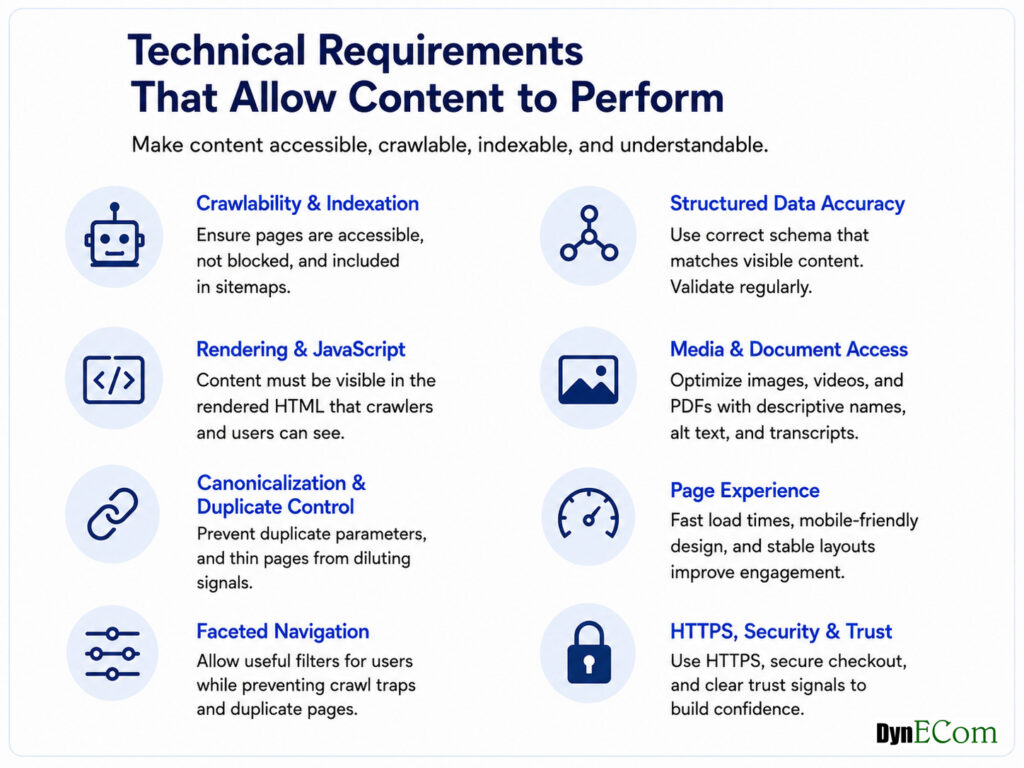
Technical SEO is not the primary subject of this guide, but content cannot perform when systems cannot access or interpret it.
Crawlability and Indexation
Important content should be:
- Publicly accessible
- Linked internally
- Rendered reliably
- Included in appropriate sitemaps
- Eligible for indexing
- Not accidentally blocked
For Google’s AI features, the page must be indexed and eligible to appear with a snippet.[1]
JavaScript and Injected Content
JavaScript can support a rich experience, but critical content should be available reliably after rendering.
Test whether crawlers receive:
- Product title
- Description
- Price
- Availability
- Selected variant
- Structured data
- Internal links
Google recommends making important content available in textual form and notes that Product structured data in initial HTML can be more reliable for shopping crawls.[1][6]
Duplicate URLs and Canonicalization
eCommerce platforms can generate duplicate or similar URLs through:
- Tracking parameters
- Sorting
- Filters
- Variants
- Pagination
- Regional versions
- Print pages
Duplicate content is normal and is not automatically a spam violation, but many URLs for the same content can complicate crawling, tracking, and canonical selection.[19]
Use consistent internal links, sitemaps, redirects, and canonical annotations. Google describes redirects and rel=canonical as strong canonical signals and sitemap inclusion as a weaker signal.[18]
Faceted Navigation
Uncontrolled filters can create millions of low-value URL combinations.
Determine:
- Which facets deserve indexable pages
- Which represent real search demand
- Which contain unique useful product sets
- Which should remain crawlable but not indexable
- Which should not be linked or crawled
The customer-facing filter strategy and technical URL strategy should be designed together.
Structured Data Validation
Validate:
- Required properties
- Recommended properties
- Visible-content consistency
- Variant relationships
- Price
- Availability
- Shipping
- Returns
- Reviews
Monitor Search Console reports and feed errors. Structured data that is technically valid but factually inconsistent is still a content-quality problem.
Images, Video, and Documents
Support discoverability and accessibility through:
- Stable media URLs
- Responsive images
- Compression
- Captions
- Transcripts
- Thumbnails
- Image and video structured data where appropriate
- Accessible PDFs
- Version-controlled documents
Page Experience
Content cannot persuade when the page is slow, unstable, inaccessible, obstructed by overlays, or difficult to navigate.
The objective is not to chase a single technical score. It is to make the content easy to consume and the purchase easy to complete.
Part 13: Measuring eCommerce Content Performance
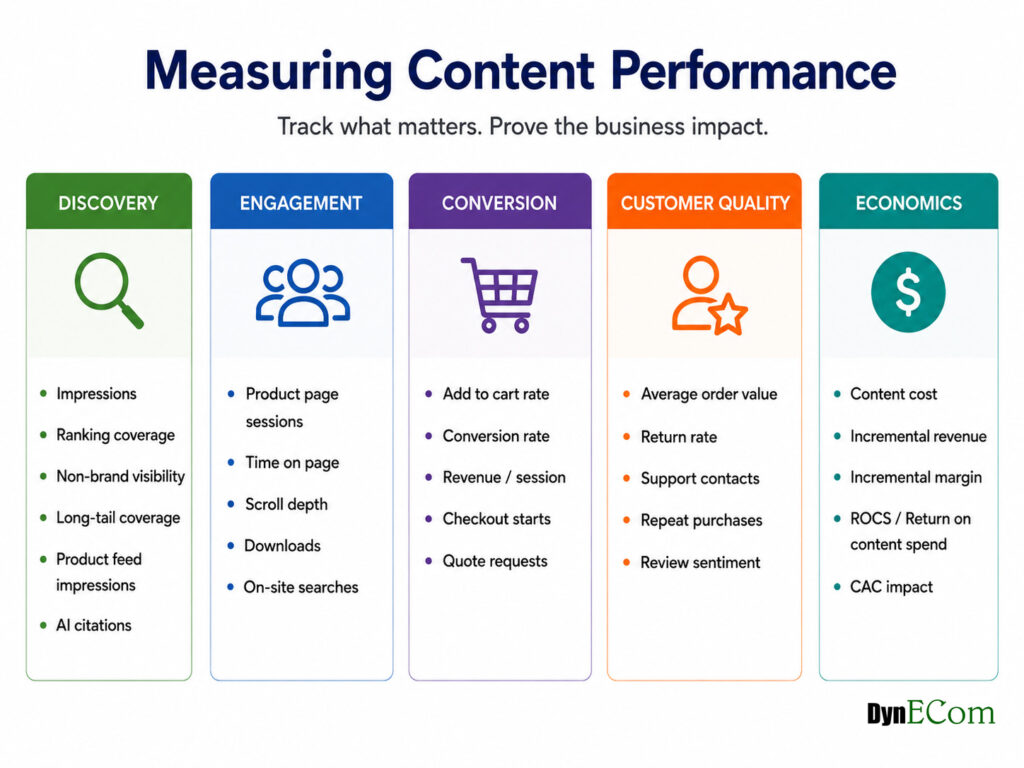
Build a KPI Hierarchy
A content program should measure leading indicators, customer behavior, and business results.
Content Quality and Operational Coverage
Track whether the program is producing trustworthy coverage.
Potential metrics:
- Percentage of priority SKUs optimized
- Attribute completeness
- Product-identification accuracy
- Claims with approved sources
- Unsupported-claim rate
- Content defect rate
- Duplicate or commodity-content rate
- Average content age
- Percentage refreshed on schedule
- Competitive gaps closed
- Six C’s score
- Cost per approved page
- Exception rate
- Rework rate
These metrics help explain why performance changes before waiting for rankings or revenue.
Discovery Metrics
Track:
- Impressions
- Ranking coverage
- Nonbrand visibility
- Long-tail query coverage
- Exact-product visibility
- Product-feed impressions
- AI citations or mentions
- Referral visibility
- Marketplace search visibility
Do not aggregate every keyword into one average position. Separate house-brand category expansion from reseller exact-product capture.
Engagement Metrics
Track actions that indicate understanding and evaluation:
- Product-page entries
- Specification expansions
- Video engagement
- Comparison use
- Internal clicks
- Technical-document downloads
- On-site search refinement
- Variant changes
- Review interaction
High engagement is not automatically positive. Repeated expansion and backtracking may indicate confusion. Interpret behavior in context.
Conversion Metrics
Track:
- Add-to-cart rate
- Checkout initiation
- Conversion rate
- Revenue per session
- Quote requests
- Lead completion
- Assisted conversion
- Product-selection accuracy
Separate traffic-source and product segments. A content change may improve conversion for organic traffic while paid traffic remains unchanged.
Customer-Quality Metrics
Track downstream outcomes:
- Average order value
- Return rate
- Cancellation rate
- Support contacts
- Review sentiment
- Repeat purchase
- Warranty claims
Content that increases orders but also increases incorrect purchases may destroy value.
Economic Metrics
Track:
- Content cost
- Incremental revenue
- Incremental gross margin
- Customer acquisition cost
- Paid-media efficiency
- Payback period
- Return on content spend
Return on Content Spend
A useful core formula is:
| Incremental gross margin attributable to optimized content ÷ total content investment |
Revenue-based return can be reported, but gross margin is closer to economic contribution.
Include:
- Creation cost
- Research cost
- Technology
- QA
- Publishing
- Ongoing refresh
DynEcom reports that a controlled test of Competitive Content on a large eCommerce site produced higher impressions, organic traffic, conversion, revenue, average order value, and a reported 31x return on content spend after the initial test period.[17] These are company-reported results from one program and should not be treated as a universal guarantee. They demonstrate why controlled measurement is valuable.
Measuring House-Brand Market Expansion
Potential indicators include:
- Nonbrand category visibility
- Problem and application query growth
- New-customer acquisition
- Brand-search growth
- House-brand share within the category
- Comparison-page engagement
- Assisted conversion
- New use-case discovery
A house-brand program may succeed before exact branded demand becomes large.
Measuring Reseller Market-Share Capture
Potential indicators include:
- Exact-product ranking coverage
- Brand-model query clicks
- Manufacturer-number visibility
- Share of exact-product traffic
- Conversion versus competing offers
- Product-level revenue share
- Availability performance
- Return rate
The reseller should know whether it is capturing more of the demand that already exists.
Measuring AI Search
Possible methods include:
- Identifiable referral traffic
- AI landing-page patterns
- Brand and product mention tracking
- Citation tests
- Manual prompt panels
- Third-party visibility tools
- Conversion of identifiable AI referrals
Limitations are significant:
- Not every mention creates a click.
- Referrer data may be incomplete.
- Prompt results vary by wording, user, location, and time.
- Google includes AI-feature traffic within overall Web reporting in Search Console rather than providing a complete separate view.[1]
Use AI visibility as one part of a broader measurement system.
Attribution, Time Lag, and False Positives
Content performance is difficult to measure because several business variables move at once. Price, stock, paid spend, seasonality, promotions, competitor actions, site changes, and product mix can all affect results. A disciplined measurement program should therefore distinguish correlation from a credible estimate of incremental impact.
Expect different response times
Metrics do not change on the same schedule.
- Content completeness and defect rates can change immediately after publication.
- Engagement and conversion signals may change as soon as qualified traffic reaches the page.
- Paid landing-page performance may respond quickly when campaigns are already active.
- Organic rankings and query coverage may take longer to reflect crawling, indexing, competition, and demand.
- House-brand awareness and branded demand may require repeated exposure over a much longer period.
- Return rates and lifetime-value effects may not be visible until orders have been delivered and used.
A test should therefore specify which leading and lagging indicators are expected to move, and when. Declaring failure after one week because organic revenue has not changed may be as misleading as declaring success after impressions rise without conversion.
Protect against common false positives
Inventory recovery A product returns to stock at the same time content is updated. Revenue rises, but availability may be the dominant cause.
Price changes A lower price improves conversion during the test. The content receives credit for an effect created by the offer.
Paid-media expansion Traffic increases because campaign spend rises. Sessions and revenue improve even if the page performs no better per visitor.
Seasonality A seasonal category enters its natural peak. A pre/post comparison attributes normal demand growth to the optimization.
Product mix The optimized group contains more high-demand, high-margin, or easier-to-convert items than the control group.
Sitewide changes A checkout, shipping, navigation, or performance improvement affects both content and non-content outcomes.
Regression to the mean Pages are selected because performance was unusually poor, then improve naturally even without intervention.
The measurement plan should record these events rather than attempting to explain them after results are known.
Separate traffic quality from page effectiveness
A page can improve while its overall conversion rate falls if it begins ranking for broader, less-qualified queries. A page can also appear to improve when paid campaigns narrow targeting and send only high-intent visitors.
Analyze performance by:
- Traffic source
- Query or campaign intent
- New versus returning visitor
- Device
- Geography
- Customer type
- Product segment
- House-brand versus reseller objective
For example, a house-brand page may initially attract more mid-funnel visitors who do not convert immediately but later return through branded search. A reseller page targeting exact manufacturer numbers should usually be judged more directly on qualified conversion and market-share capture.
Use a hierarchy of evidence
Measurement confidence improves as the design becomes more controlled:
- Before-and-after observation: useful for generating a hypothesis, but vulnerable to many confounders.
- Matched comparison: compare optimized products with similar unoptimized products.
- Difference-in-differences: compare the change in the test group with the change in the control group over the same period.
- Randomized controlled test: assign comparable products or visitors when feasible.
- Repeated replication: confirm that the effect appears across categories, seasons, or content batches.
Not every organization can run a perfect experiment. The important practice is to state the level of confidence honestly.
Measure mechanisms, not only outcomes
Revenue is the ultimate goal, but mechanism metrics show why it changed.
If compatibility content is added, measure:
- Compatibility-query visibility
- Use of fit tools or tables
- Support questions about fit
- Returns caused by incompatibility
- Conversion for compatibility-related traffic
If a house-brand buying guide is launched, measure:
- Nonbrand category visibility
- Clicks from the guide to the house-brand product
- Comparison engagement
- New-user assisted conversions
- Growth in branded searches over time
If reseller PDPs are enriched, measure:
- Exact-product visibility
- Product-page entrances
- Document downloads
- Add-to-cart rate
- Conversion against comparable products
- Return and support reasons
Mechanism metrics make the causal story more credible than a revenue change alone.
Define success before seeing the data
Before launch, document:
- Primary outcome
- Secondary outcomes
- Test period
- Minimum sample or practical threshold
- Expected direction of change
- Segments to be analyzed
- Events that would invalidate the test
- Decision rule for scaling, revising, or stopping
This reduces the temptation to search through dozens of metrics until one appears positive.
Report both business value and uncertainty
An executive summary should state:
- What changed
- Which products or pages were tested
- How the comparison was constructed
- The measured effect
- The estimated economic contribution
- Important confounding factors
- Whether the result was replicated
- The next recommended action
A precise-looking percentage is not automatically a reliable result. A trustworthy content program combines commercial ambition with honest measurement limits.
Test and Control Design
Traditional user-level A/B testing is effective for testing on-page elements such as headlines, images, or calls to action. To estimate the search and business impact of a broader content strategy, use matched test and control groups of similar pages rather than serving different content versions to search engines and users. Update the test group, leave the control group unchanged, and compare both groups over the same period. This design helps estimate the incremental effect of content while accounting for seasonality, inventory, pricing, promotions, paid media, and other influences.
Consider:
- Comparable products
- Random assignment where possible
- Pretest baseline
- Seasonality
- Price changes
- Inventory
- Paid-media changes
- Promotions
- Duration
- Statistical power
- Contamination between groups
Measure both leading and economic outcomes. A change in impressions may appear before a change in revenue. A conversion increase may be offset by lower margin or higher returns.
Marketplace and Paid-Media Metrics
Marketplace metrics may include:
- Listing quality
- Search position
- Sessions
- Conversion
- Attributed sales
- Review growth
- Return rate
Paid-media metrics may include:
- Landing-page experience diagnostics
- Conversion rate
- Cost per acquisition
- ROAS
- Profit after ad spend
Content should be judged by its contribution to the full business outcome.
Applying the Six C’s: Three Practical Content Audits
The Six C’s are most useful when they change what a team publishes. The following examples show how the same framework produces different recommendations for a house-brand product, a reseller product, and a category page.
Example 1: House-Brand Nitrile Exam Gloves
Assume an eCommerce site has introduced a house-brand powder-free nitrile exam glove. The current page includes a product title, four bullets, a short description, a size selector, and a specification table. The brand is new, so branded demand is limited.
Complete
The page identifies the material, color, size range, and package quantity, but it does not answer several important questions:
- What is the glove thickness?
- Is the texture limited to the fingertips or applied across the glove?
- What is the cuff length?
- Is the glove intended for examination, food handling, cleaning, laboratory work, or another application?
- Does the product contain latex or powder?
- What standards or certifications apply?
- How should customers choose a size?
- What is included in a case?
- What are the limitations?
The optimization plan should not begin by lengthening the opening paragraph. It should begin by verifying the missing facts and determining which ones are material to selection.
Competitive
Competitive research shows that established brands provide downloadable specification sheets, chemical-resistance charts, sizing guidance, and images explaining glove texture. Several reseller pages include customer questions about tearing, fit, and prolonged use.
The house-brand page does not need to duplicate every competitor module. It needs to close the gaps that matter and create a reason to consider the new product.
Competitive additions might include:
- A verified attribute table
- A glove-sizing guide
- A “choose this glove when” section
- A comparison with lighter and heavier options in the house-brand line
- Original images showing texture, cuff, and box labeling
- An explanation of the intended balance between dexterity and durability
- A direct statement of inappropriate applications
Current
The content should have an owner who monitors:
- Updated test or certification documents
- New sizes
- Packaging changes
- Customer questions
- Return reasons
- Competitor additions
Freshness is not achieved by changing the publication date each month. It is achieved by keeping the product evidence and buying guidance aligned with reality.
Clear
A title such as “DynEcom ProGuard X7 Premium Professional Gloves” depends too heavily on an unfamiliar brand and vague claims.
A clearer title might be:
| Powder-Free Nitrile Exam Gloves, 6 Mil, Textured Fingertips – ProGuard X7 |
The page should define 6 mil, explain where the texture appears, and state the package quantity near the purchase controls.
Credible
The page should avoid claims such as “maximum protection” unless a defined test supports them. It should state the specific standards met, explain who reviewed the product information, and link to the current technical sheet.
The most credible content may include a limitation:
| These gloves are intended for routine examination and general barrier applications. They are not a substitute for task-specific chemical-protection gloves. Review the chemical-resistance guidance before use with hazardous substances. |
Conversion-Focused
The page should reduce the risks most likely to stop purchase:
- Size uncertainty
- Package quantity confusion
- Unclear application
- Concern about tearing
- Concern about latex exposure
- Uncertainty about shipping and returns
The CTA should appear after the customer has selected size and understood box or case quantity. A relevant cross-sell may include a wall-mounted glove dispenser, but the recommendation should explain which box dimensions it supports.
House-brand search strategy
Because exact branded demand is limited, the surrounding content should target:
- How to choose nitrile glove thickness
- Latex-free exam gloves for dental offices
- Disposable gloves for extended clinical wear
- Nitrile versus vinyl exam gloves
- Glove sizing guide
These pages create category demand and route qualified shoppers to the house brand. The PDP still targets the exact brand and model, but it is not expected to create the market alone.
Example 2: A Reseller Selling a Widely Distributed Industrial Part
Assume a specialist distributor sells Brand X Model 12345, a weatherproof electrical connector available from many other resellers. Demand for the part number already exists.
Complete
The page must establish exact identity immediately:
- Brand
- Model
- Manufacturer number
- Connector type
- Pin count
- Housing material
- Voltage or current rating when supported
- Environmental rating
- Mounting method
- Included components
- Pack quantity
The customer may already know the product and need only confirmation. Missing one identifier can cause the customer to leave for a competing page.
Competitive
Most competitors publish the same manufacturer paragraph. One provides dimensions, another provides a wiring diagram, and a third offers a compatibility list. The reseller can create a stronger page by verifying and organizing the combined information.
Useful differentiators include:
- A dimension drawing summarized in HTML
- Links to the wiring diagram and manual
- Compatibility and cross-reference information
- A table comparing adjacent Brand X models
- A replacement note for a discontinued part
- Current stock and delivery information
- Access to category specialists
The content advantage is not a different product story. It is faster validation and a better purchase experience.
Current
The reseller should monitor:
- Manufacturer document revisions
- Superseded part numbers
- Stock status
- New replacement products
- Compatibility corrections
- Marketplace content changes
A reseller page can become inaccurate even when the physical product has not changed because the replacement and availability context has changed.
Clear
The product title should prioritize exact recognition:
| Brand X 12345 Weatherproof 7-Pin Electrical Connector – Panel Mount |
The first paragraph should not bury the model number under promotional copy. Compatibility statements should use explicit language and qualifications.
Credible
The reseller should distinguish between manufacturer-supported facts and retailer expertise.
Manufacturer-supported:
- Electrical rating
- Ingress protection
- Material
- Intended mounting
Retailer expertise:
- Common replacement use
- Alternative products
- Accessory selection
- Availability
- Fulfillment
Cross references should identify the evidence or be labeled for customer verification when certainty is limited.
Conversion-Focused
The likely objections differ from the glove example:
- Is this the exact part?
- Is it the current replacement?
- Does it include terminals or hardware?
- Will it fit the existing panel opening?
- Is it available now?
- Can it be returned if the system differs?
The page should address these questions near the relevant specifications and offer information.
Reseller search strategy
The keyword emphasis should include:
- Brand X 12345
- Brand X 12345 connector
- Replacement for Brand X 12345
- Brand X 12345 dimensions
- Brand X 12345 wiring diagram
- Brand X 12345 in stock
- Buy Brand X 12345
Supporting category and comparison content remains useful, but exact-product visibility is the primary market-share opportunity.
Example 3: A Category Page for Electrical Enclosures
Assume the current category page displays hundreds of enclosures with a generic heading and filters for brand and price. It has a 500-word block of copy below the product grid but provides little selection help.
Complete
A complete category experience should expose the attributes customers use to narrow the assortment:
- Enclosure type
- Material
- Indoor or outdoor use
- Ingress or environmental rating
- Width, height, and depth
- Mounting method
- Door style
- Finish
- Certification
- Application
The page should also explain which attributes matter and link to deeper guidance.
Competitive
Competitor pages may offer better filters, application collections, dimension tools, or comparison charts. The opportunity is not to write more category prose. It is to make selection easier.
Possible improvements include:
- A short introduction defining the assortment
- An attribute-based buying guide
- Application collections such as outdoor, washdown, or corrosive environments
- Better product-card attributes
- A material comparison
- Category FAQs
- Links to installation and rating explainers
Current
Monitor:
- New products
- Discontinued products
- Empty collections
- Filter values
- Product-count changes
- New rating standards or manufacturer documents
- Search terms that return poor results
Clear
Replace vague labels such as “Protection Level” with the terminology customers use and define it. Normalize dimensions and material names. Avoid multiple filters that represent the same concept.
Credible
Buying guidance should distinguish general education from engineering advice. A category page can explain what an IP rating means, but it should not promise that every product is suitable for a particular hazardous environment without product-specific evidence.
Conversion-Focused
The category page should help the customer reach a viable shortlist quickly. Measure:
- Filter use
- Zero-result searches
- Comparison use
- Product-card clicks
- Backtracking
- Add-to-cart after category entry
- Return rate by selection path
The category is optimized when it makes the purchase decision easier, not simply when the copy block becomes longer.
A Simple Six C’s Scoring Method
Teams can score each dimension from 0 to 5.
Complete
- 0: Product cannot be identified or evaluated.
- 1: Minimal identity and generic copy.
- 2: Basic specifications but major decision gaps.
- 3: Most material facts and common questions covered.
- 4: Strong decision support with minor gaps.
- 5: Complete for the intended customer and product complexity.
Competitive
- 0: Materially weaker than visible alternatives.
- 1: Commodity manufacturer content.
- 2: Meets basic category practice.
- 3: Better than some competitors.
- 4: Clearly stronger than most visible pages.
- 5: Provides a defensible information advantage.
Current
- 0: Known outdated or contradictory content.
- 1: No owner or review date.
- 2: Reviewed only when a major problem occurs.
- 3: Defined review process.
- 4: Trigger-based updates are operating.
- 5: Important product, customer, competitor, and performance changes are monitored.
Clear
- 0: Ambiguous or misleading.
- 1: Difficult to identify and scan.
- 2: Understandable with effort.
- 3: Generally clear and organized.
- 4: Easy to understand across customer and machine contexts.
- 5: Complex decisions are made unusually simple without losing accuracy.
Credible
- 0: Unsupported or incorrect claims.
- 1: Heavy promotion and weak evidence.
- 2: Mostly factual but poorly sourced.
- 3: Claims are supportable and limitations are present.
- 4: Strong evidence, trust, and transparent methodology.
- 5: The page is a dependable reference for the category or product.
Conversion-Focused
- 0: The page prevents confident action.
- 1: CTA exists but major risks remain unanswered.
- 2: Basic purchase information is present.
- 3: Common objections and fit questions are addressed.
- 4: The page actively improves selection and reduces risk.
- 5: The content creates a measurably stronger purchase outcome.
A score is not a substitute for customer and performance data. It creates a consistent diagnostic language across teams. Track the total score, but also track each C separately. A page with excellent conversion content and poor credibility should not be considered optimized.
Part 14: A 90-Day Implementation Roadmap
Days 1–30: Diagnose
Define objectives
Decide whether the program is focused on:
- House-brand market expansion
- Reseller market-share capture
- Conversion
- AI visibility
- Paid-media efficiency
- Marketplace performance
- Data quality
Inventory content
Record:
- Page type
- Product owner
- Revenue and margin
- Search visibility
- Conversion
- Content completeness
- Last update
- Known defects
Segment the catalog
Separate:
- House brand and reseller products
- Priority and long-tail SKUs
- Simple and complex products
- High-risk categories
- New and mature products
Evaluate data quality
Audit product matching, attributes, source coverage, variants, feeds, and structured data.
Identify competitors
Determine which pages compete for important queries and customer decisions.
Establish baselines
Capture content-quality, discovery, conversion, customer, and economic metrics.
Select test products
Choose a group large and comparable enough to measure.
Days 31–60: Build and Test
- Create category attribute models.
- Build content briefs and style rules.
- Define source hierarchy.
- Implement automated and human QA.
- Optimize priority pages.
- Align structured data and feeds.
- Launch test and control groups.
- Create reporting.
- Assign content owners.
Days 61–90: Measure and Scale
- Compare test and control performance.
- Correct content defects.
- Identify winning modules.
- Review returns and support feedback.
- Expand to additional products.
- Establish refresh triggers.
- Build priority supporting clusters.
- Refine governance and exception handling.
Scaling should follow evidence. Do not automate a weak template across the entire catalog.
Common eCommerce Content Mistakes
Avoid:
- Copying manufacturer descriptions without adding value
- Writing before exact product matching
- Optimizing every page identically
- Using unsupported claims
- Treating specifications as sufficient content
- Hiding essential information in PDFs
- Publishing FAQs no one asks
- Ignoring category pages
- Separating SEO from conversion
- Sending paid traffic to incomplete pages
- Using identical copy in every channel
- Publishing AI content without evidence controls
- Treating model agreement as validation
- Failing to refresh
- Measuring rankings without revenue
- Improving low-value pages before strategic pages
- Creating cluster pages that compete with the pillar
- Treating house-brand and reseller keyword strategies identically
- Republishing external reviews improperly
- Publishing content without an owner
The Future of eCommerce Content
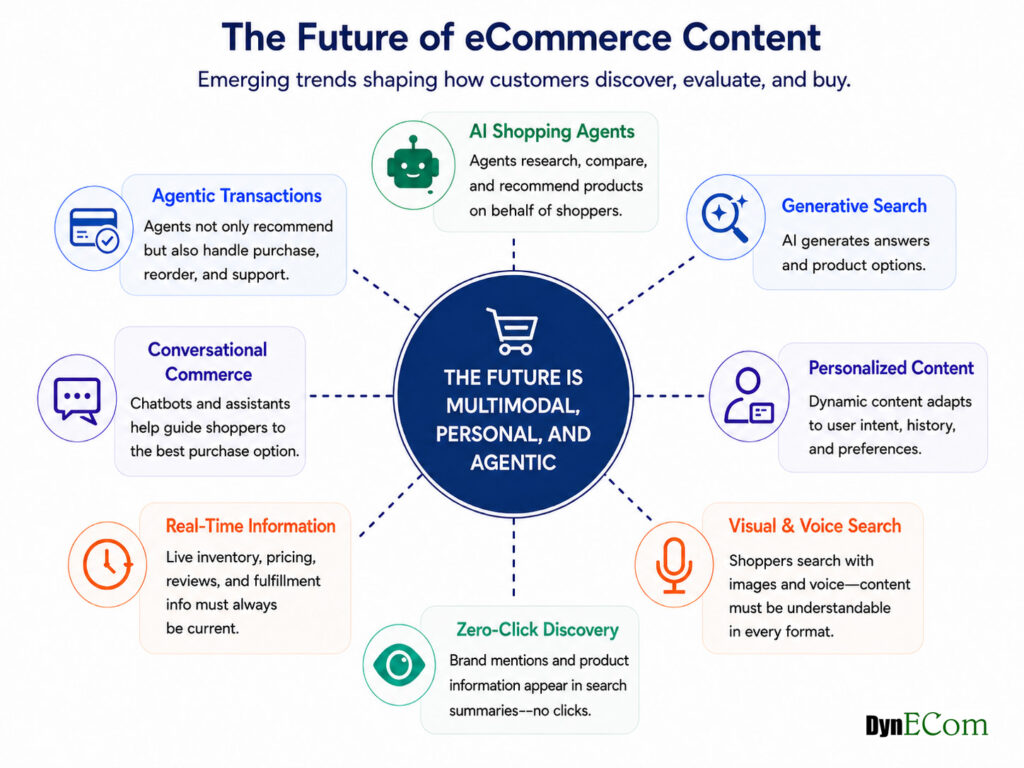
Several developments are likely to increase the importance of structured, reliable product knowledge.
AI shopping agents
Agents may research, compare, recommend, and eventually transact with less manual browsing.
Agentic commerce protocols
Merchant integrations such as OpenAI’s ACP are creating more direct connections between catalogs and AI discovery.[11]
Conversational brand experiences
Retailers may deploy assistants that use product data, customer context, inventory, and support information.
Visual and multimodal search
Images, video, and product diagrams will become more useful discovery inputs.
Personalized buying guidance
Content presentation may adapt to industry, application, account, and prior purchases.
Real-time synchronization
Web pages, feeds, marketplaces, ads, and agents will need current price, availability, variants, and product facts.
Zero-click and third-party transactions
More evaluation may occur outside the retailer’s site. The retailer’s content can still influence the decision, but measurement and customer ownership may become more difficult.
The organizations best prepared for this future will not be those that generated the most text. They will be those that built the most reliable and useful product-information systems.
Final Strategic Takeaway
The future of eCommerce content is not more copy. It is a continuously improving product-information system that creates more complete, competitive, accurate, and persuasive buying experiences than the alternatives available to the customer.
eCommerce Content Optimization Checklist
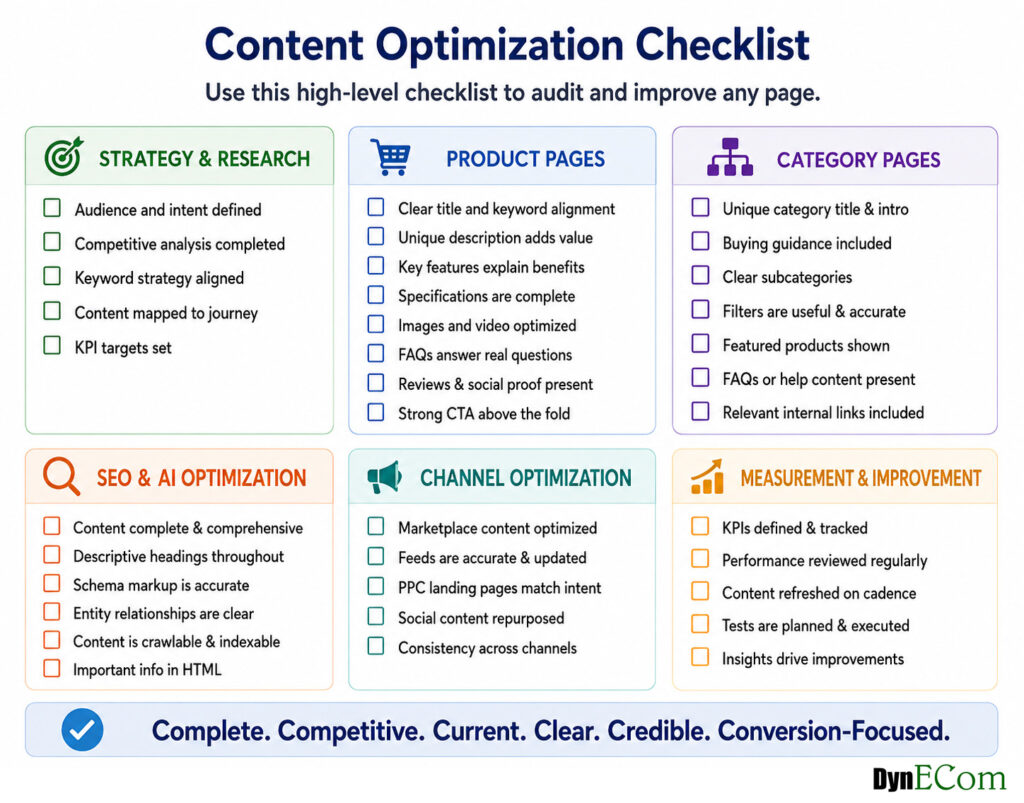
Strategy
- ☐ Is the primary goal market expansion, market-share capture, conversion, or another defined outcome?
- ☐ Is the product a house brand or reseller product?
- ☐ Is the intended audience and purchase stage defined?
- ☐ Is the page type aligned with intent?
- ☐ Are priority products identified?
Product identity and data
- ☐ Is the exact product confirmed?
- ☐ Are model, manufacturer number, variant, and pack quantity correct?
- ☐ Are material attributes complete?
- ☐ Are units and controlled values normalized?
- ☐ Are conflicting sources resolved or flagged?
Product page
- ☐ Does the title identify the product clearly?
- ☐ Is the value statement specific?
- ☐ Do bullets explain meaning and benefit?
- ☐ Are applications supported?
- ☐ Is compatibility explicit and verified?
- ☐ Are limitations explained?
- ☐ Are likely questions answered?
- ☐ Are alternatives and accessories relevant?
- ☐ Are images accurate?
- ☐ Are technical documents summarized in HTML?
Category page
- ☐ Does the page define the assortment?
- ☐ Are filters useful and normalized?
- ☐ Do product cards differentiate items?
- ☐ Is buying guidance available?
- ☐ Are category FAQs distinct from product FAQs?
- ☐ Are internal links useful?
SEO and AI search
- ☐ Is important content crawlable and indexable?
- ☐ Are customer terms used naturally?
- ☐ Does the page provide semantic completeness?
- ☐ Is there original, non-commodity value?
- ☐ Does structured data match visible content?
- ☐ Are feeds accurate and current?
- ☐ Is the content better than visible competitors?
Conversion
- ☐ Does the page establish product identity, fit, performance, value, seller credibility, delivery, protection, and successful use?
- ☐ Is the CTA appropriate?
- ☐ Does the page reduce risk without overselling?
- ☐ Are cross-sells relevant and explained?
AI-assisted production
- ☐ Were current sources retrieved?
- ☐ Are material claims linked to evidence?
- ☐ Were prohibited inferences avoided?
- ☐ Were numeric and variant checks completed?
- ☐ Was risk-based human review performed?
Measurement and refresh
- ☐ Are content-quality metrics tracked?
- ☐ Is a baseline available?
- ☐ Are revenue, margin, and customer outcomes measured?
- ☐ Does the page have an owner?
- ☐ Are refresh triggers defined?
Frequently Asked Questions
What is eCommerce content optimization?
eCommerce content optimization is the continuous process of improving product, category, and supporting content so that customers and digital systems can discover, understand, compare, trust, and act on it more effectively. It includes product data, descriptive copy, media, structured data, feeds, customer questions, conversion content, measurement, and refresh processes.
How is eCommerce content optimization different from eCommerce SEO?
eCommerce SEO focuses on discovery and visibility in search. Content optimization includes SEO but also addresses product understanding, marketplace presentation, paid landing pages, social reuse, conversion, customer confidence, data quality, and ongoing maintenance.
What is product content optimization?
Product content optimization improves the information associated with an exact product. It may include the title, bullets, description, attributes, applications, compatibility, FAQs, comparisons, images, video, reviews, documents, structured data, and feeds.
How do you optimize eCommerce content for traditional SEO and AI search at the same time?
Build one reliable product-information foundation. Use accurate identity and attributes, answer the customer’s decision questions, create original non-commodity information, structure content clearly, make it crawlable, align structured data and feeds, demonstrate credibility, and keep the information current. Google says its standard SEO foundations remain applicable to AI Overviews and AI Mode.[1]
Is GEO different from SEO?
GEO emphasizes visibility within generative and conversational experiences. It differs in the outcome being observed—such as citations, mentions, product recommendations, and synthesized answers—but many of the inputs overlap with strong SEO: accessible content, product clarity, authority, useful structure, and original value.
Does manufacturer-supplied content hurt SEO?
Manufacturer content is not inherently harmful. It is often the best source for product facts. The competitive problem arises when many sellers publish the same limited information and add no original decision support. The solution is not changing facts; it is adding verified context, selection guidance, applications, comparisons, FAQs, seller value, and other useful information.
How can a reseller create original product content?
A reseller can add:
- Plain-English explanations
- Complete attributes
- Compatibility and cross references
- Applications
- Alternatives
- Comparisons
- Required accessories
- Technical-document summaries
- Customer-service insights
- Shipping and return clarity
- Category expertise
The reseller should add context without inventing different facts.
How should house-brand content differ from reseller content?
House-brand content should place relatively more emphasis on market expansion: category education, problems, applications, benefits, comparisons, and reasons the unfamiliar product deserves consideration. Reseller content should place relatively more emphasis on market-share capture: exact products, identifiers, compatibility, replacements, availability, and seller differentiation.
Why should house brands emphasize mid-funnel searches?
Customers may not know the house-brand name. They are more likely to search for the problem, category, application, or desired benefit. Mid-funnel content helps the brand enter the consideration set before branded demand exists.
Why should resellers emphasize bottom-of-funnel searches?
Demand for a distributed brand, model, or manufacturer part number often already exists. The reseller competes with other sellers to capture that demand. Exact identity, availability, fit, trust, shipping, and support become especially important.
How long should a product description be?
Long enough to answer the material purchase questions and no longer. A simple product may need a concise description. A complex technical product may require extensive compatibility, application, installation, comparison, and safety information. Google says it does not have a preferred word count.[3]
How much content should a category page contain?
Enough to define the assortment, explain important differences, support filtering, answer category-level questions, and route customers to useful products or guides. Essential guidance should be easy to find without pushing the product grid unnecessarily far down the page.
Should website and marketplace descriptions be identical?
Usually not. The product facts should remain consistent, but marketplaces have different fields, character limits, policies, shared product pages, and customer contexts. Owned-site content can include internal links, seller benefits, deeper comparisons, and broader support.
Does product content affect paid advertising?
Yes. Product content can improve message continuity, landing-page usefulness, product-feed quality, and conversion. Google considers landing-page relevance and usefulness within its ad-quality diagnostics.[9][10] More words do not automatically reduce CPC; the content must improve the customer experience and business outcome.
Can social media improve product pages?
Yes. Social questions and comments reveal objections, terminology, desired use cases, and confusion. Those insights can improve FAQs, descriptions, images, comparisons, and category guidance. Product content can also supply social scripts, demonstrations, and carousels.
How often should eCommerce content be updated?
Use event-based triggers rather than an arbitrary schedule. Review content when products, documents, competitors, questions, reviews, availability, policies, or performance change. High-value and fast-changing pages may require more frequent monitoring than stable long-tail products.
Is AI-generated product content safe to use?
AI-assisted content can be valuable when it is grounded in current approved sources, constrained by clear rules, validated claim by claim, and reviewed according to risk. It is unsafe when the model is asked to guess, fill blanks, infer compatibility, or validate itself.
How do you prevent hallucinations in AI-generated product content?
Use exact product matching, current source retrieval, source-level evidence, prohibited inference rules, numeric checks, variant checks, confidence levels, exception queues, and human review. A second model may challenge the output but should not be treated as proof.
Which product pages should be optimized first?
Prioritize products using revenue, margin, search demand, paid spend, conversion, inventory, competitive gaps, content defects, strategic importance, and product lifecycle. High-value products with meaningful information gaps are often the strongest starting point.
How should content performance be measured?
Use a hierarchy that includes content quality, discovery, engagement, conversion, customer outcomes, and economics. Rankings and traffic alone are insufficient.
What is return on content spend?
Return on content spend compares the incremental economic value generated by content with the cost of researching, creating, validating, publishing, and maintaining it. A useful formula is incremental gross margin divided by total content investment.
What information should remain visible instead of being placed only in a PDF?
Any information material to product selection should be available in HTML. This includes identity, critical specifications, compatibility, dimensions, included components, limitations, installation requirements, and other purchase-critical facts. The PDF should provide the full authoritative document and deeper technical detail.
Does schema improve AI visibility?
Structured data helps systems understand page content and can make pages eligible for search features, but there is no special schema that guarantees AI citation. The markup must match visible content and should be treated as part of a broader product-information strategy.[1][5]
Is duplicate content a penalty?
Duplicate or similar content is common on eCommerce sites and is not automatically a spam violation. Search engines may select a canonical version and crawl duplicates less frequently. The larger business problem is that commodity content gives customers and search systems little reason to prefer one page.[19]
Should every filter combination become an indexable page?
No. Index only combinations that represent meaningful demand, contain a useful product set, and can offer distinct value. Uncontrolled faceted navigation can create large numbers of duplicate or low-value URLs.
Can optimized content reduce returns?
It can when it clarifies fit, compatibility, size, included components, limitations, and realistic expectations. This should be measured rather than assumed.
About DynEcom
DynEcom focuses on Competitive eCommerce Content: product and category content designed not merely to follow SEO, GEO, and conversion best practices, but to create a more complete and useful buying experience than competing pages.
DynEcom’s approach combines:
- Competitive content research
- Product-data enrichment
- AI-assisted content production
- Accuracy controls
- Content refreshes
- Performance measurement
DynEcom reports experience supporting eCommerce teams and content programs for large retailers and B2B sellers. Its published case study describes a controlled test in which products receiving Competitive Content outperformed a control group across search impressions, organic traffic, conversion, revenue, engagement, and average order value during the measured period.
Sources and Further Reading
- Google Search Central, AI Features and Your Website.
- Google Search Central, Google’s Guide to Optimizing for Generative AI Features on Google Search.
- Google Search Central, Creating Helpful, Reliable, People-First Content.
- Google Search Central, Guidance on Using Generative AI Content on Your Website.
- Google Search Central, Introduction to Product Structured Data.
- Google Search Central, Merchant Listing Product and Offer Structured Data.
- Google Merchant Center, Product Detail Attribute and Create Rich Product Description Pages.
- Google Merchant Center, Title and Structured Title.
- Google Ads Help, About Quality Score for Search Campaigns.
- Google Ads Help, Five Ways to Use Quality Score.
- OpenAI, Powering Product Discovery in ChatGPT.
- OpenAI Help Center, Using Shopping Research in ChatGPT.
- OpenAI Help Center, Shopping With ChatGPT Search.
- Walmart Marketplace, Listing Quality and Marketplace Learn documentation.
- Amazon, How to Create Amazon Product Listings.
- Meta Help Center, Set Up a Shop on Facebook and Instagram.
- DynEcom, Competitive Content Case Study and Competitive Content Overview.
- Google Search Central, How to Specify a Canonical URL.
- Google Search Central, What Is Canonicalization?.
- Google Search Central, Search Essentials.
- Google Merchant Center, Title and Structured Title Best Practices.
- Google Merchant Center, Tips to Optimize Your Product Data.

Greg Harris is the President of DynEcom and an eCommerce marketing strategist focused on product content, competitive research, SEO, AI search visibility, and conversion. His work emphasizes the role of product pages as both discovery assets and decision-support systems. Greg has specialized in direct marketing and eCommerce techniques for over forty years. He has helped more than 50 eCommerce businesses improve their online visibility, traffic, and revenue.