
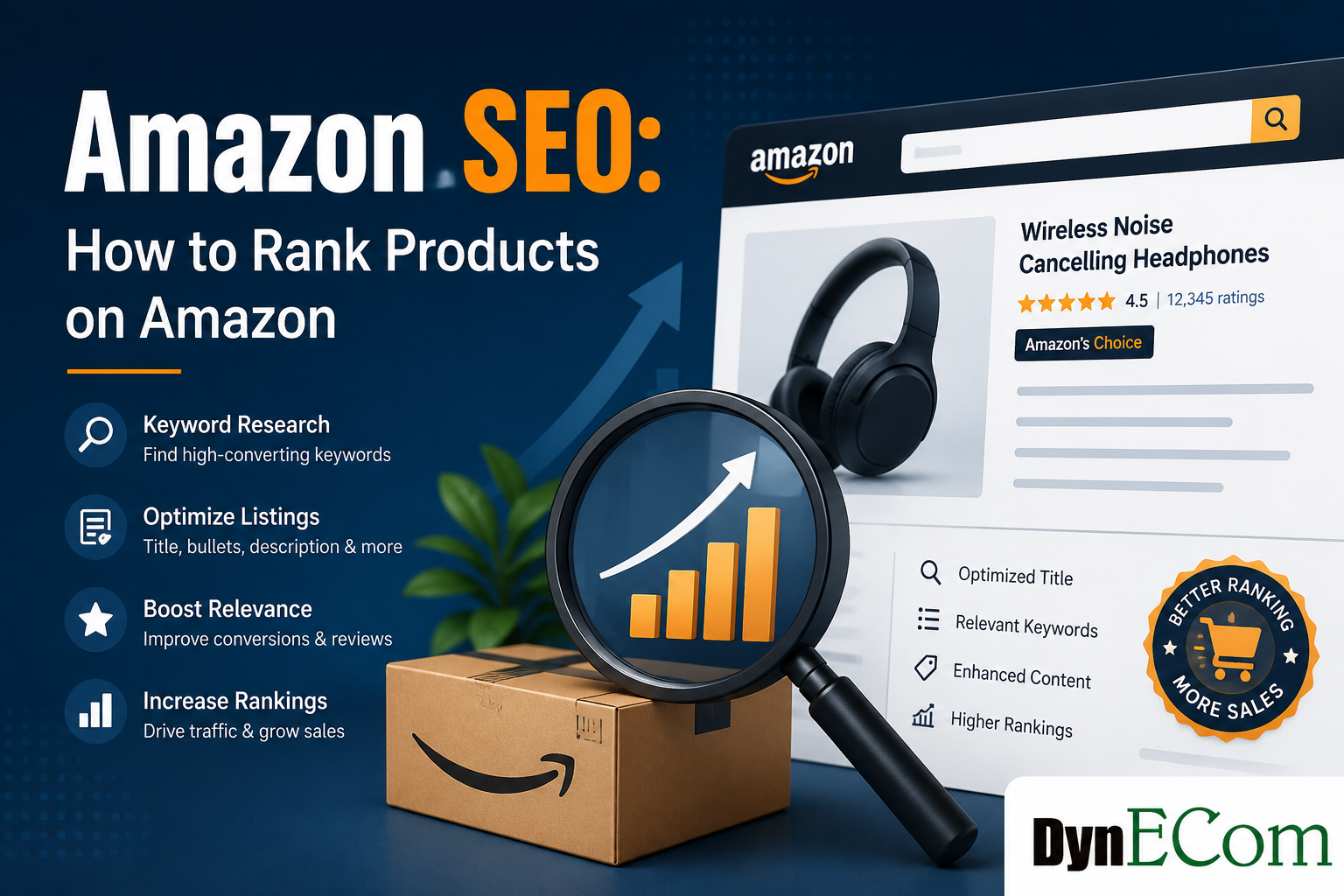
What Is Amazon SEO and Why Does It Matter?
Amazon is not just an online marketplace; it is one of the world’s largest product search engines. Millions of customers visit Amazon every day with a strong purchase intent, searching for products they want to buy. However, having a great product does not guarantee visibility. To win on Amazon, sellers need to understand how Amazon’s search algorithm works and optimize their listings accordingly.
This is where Amazon SEO becomes essential.
Amazon SEO is the process of optimizing product listings, keywords, advertising strategies, and customer experience signals to improve organic rankings on Amazon search results. A higher ranking means increased visibility, more clicks, higher conversion rates, and ultimately more sales.
Unlike traditional search engines, Amazon’s algorithm focuses heavily on purchase intent. The goal is not simply to show relevant products but to show products that are most likely to convert.
How Does Amazon’s Search Algorithm Work?
Amazon uses a ranking system called A9/A10 algorithm to determine which products appear at the top of search results.
The algorithm evaluates multiple ranking factors:
| Ranking Factor | Impact on Amazon Ranking |
|---|---|
| Keyword Relevance | Helps Amazon understand what your product is |
| Sales History | Products with consistent sales rank higher |
| Conversion Rate | Higher conversions signal customer satisfaction |
| Click-Through Rate (CTR) | Indicates listing attractiveness |
| Reviews & Ratings | Builds trust and improves purchase likelihood |
| Pricing Competitiveness | Influences conversion probability |
| Inventory Availability | Out-of-stock products lose ranking momentum |
| Advertising Performance | Paid visibility can improve sales velocity |
The key difference between Google SEO and Amazon SEO is:
- Google focuses on providing information.
- Amazon focuses on generating purchases.
Therefore, Amazon rewards products that consistently satisfy customers and generate sales.
Step 1: Conduct Amazon Keyword Research
Keyword research is the foundation of successful Amazon SEO.
Customers do not search using product names; they search using problems, features, and buying intent.
For example:
A seller may list: “Women’s Lightweight Running Shoes”
Customers may search:
- running shoes for women
- women’s walking sneakers
- comfortable shoes for standing all day
- slip resistant sneakers
The goal of keyword research is to identify the terms customers actually use.
Types of Amazon Keywords
| Keyword Type | Example | Purpose |
|---|---|---|
| Primary Keywords | running shoes for women | Main ranking keywords |
| Long-Tail Keywords | lightweight running shoes for women | Higher purchase intent |
| Feature Keywords | memory foam sneakers | Highlight benefits |
| Problem-Solving Keywords | shoes for standing all day | Address customer needs |
| Competitor Keywords | Nike running shoes alternative | Capture comparison shoppers |
Step 2: Optimize Amazon Product Title
The product title is one of the strongest ranking factors.
A good Amazon title should include:
- Brand name
- Main keyword
- Product type
- Key features
- Important specifications
Example:
❌ Poor Title: Comfortable Shoes for Women
✅ Optimized Title: Skechers Women’s Slip-On Sneakers, Lightweight Walking Shoes with Memory Foam Comfort, Casual Running Shoes
Why the second title performs better:
- Includes important search terms
- Explains product benefits
- Matches customer searches
Amazon Title Optimization Best Practices
| Do | Avoid |
|---|---|
| Include primary keyword early | Keyword stuffing |
| Mention important features | Repeating keywords |
| Use customer language | Excessive capitalization |
| Keep it readable | Promotional claims |
Step 3: Optimize Bullet Points for Rankings and Conversion
Amazon bullet points serve two purposes:
- Improve keyword relevance
- Convince customers to purchase
A strong bullet point structure: Feature → Benefit → Customer Value
Example:
❌ Weak: Memory Foam Sole
✅ Strong: Memory Foam Cushioning – Provides lightweight support and comfort for everyday walking, travel, and extended wear.
Include:
- Product benefits
- Usage scenarios
- Important specifications
- Relevant keywords naturally
Step 4: Optimize Product Description and A+ Content
A product description provides additional ranking signals and helps customers make buying decisions.
A strong description should:
- Explain product benefits
- Address customer problems
- Include secondary keywords
- Build trust
A+ Content Benefits
Amazon A+ Content can improve:
- Conversion rate
- Brand credibility
- Customer understanding
Effective A+ modules include:
| Module | Purpose |
|---|---|
| Brand Story | Build trust |
| Comparison Chart | Highlight differences |
| Lifestyle Images | Show product usage |
| Feature Modules | Explain benefits |
Higher conversion rates indirectly improve ranking because Amazon rewards products that generate sales.
Step 5: Use Backend Search Terms Effectively
Amazon provides backend keyword fields where sellers can add additional search terms.
These should include:
- Synonyms
- Alternative names
- Misspellings
- Related searches
Example:
Frontend Keyword: coffee maker
Backend Keywords: espresso machine brewer automatic coffee machine kitchen appliance
Avoid repeating keywords already used in your listing.
Step 6: Improve Conversion Rate
Ranking depends heavily on sales performance. A product receiving traffic but not converting will lose ranking. Improve conversion by optimizing:
Product Images
Customers cannot touch products online, so images must answer questions.
Include:
- Main image
- Product benefits
- Size comparison
- Lifestyle images
- Usage instructions
Pricing Strategy
Customers compare multiple products. Factors affecting conversion:
- Competitive pricing
- Discounts
- Coupons
- Promotions
Reviews and Ratings
Reviews strongly influence purchasing decisions. Improve reviews through:
- High-quality products
- Excellent customer service
- Amazon Vine program (eligible products)
- Better product expectations
Step 7: Use Amazon PPC to Improve Organic Ranking
Amazon PPC and SEO work together. Advertising creates:
PPC Traffic → Sales → Better Ranking → More Organic Sales
A common mistake is treating PPC only as a sales channel. Instead, use PPC to discover:
- Converting keywords
- Customer search terms
- High-performing products
PPC Keyword Strategy
| Campaign Type | Purpose |
|---|---|
| Auto Campaign | Discover keywords |
| Broad Match | Find variations |
| Phrase Match | Expand reach |
| Exact Match | Scale winners |
| Product Targeting | Capture competitor traffic |
Step 8: Monitor Amazon SEO Performance Metrics
Track these metrics regularly:
| Metric | Why It Matters |
|---|---|
| Organic Ranking | Measures visibility |
| Sessions | Measures traffic |
| Conversion Rate | Measures listing effectiveness |
| Sales Velocity | Influences ranking |
| CTR | Measures search appeal |
| TACOS | Measures advertising efficiency |
| Keyword Ranking | Tracks SEO progress |
Amazon SEO vs Amazon PPC
| Amazon SEO | Amazon PPC |
|---|---|
| Organic visibility | Paid visibility |
| Long-term growth | Immediate traffic |
| Requires optimization | Requires budget |
| Builds ranking authority | Generates sales velocity |
| Lower cost over time | Continuous spending |
The best Amazon strategy combines both.
Common Amazon SEO Mistakes
1. Keyword Stuffing: Adding too many keywords makes listings difficult to read and can reduce conversions.
2. Ignoring Search Intent: Ranking for irrelevant keywords creates traffic but not sales.
3. Poor Images: High traffic with low conversion hurts ranking.
4. Not Updating Keywords: Customer search behavior changes frequently.
5. Running PPC Without Optimization: Spending money on non-converting keywords increases advertising costs.
Amazon SEO Checklist
✅ Conduct keyword research
✅ Optimize product title
✅ Add relevant keywords naturally
✅ Improve bullet points
✅ Create strong A+ Content
✅ Optimize images
✅ Improve reviews and ratings
✅ Run PPC campaigns
✅ Monitor keyword rankings
✅ Continuously optimize based on data
Final Thoughts
Successful Amazon SEO is not about adding more keywords; it is about understanding customer search behavior and creating a listing that Amazon believes will satisfy shoppers.
The brands that win on Amazon combine:
- Strong keyword strategy
- Conversion-focused content
- Customer reviews
- Competitive pricing
- Data-driven PPC campaigns
By continuously optimizing these areas, sellers can improve organic rankings, increase visibility, and build sustainable growth on Amazon.
Looking to dive deeper into eCommerce SEO? Our Ultimate eCommerce SEO & GEO Guide for 2026 is a complete resource packed with actionable strategies, best practices, and real-world examples to help online stores improve rankings, traffic, and revenue. Read it here: https://dynecom.com/the-ultimate-ecommerce-seo-geo-guide-for-2026/

Dharmendra Tripathi is a Senior Digital Marketing & Customer Success leader with deep expertise in eCommerce SEO, performance marketing, and marketplace growth. With years of experience managing SEO and advertising campaigns across Google, Meta, Amazon, Walmart, and Shopify, he helps brands improve search visibility, maximize advertising ROI, and accelerate online sales. Passionate about AI-powered search, content optimization, and analytics, Dharmendra regularly shares actionable insights to help eCommerce businesses stay ahead in an evolving digital landscape.