
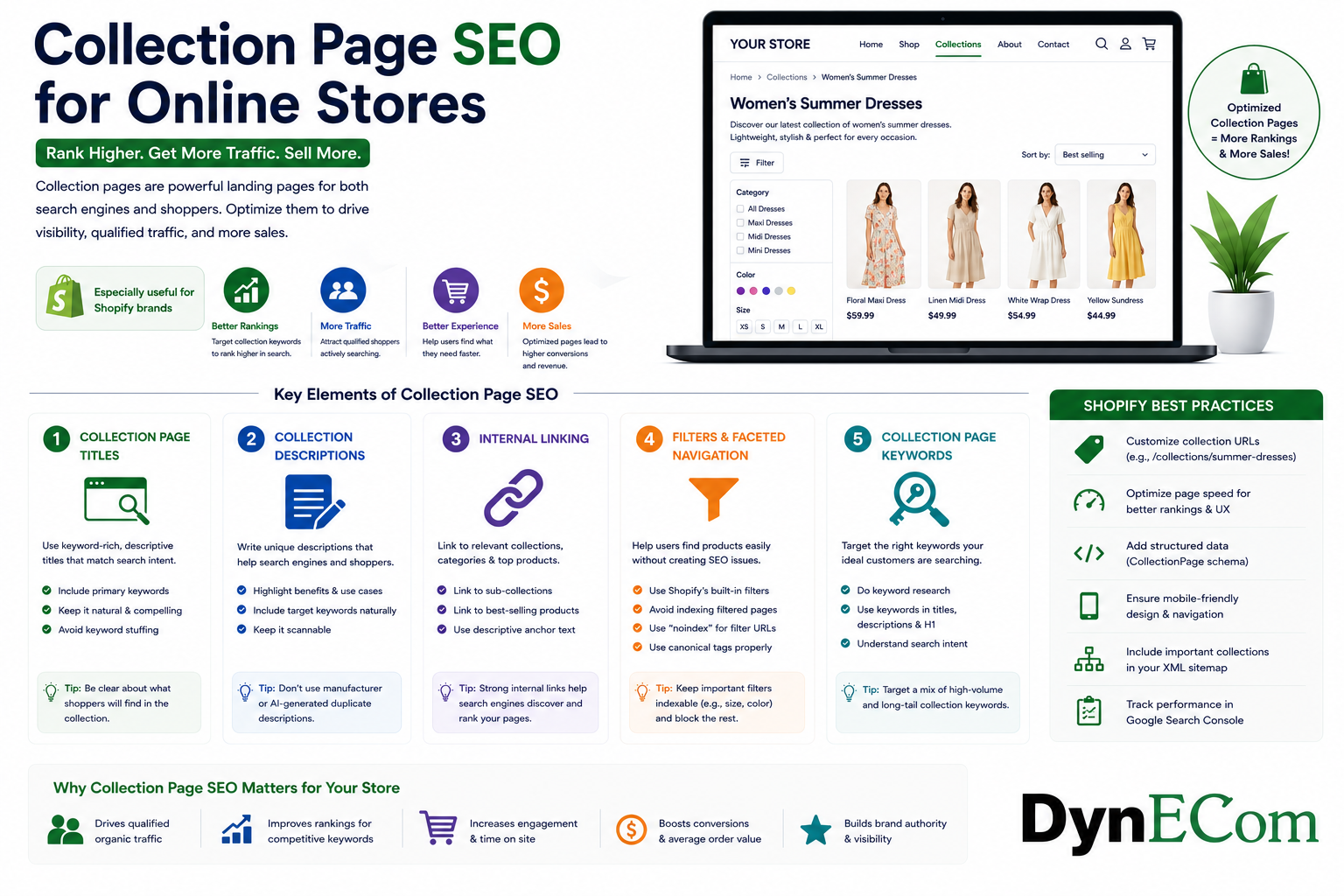
Collection Page SEO for Online Stores: A Complete Guide for Shopify Brands
For eCommerce brands, product pages often receive the majority of SEO attention. However, collection pages (also known as category pages) are one of the most powerful yet underutilized SEO assets for driving organic traffic and revenue.
A well-optimized collection page can rank for high-intent search queries such as:
- “women’s running shoes”
- “organic skincare products”
- “best wireless headphones”
- “summer dresses for women”
Unlike individual product pages that target specific products, collection pages target broader category-level searches where shoppers are still exploring options.
For Shopify brands, optimizing collection pages is especially important because Shopify automatically creates collection URLs that can become valuable organic landing pages when properly structured.
What Is Collection Page SEO?
Collection page SEO is the process of optimizing eCommerce category pages to improve search engine visibility, attract qualified shoppers, and increase conversions.
A collection page typically includes:
- Category title
- Product listings
- Category description
- Filters and sorting options
- Images
- Internal links
- SEO metadata
Example: A Shopify store selling fitness equipment may have:
❌ Basic Collection Page: Yoga Mats
URL:
store.com/collections/yoga-matsOnly showing products.
Optimized Collection Page:
Title: Premium Yoga Mats for Beginners & Professionals
Description: Explore non-slip yoga mats designed for home workouts, studio sessions, and professional practice. Choose from lightweight, eco-friendly, and extra-cushioned options.
Target keywords:
- yoga mats
- best yoga mats
- non-slip yoga mats
- eco-friendly yoga mats
This page has a much better chance of ranking for multiple search terms.
Why Collection Page SEO Matters
1. Collection Pages Target High-Volume Keywords
Product pages usually target specific searches:
Example:
Product Page: Nike Air Zoom Pegasus 41 Women’s Running Shoes
Keyword: Nike Pegasus 41 women’s size 8
Search volume: Low
Collection Page: Women’s Running Shoes
Keywords:
- women’s running shoes
- best running shoes for women
- lightweight running shoes
- gym shoes for women
Search volume: Much higher
2. Collection Pages Drive Revenue
Visitors landing on collection pages already show shopping intent.
They are not searching for information.
They are comparing products.
Example:
Search: Best wireless earbuds
User intent: “I want to buy earbuds but haven’t selected a product yet.”
A well-designed collection page helps them discover products.
3. Collection Pages Improve Internal Linking
Collection pages create a strong SEO structure:
Homepage
    |
    |
Category Page
    |
    |
Product Pages
Example:
Homepage: Women’s Fashion
↓
Collection: Summer Dresses
↓
Products:
- Floral Maxi Dress
- Linen Dress
- Casual Dress
This helps Google understand site hierarchy.
Shopify Collection Page SEO Checklist
1. Optimize Collection Page Titles
The collection title should include the primary keyword naturally.
Poor Example: Collection
Better: Women’s Leather Handbags
Best: Women’s Leather Handbags – Premium Everyday Bags
Formula: Primary Keyword + User Intent + Differentiator
Examples:
- Men’s Running Shoes for Daily Training
- Organic Face Creams for Sensitive Skin
- Modern Office Furniture for Home Workspaces
2. Write SEO-Friendly Collection Descriptions
Many Shopify stores ignore collection descriptions. This is a missed SEO opportunity. A good description should include:
- Primary keyword
- Related keywords
- Product benefits
- Buying guidance
- Internal links
Example: Discover our collection of women’s running shoes designed for comfort, durability, and everyday performance. From lightweight trainers to cushioned running sneakers, find the perfect pair for workouts, walking, and outdoor activities.
Keywords included naturally:
- women’s running shoes
- running sneakers
- lightweight trainers
3. Optimize Collection Page Meta Titles
Your meta title appears in Google results.
Formula:
Primary Keyword | Brand NameExamples:
❌ Products | ABC Store
✅ Women's Summer Dresses | ABC Fashion
Recommended length: 50–60 characters
4. Optimize Meta Descriptions
A good meta description improves CTR.
Example: Shop stylish women’s summer dresses made with lightweight fabrics and modern designs. Explore casual, floral, and premium dresses for every occasion.
Include:
✓ Keyword
✓ Product benefits
✓ Call-to-action
5. Use SEO-Friendly URLs
Shopify automatically creates:
/collections/category-nameKeep URLs:
- Short
- Keyword-focused
- Easy to understand
Good: /collections/womens-running-shoes
Avoid: /collections/category12345
6. Add Collection Page Content Above Products
Many Shopify themes place products immediately after the heading. For SEO, add helpful content.
Example structure:
H1: Women's Running Shoes
Intro paragraph: 100-150 words
Featured products
Buying guide
FAQs
Related collections
This provides Google with context.
7. Improve Product Filtering
Filters improve user experience and SEO when implemented correctly.
Useful filters:
- Size
- Color
- Material
- Price
- Brand
- Features
Example: Women’s Dresses:
Filters:
- Maxi Dresses
- Summer Dresses
- Party Dresses
- Casual Dresses
Avoid creating thousands of indexable filter pages.
Example:
Bad:/collections/shoes?color=red&size=8
Google may crawl endless combinations.
8. Add Internal Links
Collection pages should link to related categories.
Example: Women’s Shoes Collection:
Links to:
- Running Shoes
- Walking Shoes
- Sneakers
- Hiking Shoes
This strengthens SEO authority.
9. Optimize Collection Page Images
Images should include:
File Name:
Bad:IMG12345.jpg
Good:womens-leather-handbags.jpg
Alt Text:
Bad:image
Good:Brown leather handbag for women
10. Add Structured Data
Collection pages can benefit from:
Product Schema
Helps Google understand:
- Product names
- Prices
- Availability
- Reviews
Breadcrumb Schema
Example:
Home
>
Women's Shoes
>
Running Shoes
Improves search appearance.
Collection Page SEO vs Product Page SEO
| Factor | Collection Page | Product Page |
|---|---|---|
| Target | Category keywords | Specific product keywords |
| Search Intent | Research + shopping | Purchase intent |
| Traffic Potential | Higher | Lower |
| Keywords | Broad | Long-tail |
| Example | Women’s Sneakers | Nike Air Max Women’s Size 8 |
| Goal | Discovery | Conversion |
Common Collection Page SEO Mistakes
1. Thin Content
Problem: Only showing products.
Solution:
Add:
- Category description
- Buying guides
- FAQs
- Related links
2. Duplicate Collection Pages
Example: Same products:
/collections/shoes
/collections/footwear
Both targeting the same keyword.
Solution: Choose one primary collection.
3. Keyword Stuffing
Bad: Buy shoes. Shoes for women. Women’s shoes. Best shoes online.
Google may reduce rankings.
Solution: Write naturally.
4. Ignoring Seasonal Collections
Create optimized pages:
Examples:
- Christmas Gifts
- Black Friday Deals
- Summer Collection
- Back-to-School Products
These can capture seasonal searches.
Shopify Collection Page SEO Strategy Example
Brand: Outdoor Clothing Store
Collection: “Women’s Hiking Jackets”
Keyword Research:
Primary: women’s hiking jackets
Secondary:
- waterproof hiking jackets
- lightweight hiking jackets
- winter hiking jackets
Optimization:
Title: Women’s Hiking Jackets
Description: Explore waterproof and lightweight women’s hiking jackets designed for outdoor adventures.
URL:/collections/womens-hiking-jackets
Internal Links:
- Hiking Pants
- Outdoor Boots
- Camping Gear
FAQ:
Q:
Are hiking jackets waterproof?
Q:
What jacket is best for cold weather hiking?
Measuring Collection Page SEO Success
Track:
Organic Metrics
- Organic traffic
- Keyword rankings
- Impressions
- CTR
eCommerce Metrics
- Revenue
- Conversion rate
- Add-to-cart rate
- Average order value
Tools:
- Google Search Console
- Google Analytics
- Shopify Analytics
- Ahrefs
- Semrush
Final Takeaways
For Shopify brands, collection pages are not just product listing pages — they are SEO landing pages designed to capture high-intent category searches.
A strong collection page SEO strategy should focus on:
✅ Keyword-focused titles
✅ Optimized descriptions
✅ Clean URLs
✅ Strong internal linking
✅ Better filtering
✅ Structured data
✅ Helpful buying content
✅ Conversion-focused design
When optimized correctly, collection pages can become some of the highest-performing organic traffic and revenue sources for an eCommerce brand.
Looking to dive deeper into eCommerce SEO? Our Ultimate eCommerce SEO & GEO Guide for 2026 is a complete resource packed with actionable strategies, best practices, and real-world examples to help online stores improve rankings, traffic, and revenue. Read it here: https://dynecom.com/the-ultimate-ecommerce-seo-geo-guide-for-2026/

Dharmendra Tripathi is a Senior Digital Marketing & Customer Success leader with deep expertise in eCommerce SEO, performance marketing, and marketplace growth. With years of experience managing SEO and advertising campaigns across Google, Meta, Amazon, Walmart, and Shopify, he helps brands improve search visibility, maximize advertising ROI, and accelerate online sales. Passionate about AI-powered search, content optimization, and analytics, Dharmendra regularly shares actionable insights to help eCommerce businesses stay ahead in an evolving digital landscape.