
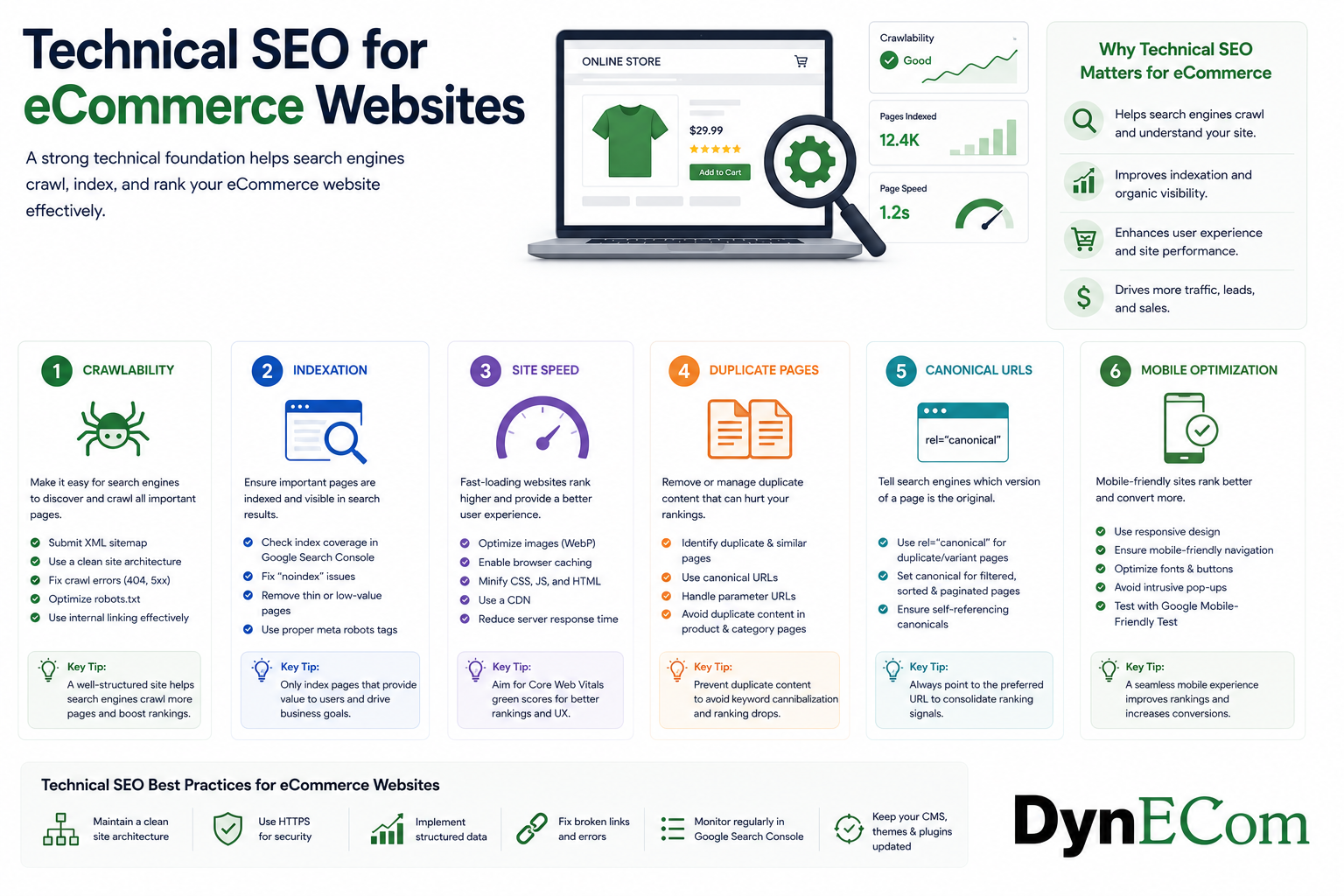
Why Technical SEO Matters for eCommerce Websites
A successful eCommerce website requires more than great products and attractive designs. Behind every high-performing online store is a strong technical foundation that allows search engines to discover, understand, and rank thousands of product pages efficiently.
This foundation is called technical SEO for eCommerce.
Technical SEO for eCommerce focuses on improving the technical structure of an online store so search engines can:
- Crawl website pages efficiently
- Index important products and categories
- Understand website architecture
- Deliver better user experiences
- Rank relevant pages higher in search results
For eCommerce websites, technical SEO becomes even more important because online stores often contain:
- Hundreds or thousands of product pages
- Multiple product variations
- Category and subcategory pages
- Filters and sorting options
- Dynamic URLs
- Duplicate content issues
A small technical issue can impact thousands of pages.
For example:
A website with 50,000 products may lose significant organic traffic if search engines cannot properly index product pages due to incorrect settings.
What Is Technical SEO for eCommerce?
Technical SEO for eCommerce is the process of optimizing the technical elements of an online store to improve search engine crawling, indexing, website performance, and user experience.
Unlike content SEO, which focuses on keywords and pages, technical SEO focuses on the infrastructure behind the website.
Key areas include:
- Crawlability
- Indexation
- Website speed
- Duplicate content management
- Canonical URLs
- Mobile optimization
Why Technical SEO Is Important for eCommerce Websites
1. Helps Search Engines Discover Products
Search engines use automated bots called crawlers to discover website pages.
For large eCommerce websites, proper crawling is critical.
Example:
An online retailer has:
- 20,000 products
- 500 categories
- Thousands of filtered URLs
Without proper technical SEO, search engines may:
- Crawl unnecessary pages
- Miss important products
- Waste crawl budget
2. Improves Organic Rankings
Search engines prefer websites that provide:
- Fast experiences
- Clear structure
- Accessible content
- Mobile-friendly pages
Technical SEO improvements can directly support better rankings.
3. Improves Customer Experience
Many technical SEO factors also impact shoppers.
Examples:
Slow pages:
→ Customers leave
Broken links:
→ Customers lose trust
Poor mobile experience:
→ Lost mobile sales
Technical SEO improves both rankings and conversions.
1. Crawlability Optimization for eCommerce Websites
What Is Crawlability?
Crawlability refers to how easily search engines can access and explore website pages.
Search engines need to crawl product pages before they can index and rank them.
Common Crawlability Issues in eCommerce
1. Too Many Filter URLs
eCommerce websites often use filters:
Example:
/shoes?color=black
/shoes?size=10
/shoes?brand=nike
Each variation may create a separate URL.
Problems:
- Duplicate pages
- Wasted crawl budget
- Indexing issues
2. Poor Website Architecture
A strong structure helps search engines understand relationships.
Example:
Good structure:
Homepage
 |
Category
 |
Subcategory
 |
Product Page
Example:
Homepage
 |
Furniture
 |
Office Chairs
 |
Ergonomic Office Chair
3. Broken Links
Broken links create poor user experience and crawling problems.
Common causes:
- Deleted products
- Old category pages
- Incorrect redirects
Regularly check:
- 404 errors
- Broken internal links
- Redirect chains
Crawlability Checklist
- Submit XML sitemap
- Maintain logical site structure
- Fix broken links
- Optimize robots.txt
- Remove unnecessary indexed pages
- Use internal linking properly
2. Indexation Optimization
What Is Indexation?
Indexation determines which pages search engines store and display in search results.
A page that is not indexed cannot rank.
Common eCommerce Indexation Problems
Problem 1: Important Product Pages Not Indexed
Example:
A brand launches 500 new products but only 350 appear in Google.
Possible causes:
- Poor internal linking
- No sitemap submission
- Incorrect noindex tags
Problem 2: Too Many Low-Value Pages Indexed
Examples:
- Filter pages
- Search result pages
- Duplicate product variations
These pages may dilute SEO authority.
How to Improve Indexation
Create XML Sitemap
An XML sitemap helps search engines discover important pages.
Include:
- Product pages
- Category pages
- Important landing pages
Avoid:
- Duplicate URLs
- Expired products
- Low-value pages
Use Robots.txt Correctly
Robots.txt controls crawler access.
Example:
Allow:
/products/Block:
/checkout/Use Noindex Strategically
Use noindex for:
- Internal search pages
- Duplicate filter pages
- Thin content pages
Indexation Checklist
- Important pages indexed
- Sitemap updated
- No accidental noindex tags
- Low-value pages excluded
- Search Console monitored
3. Site Speed Optimization for eCommerce
Website speed is one of the most important technical SEO factors.
Slow websites impact:
- Rankings
- Conversion rates
- Customer satisfaction
Why Speed Matters
Imagine two stores:
Store A:
Page load time: 2 seconds
Store B:
Page load time: 7 seconds
The second store is more likely to lose customers before they even view products.
Common Causes of Slow eCommerce Websites
Large Product Images
Online stores often use hundreds of images.
Solutions:
- Compress images
- Use WebP format
- Optimize image dimensions
Too Many Scripts
Common causes:
- Tracking tools
- Apps
- Plugins
- Widgets
Remove unnecessary scripts.
Poor Hosting Performance
Large stores need reliable infrastructure.
Site Speed Optimization Checklist
- Compress images
- Improve server response time
- Minify CSS and JavaScript
- Use caching
- Optimize third-party scripts
- Improve Core Web Vitals
4. Managing Duplicate Pages in eCommerce
Duplicate content is one of the biggest technical SEO challenges for online stores.
Why Duplicate Content Happens
Product Variations
Example:
Same product:
- Red shirt
- Blue shirt
- Black shirt
Different URLs may create duplicate pages.
Sorting Pages
Examples:
/products?sort=price-low
/products?sort=popular
Manufacturer Descriptions
Many sellers copy identical descriptions.
Example:
100 retailers using the same manufacturer description creates no unique SEO value.
How to Fix Duplicate Content
Create Unique Product Content
Improve:
- Product descriptions
- Features
- Benefits
- FAQs
Control Duplicate URLs
Use:
- Canonical tags
- Noindex rules
- URL management
Duplicate Content Checklist
- Unique descriptions
- Controlled product variations
- Proper canonical tags
- Filter pages managed
- Duplicate URLs identified
5. Canonical URLs for eCommerce SEO
What Are Canonical URLs?
Canonical URLs tell search engines which version of a page should be considered the primary version.
Example:
A product exists through multiple URLs:
example.com/red-chair
example.com/chairs/red-chair
example.com/products/red-chair
A canonical tag tells Google:
This is the main product URL.
Why Canonical URLs Matter
They help:
- Prevent duplicate content issues
- Consolidate ranking signals
- Improve indexing efficiency
Canonical URL Best Practices
- Use self-referencing canonicals
- Maintain consistent URLs
- Avoid conflicting canonical tags
- Use canonical tags for product variations
Example:
Product:
“Wireless Headphones”
Canonical:
example.com/wireless-headphonesAll duplicate versions point back to this URL.
6. Mobile Optimization for eCommerce Websites
Mobile optimization is essential because a large percentage of online shopping happens through smartphones.
Google also uses mobile-first indexing.
Mobile SEO Best Practices
Responsive Design
Website should automatically adapt to:
- Smartphones
- Tablets
- Different screen sizes
Mobile-Friendly Navigation
Ensure:
- Easy category browsing
- Simple menus
- Search functionality
- Clear buttons
Optimize Mobile Product Pages
Include:
- Clear product images
- Easy-to-read descriptions
- Visible pricing
- Simple checkout
Mobile Optimization Checklist
- Responsive website
- Fast mobile speed
- Easy navigation
- Mobile-friendly checkout
- Optimized images
Technical SEO Checklist for eCommerce Websites
| Area | Action |
|---|---|
| Crawlability | Optimize site structure and crawling |
| Indexation | Ensure important pages are indexed |
| Speed | Improve loading performance |
| Duplicate Content | Remove or control duplicates |
| Canonicals | Define preferred URLs |
| Mobile SEO | Optimize mobile experience |
| Sitemap | Maintain updated XML sitemap |
| URLs | Create clean URL structures |
Technical SEO Tools for eCommerce Websites
Google Search Console
Best for:
- Index monitoring
- Crawl issues
- Search performance
Screaming Frog
Best for:
- Website crawling
- Duplicate detection
- Technical audits
Google PageSpeed Insights
Best for:
- Speed testing
- Core Web Vitals
Ahrefs / Semrush
Best for:
- Technical audits
- SEO monitoring
Common Technical SEO Mistakes eCommerce Brands Make
1. Indexing Every Page
More indexed pages do not always mean better SEO.
Quality matters more than quantity.
2. Ignoring Product Variations
Poor handling of variations can create thousands of duplicate pages.
3. Using Slow Images
Large product images are one of the biggest speed problems.
4. Forgetting Mobile Users
A desktop-perfect website can still lose mobile customers.
Future of Technical SEO for eCommerce
As AI-powered search continues growing, technical SEO will become even more important.
Search engines and AI systems need:
- Accurate product information
- Clean website structures
- Fast experiences
- Structured data
Brands with strong technical foundations will have an advantage in:
- Google Search
- AI shopping assistants
- Voice search
- Marketplace discovery
Final Thoughts
Technical SEO for eCommerce websites is the foundation that allows products to become discoverable, searchable, and competitive.
A strong technical SEO strategy ensures:
- Search engines can crawl products
- Important pages get indexed
- Websites load quickly
- Duplicate content is controlled
- Customers receive better experiences
For growing eCommerce brands, technical SEO is not just a backend task — it is a direct driver of visibility, traffic, and revenue.
By consistently improving crawlability, indexation, speed, canonical URLs, and mobile performance, online stores can build a stronger SEO foundation and compete effectively in an increasingly crowded digital marketplace.
Want to master eCommerce SEO? Explore our comprehensive guide, The Ultimate eCommerce SEO & GEO Guide for 2026, where we cover everything from technical SEO and product page optimization to AI search, Google Shopping, Amazon, Walmart, Shopify SEO, and the latest GEO (Generative Engine Optimization) strategies. Read the complete guide here: https://dynecom.com/the-ultimate-ecommerce-seo-geo-guide-for-2026/

Dharmendra Tripathi is a Senior Digital Marketing & Customer Success leader with deep expertise in eCommerce SEO, performance marketing, and marketplace growth. With years of experience managing SEO and advertising campaigns across Google, Meta, Amazon, Walmart, and Shopify, he helps brands improve search visibility, maximize advertising ROI, and accelerate online sales. Passionate about AI-powered search, content optimization, and analytics, Dharmendra regularly shares actionable insights to help eCommerce businesses stay ahead in an evolving digital landscape.