
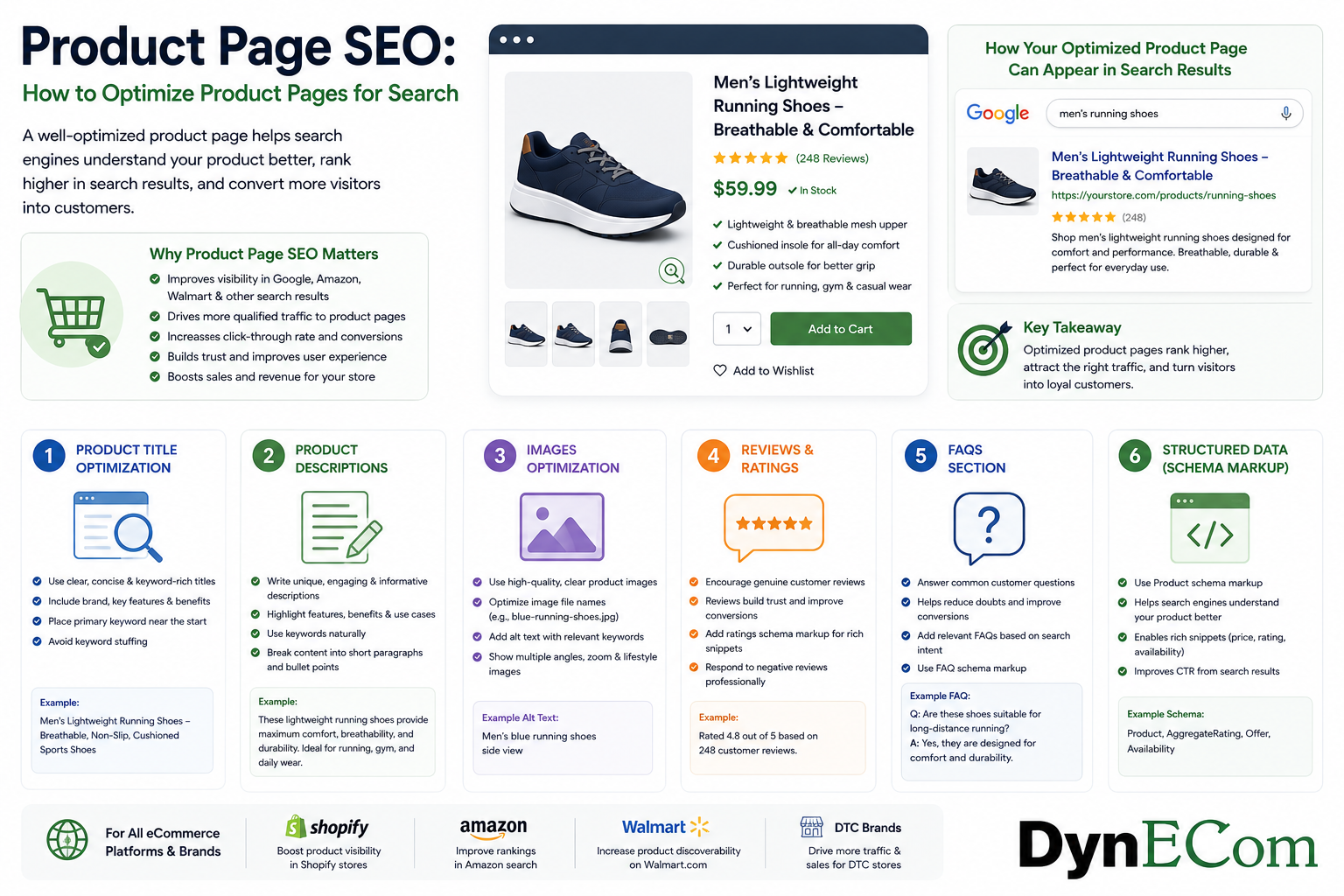
Why Product Page SEO Matters
For any eCommerce business, product pages are where search visibility turns into revenue.
A customer searching for a specific product is usually closer to making a purchase than someone browsing general information. If your product page appears at the right moment with the right information, it can directly influence buying decisions.
This is where product page SEO becomes critical.
Product page SEO is the process of optimizing individual product pages so they rank higher in search engines and marketplace search results while providing a better shopping experience for customers.
A well-optimized product page helps:
- Increase organic traffic
- Improve product visibility
- Increase click-through rates
- Improve conversion rates
- Reduce dependency on paid advertising
Product page SEO applies across different eCommerce platforms, including:
- Shopify stores
- WooCommerce websites
- Amazon listings
- Walmart Marketplace listings
- Direct-to-consumer (DTC) websites
Whether you sell furniture, electronics, beauty products, supplements, apparel, or automotive products, optimizing product pages is one of the highest-impact SEO activities you can perform.
What Is Product Page SEO?
Product page SEO is the practice of optimizing product pages using relevant keywords, high-quality content, technical improvements, structured data, and conversion-focused elements to help products rank better and sell more.
Unlike traditional website pages, product pages have two audiences:
1. Search Engines
Search engines need to understand:
- What the product is
- Who it is for
- Which searches it matches
- Why it should rank
2. Customers
Customers need:
- Clear product information
- Confidence in quality
- Answers to questions
- Reasons to purchase
Successful product page SEO balances both.
Why Product Page SEO Is Important for eCommerce Brands
1. Captures High-Intent Searches
Product searches usually indicate buying intent.
Compare:
Informational search:
“How do office chairs work?”
Purchase search:
“Ergonomic office chair with lumbar support”
The second searcher is much closer to purchasing.
Optimized product pages help brands capture these valuable searches.
2. Reduces Dependence on Paid Advertising
Many brands rely heavily on ads to drive sales.
While advertising can generate immediate traffic, SEO creates long-term visibility.
Example:
A Shopify brand selling skincare products may spend thousands of dollars monthly on Google Ads.
By optimizing product pages for:
- “Vitamin C serum for sensitive skin”
- “Natural face moisturizer”
- “Anti-aging skincare products”
the brand can generate consistent organic traffic over time.
3. Improves Marketplace Rankings
For Amazon and Walmart sellers, product page optimization directly impacts marketplace visibility.
Marketplace algorithms consider:
- Product relevance
- Keywords
- Conversion rate
- Sales history
- Reviews
- Product information quality
Better product pages increase the chances of appearing higher in search results.
Product Page SEO Checklist
A successful product page SEO strategy includes:
- Product title optimization
- Product description optimization
- Image SEO
- Customer reviews
- FAQs
- Structured data
- Internal linking
- Conversion optimization
1. Product Title Optimization
The product title is one of the strongest SEO signals on any product page.
It helps search engines and customers quickly understand what the product is.
How to Write SEO-Friendly Product Titles
A strong product title should include:
- Brand name
- Main product keyword
- Important features
- Size or variation
- Key differentiators
Example:
Weak:
Premium Chair
Optimized:
Chromcraft Ergonomic Dining Chair with Casters, Swivel Tilt Design, Memory Foam Seat
The optimized title provides:
- Brand information
- Product category
- Important features
- Search relevance
Product Title Best Practices
Include Primary Keywords Naturally
Example:
Keyword:
wireless noise cancelling headphones
Title:
Wireless Noise Cancelling Headphones with Bluetooth and 40-Hour Battery Life
Avoid:
Best Cheap Wireless Noise Cancelling Headphones Buy Now
Keyword stuffing reduces readability and may hurt performance.
Avoid Unnecessary Words
Remove:
- Promotional language
- Subjective claims
- Repeated keywords
Avoid:
Amazing Premium Best Quality Product
Use:
Product-specific information
Product Title Optimization for Amazon and Walmart
Marketplace titles require additional consideration.
Amazon Product Titles
Focus on:
- Main keyword
- Brand
- Product attributes
- Customer search terms
Example:
GEARit 4K HDMI Cable 10ft High-Speed HDMI 2.0 Cable, 4K 60Hz, HDR, ARC Compatible
Walmart Product Titles
Focus on:
- Search relevance
- Clear product attributes
- Customer readability
Example:
Ergonomic Office Chair with Adjustable Lumbar Support and Mesh Back
2. Product Description Optimization
A product description does more than explain features.
It helps:
- Search engines understand relevance
- Customers understand benefits
- Increase purchase confidence
Features vs Benefits
Many brands only list features.
Example:
Feature:
Memory foam seat
Better:
Memory foam cushioning provides enhanced comfort during extended sitting periods.
Benefits explain why customers should care.
Product Description SEO Best Practices
Include Relevant Keywords
Naturally include:
- Product category
- Features
- Use cases
- Related terms
Example:
For a standing desk:
Include:
- adjustable standing desk
- home office desk
- ergonomic workspace
- height adjustable desk
Answer Customer Questions
Strong descriptions address:
- Who is this product for?
- How does it work?
- What makes it different?
- What problem does it solve?
Avoid Duplicate Manufacturer Content
Many sellers copy manufacturer descriptions.
Problems:
- No differentiation
- Duplicate content
- Weak SEO value
Create original content focused on customer needs.
3. Product Image SEO
Images are extremely important for eCommerce because customers cannot physically interact with products.
Optimized images improve:
- Search visibility
- User engagement
- Conversion rates
Product Image SEO Checklist
- Use high-resolution images
- Optimize image file names
- Add descriptive alt text
- Compress images for speed
- Include multiple angles
- Add lifestyle images
- Show product dimensions
Example
Poor image filename:
IMG001.jpgOptimized:
black-ergonomic-office-chair-lumbar-support.jpgSearch engines can better understand optimized images.
Types of Product Images That Improve Conversion
A strong product page should include:
Main Product Image
Shows the product clearly.
Lifestyle Image
Shows the product in real-world use.
Example:
A furniture brand showing a chair inside a modern dining room.
Feature Image
Highlights:
- Materials
- Dimensions
- Technology
- Benefits
Comparison Image
Shows differences between models.
4. Reviews and Ratings Optimization
Reviews are one of the strongest trust signals in eCommerce.
They influence:
- Customer confidence
- Conversion rates
- Search rankings
Why Reviews Matter for SEO
Reviews provide fresh user-generated content.
Customers naturally mention:
- Product benefits
- Use cases
- Features
These keywords can help improve search relevance.
Review Optimization Best Practices
- Encourage verified reviews
- Ask customers for photos
- Respond to negative feedback
- Highlight common customer benefits
- Display ratings prominently
Example:
Product A:
⭐ 4.8 rating
1,500 reviews
Product B:
⭐ 3.9 rating
50 reviews
Most shoppers will trust Product A more.
5. Product FAQs for SEO
FAQs help answer customer questions before purchase.
They also create opportunities to rank for long-tail searches.
Common Product FAQ Examples
Furniture
Q:
Does this chair require assembly?
A:
Yes, minimal assembly is required with included instructions.
Electronics
Q:
Does this cable support 4K video?
A:
Yes, it supports 4K resolution at 60Hz.
Beauty Products
Q:
Is this suitable for sensitive skin?
A:
Yes, the formula is designed for sensitive skin types.
FAQ SEO Benefits
FAQs can help:
- Capture conversational searches
- Improve customer confidence
- Reduce purchase hesitation
- Increase conversion rates
6. Structured Data for Product Pages
Structured data helps search engines understand product information.
For eCommerce websites, the most important schema types are:
Product Schema
Includes:
- Product name
- Brand
- Price
- Availability
- SKU
Review Schema
Includes:
- Rating
- Number of reviews
- Customer feedback
Offer Schema
Includes:
- Price
- Currency
- Availability
Example Google result:
Ergonomic Office Chair

★★★★★
4.7 (850 reviews)

$199.99
In Stock
Rich results improve visibility and click-through rates.
Product Page SEO for Different Platforms
Shopify Product Page SEO
Focus on:
- Google rankings
- Product descriptions
- Blog content
- Internal linking
- Structured data
Amazon Product Page SEO
Focus on:
- Search keywords
- Title optimization
- Bullet points
- Backend keywords
- Reviews
- Conversion rate
Walmart Product Page SEO
Focus on:
- Item content quality
- Product attributes
- Search relevance
- Competitive pricing
- Reviews
- Fulfillment performance
Common Product Page SEO Mistakes
1. Keyword Stuffing
Adding keywords excessively creates poor customer experiences.
2. Missing Product Information
Incomplete pages reduce trust.
Missing:
- Dimensions
- Specifications
- Benefits
- FAQs
3. Poor Images
Low-quality images reduce conversions.
4. Ignoring Reviews
Products without reviews struggle to compete.
5. Copying Manufacturer Content
Unique content creates stronger SEO value.
Product Page SEO Audit Checklist
| Area | Check |
|---|---|
| Title | Includes relevant keywords |
| Description | Unique and benefit-focused |
| Images | Optimized and high-quality |
| Reviews | Ratings displayed |
| FAQs | Customer questions answered |
| Schema | Product markup implemented |
| Mobile | Page works smoothly |
| Speed | Fast loading experience |
Final Thoughts
Product page SEO is one of the most important growth strategies for any eCommerce business.
A successful product page does not simply describe a product — it helps search engines understand the product while helping customers make confident purchase decisions.
Brands that optimize:
- Product titles
- Descriptions
- Images
- Reviews
- FAQs
- Structured data
can improve rankings, increase organic traffic, and generate more sales across Google, Amazon, Walmart, Shopify, and other eCommerce platforms.
The future of eCommerce belongs to brands that create product experiences that are not only searchable but also useful, trustworthy, and conversion-focused.
Continue Your eCommerce SEO Journey: Discover our Ultimate eCommerce SEO & GEO Guide for 2026, an in-depth resource covering technical SEO, on-page optimization, product page SEO, category page SEO, schema markup, AI search optimization, Google Merchant Center, Amazon SEO, Walmart SEO, Shopify SEO, and much more. Read the complete guide: https://dynecom.com/the-ultimate-ecommerce-seo-geo-guide-for-2026/

Dharmendra Tripathi is a Senior Digital Marketing & Customer Success leader with deep expertise in eCommerce SEO, performance marketing, and marketplace growth. With years of experience managing SEO and advertising campaigns across Google, Meta, Amazon, Walmart, and Shopify, he helps brands improve search visibility, maximize advertising ROI, and accelerate online sales. Passionate about AI-powered search, content optimization, and analytics, Dharmendra regularly shares actionable insights to help eCommerce businesses stay ahead in an evolving digital landscape.