
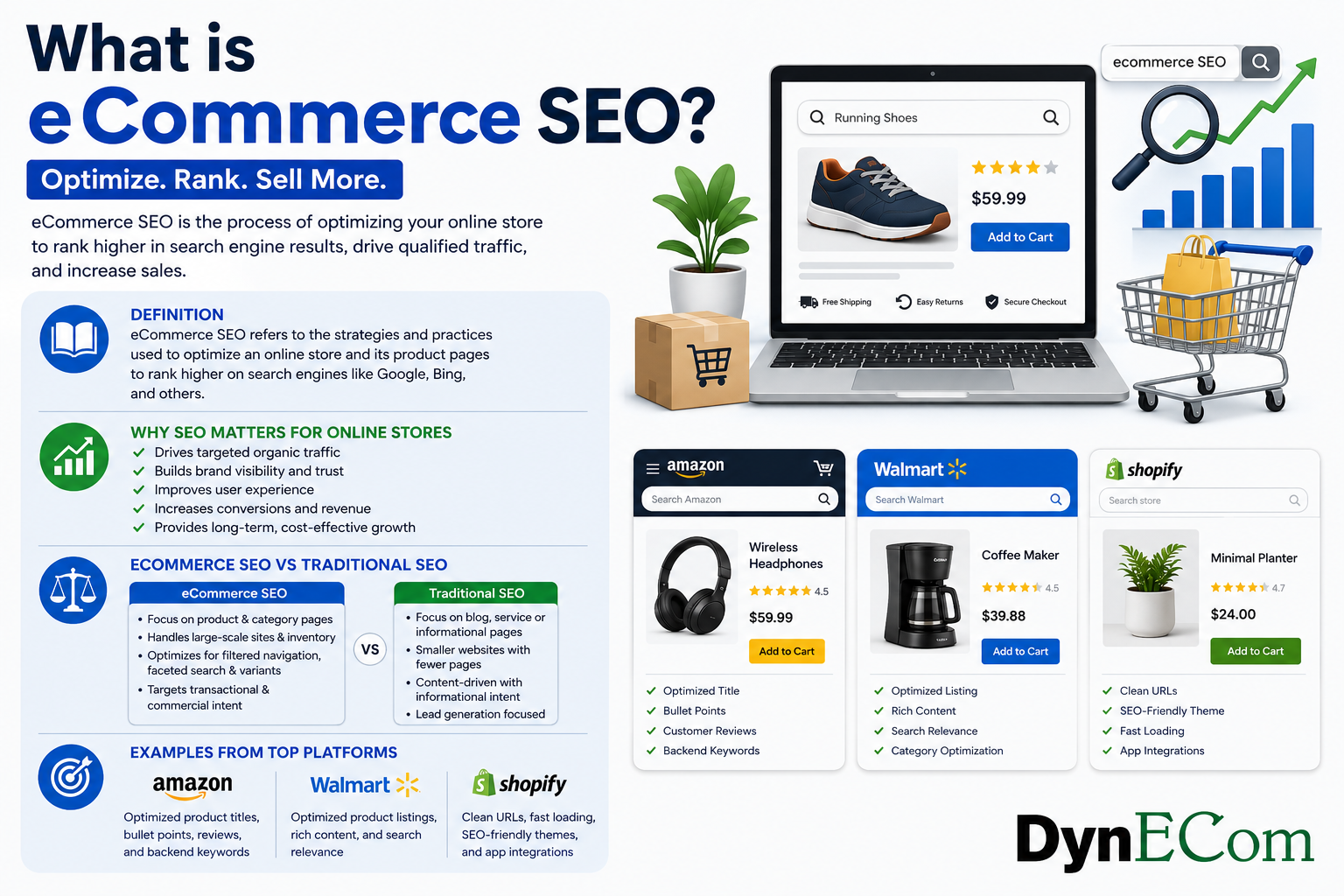
eCommerce SEO (Search Engine Optimization) is the process of optimizing an online store, product pages, category pages, and digital content to improve visibility in search engines and marketplace search results. The goal of eCommerce SEO is to help potential customers discover products organically, increase website traffic, improve rankings, and generate more sales without depending entirely on paid advertising.
Unlike traditional SEO, which focuses mainly on improving website visibility, eCommerce SEO is specifically designed to help products rank, attract buyers, and convert visitors into customers.
For example, when a shopper searches:
- “best wireless headphones”
- “running shoes for women”
- “office chair with lumbar support”
Search engines and marketplaces analyze thousands of signals to decide which products appear first. eCommerce SEO helps brands optimize those signals to increase their chances of ranking higher.
A successful eCommerce SEO strategy combines:
- Keyword research
- Product page optimization
- Technical SEO
- Category optimization
- Internal linking
- Structured data
- User experience improvements
- Reviews and reputation management
- Content marketing
Simply put:
“eCommerce SEO helps the right customers find the right products at the right time.”
Why Does eCommerce SEO Matter for Online Stores?
The online shopping ecosystem has become extremely competitive. Thousands of brands compete for the same customers, and appearing on the first page of search results can directly impact revenue.
According to industry studies, organic search remains one of the largest sources of website traffic for online businesses because customers actively search for products they already want to buy.
A customer searching “best standing desk for home office” has a much higher purchase intent than someone casually browsing social media.
This is why eCommerce SEO is critical.
1. Increases Organic Traffic Without Increasing Ad Spend
Paid advertising can generate immediate sales, but it requires continuous investment.
For example:
A brand spending $20,000/month on ads may stop receiving traffic immediately after reducing the budget.
However, a well-optimized product page ranking organically can continue generating visitors and sales over time.
Example:
A Shopify store selling skincare products ranks organically for:
- “vitamin C serum for sensitive skin”
- “best anti-aging moisturizer”
Every month, thousands of potential customers discover those products without additional advertising costs.
2. Improves Product Visibility
Most shoppers do not browse hundreds of pages before purchasing.
Research shows customers usually interact with products appearing near the top of search results.
For marketplaces like Amazon and Walmart, ranking position is extremely important.
A product appearing:
- Position #1
- Position #5
- Position #50
will have dramatically different visibility and sales potential.
eCommerce SEO helps improve:
- Product titles
- Product descriptions
- Attributes
- Keywords
- Images
- Reviews
- Conversion signals
to increase ranking opportunities.
3. Builds Long-Term Brand Growth
Advertising provides short-term visibility.
SEO creates long-term digital assets.
For example:
A company publishing:
- Buying guides
- Comparison articles
- Product education content
- FAQs
can attract customers throughout the buying journey.
Instead of only targeting customers ready to purchase, brands can capture users researching solutions.
Example:
A furniture brand can create content around:
“Best Dining Chairs for Small Apartments”
This article can introduce customers to products before they search for specific brands.
4. Improves Customer Experience
Modern SEO is not only about keywords.
Search engines reward websites that provide better experiences.
eCommerce SEO improves:
- Website speed
- Navigation
- Mobile experience
- Product information
- Images
- Reviews
- Checkout experience
A better shopping experience leads to:
- Higher conversion rates
- Lower bounce rates
- More repeat purchases
How Does eCommerce SEO Work?
A successful eCommerce SEO strategy focuses on multiple areas.
1. Keyword Research
Keyword research identifies what customers search before purchasing.
Example:
A furniture company selling chairs may target:
| Keyword | Search Intent |
|---|---|
| dining chairs | High purchase intent |
| best dining chairs 2026 | Research intent |
| ergonomic office chair | Purchase intent |
| how to choose dining chairs | Educational intent |
The goal is not simply finding high-volume keywords.
The goal is finding keywords that bring customers who are likely to buy.
2. Product Page Optimization
Product pages are the most important pages in eCommerce SEO.
A well-optimized product page includes:
Product Title
Should include:
- Brand name
- Product type
- Important attributes
- Search terms
Example:
Poor title:
Premium Chair
Optimized title:
Chromcraft Dining Chair with Casters, Swivel Tilt Design, Memory Foam Seat
Product Description
A strong description should:
- Explain benefits
- Answer customer questions
- Include relevant keywords naturally
- Improve purchase confidence
Product Images
Images influence both ranking and conversion.
Best practices:
- Multiple product images
- Lifestyle images
- Size demonstrations
- Feature callouts
Reviews
Reviews influence:
- Customer trust
- Conversion rate
- Marketplace ranking
Products with strong ratings typically outperform products with limited reviews.
eCommerce SEO vs Traditional SEO
Although both strategies focus on improving search visibility, their objectives and methods are different.
| Factor | Traditional SEO | eCommerce SEO |
|---|---|---|
| Main Goal | Increase website traffic | Increase product visibility and sales |
| Target Pages | Blogs, service pages, landing pages | Product pages, category pages, collections |
| Keywords | Informational keywords | Buyer-focused keywords |
| Conversion Goal | Leads, engagement | Purchases |
| Optimization Focus | Content and authority | Products, categories, conversion |
| Metrics | Traffic, rankings, backlinks | Revenue, conversion rate, product rankings |
| Examples | News websites, service companies | Amazon sellers, Shopify stores, Walmart sellers |
eCommerce SEO Examples
Example 1: Amazon SEO
Amazon operates differently from Google because it is primarily a shopping search engine.
When customers search:
“wireless earbuds”
Amazon considers:
- Product relevance
- Sales history
- Reviews
- Conversion rate
- Pricing
- Availability
- Advertising performance
Amazon sellers optimize:
- Titles
- Bullet points
- Backend keywords
- A+ content
- Images
- Reviews
Example:
A headphone brand improving its title from:
Bluetooth Earbuds
to:
Wireless Bluetooth Earbuds with Noise Cancellation, 40-Hour Battery Life
can improve keyword relevance and visibility.
Example 2: Walmart Marketplace SEO
Walmart SEO focuses on helping products rank higher in Walmart search results.
Important Walmart ranking factors include:
- Product content quality
- Competitive pricing
- Availability
- Reviews
- Fulfillment performance
- Conversion rate
For example:
A tire brand selling on Walmart can improve rankings by optimizing:
- Tire size keywords
- Vehicle compatibility
- Product attributes
- Images
- Technical specifications
Better product information helps Walmart understand when to display the product.
Example 3: Shopify Store SEO
Shopify stores rely heavily on Google search traffic.
A Shopify brand selling fitness equipment may create:
Product pages:
- Adjustable Dumbbells
Category pages:
- Home Gym Equipment
Content pages:
- Best Home Workout Equipment Guide
This creates a complete SEO ecosystem:
Search → Content → Product → Purchase
Common eCommerce SEO Mistakes
1. Keyword Stuffing
Adding keywords excessively can reduce readability and hurt rankings.
Good SEO focuses on relevance, not repetition.
2. Duplicate Product Content
Many online stores copy manufacturer descriptions.
This creates:
- Duplicate content
- Weak differentiation
- Lower rankings
Brands should create unique product content.
3. Ignoring Category Pages
Many stores optimize only products.
Category pages can rank for valuable searches like:
- “best office chairs”
- “women running shoes”
- “organic skincare products”
4. Focusing Only on Paid Ads
Ads provide immediate traffic, but SEO creates sustainable growth.
The strongest brands combine:
- Paid advertising
- Organic SEO
- Content marketing
The Future of eCommerce SEO
The future of eCommerce SEO is moving beyond traditional search engines.
Customers increasingly use:
- AI assistants
- Voice search
- Shopping recommendations
- Generative search engines
Brands will need to optimize for:
- Better product data
- Strong brand authority
- Structured information
- Helpful content
AI search systems will favor brands that provide accurate, detailed, and trustworthy information.
Frequently Asked Questions (FAQs)
What is eCommerce SEO?
eCommerce SEO is the process of optimizing online stores and product pages to improve organic visibility, attract shoppers, and increase sales.
Why is SEO important for eCommerce?
SEO helps online stores generate consistent traffic, reduce dependency on paid advertising, and build long-term brand visibility.
Is eCommerce SEO different from Google SEO?
Yes. Traditional SEO focuses on websites and information, while eCommerce SEO focuses on products, categories, and purchase-driven searches.
Does Amazon use SEO?
Yes. Amazon has its own search algorithm that ranks products based on relevance, sales performance, reviews, pricing, and customer experience.
Final Thoughts
eCommerce SEO is no longer optional for brands that want sustainable online growth. Whether selling through a Shopify store, Amazon, Walmart, or multiple marketplaces, SEO helps businesses reach customers organically and compete effectively.
Brands that invest in optimized product pages, valuable content, strong technical foundations, and customer-focused experiences can build a long-term growth engine that goes beyond paid advertising.
The future of eCommerce belongs to brands that are not only visible but also discoverable, trustworthy, and optimized for every stage of the customer journey.
Want to master eCommerce SEO? Explore our comprehensive guide, The Ultimate eCommerce SEO & GEO Guide for 2026, where we cover everything from technical SEO and product page optimization to AI search, Google Shopping, Amazon, Walmart, Shopify SEO, and the latest GEO (Generative Engine Optimization) strategies. Read the complete guide here: https://dynecom.com/the-ultimate-ecommerce-seo-geo-guide-for-2026/

Dharmendra Tripathi is a Senior Digital Marketing & Customer Success leader with deep expertise in eCommerce SEO, performance marketing, and marketplace growth. With years of experience managing SEO and advertising campaigns across Google, Meta, Amazon, Walmart, and Shopify, he helps brands improve search visibility, maximize advertising ROI, and accelerate online sales. Passionate about AI-powered search, content optimization, and analytics, Dharmendra regularly shares actionable insights to help eCommerce businesses stay ahead in an evolving digital landscape.