
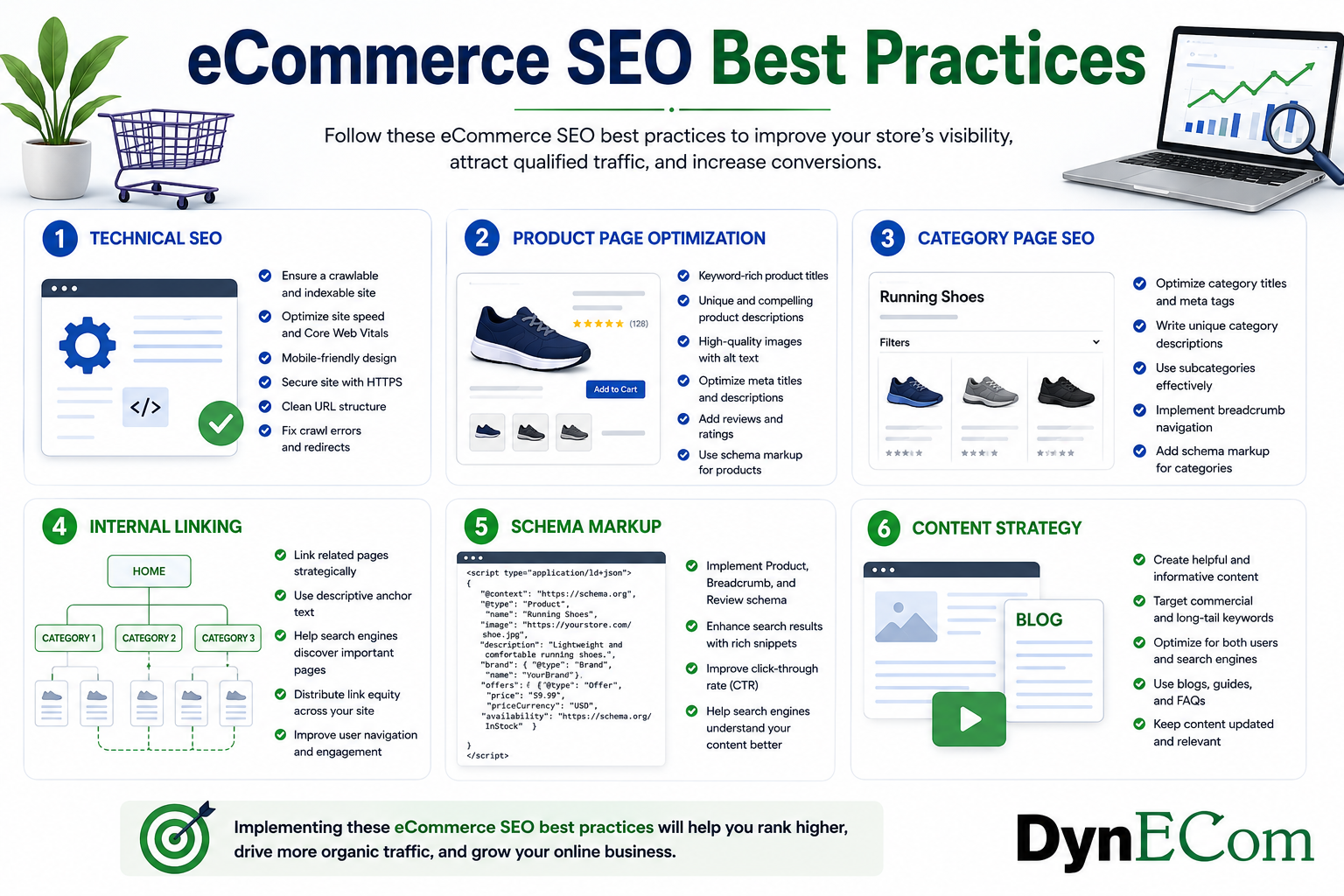
Why eCommerce SEO Best Practices Matter
The eCommerce industry has become increasingly competitive. Millions of products compete for visibility across search engines and marketplaces every day. Having a great product is no longer enough — brands need a strong eCommerce SEO strategy to ensure customers can discover their products when they are actively searching.
eCommerce SEO best practices help online stores improve search visibility, attract qualified traffic, increase conversions, and build sustainable growth without relying only on paid advertising.
A successful eCommerce SEO strategy combines multiple areas:
- Technical SEO
- Product page optimization
- Category page optimization
- Internal linking
- Schema markup
- Content marketing
- User experience optimization
Whether you operate a Shopify store, WooCommerce website, Amazon storefront, Walmart Marketplace account, or a large enterprise eCommerce platform, implementing these best practices can significantly impact organic visibility and revenue.
What Are eCommerce SEO Best Practices?
eCommerce SEO best practices are proven techniques used to optimize online stores so search engines can better understand products, categories, and website content.
The objective is not only to rank higher but also to attract customers who have strong purchase intent.
For example:
A customer searching:
“best ergonomic office chair for home office”
is closer to making a purchase than someone searching:
“what is an office chair?”
An effective eCommerce SEO strategy helps brands appear in front of these high-intent customers.
1. Technical SEO Optimization for eCommerce Websites
Technical SEO creates the foundation of an optimized online store. Even the best product content will struggle if search engines cannot properly crawl, index, and understand the website.
Improve Website Speed
Page speed directly impacts:
- Search rankings
- Customer experience
- Conversion rates
Online shoppers expect pages to load quickly. Slow websites often experience:
- Higher bounce rates
- Lower conversions
- Reduced organic visibility
Best Practices:
- Compress product images
- Use modern image formats like WebP
- Minimize unnecessary scripts
- Improve server response time
- Use a reliable hosting provider
Example:
A Shopify fashion store with hundreds of product images can improve loading speed by compressing images without reducing visual quality.
Optimize Mobile Experience
Mobile commerce continues to grow rapidly. Most shoppers browse and purchase products using smartphones.
Google also follows mobile-first indexing, meaning it primarily evaluates the mobile version of websites.
Ensure:
- Responsive design
- Easy navigation
- Mobile-friendly product pages
- Simple checkout process
- Readable fonts
Fix Duplicate Content Issues
Duplicate content is one of the biggest challenges for eCommerce websites.
Common causes:
- Similar product descriptions
- Multiple URLs for the same product
- Filter pages
- Sorting parameters
Example:
A clothing store may have:
example.com/shirts
example.com/shirts?color=blue
example.com/shirts?size=medium
Search engines may see these as duplicate pages.
Solutions:
- Use canonical tags
- Optimize URL structures
- Manage faceted navigation
- Avoid unnecessary indexed pages
Create SEO-Friendly URLs
Good URLs help both users and search engines understand page topics.
Bad:
website.com/product?id=45892Better:
website.com/ergonomic-office-chairBest practices:
- Keep URLs short
- Include relevant keywords
- Avoid unnecessary numbers
- Use hyphens
2. Product Page Optimization
Product pages are the most important pages in eCommerce SEO because they directly influence rankings and conversions.
A well-optimized product page should satisfy two goals:
- Help search engines understand the product
- Help customers make purchase decisions
Optimize Product Titles
Product titles should include important search terms while remaining customer-friendly.
Example:
Poor:
Premium Chair
Optimized:
Ergonomic Office Chair with Lumbar Support and Adjustable Height
A strong product title includes:
- Brand name
- Product type
- Key features
- Important specifications
Write SEO-Friendly Product Descriptions
A product description should answer:
- What is the product?
- Who is it for?
- Why should customers buy it?
- What makes it different?
Avoid copying manufacturer descriptions.
Instead:
- Highlight benefits
- Include keywords naturally
- Explain features
- Answer customer questions
Example:
Instead of:
“This chair has adjustable arms.”
Write:
“Adjustable armrests allow users to customize their sitting position for improved comfort during long work sessions.”
Optimize Product Images
Images influence both SEO and conversion rates.
Best practices:
- Use high-quality images
- Add descriptive file names
- Include alt text
- Show multiple angles
- Add lifestyle images
Example:
Instead of:
IMG12345.jpgUse:
ergonomic-office-chair-black.jpgAdd Customer Reviews
Reviews are powerful ranking and conversion signals.
They help with:
- Customer trust
- Click-through rates
- Purchase decisions
Encourage:
- Verified reviews
- Product photos
- Detailed customer feedback
3. Category Page SEO
Many eCommerce brands focus only on product pages and ignore category pages.
However, category pages often rank for high-volume keywords.
Examples:
- Running shoes
- Office furniture
- Organic skincare
- Home appliances
Optimize Category Page Titles
Example:
Generic:
Chairs
Better:
Ergonomic Office Chairs for Home and Business
Include:
- Primary keyword
- Product category
- Customer intent
Create Helpful Category Descriptions
A category page should provide context.
Example:
Instead of:
“Shop our chairs.”
Create:
“Explore ergonomic office chairs designed for comfort, productivity, and long working hours.”
This helps search engines understand category relevance.
Improve Category Navigation
Users should easily move between:
Homepage → Category → Product
Example:
Home
 |
Office Furniture
 |
Office Chairs
 |
Ergonomic Office Chair
This improves:
- User experience
- Crawlability
- Internal linking
4. Internal Linking Strategy
Internal linking helps search engines understand website structure and distribute authority across pages.
A strong internal linking strategy improves:
- Rankings
- Crawl efficiency
- User navigation
Example eCommerce Internal Linking Structure
Homepage

↓
Category Page

↓
Sub Category

↓
Product Pages

↓
Related Products
Best Internal Linking Practices
Link Related Products
Example:
A laptop product page can link to:
- Laptop accessories
- Laptop bags
- Wireless keyboards
Create Buying Guides
Example:
Article:
“Best Office Chairs for Remote Workers”
Links to:
- Ergonomic chairs
- Executive chairs
- Budget office chairs
Avoid Orphan Pages
An orphan page has no internal links pointing toward it.
Every important product should be discoverable through website navigation.
5. Schema Markup for eCommerce SEO
Schema markup helps search engines better understand product information.
It can improve search appearance through rich results.
Common eCommerce schema types:
Product Schema
Provides:
- Product name
- Price
- Availability
- Brand
Review Schema
Displays:
- Ratings
- Reviews
- Customer feedback
Example:
Google search result:
⭐ 4.8 rating
500 reviews
FAQ Schema
Useful for answering common customer questions.
Example:
Questions:
- Does this product include warranty?
- How long does shipping take?
- Is installation required?
6. Content Strategy for eCommerce SEO
Content marketing helps brands attract customers before they are ready to purchase.
A strong content strategy includes:
- Educational blogs
- Buying guides
- Comparison articles
- FAQs
- Product guides
Create Buying Guides
Buying guides target customers researching options.
Examples:
- Best Office Chairs for Back Support
- Best Running Shoes for Beginners
- Complete Guide to Choosing a Mattress
These pages can drive highly qualified traffic.
Create Comparison Content
Customers often compare products before purchasing.
Examples:
- Product A vs Product B
- Best Products Under $100
- Top 10 Products for Specific Needs
Optimize FAQs
FAQ content captures long-tail searches.
Examples:
“What size office chair do I need?”
“How long does a standing desk last?”
eCommerce SEO Best Practices Checklist
| Area | Best Practice |
|---|---|
| Technical SEO | Improve speed, mobile optimization, crawlability |
| Product Pages | Optimize titles, descriptions, images, reviews |
| Category Pages | Create keyword-focused categories |
| Internal Linking | Connect products, categories, and content |
| Schema Markup | Add product, review, FAQ schema |
| Content Strategy | Publish guides, comparisons, FAQs |
| User Experience | Improve navigation and conversion |
Common eCommerce SEO Mistakes to Avoid
Ignoring Search Intent
Ranking for irrelevant keywords does not generate sales.
Focus on keywords that match customer buying behavior.
Using Duplicate Product Descriptions
Unique content helps products stand out.
Neglecting Technical SEO
Broken links, slow pages, and indexing issues can limit rankings.
Creating Content Without a Strategy
Random blog posts rarely generate meaningful traffic.
Content should support:
- Product discovery
- Customer education
- Purchase decisions
Future of eCommerce SEO
The future of eCommerce SEO will be shaped by:
- Artificial intelligence search
- Voice commerce
- Personalized recommendations
- Generative search experiences
Brands will need:
- Better product data
- Stronger content quality
- Clear brand authority
- Structured information
Search engines and AI systems will increasingly prioritize businesses that provide accurate, trustworthy, and helpful information.
Final Thoughts
Following eCommerce SEO best practices allows brands to create a sustainable growth engine that attracts customers organically.
The strongest eCommerce brands combine:
- Technical SEO excellence
- Optimized product pages
- Strong category architecture
- Smart internal linking
- Structured data
- Helpful content
SEO is no longer just about ranking higher — it is about creating a better shopping experience that connects customers with products they actually want to buy.
By implementing these strategies consistently, online stores can improve visibility, increase conversions, and build long-term competitive advantages in an increasingly crowded digital marketplace.
Looking to dive deeper into eCommerce SEO? Our Ultimate eCommerce SEO & GEO Guide for 2026 is a complete resource packed with actionable strategies, best practices, and real-world examples to help online stores improve rankings, traffic, and revenue. Read it here: https://dynecom.com/the-ultimate-ecommerce-seo-geo-guide-for-2026/

Dharmendra Tripathi is a Senior Digital Marketing & Customer Success leader with deep expertise in eCommerce SEO, performance marketing, and marketplace growth. With years of experience managing SEO and advertising campaigns across Google, Meta, Amazon, Walmart, and Shopify, he helps brands improve search visibility, maximize advertising ROI, and accelerate online sales. Passionate about AI-powered search, content optimization, and analytics, Dharmendra regularly shares actionable insights to help eCommerce businesses stay ahead in an evolving digital landscape.