
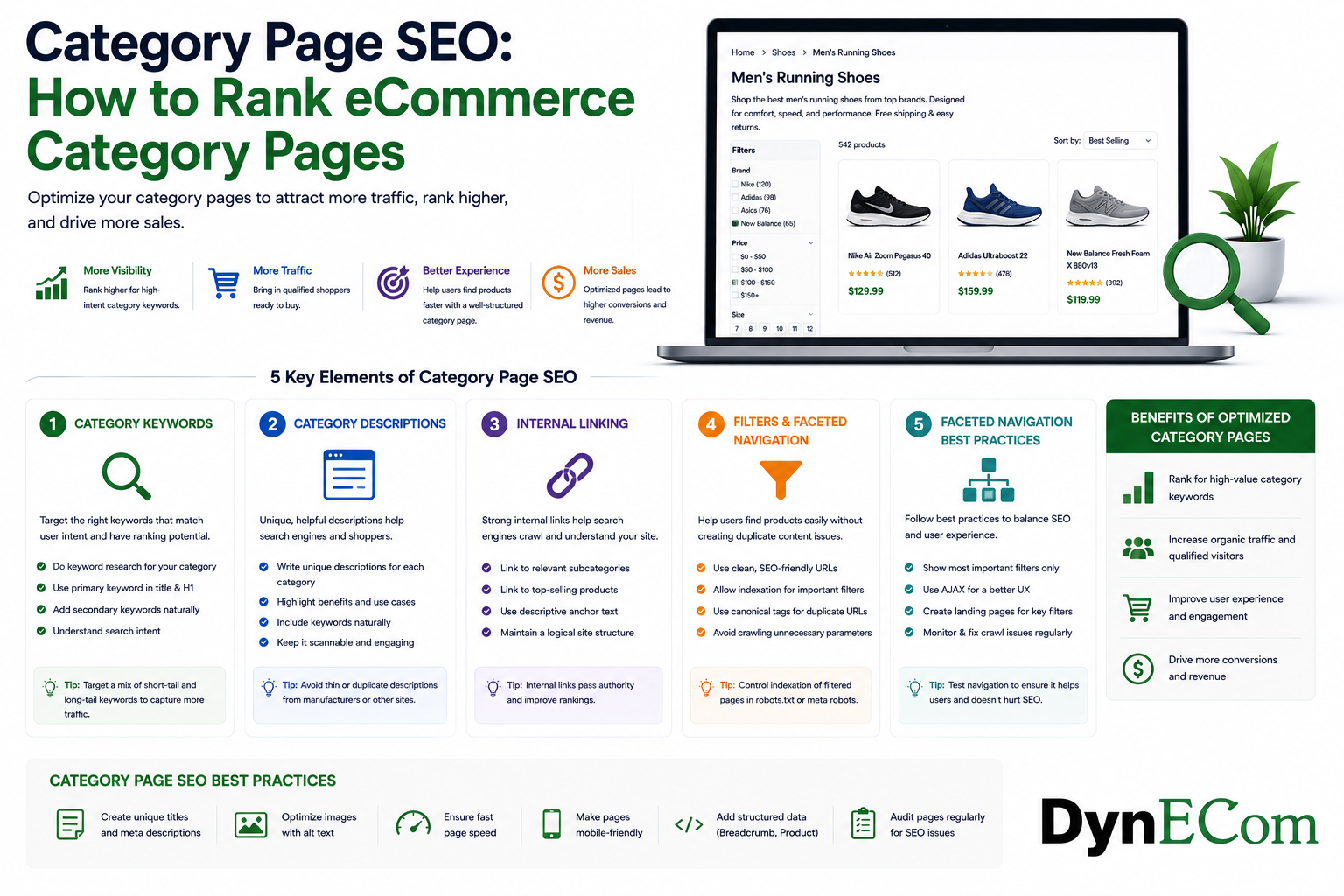
Category pages are some of the most valuable assets in an eCommerce website because they target customers with strong purchase intent. While product pages capture specific searches, category pages help businesses rank for broader, high-volume keywords and guide shoppers toward relevant products.
A strong category page SEO strategy helps search engines understand your product hierarchy, improves organic visibility, increases internal link authority, and drives more qualified traffic to your store.
This guide covers how to optimize eCommerce category pages using category descriptions, internal linking, filters, faceted navigation, and category keyword strategies.
What is Category Page SEO?
Category page SEO is the process of optimizing eCommerce category and collection pages to rank higher in search engines for relevant product category keywords.
Examples:
A product page targets:
Nike Air Max 270 Men’s Running Shoes
A category page targets:
Men’s Running Shoes
or:
Laptop Batteries
Category pages usually have:
- Higher search volume
- Broader customer intent
- More ranking potential
- Greater impact on overall organic traffic
Why Category Pages Matter for eCommerce SEO
Category pages act as the connection between:
Search Engine → Category → Products → Purchase
A well-optimized category page helps Google understand:
- What products you sell
- Which keywords you should rank for
- How products are grouped
- Which pages are most important
Example:
Poor category structure:
Homepage
 |
Products
 |
1000 Product Pages
Optimized structure:
Homepage
 |
Electronics
 |
Laptop Accessories
 |
Laptop Batteries
 |
Dell Laptop Batteries
 |
Product Pages
This creates a clear SEO hierarchy.
Category Page SEO Framework
A complete category page optimization strategy includes:
| Area | SEO Goal |
|---|---|
| Category Keywords | Target relevant search terms |
| Category Description | Improve relevance and rankings |
| Internal Linking | Distribute authority |
| Filters | Improve user experience |
| Faceted Navigation | Avoid duplicate content issues |
| Product Listings | Improve conversions |
1. Category Keyword Optimization
The foundation of category page SEO is selecting the right keywords.
Identify Category-Level Keywords
Focus on keywords with:
✅ High search volume
✅ Commercial intent
✅ Product discovery intent
Examples:
| Category | Primary Keyword |
|---|---|
| Shoes | men’s running shoes |
| Furniture | dining chairs |
| Electronics | wireless headphones |
| Auto Parts | brake pads |
Use Long-Tail Category Keywords
Long-tail keywords attract more qualified shoppers.
Example:
Broad keyword:
- shoes
Better category keywords:
- women’s running shoes
- waterproof hiking shoes
- men’s leather dress shoes
Long-tail category keywords usually have:
- Lower competition
- Higher conversion intent
- Better ranking opportunities
2. Create SEO-Friendly Category Descriptions
Many eCommerce websites only display product grids.
Example:
Men's Shoes

[Product listings]
This provides little context for search engines.
Optimized Category Description Example
Instead:
Explore our collection of men’s running shoes designed for daily workouts, outdoor activities, and athletic performance. Shop lightweight running shoes with cushioned support, breathable materials, and durable soles from trusted brands.
Benefits:
✅ Includes category keywords
✅ Explains product relevance
✅ Matches search intent
✅ Improves ranking signals
Category Description Best Practices
A good category description should include:
1. Introduction
Explain the category.
Example:
- Shop premium laptop batteries designed for reliable performance and compatibility.
2. Product Benefits
Explain why customers need these products.
Example:
- Find replacement batteries with long-lasting power, reliable performance, and compatibility across popular laptop models.
3. Buying Guidance
Help users make decisions.
Example:
- Choose a battery based on laptop model, voltage requirements, capacity, and compatibility.
4. Internal Links
Link to related categories.
Example:
- Explore Dell laptop batteries, HP laptop batteries, and Lenovo replacement batteries.
3. Internal Linking Strategy
Internal linking helps search engines discover pages and distribute ranking authority.
A strong category page should link to:
- Subcategories
- Related categories
- Popular products
- Buying guides
Example Internal Linking Structure
Laptop Batteries
|
├── Dell Laptop Batteries
├── HP Laptop Batteries
├── Lenovo Laptop Batteries
|
├── Laptop Battery Buying Guide
└── Battery Replacement FAQ
Internal Linking Opportunities
Add links:
Category → Subcategory
Example:
- Shop gaming laptops, business laptops, and student laptops.
Category → Blog Content
Example:
- Learn how to choose the right laptop battery.
Category → Best Sellers
Example:
- Explore our top-rated replacement batteries.
4. Filters and Faceted Navigation SEO
Filters improve shopping experience but can create SEO problems.
Common filters:
- Brand
- Size
- Colour
- Price
- Material
- Rating
- Compatibility
Example:
/shoes
/shoes?brand=nike
/shoes?color=black
/shoes?size=10
These can create thousands of URLs.
Faceted Navigation Problems
Duplicate Pages
Example:
Running Shoes
Running Shoes + Black
Running Shoes + Size 10
Running Shoes + Nike
Search engines may see these as duplicate pages.
Crawl Budget Waste
Google spends time crawling unnecessary URLs instead of important pages.
Ranking Dilution
Multiple similar pages compete for the same keywords.
Faceted Navigation Best Practices
Option 1: Noindex Low-Value Filters
Use for:
- Price filters
- Sorting pages
- Temporary filters
Example:
/shoes?sort=price-lowOption 2: Create SEO Landing Pages
For valuable filters:
Example:
Instead of:
/shoes?brand=nikeCreate:
/nike-running-shoes- Unique content
- Keyword targeting
- Internal links
Option 3: Canonical Tags
Use canonical tags to tell Google the preferred page.
Example:
Filtered page:
/shoes?color=black/shoes5. Optimize Product Listings on Category Pages
Category pages should not only contain products; they should help users choose.
Include:
Product Sorting
Allow:
- Best selling
- Highest rated
- New arrivals
- Price low to high
Product Information
Display:
- Product name
- Price
- Ratings
- Reviews
- Key benefits
Structured Data
Implement:
- Product schema
- Breadcrumb schema
- Item list schema
This helps search engines understand category-product relationships.
6. Category Page Content Gap Analysis
Analyze competitors:
Questions:
- Do they have category guides?
- Do they answer customer questions?
- Do they include buying advice?
- Do they have stronger internal links?
Example:
Competitor category:
- Running Shoes
Includes:
- Running shoe types
- Size guide
- FAQs
- Comparison tables
Your category page:
- Only product grid
Opportunity:
- Add helpful content.
7. Category Page SEO Checklist
Keyword Optimization
✅ Primary category keyword identified
✅ Secondary keywords included
✅ Search intent matched
Content
✅ Unique category description
✅ Buying guidance included
✅ FAQs added
✅ Related categories linked
Technical SEO
✅ Clean URL structure
✅ Proper canonical tags
✅ Filters controlled
✅ Breadcrumbs implemented
Internal Linking
✅ Subcategories linked
✅ Related categories linked
✅ Blog content connected
Category Page SEO vs Product Page SEO
| Factor | Category Page | Product Page |
|---|---|---|
| Target Keyword | Broad category terms | Specific product terms |
| Search Intent | Discovery | Purchase |
| Content | Category guides | Product details |
| Links | Subcategories/products | Related products |
| Goal | Traffic growth | Conversion |
Final Recommendations for eCommerce Brands
To rank category pages effectively:
- Target high-value category keywords
- Build detailed category descriptions
- Create logical site architecture
- Optimize internal linking
- Control faceted navigation
- Create SEO-friendly filter pages only where valuable
- Add helpful buying content
- Continuously monitor rankings and competitors
A well-optimized category page can become one of the strongest organic traffic drivers for an eCommerce website by attracting high-intent shoppers before they reach individual product pages.
Looking to dive deeper into eCommerce SEO? Our Ultimate eCommerce SEO & GEO Guide for 2026 is a complete resource packed with actionable strategies, best practices, and real-world examples to help online stores improve rankings, traffic, and revenue. Read it here: https://dynecom.com/the-ultimate-ecommerce-seo-geo-guide-for-2026/

Dharmendra Tripathi is a Senior Digital Marketing & Customer Success leader with deep expertise in eCommerce SEO, performance marketing, and marketplace growth. With years of experience managing SEO and advertising campaigns across Google, Meta, Amazon, Walmart, and Shopify, he helps brands improve search visibility, maximize advertising ROI, and accelerate online sales. Passionate about AI-powered search, content optimization, and analytics, Dharmendra regularly shares actionable insights to help eCommerce businesses stay ahead in an evolving digital landscape.