
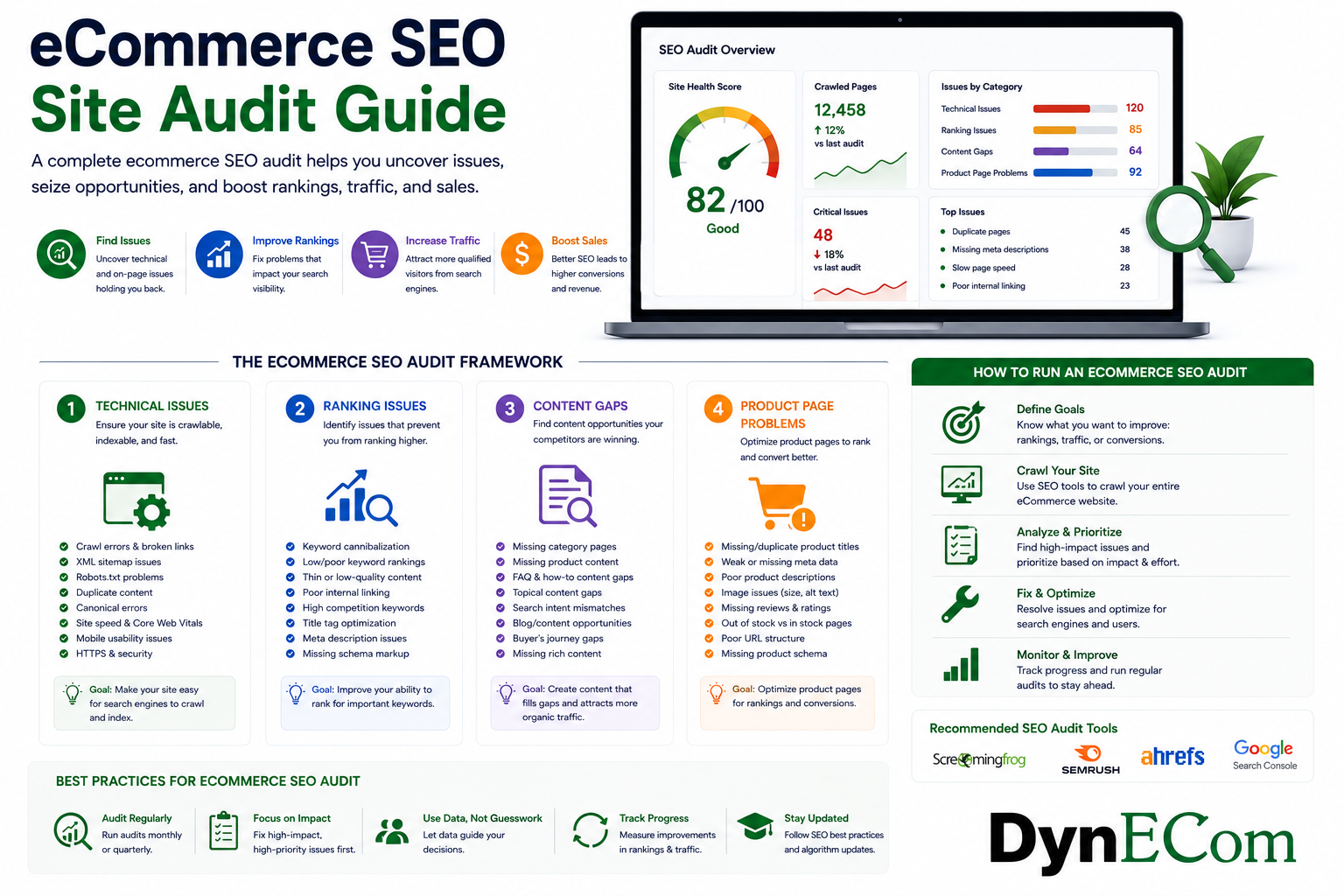
An eCommerce SEO audit is a systematic review of your online store’s technical health, search visibility, content quality, and product page optimization. The goal is to identify issues preventing your products from ranking higher, attracting qualified traffic, and converting visitors into customers.
Unlike a traditional website audit, an eCommerce SEO audit requires analyzing hundreds or thousands of product pages, category structures, filters, internal linking, and shopping-specific ranking factors.
A successful audit helps answer:
- Why are my products not ranking on Google?
- Why is organic traffic declining?
- Which technical issues are limiting visibility?
- Are my category and product pages optimized for search intent?
- Are customers finding the right products through search?
eCommerce SEO Audit Framework
A complete eCommerce SEO audit should cover four major areas:
| Audit Area | Objective | Key Questions |
|---|---|---|
| Technical SEO Audit | Ensure search engines can crawl and index pages | Can Google access and understand all pages? |
| Ranking Audit | Improve keyword visibility | Are products ranking for relevant searches? |
| Content Audit | Identify optimization opportunities | Does content match customer search intent? |
| Product Page Audit | Improve product discovery and conversions | Are product pages optimized to rank and sell? |
1. Technical SEO Audit
Technical SEO forms the foundation of an eCommerce website. Even the best content cannot rank if search engines cannot properly crawl or index your pages.
1.1 Website Crawlability & Indexation
Common Issues:
- Important product pages not indexed
- Duplicate URLs created by filters
- Incorrect robots.txt blocking pages
- Poor XML sitemap structure
- Orphan product pages with no internal links
Audit Checklist:
✅ Check indexed pages in Google Search Console
✅ Review XML sitemap coverage
✅ Identify excluded pages
✅ Remove unnecessary URLs from indexing
✅ Ensure important categories/products are crawlable
Example:
example.com/shoes?color=blue
example.com/shoes?size=10
These filter URLs may create thousands of duplicate pages.
Solution:
- Use canonical tags
- Control parameter indexing
- Improve category page structure
1.2 Site Speed & Core Web Vitals
Page speed directly impacts user experience and conversions.
Important metrics:
| Metric | Recommended Target |
|---|---|
| Largest Contentful Paint (LCP) | < 2.5 seconds |
| Interaction to Next Paint (INP) | < 200 ms |
| Cumulative Layout Shift (CLS) | < 0.1 |
Common eCommerce Speed Issues:
- Large product images
- Excessive scripts
- Slow checkout plugins
- Heavy apps/extensions
- Poor mobile optimization
Improvements:
- Compress product images
- Use WebP format
- Lazy load images
- Reduce unnecessary JavaScript
- Improve hosting performance
1.3 URL Structure Audit
SEO-friendly URLs help search engines understand product categories.
Poor URL:
website.com/product?id=45892Optimized URL:
website.com/mens-running-shoes/nike-air-max-2026Best practices:
✅ Include relevant keywords
✅ Keep URLs short
✅ Avoid unnecessary parameters
✅ Maintain logical hierarchy
Example:
Home
 |
Shoes
 |
Men's Shoes
 |
Running Shoes
 |
Product Page
1.4 Mobile SEO Audit
Since most eCommerce searches happen on mobile, mobile optimization is critical.
Audit:
- Mobile page speed
- Navigation usability
- Product image display
- Search functionality
- Checkout experience
Common problems:
❌ Small buttons
❌ Slow product pages
❌ Difficult filters
❌ Poor mobile menus
2. Ranking Issues Audit
The goal of an eCommerce SEO audit is not only fixing errors but improving rankings for high-value searches.
2.1 Keyword Visibility Analysis
Identify:
- Keywords ranking positions
- Missing keyword opportunities
- Competitor ranking gaps
Example:
Current ranking:
| Keyword | Position |
|---|---|
| running shoes men | 42 |
| men’s athletic shoes | 58 |
| lightweight running shoes | Not ranking |
Opportunity:
Create optimized content targeting these missing terms.
2.2 Search Intent Analysis
Every keyword has a different intent.
| Search Intent | Example | Best Page Type |
|---|---|---|
| Informational | best running shoes | Blog guide |
| Commercial | best Nike running shoes | Category page |
| Transactional | buy Nike Air Max | Product page |
A common SEO mistake is targeting transactional keywords with blog content.
2.3 Competitor Ranking Analysis
Analyze:
- Competitor keywords
- Content length
- Category structure
- Backlinks
- Product page optimization
Questions:
- Why does competitor rank above you?
- Do they have better category pages?
- Are their product descriptions more detailed?
- Do they have stronger authority?
3. Content Gap Audit
Content helps search engines understand product relevance and captures customers earlier in the buying journey.
3.1 Category Page Content Gaps
Many eCommerce stores underestimate category pages.
Weak category page:
Men’s Shoes
Optimized category page:
Shop men’s running shoes designed for daily training, outdoor workouts, and athletic performance. Explore lightweight options with cushioned support from top brands.
Include:
✅ Category introduction
✅ Buying guides
✅ FAQs
✅ Internal links
✅ Comparison content
3.2 Blog Content Opportunities
Find questions customers search before purchasing.
Examples:
| Customer Search | Content Opportunity |
|---|---|
| Best shoes for standing all day | Buying guide |
| Running shoes vs walking shoes | Comparison article |
| How to choose shoe size | Educational guide |
3.3 Missing Long-Tail Keywords
Long-tail keywords often convert better.
Example:
Broad keyword:
laptop batteryLong-tail:
Dell Inspiron 15 replacement laptop batteryLong-tail searches usually have:
- Lower competition
- Higher purchase intent
- Better conversion rates
4. Product Page SEO Audit
Product pages are the most important pages for eCommerce SEO.
4.1 Product Title Optimization
A good product title should include:
Formula:
Brand + Product Type + Key Attribute + Model + Use Case
Example:
Poor:
Wireless Headphones
Better:
Sony Wireless Bluetooth Headphones with Noise Cancellation, 30-Hour Battery Life
4.2 Product Description Optimization
A strong description should answer:
- What is the product?
- Who is it for?
- What problem does it solve?
- What makes it different?
Include:
✅ Primary keywords
✅ Benefits
✅ Specifications
✅ Use cases
✅ FAQs
Avoid:
❌ Keyword stuffing
❌ Duplicate manufacturer content
❌ Generic descriptions
4.3 Product Schema Markup
Implement structured data:
- Product schema
- Review schema
- Price schema
- Availability schema
Example:
Google can understand:
- Product name
- Price
- Rating
- Stock availability
This improves eligibility for rich search results.
4.4 Product Image Optimization
Images influence both SEO and conversion.
Checklist:
✅ Descriptive file names
Bad:
IMG12345.jpgblack-running-shoes-men.jpg✅ Alt text optimization
Example:
Men's black running shoes with cushioned sole4.5 Reviews & Ratings Optimization
Reviews influence:
- Search visibility
- Click-through rate
- Conversion rate
Improve:
- Review collection
- Customer feedback response
- Product rating visibility
eCommerce SEO Audit Priority Matrix
| Priority | Issue | Impact |
|---|---|---|
| High | Indexation problems | Lost rankings |
| High | Product page optimization | Revenue impact |
| High | Site speed | Ranking + conversion |
| Medium | Content gaps | Organic growth |
| Medium | Internal linking | Better crawlability |
| Low | Minor metadata issues | Small improvements |
Recommended eCommerce SEO Audit Process
Phase 1: Technical Audit
- Crawl website
- Fix indexing issues
- Improve speed
- Clean URLs
Phase 2: Keyword & Ranking Audit
- Analyze rankings
- Find keyword gaps
- Compare competitors
Phase 3: Content Optimization
- Improve category pages
- Create buying guides
- Add FAQs
Phase 4: Product Optimization
- Rewrite titles
- Improve descriptions
- Add structured data
- Optimize images
Final Checklist: eCommerce SEO Audit
✅ Website crawlability checked
✅ Indexation issues fixed
✅ Core Web Vitals optimized
✅ Keyword rankings analyzed
✅ Competitor gaps identified
✅ Category pages optimized
✅ Product titles improved
✅ Product descriptions enhanced
✅ Schema implemented
✅ Internal linking improved
✅ Content gaps covered
Conclusion
A successful eCommerce SEO audit is not just about finding technical errors. It is about creating a search-friendly shopping experience where customers can easily discover, evaluate, and purchase products.
By combining technical SEO improvements, keyword optimization, content strategy, and product page enhancements, businesses can increase organic visibility, reduce dependency on paid advertising, and build sustainable long-term growth.
Want to master eCommerce SEO? Explore our comprehensive guide, The Ultimate eCommerce SEO & GEO Guide for 2026, where we cover everything from technical SEO and product page optimization to AI search, Google Shopping, Amazon, Walmart, Shopify SEO, and the latest GEO (Generative Engine Optimization) strategies. Read the complete guide here: https://dynecom.com/the-ultimate-ecommerce-seo-geo-guide-for-2026/

Dharmendra Tripathi is a Senior Digital Marketing & Customer Success leader with deep expertise in eCommerce SEO, performance marketing, and marketplace growth. With years of experience managing SEO and advertising campaigns across Google, Meta, Amazon, Walmart, and Shopify, he helps brands improve search visibility, maximize advertising ROI, and accelerate online sales. Passionate about AI-powered search, content optimization, and analytics, Dharmendra regularly shares actionable insights to help eCommerce businesses stay ahead in an evolving digital landscape.